
PET-370 · Lesson 10 of 12 · 19 min
Cold heavy oil production and waterflooding of heavy oil
Not all of Prairie Crest's heavy oil is produced with heat. Mei Lin's evaluation of the Saskatchewan lease near Lloydminster raises an older question first. 'Before we spend money on steam,' she says, 'tell me what we could get without it.' Lena hands Ethan a stack of well files from the neighbouring section. 'Most of the heavy oil around Lloydminster has been produced cold,' she says. 'The wells produce sand with the oil on purpose. And further west, some of the biggest heavy oil pools in Alberta are being waterflooded and polymer flooded. You need to know when heat is worth it and when it is not.'
This lesson covers the non-thermal methods used in heavy oil: primary production, cold heavy oil production with sand (CHOPS), waterflooding and polymer flooding. It explains why water performs poorly against viscous oil, how polymer improves the mobility ratio and how these methods fit with thermal recovery.
Primary production of heavy oil
Heavy oils with viscosities of a few hundred to a few thousand centipoise at reservoir temperature can flow into wells without heat, though slowly. Primary recovery from such reservoirs is low, often only about 5 to 10 percent of the oil in place, because the driving energy from solution gas and rock compaction is small and the viscous oil does not flow far. Horizontal wells increase contact with thin pay and are widely used, as are multilateral wells with several branches. Progressive cavity pumps, PCPs, are the standard lift method because they handle viscous fluids and some sand well at the moderate temperatures of cold production.
Some heavy oils show foamy oil behaviour: as the pressure falls below the bubble point, gas comes out of solution as tiny dispersed bubbles that stay trapped in the viscous oil instead of forming a free gas phase. The foamy oil keeps its volume and drive energy for longer, which helps explain why primary recovery from some Canadian heavy oil reservoirs is higher than conventional models predict.
Cold heavy oil production with sand
In the 1980s and 1990s, operators in the heavy oil belt around Lloydminster on the Alberta-Saskatchewan border found that wells which were allowed to produce large volumes of sand along with the oil produced far more oil than wells with sand control. The approach became known as cold heavy oil production with sand, CHOPS. Wells are completed without screens, and PCPs lift a mixture of oil, water, gas and sand. Sand production is very high at first, sometimes tens of percent of the produced volume, and then falls to a few percent or less.
CHOPS works through several mechanisms. Removing sand creates high-permeability channels, called wormholes, that extend tens to hundreds of metres from the well and greatly increase the effective drainage area. Continuous sand movement prevents fines and asphaltenes from plugging the near-well region. Foamy oil drive provides energy, and the sand matrix around the wormholes deforms and dilates. Recoveries of about 10 to 15 percent are typical, higher than primary production with sand control.
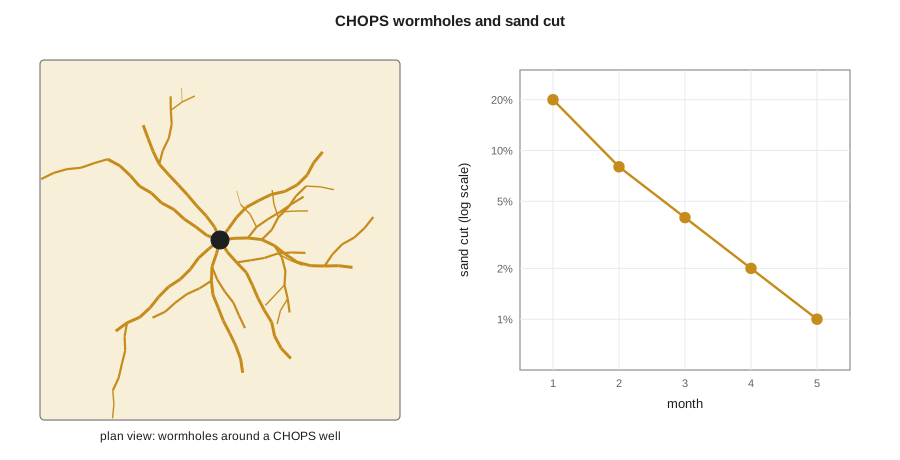
CHOPS has drawbacks. The produced sand must be separated, stored, transported and disposed of, usually in salt caverns, landfill or by injection. Wormholes can connect wells to water zones or to neighbouring wells, causing sudden water production. And when the wormholes have depleted the reservoir, the remaining oil is often in a disturbed matrix that is harder to recover with follow-up processes, though several operators have run thermal and solvent pilots in former CHOPS fields.
Waterflooding heavy oil
Water is cheap and widely available, and waterflooding is the most common secondary recovery method in light oil. In heavy oil it performs poorly because of the very unfavourable mobility ratio. The mobility of each fluid is its relative permeability divided by its viscosity, and the end-point mobility ratio compares water behind the front with oil ahead of it:
When M is much larger than one, water moves far faster than oil, forms fingers through the oil and breaks through early to the producers. After breakthrough, the water cut rises quickly toward 100 percent while much of the oil remains. Even so, waterflooding of heavy oil can be economic, because it adds energy and keeps the reservoir pressure up, and many heavy oil pools in Alberta and Saskatchewan have been waterflooded for decades. Recoveries are typically a few percent to about 10 percent above primary, achieved at very high water cuts.
# Cold heavy oil: fractional flow under a waterflood and polymer, and a CHOPS sand cut check
SI = True
def fw(Sw, mu_o, mu_w, Swc=0.20, Sor=0.25, nw=3.0, no=2.0, krw0=0.3, kro0=0.9):
    Se = max(0.0, min(1.0, (Sw - Swc) / (1 - Swc - Sor)))
    krw, kro = krw0 * Se ** nw, kro0 * (1 - Se) ** no
    return 1.0 / (1.0 + (kro / mu_o) * (mu_w / krw)) if krw > 0 else 0.0
mu_o = 1200.0                     # cP heavy oil at reservoir temperature
for mu_w, label in ((0.6, "water"), (20.0, "polymer at 20 cP"), (60.0, "polymer at 60 cP")):
    M = (0.3 / mu_w) / (0.9 / mu_o)
    fw50 = fw(0.50, mu_o, mu_w)
    print(f"{label:17s}: end-point mobility ratio {M:6.1f}; water cut at Sw = 0.50 is {fw50:.0%}")
# CHOPS: sand cut and annual sand volume for a cold producer
oil = 12.0 if SI else 75.0        # m3/d or bbl/d of oil
sand_cut = [0.20, 0.08, 0.04, 0.02, 0.01]   # volume fraction of produced liquids in the first months
for i, sc in enumerate(sand_cut, 1):
print(f"month {i}: sand cut {sc:.0%} -> {oil * sc / (1 - sc):.2f} {'m3' if SI else 'bbl'} of sand per day")water : end-point mobility ratio 666.7; water cut at Sw = 0.50 is 100% polymer at 20 cP : end-point mobility ratio 20.0; water cut at Sw = 0.50 is 94% polymer at 60 cP : end-point mobility ratio 6.7; water cut at Sw = 0.50 is 84% month 1: sand cut 20% -> 3.00 m3 of sand per day month 2: sand cut 8% -> 1.04 m3 of sand per day month 3: sand cut 4% -> 0.50 m3 of sand per day month 4: sand cut 2% -> 0.24 m3 of sand per day month 5: sand cut 1% -> 0.12 m3 of sand per day
The calculation shows the scale of the problem and of the remedy. Against 1,200 cP oil, plain water gives an end-point mobility ratio near 670. Raising the viscosity of the injected water to 20 cP with polymer cuts the ratio to 20, and 60 cP brings it below 7, lowering the water cut at the same saturation and pushing more oil ahead of the front.
Polymer flooding
Polymer flooding adds a water-soluble polymer, usually partially hydrolysed polyacrylamide, HPAM, to the injection water at concentrations of about 1,000 to 3,000 parts per million. The polymer increases the water viscosity and also reduces the permeability of the rock to water slightly, both of which improve the mobility ratio and the sweep of the flood. Polymer flooding has become an important heavy oil method in Canada: at the Pelican Lake field in northern Alberta, where the oil is several hundred to a few thousand centipoise, horizontal-well polymer flooding has substantially raised recovery over primary production, and polymer floods operate in several Saskatchewan and Alberta pools.
Elsewhere, polymer has been tested in heavy and viscous oil from Oman to the North Slope of Alaska, where a polymer flood pilot in the Milne Point field, supported by the U.S. Department of Energy, began in 2018. The main design questions are polymer concentration and slug size, the stability of the polymer against salinity, temperature and shear, the injectivity of viscous water and the timing of injection, since starting polymer early in the life of a flood generally gives the best results.
Choosing between cold and thermal methods
The choice depends mainly on oil viscosity, reservoir thickness and depth. Bitumen with viscosities above about 100,000 cP will not flow cold and needs heat, solvent or mining. Heavy oils of a few hundred to a few thousand centipoise can often be produced cold, with horizontal wells, CHOPS or waterflood and polymer, and the economics of steam then depend on thickness: thin reservoirs, generally less than about 10 m (33 ft), lose too much heat to the cap and base rock for steam to be efficient. Cold methods have much lower energy use and emissions per barrel, but also lower recovery. Many operators produce a field cold first, then evaluate thermal or solvent follow-up processes for the oil left behind.
Worked problem
End-point mobility ratio
A heavy oil has μ_o = 2,000 cP with k_ro° = 0.85. Water has μ_w = 0.5 cP and k_rw° = 0.25. Calculate M for water, and for polymer solution with an effective viscosity of 40 cP, assuming k_rw° is unchanged.
Show solution
- Water: M = (0.25 / 0.5) / (0.85 / 2,000) = 0.5 / 4.25 × 10⁻⁴ = 1,176.
- Polymer: M = (0.25 / 40) / (0.85 / 2,000) = 6.25 × 10⁻³ / 4.25 × 10⁻⁴ = 14.7.
- The polymer reduces M by a factor of 80.
Answer: About 1,200 for water and about 15 for polymer. A ratio of 15 is still unfavourable, but sweep is far better; in practice permeability reduction by the polymer lowers it further.
Sand handling and disposal
Producing sand deliberately creates a surface problem. In CHOPS operations, produced fluids are collected in heated tanks at each well, where the sand settles out. The oil is trucked or piped to a battery for treating, and the sand, mixed with residual oil and water, is trucked to disposal. Disposal options include placing sand in engineered landfills, injecting it as slurry into deep formations, and placing it in caverns dissolved in deep salt beds. Some operators reuse cleaned sand in road construction. Sand handling is a large part of the operating cost of CHOPS wells, and trucking adds to traffic, road wear and emissions in rural areas, so regulators require tracking of produced sand from well to disposal.
The wells themselves need regular maintenance. PCPs wear as they handle sand, and wells may fill with sand when production slows, requiring cleanouts with a service rig or a coiled tubing unit. Operators design the pumping system and well spacing to keep these costs manageable, and they monitor sand cut and pump torque closely to catch problems early.
Waterflood design for viscous oil
Designing a waterflood in heavy oil starts with the same questions as in light oil, pattern type, well spacing, injection rate and water source, but the answers differ. Because water breaks through early, closer well spacing and horizontal wells are used to keep the oil moving and make the most of the energy the injected water adds. Injection is often started early, before the reservoir pressure falls far, because foamy oil drive and solution gas are more effective when the pressure is kept above the level at which free gas forms. Produced water is usually reinjected, so the water source is largely the field itself. Engineers monitor the water-oil ratio and the response of each producer, and convert or shut in wells as the flood matures.
Combining cold and thermal methods
The methods in this lesson are not alternatives to thermal recovery so much as earlier or parallel steps. A field may be produced cold with horizontal wells or CHOPS, then waterflooded and polymer flooded, and finally evaluated for steam, solvent or other processes for the remaining oil. At each step the question is the same: what is the cheapest way, in cost and emissions, to produce the next barrel? Answering it well requires an engineer who understands both the cold methods and the thermal ones, which is the point of this course.
For the Saskatchewan and Alaska evaluations that began this lesson, Ethan sets out the cold options first: horizontal wells, waterflood and polymer, with their expected recovery, cost and emissions. Then he shows what steam or solvent would add, and at what cost. Mei Lin reads the comparison twice. 'That is what the board needs,' she says. 'Not which method is best in general, but which is best here.'
Common mistakes
MistakeAssuming waterfloods fail in heavy oil.
InsteadThey add energy and some recovery, but at very high water cuts.
MistakeFitting sand control on CHOPS wells.
InsteadCHOPS depends on producing sand to create wormholes.
MistakeIgnoring polymer degradation.
InsteadSalinity, temperature and shear can reduce polymer viscosity.
MistakeUsing steam in thin pay by default.
InsteadBelow about 10 m (33 ft), heat losses often make cold methods better.
Summary and key terms
- Primary recovery of heavy oil is typically 5 to 10 percent; foamy oil can help.
- CHOPS produces sand deliberately, forming wormholes that enlarge the drainage area.
- Waterflooding heavy oil suffers from a very high mobility ratio and early breakthrough.
- Polymer raises water viscosity, lowering the mobility ratio and improving sweep.
- Thick, very viscous reservoirs need heat; thinner, less viscous ones are often produced cold first.
- CHOPS
- Cold heavy oil production with sand.
- Wormhole
- A high-permeability channel created by sand production.
- Foamy oil
- Heavy oil in which gas bubbles stay dispersed as pressure falls.
- PCP
- Progressive cavity pump, the usual lift method for cold heavy oil.
- Mobility ratio
- Mobility of the displacing fluid divided by that of the displaced oil.
- HPAM
- Partially hydrolysed polyacrylamide, the most common flooding polymer.
Practice problems
Work each problem on paper first, then reveal the answer to check.
Why does CHOPS improve rates?
Show answer
Wormholes extend the drainage area and sand movement prevents plugging.
What happens when M is very large?
Show answer
Water fingers through the oil and breaks through early.
Why do waterfloods continue in heavy oil despite poor sweep?
Show answer
They maintain pressure and add some recovery cheaply.
How does polymer improve a waterflood?
Show answer
It raises water viscosity and lowers its mobility.
Lesson quiz · 5 questions
Score 60% or more to complete this lesson.
Create a free account to save your progress, take quizzes and earn a certificate.