
PET-350 · Lesson 8 of 12 · 19 min
Shaly sand interpretation
The lower part of the Cardium in the 100/08-27 delineation well is shalier than the top. Its resistivity is lower and Archie's equation gives water saturations of 55 to 85 percent, which would make it waste rock. But the mud logger reported oil shows there, and an older well nearby produced dry oil from a similar interval. 'Archie is telling us this rock is wet,' Imogen says, 'but Archie assumes only the pore water conducts. In shaly sands the clay conducts too, and Archie blames that extra conductivity on water. Let's see what the shaly-sand models say.'
This lesson explains how clays change log responses, how shale is distributed in sandstones, the difference between total and effective porosity, and the main shaly-sand saturation models: the Simandoux and Indonesian equations, and the Waxman-Smits and dual-water models that are based on the physics of clay conductivity.
Why shale matters
Most sandstones contain some clay, and it affects every log. It raises the gamma ray and the neutron porosity, changes the density depending on the clay's grain density, slows sonic travel and, most importantly for saturation, adds electrical conductivity. Clay particles carry a negative surface charge, balanced by a layer of positive ions held in the water close to the clay surfaces. These counter-ions move in an electric field and carry current even when the pore water is fresh. The amount of this conduction depends on the clay's cation exchange capacity, which is high for smectite, moderate for illite and low for kaolinite and chlorite.
The effect on saturation is largest when the formation water is fresh, because then the pore water conducts poorly and the clay's contribution is a large fraction of the total. In very salty water, such as many Williston Basin brines, the clay contribution is relatively smaller, though still significant in very shaly rock.
How shale is distributed
Shale can sit in a sandstone in three main ways, and each affects porosity and permeability differently.
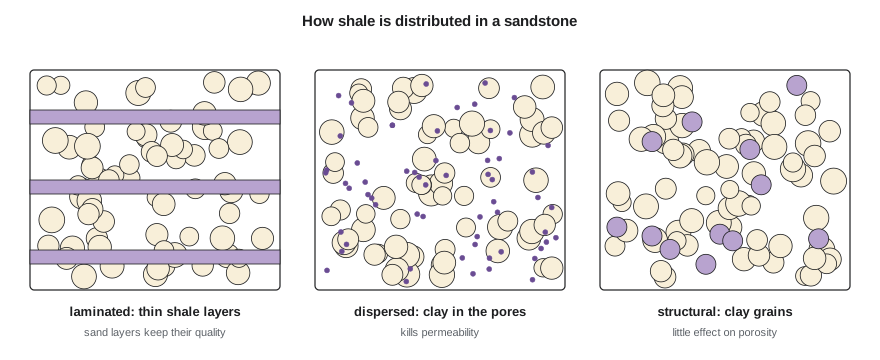
Laminated shale forms thin layers between clean sand layers. The sand layers keep their porosity and permeability; the shale layers are simply thin non-reservoir beds. Resistivity tools that cannot resolve the laminations read a parallel combination of the low-resistivity shale and the higher-resistivity sand, so they read low. Dispersed clay fills the pore space between sand grains, often as authigenic clay grown after deposition. It reduces porosity and, because it clogs pore throats, reduces permeability strongly. Structural shale consists of clay grains or rock fragments that take the place of sand grains, with little effect on porosity.
The Thomas-Stieber method uses a crossplot of total porosity against shale volume to estimate how much of each type is present, by comparing points with the lines expected for pure laminated and pure dispersed mixtures. Core descriptions and thin sections help confirm the result.
Total and effective porosity
Total porosity includes all the pore space, including the water bound to clay surfaces and held in the clay structure. Effective porosity excludes clay-bound water and counts only the pore space that can hold movable fluid and hydrocarbon. The density tool measures something close to total porosity in shaly rock; the neutron reads even higher because of bound hydrogen. A common estimate subtracts the shale contribution.
Here φsh is the apparent porosity of the shale from the same tools, picked in a nearby shale. Saturation models are written either in terms of total porosity and total water saturation, or in terms of effective porosity and effective water saturation. Mixing the two is a common source of error.
The Simandoux equation
The Simandoux equation, published in 1963 from laboratory work on artificial shaly sands, treats the shale as a separate conductor in parallel with the clean-sand water.
Rsh is the resistivity of nearby shale. When Vsh is zero, the equation reduces to Archie. It is a quadratic in Sw when n = 2 and is solved directly. The Simandoux equation and its modified forms have been widely used for sandstones with moderate shale content and salty formation water.
The Indonesian equation
The Indonesian equation was developed by Poupon and Leveaux in 1971 for the shaly sands of Indonesia, where formation waters are relatively fresh and shale volumes high. It uses an empirical exponent on shale volume that makes the shale contribution grow less than linearly.
The Indonesian equation is popular because it behaves sensibly over a wide range of shale volumes and water salinities, and it rarely gives unphysical saturations. Like Simandoux, it is empirical, and its parameters should be checked against core or production.
# Shaly sand: Archie versus Simandoux and Indonesian saturations for the same interval
import math
a, m, n = 1.0, 2.0, 2.0
rw, rsh = 0.045, 3.0
def archie(phi, rt): return (a * rw / (phi ** m * rt)) ** (1 / n)
def simandoux(phi, rt, v):             # solve 1/Rt = phi^m Sw^n/(a Rw) + v Sw/Rsh for Sw (n = 2)
    A = phi ** m / (a * rw); B = v / rsh; C = -1 / rt
    return (-B + math.sqrt(B * B - 4 * A * C)) / (2 * A)
def indonesian(phi, rt, v):
    term = v ** (1 - v / 2) / math.sqrt(rsh) + math.sqrt(phi ** m / (a * rw))
    return (1 / (math.sqrt(rt) * term)) ** (2 / n)
print(" Vsh   phi    Rt   Archie  Simandoux  Indonesian")
for v, phi, rt in ((0.05, 0.13, 18.0), (0.20, 0.12, 9.5), (0.35, 0.10, 6.0)):
print(f"{v:4.2f} {phi:5.2f} {rt:6.1f} {archie(phi, rt):6.2f} {simandoux(phi, rt, v):6.2f} {indonesian(phi, rt, v):6.2f}")Vsh phi Rt Archie Simandoux Indonesian 0.05 0.13 18.0 0.38 0.36 0.37 0.20 0.12 9.5 0.57 0.48 0.46 0.35 0.10 6.0 0.87 0.64 0.57
The program shows the pattern. In the cleanest interval, with 5 percent shale, the three equations agree within a few saturation units. At 20 percent shale, Archie gives 57 percent and the shaly-sand models give 46 to 48 percent. At 35 percent shale, Archie gives 87 percent, Simandoux 64 percent and Indonesian 57 percent. The models agree with each other more than with Archie, but they still differ by several saturation units, which matters in a marginal interval.
For the shaly lower Cardium in the 100/08-27 delineation well, the shaly-sand models move the saturation from apparently wet to borderline pay. Imogen does not choose between them on taste. She asks for cation exchange capacity measurements on core plugs, so that the more physical Waxman-Smits model can be calibrated, and she plans to compare the results with the formation tester samples in lesson 10.
Waxman-Smits and dual-water models
In 1968 Waxman and Smits published a model based on laboratory measurements of the conductivity of shaly core samples. They related the clay's extra conductivity to the cation exchange capacity per unit pore volume, Qv, which can be measured on core. Their equation adds a clay conductance term, BQv, to the water conductivity, where B is the equivalent conductance of the clay counter-ions and depends on temperature and water salinity.
The dual-water model, developed by Clavier, Coates and Dumanoir in 1977, simplifies the Waxman-Smits approach by treating the rock as containing two waters: clay-bound water near clay surfaces, with its own resistivity, and free water in the rest of the pore space with resistivity Rw. The fraction of bound water can be estimated from logs. Both models are grounded in physics and work over a wide range of salinities, but they need parameters such as Qv or bound-water fraction that are best measured on core or estimated carefully from logs. They are standard in most commercial petrophysical software.
Choosing a model
No shaly-sand model is correct for every rock. A practical approach is to use more than one model and see whether they agree, to calibrate against core measurements of Qv, capillary pressure saturations or Dean-Stark extractions where available, and to check against formation tester samples and production. Where models disagree widely, the difference becomes part of the uncertainty range reported to reservoir engineers.
Worked problem
Simandoux saturation
A shaly sand has porosity 0.12, Vsh 0.25, Rt 8 ohm·m and Rsh 3 ohm·m. Rw is 0.05 ohm·m, and a = 1, m = 2, n = 2. Find Sw by Archie and by Simandoux.
Show solution
- Archie: Sw = (0.05/(0.0144 × 8))^0.5 = (0.05/0.1152)^0.5 = 0.434^0.5 = 0.66.
- Simandoux: 1/8 = (0.0144/0.05) Sw² + (0.25/3) Sw, so 0.288 Sw² + 0.0833 Sw − 0.125 = 0.
- Sw = [−0.0833 + √(0.0833² + 4 × 0.288 × 0.125)]/(2 × 0.288) = [−0.0833 + √(0.00694 + 0.144)]/0.576.
- Sw = (−0.0833 + 0.3885)/0.576 = 0.53.
Answer: Archie gives about 66 percent water and Simandoux about 53 percent; the clay conductivity accounts for the difference.
Laminated sands: a different approach
When shale is laminated rather than dispersed, the sand layers between the shale laminations may be clean and of good quality, and the right approach is to evaluate the sand layers themselves. Resistivity measured along the bedding (horizontal resistivity) is dominated by the conductive shale layers, while resistivity measured across the bedding (vertical resistivity) is dominated by the resistive sand layers. Tri-axial induction tools measure both. With the shale fraction from the gamma ray or an image log, a simple series-parallel model separates the sand-layer resistivity, which can then go into Archie's equation with the sand-layer porosity. This laminated sand analysis can turn an interval that looks like 70 percent water into one where the sand layers hold 30 percent water, and it has added significant reserves in thinly bedded deltaic and turbidite reservoirs.
Shale parameters
All the shaly-sand models need shale parameters: Rsh for Simandoux and Indonesian, the shale's apparent porosity for effective porosity, and Qv or bound-water properties for the physical models. These are picked in shales near the reservoir, on the assumption that the clay in the reservoir behaves like the clay in the shale. That is not always true. Authigenic clays that grew in the sand pores after burial, such as kaolinite booklets or chlorite rims, may differ from the detrital clays in the shale. Where core mineralogy shows such differences, the shale parameters are adjusted or the physical models are calibrated directly on reservoir plugs.
Shaly sands and productivity
Clay affects not just the saturation calculation but also how the rock produces. Dispersed clays reduce permeability and raise irreducible water saturation; swelling clays such as smectite can damage the near-well rock if fresh water is used in completions (PET-330); fines migration can plug pore throats during production (PET-340). For the lower Cardium at the 100/08-27 delineation well, Imogen passes the clay types from X-ray diffraction to Tom Ashworth, who adjusts the fracturing fluid chemistry to protect the clays.
Comparing models on the delineation well
Ethan runs Archie, Simandoux, Indonesian and a dual-water model over the whole reservoir interval and plots the four saturation curves side by side. In the clean upper sand they overlie within three saturation units. In the shalier lower part they spread out: Archie reads wettest, Simandoux and Indonesian read 10 to 25 units drier, and the dual-water model, using bound-water fractions estimated from the NMR clay-bound water, falls between them. Imogen asks him to compare each with the core Dean-Stark saturations from the few plugs cut with low-invasion practices, and with the saturation-height prediction from capillary pressure. The dual-water and Indonesian curves fit those checks best, so they become the base and low-water cases, with Archie kept as a pessimistic case for the uncertainty range in lesson 12.
The exercise shows the usual pattern: the choice of shaly-sand model matters only where shale volume is significant, but there it can matter a great deal, and the right choice comes from independent data rather than from the logs themselves.
Common mistakes
MistakeApplying Archie to shaly rocks and writing them off as wet.
InsteadUse a shaly-sand model and calibrate it to core and tests.
MistakeMixing total and effective porosity in one saturation equation.
InsteadUse total porosity with total-porosity models and effective porosity with effective models.
MistakePicking Rsh in an unusually resistive or organic shale.
InsteadUse a representative shale near the reservoir.
MistakeAssuming the shale distribution does not matter.
InsteadLaminated shale leaves good sand layers; dispersed clay destroys permeability.
MistakeTreating agreement between two empirical models as proof.
InsteadCheck against physical measurements and production.
Summary and key terms
- Clay surfaces carry exchangeable ions that conduct current, lowering resistivity in shaly sands.
- Shale may be laminated, dispersed or structural, with different effects on porosity and permeability.
- Effective porosity excludes clay-bound water; total porosity includes it.
- Simandoux and Indonesian equations add an empirical shale conductance to Archie's equation.
- Waxman-Smits and dual-water models relate clay conductivity to cation exchange capacity or bound water.
- Shaly-sand results should be calibrated against core and tests and reported with their uncertainty.
- Shaly sand
- A sandstone containing enough clay to affect its log responses.
- Cation exchange capacity
- The amount of exchangeable positive ions a clay can hold.
- Effective porosity
- Porosity excluding clay-bound water.
- Laminated shale
- Thin layers of shale interbedded with clean sand.
- Dispersed clay
- Clay that fills pores between sand grains.
- Dual-water model
- A saturation model that treats clay-bound water and free water separately.
Practice problems
Work each problem on paper first, then reveal the answer to check.
Why is the clay effect largest in fresh formation water?
Show answer
The pore water conducts poorly, so the clay's share is large.
Which shale distribution damages permeability most?
Show answer
Dispersed clay filling pore throats.
What does the Simandoux equation reduce to when Vsh is zero?
Show answer
Archie's equation.
What core measurement does Waxman-Smits need?
Show answer
Cation exchange capacity, giving Qv.
Lesson quiz · 5 questions
Score 60% or more to complete this lesson.
Create a free account to save your progress, take quizzes and earn a certificate.