
PET-350 · Lesson 2 of 12 · 20 min
The borehole environment
Victor Haines hands Ethan the field print of the 100/08-27 delineation well and points at the header before Ethan can look at the curves. 'Mud weight, mud type, the three mud resistivities and the temperatures they were measured at, bottomhole temperature, bit size. Write them down,' he says. 'Every tool in that string is measuring the formation through a hole full of mud, past a layer of mud cake, into rock that has been flushed with mud filtrate. If you do not know what the mud did, you do not know what the tool saw.'
This lesson describes the environment in and around the borehole that logging tools have to see through: the drilling mud, the mud cake on the borehole wall, and the zone of rock invaded by mud filtrate. It shows how temperature changes with depth and how the resistivities of the mud and filtrate must be corrected to formation temperature, and it explains why hole size and shape matter for tool readings.
Mud, mud cake and filtrate
During drilling, the well is kept full of drilling fluid whose pressure is set a little above the formation pore pressure, so that formation fluids do not flow into the well (PET-310). In a permeable formation this overbalance pushes the liquid part of the mud, the mud filtrate, into the rock. The solid particles in the mud cannot enter the small pores, so they build up on the borehole wall as mud cake. The mud cake soon becomes so tight that it limits further filtrate loss to a slow seep. In impermeable shale, no filtrate enters and no mud cake forms.
Each of these has its own resistivity. In a water-based mud, the mud resistivity, written Rm, is typically between a few tenths and a few ohm-metres at surface temperature. The filtrate resistivity, Rmf, is usually a little lower, and the mud cake resistivity, Rmc, a little higher, because the cake is packed with solids. These three values are measured at the well site on samples, at a recorded temperature, and appear on the log header. They are used to correct resistivity readings and to calculate formation water resistivity from the spontaneous potential.
Oil-based and synthetic-based muds have a continuous oil phase and do not conduct electricity, so the mud resistivities are effectively infinite. Their filtrate is oil, which changes the interpretation of the invaded zone. Some tools, such as the spontaneous potential and the laterolog resistivity tools, need a conductive path through the mud and cannot work in oil-based mud. Induction resistivity tools, which use electromagnetic induction rather than direct current, work in both.
The invasion profile
The rock around a permeable borehole is divided into zones by how much filtrate has entered it. Next to the borehole wall is the flushed zone, where filtrate has displaced almost all the movable formation water and much of the movable hydrocarbon. Its resistivity is written Rxo, and its water saturation, Sxo, is mostly filtrate. Beyond it lies the transition zone, where the mixture of filtrate and original fluids changes with distance. Beyond that is the uninvaded zone, also called the virgin zone, which holds the original formation fluids at their original saturations. Its resistivity, Rt, is the true resistivity that saturation calculations need.
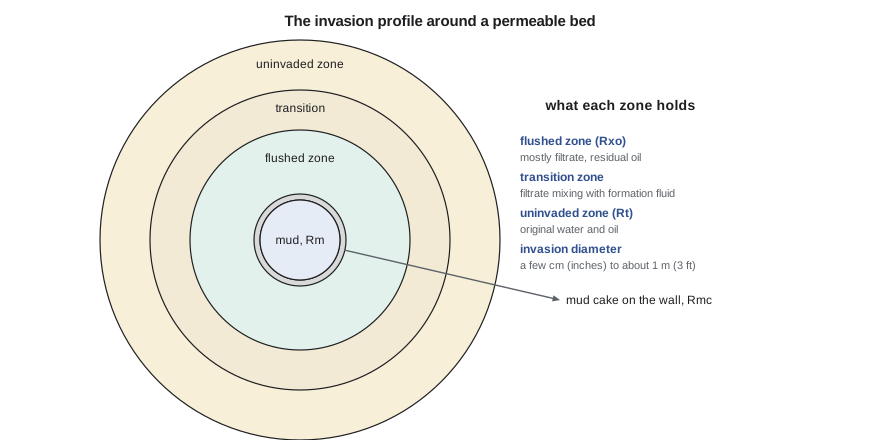
The depth of invasion depends on the rock's porosity and permeability, the overbalance, the mud's filtration properties and the time since the formation was drilled. A useful rule is that lower-porosity rocks invade deeper for the same filtrate volume, because each unit of filtrate fills less pore volume. Invasion is usually a few centimetres to a metre, or about an inch to a few feet. Logs run days after the formation was drilled see deeper invasion than LWD logs run within minutes or hours.
Invasion changes what each tool reads. Shallow-reading tools such as the density, neutron and micro-resistivity tools see mainly the flushed zone. Deep resistivity tools are designed to see past the invaded zone into the uninvaded rock, but when invasion is deep they read a mixture. Lesson 4 shows how readings from tools with different depths of investigation are combined to estimate Rt, Rxo and the invasion diameter.
Invasion can also be useful. Because only permeable rock accepts filtrate, separation between shallow and deep resistivity curves is a qualitative indication of permeability. In an oil zone drilled with fresh water-based mud, the flushed zone holds fresh filtrate and residual oil while the uninvaded zone holds salty connate water and much more oil, so the shallow and deep readings separate. In a water zone with salty formation water, the deep reading is lower than the shallow one, because the flushed zone holds fresher filtrate.
Temperature in the well
Resistivities of water and mud depend strongly on temperature, because ions move more easily in hot water. Formation temperature must therefore be known at every depth of interest. The usual source is the maximum recorded temperature from a thermometer in the tool string, taken at total depth, together with a surface or mean annual ground temperature. A linear geothermal gradient between the two gives temperature at any depth.
Logged bottomhole temperatures are often lower than the true undisturbed formation temperature, because circulating mud has cooled the rock near the well and the logs are run before it fully recovers. Where several logging runs record temperatures at different times since circulation stopped, a Horner-style plot of temperature against the logarithm of a time ratio can be extrapolated to estimate the static temperature. For a single run, petrophysicists accept the recorded value or apply a regional correction.
Correcting resistivity to formation temperature
The resistivity of a salt solution falls as temperature rises. For sodium chloride solutions, a simple relation published by Arps is used almost universally to move a resistivity from one temperature to another.
The constants come from fitting the behaviour of sodium chloride brines over the range met in most wells. The relation is an approximation, but it is accurate enough for interpretation and is built into every chart book and software package.
# Formation temperature and Arps correction of mud resistivities to that temperature
SI = True
if SI:   # metres and degrees C
    surf, bht, td, depth = 8.0, 62.0, 1600.0, 1556.0
    rm, rmf, rmc, tmeas = 1.10, 0.85, 1.45, 18.0
    f = lambda t: t + 21.5          # Arps in Celsius uses T + 21.5
    tu, du = "°C", "m"
else:    # feet and degrees F
    surf, bht, td, depth = 45.0, 245.0, 10600.0, 10455.0
    rm, rmf, rmc, tmeas = 0.95, 0.75, 1.25, 70.0
    f = lambda t: t + 6.77          # Arps in Fahrenheit uses T + 6.77
    tu, du = "°F", "ft"
grad = (bht - surf) / td
tf = surf + grad * depth
print(f"geothermal gradient: {grad * (100 if SI else 100):.2f} {tu} per 100 {du}")
print(f"formation temperature at {depth:,.0f} {du}: {tf:.1f} {tu}")
for name, r in (("Rm  (mud)", rm), ("Rmf (filtrate)", rmf), ("Rmc (mudcake)", rmc)):
    r2 = r * f(tmeas) / f(tf)
print(f"{name:15s} {r:6.3f} ohm·m at {tmeas:.0f} {tu} -> {r2:6.3f} ohm·m at formation temperature")geothermal gradient: 3.38 °C per 100 m formation temperature at 1,556 m: 60.5 °C Rm (mud) 1.100 ohm·m at 18 °C -> 0.530 ohm·m at formation temperature Rmf (filtrate) 0.850 ohm·m at 18 °C -> 0.409 ohm·m at formation temperature Rmc (mudcake) 1.450 ohm·m at 18 °C -> 0.698 ohm·m at formation temperature
For the 100/08-27 delineation well, the program gives a gradient of about 3.4 °C per 100 m and a formation temperature of 60.5 °C at the middle of the Cardium. The mud resistivities measured at 18 °C fall by about half when corrected: the filtrate resistivity drops from 0.85 to about 0.41 ohm·m. Using the surface value instead of the corrected one would roughly double every quantity calculated from Rmf, including the formation water resistivity in lesson 3.
Hole size, shape and mud weight
The caliper measures the borehole diameter, either with a single arm on a pad tool or with several independent arms that show an oval hole. In a perfect hole the caliper reads the bit size. In permeable rock it reads slightly under bit size because of mud cake. In weak shale or in salt dissolved by undersaturated water-based mud, it reads larger than the bit, showing a washout. Breakouts, where the borehole spalls on opposite sides because of stress, show as an oval hole with the long axis aligned with the minimum horizontal stress direction, which is useful information for completion design.
Hole condition affects tools differently. Pad tools such as the density and micro-resistivity tools press against the borehole wall and need good contact; in rugose or washed-out hole they read the mud instead of the rock, giving false low densities and false high porosities. Centred tools such as induction resistivity are affected by the volume of mud around them, especially in large holes with salty mud. Neutron tools are sensitive to hole size and mud weight. Each service company publishes environmental corrections for these effects, and most are applied automatically in processing, but the petrophysicist must know when the hole is too poor for any correction to rescue the data.
Mud weight matters too. Barite, used to weight heavy muds, has a very high photoelectric absorption and a high density, and it can dominate the readings of the density tool's photoelectric factor in mud cake. Lesson 5 returns to this effect.
Interpreting with the environment in mind
Imogen asks Ethan to annotate the field print before any calculation. He marks the casing shoe, where the curves change character, the washed-out shale above the Cardium, the slightly undergauge caliper across the sand that shows mud cake, and the separation of the resistivity curves that suggests invasion. 'You have just found the permeable intervals without calculating a single porosity,' she says. 'Now you know where to look harder, and where the pad tools may be unreliable.'
Worked problem
Correcting Rmf
A mud filtrate measures 0.62 ohm·m at 20 °C. The formation temperature at the zone of interest is 70 °C. What is Rmf at formation temperature?
Show solution
- Use the Celsius form of the Arps relation.
- Rmf at 70 °C = 0.62 × (20 + 21.5)/(70 + 21.5) = 0.62 × 41.5/91.5.
- Rmf = 0.62 × 0.4536 = 0.281 ohm·m.
Answer: Rmf at formation temperature is about 0.28 ohm·m, less than half its surface value.
Invasion in oil-based mud wells
Oil-based and synthetic muds are popular because they protect water-sensitive shales, reduce torque and drag in long horizontal wells and drill faster in many formations. Their filtrate is oil, so the flushed zone in an oil-bearing rock holds the original oil plus filtrate oil and the irreducible water, and it reads nearly as resistive as the uninvaded zone. In a water-bearing rock, oil filtrate replaces some of the formation water near the well and raises the shallow resistivity well above the deep reading. Resistivity separation in an oil-based mud well therefore says little about hydrocarbons in the formation, and interpreters lean more on the deep resistivity, the porosity logs, NMR and formation tests. Because the filtrate does not mix with formation water, core cut with oil-based mud and low-invasion coring practices can preserve the original water saturation, which is valuable for calibration (lesson 11).
Time and invasion
Invasion is not fixed. In the first minutes after the bit cuts a permeable bed, filtrate loss is fast because no mud cake has formed; this is called spurt loss. Once the cake builds, filtrate continues to leak more slowly, and invasion deepens with time. Logs run on the same interval days apart can read differently for that reason alone. Comparing LWD resistivity recorded while drilling with wireline resistivity recorded later is a simple way to see how much invasion has progressed, and the change itself shows which intervals are permeable. Some operators run time-lapse resistivity deliberately in exploration wells for this purpose. In wells where the mud is circulated for a long time across the reservoir, for example while drilling deeper sections, the near-well rock can also be eroded or cooled, which affects both resistivity and temperature readings.
For the 100/08-27 delineation well, the wireline logs were run about two days after the Cardium was drilled. The LWD resistivity recorded through the same interval reads a little higher than the wireline deep curve in the best sand, which Imogen takes as a sign that invasion has deepened since drilling. She notes it for the resistivity inversion in lesson 4.
Common mistakes
MistakeUsing surface mud resistivities in calculations.
InsteadCorrect Rm, Rmf and Rmc to formation temperature first.
MistakeAssuming the maximum recorded temperature is the true formation temperature.
InsteadRecorded temperatures are often low because mud has cooled the rock; consider a correction.
MistakeTrusting pad-tool readings in washed-out hole.
InsteadCheck the caliper and density correction curve; discard or flag readings where pad contact is lost.
MistakeExpecting the spontaneous potential to work in oil-based mud.
InsteadThe SP needs conductive mud; use other methods for Rw in oil-based mud wells.
MistakeIgnoring invasion when choosing Rt.
InsteadEven deep tools read some flushed-zone resistivity when invasion is deep; correct for it.
Summary and key terms
- Drilling fluid filtrate invades permeable rock and leaves a mud cake on the borehole wall.
- The invasion profile has a flushed zone (Rxo), a transition zone and an uninvaded zone (Rt).
- Shallow tools see mainly the flushed zone; deep resistivity tools aim to see the uninvaded zone.
- Formation temperature comes from a geothermal gradient between surface and the recorded bottomhole temperature.
- Resistivities are corrected to formation temperature with the Arps relation.
- The caliper shows washouts, mud cake and breakouts, which affect tool readings and need environmental corrections.
- Mud filtrate
- The liquid part of drilling mud that enters permeable rock.
- Mud cake
- The layer of mud solids deposited on the wall of a permeable formation.
- Flushed zone
- The rock next to the borehole where filtrate has displaced most movable fluids.
- True resistivity (Rt)
- The resistivity of the uninvaded formation.
- Geothermal gradient
- The rate at which temperature increases with depth.
- Washout
- An enlarged section of borehole where the wall has eroded or collapsed.
Practice problems
Work each problem on paper first, then reveal the answer to check.
Why does mud cake form on sandstones but not on shales?
Show answer
Sandstone accepts filtrate, leaving solids behind; shale is impermeable.
What happens to resistivity of brine when temperature rises?
Show answer
It falls.
Which zone holds the original formation fluids?
Show answer
The uninvaded or virgin zone.
Why is resistivity separation a permeability indicator?
Show answer
Only permeable rock is invaded, so curves of different depth read differently.
Lesson quiz · 5 questions
Score 60% or more to complete this lesson.
Create a free account to save your progress, take quizzes and earn a certificate.