
PET-310 · Lesson 7 of 12 · 20 min
Well control
Ethan's next assignment is the well control section of the program. Marcus sends him to a one-week well control course first, and on his return asks him to fill in a kill sheet for an imaginary kick at the landing point. 'Every number on that sheet should be ready before we spud,' Marcus says. 'When a well kicks at three in the morning, the crew should be reading, not calculating.'
Barriers and kicks
A kick is an unplanned flow of formation fluid into the wellbore, which happens when the pressure in the well falls below the pore pressure of a permeable formation. If a kick is not detected and controlled, it can become a blowout: an uncontrolled flow at surface or into another formation (an underground blowout). Well control is organized around barriers. While drilling, the primary barrier is the hydrostatic pressure of the mud column; the secondary barrier is the blowout preventer stack with the casing, wellhead and cement. Industry practice and regulations require two independent, tested barriers whenever there is a flow potential.
Causes of kicks
Most kicks come from a few causes. Insufficient mud weight for the pore pressure encountered, often when drilling into an unexpected overpressured zone. Failure to keep the hole full when pulling pipe, so the mud level and hydrostatic pressure fall. Swabbing, from pulling pipe too fast or with a balled bit (lesson 5). Lost circulation, where mud flows into a weak zone and the level in the annulus drops. Gas-cut mud, which lowers the average density. And, in cementing and completion operations, fluids lighter than expected or unplanned pressure from below.
Kick detection
Kicks are detected by watching volumes and flows. While drilling, the main warning signs are an increase in the flow rate out of the well with constant pump rate, and a gain in pit volume. Secondary signs include a drilling break, a fall in pump pressure with a rise in pump rate, gas-cut mud and changes in torque and drag. While tripping, the key check is the trip tank: when pipe is pulled, the hole should take exactly the volume of steel removed; if it takes less, fluid may be entering. A flow check, stopping all operations with the pumps off and watching for flow at the flowline, confirms whether the well is flowing.
Early detection keeps kicks small, and small kicks are much easier to control. Crews practise pit drills and trip drills so that the time from the first sign to a closed well is short.
Shutting in the well
When a kick is confirmed, the crew shuts in the well. In the hard shut-in method, the driller spaces out the string so that no tool joint is across the preventers, stops the pumps and closes an annular or ram preventer with the choke already closed. In the soft method, the choke line is opened first and then closed after the preventer. Most operators now use the hard shut-in because it limits the influx size. The crew then records the shut-in drill pipe pressure (SIDPP), the shut-in casing pressure (SICP) and the pit gain.
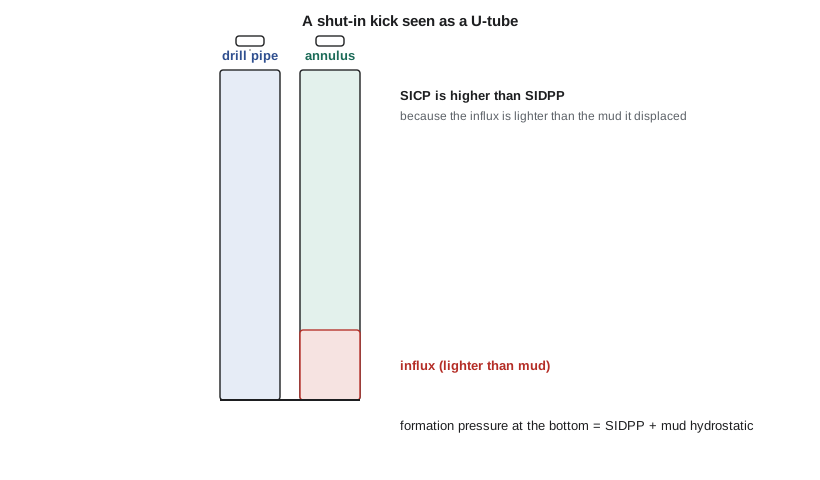
The drill string and annulus act like a U-tube joined at the bottom. Because the drill pipe is full of clean mud of known density, the SIDPP gives the formation pressure directly: formation pressure equals SIDPP plus the hydrostatic pressure of the mud in the pipe. The annulus contains the lighter influx, so the SICP is higher. From the pit gain and the annular capacity, the height of the influx can be estimated, and from the difference between SICP and SIDPP, its density, which tells whether it is gas, oil or water.
Kill methods
To kill the well, the influx must be circulated out and the hole filled with mud heavy enough to balance the formation pressure, while keeping the bottomhole pressure constant: high enough to prevent more influx, and not so high that it fractures the weakest formation. This constant bottomhole pressure principle is applied by adjusting the choke while pumping at a slow, pre-recorded rate. The slow circulating rate pressure, measured regularly during drilling, gives the frictional pressure needed to pump at that rate.
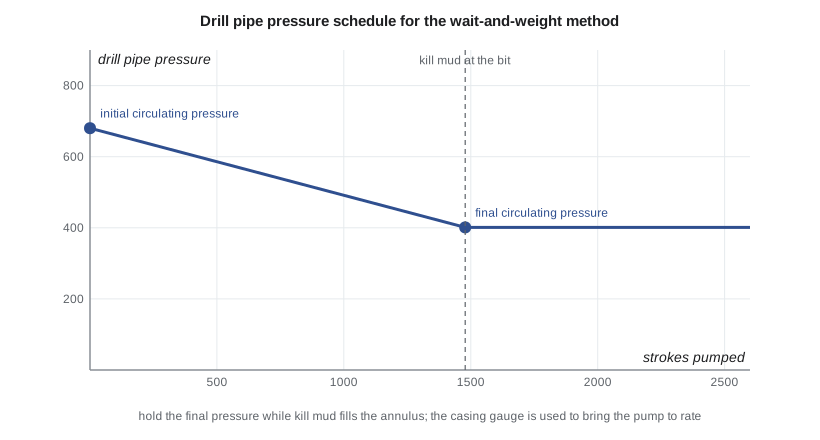
In the driller's method, the influx is first circulated out with the original mud, holding the drill pipe pressure at the initial circulating pressure; then kill mud is circulated in a second circulation. It is simple and starts immediately. In the wait-and-weight method, kill mud is mixed first and circulated in one circulation, with the drill pipe pressure falling on a schedule from the initial to the final circulating pressure as kill mud fills the string. It gives lower casing shoe pressures when the gas reaches the shoe, but requires a waiting period and a pressure schedule.
Kick tolerance and MAASP
The weakest point in the open hole, usually just below the last shoe, limits how large a kick can be handled. The maximum allowable annular surface pressure (MAASP) is the surface pressure at which the shoe would fracture with the current mud in the hole, calculated from the leak-off or integrity test. Kick tolerance is the largest influx volume, at a given intensity, that can be shut in and circulated out without exceeding the shoe strength. It is planned for each section and recalculated as the hole is deepened. A small kick tolerance is a reason to set casing sooner, to drill with more care, or to use managed-pressure drilling.
# Kill sheet for a kick: kill mud weight, circulating pressures, strokes, influx type and kick tolerance
import math
SI = True
if SI:   # inputs in field units converted from the metric kill sheet
    tvd_m, md_m, mw_r, sidpp_k, sicp_k, gain_m3, scr_k = 1540.0, 2900.0, 1150.0, 600.0, 1000.0, 1.0, 2400.0
    tvd, md, mw = tvd_m / 0.3048, md_m / 0.3048, mw_r / 119.826
    sidpp, sicp, gain, scr = sidpp_k / 6.894757, sicp_k / 6.894757, gain_m3 / 0.158987, scr_k / 6.894757
    shoe_tvd, lot_emw = 210 / 0.3048, 1778 / 119.826
else:
    tvd, md, mw, sidpp, sicp, gain, scr = 10300.0, 10600.0, 10.2, 300.0, 450.0, 20.0, 380.0
    shoe_tvd, lot_emw = 2100.0, 15.8
kmw = mw + sidpp / (0.052 * tvd)
icp = scr + sidpp
fcp = scr * kmw / mw
cap_dp, cap_ann = 0.01422, 0.0459            # bbl/ft: inside 4-1/2 in pipe, annulus 8-3/4 in hole x 4-1/2 in pipe (approximate)
spm, bps = 30.0, 0.102                        # slow pump rate strokes/min, pump output bbl/stroke
stks = md * cap_dp / bps
h_infl = gain / cap_ann
g_infl = mw * 0.052 - (sicp - sidpp) / h_infl
kind = "gas" if g_infl < 0.15 else ("oil or gas-cut fluid" if g_infl < 0.35 else "water")
maasp = (lot_emw - mw) * 0.052 * shoe_tvd
if SI:
    print(f"kill mud density {kmw*119.826:,.0f} kg/m3 (round up to {math.ceil(kmw*119.826/10)*10:,.0f})")
    print(f"initial circulating pressure {icp*6.894757:,.0f} kPa; final circulating pressure {fcp*6.894757:,.0f} kPa")
    print(f"surface to bit {stks:,.0f} strokes, {stks/spm:.0f} min at {spm:.0f} strokes/min")
    print(f"influx height {h_infl*0.3048:,.0f} m, gradient {g_infl*22.6206:.1f} kPa/m -> probably {kind}")
    print(f"maximum allowable annular surface pressure (MAASP) {maasp*6.894757:,.0f} kPa; shut-in casing pressure {sicp*6.894757:,.0f} kPa")
else:
    print(f"kill mud weight {kmw:.2f} ppg (round up to {math.ceil(kmw*10)/10:.1f})")
    print(f"initial circulating pressure {icp:,.0f} psi; final circulating pressure {fcp:,.0f} psi")
    print(f"surface to bit {stks:,.0f} strokes, {stks/spm:.0f} min at {spm:.0f} strokes/min")
    print(f"influx height {h_infl:,.0f} ft, gradient {g_infl:.3f} psi/ft -> probably {kind}")
    print(f"maximum allowable annular surface pressure (MAASP) {maasp:,.0f} psi; shut-in casing pressure {sicp:,.0f} psi")
# drill pipe pressure schedule for the wait-and-weight method
for f in (0, 0.25, 0.5, 0.75, 1.0):
    p = icp - (icp - fcp) * f
print(f" {f*100:3.0f}% of strokes to bit ({stks*f:6,.0f}): {p*6.894757:7,.0f} kPa" if SI else f" {f*100:3.0f}% of strokes to bit ({stks*f:6,.0f}): {p:6,.0f} psi")kill mud density 1,190 kg/m3 (round up to 1,190)
initial circulating pressure 3,000 kPa; final circulating pressure 2,483 kPa
surface to bit 1,326 strokes, 44 min at 30 strokes/min
influx height 42 m, gradient 1.7 kPa/m -> probably gas
maximum allowable annular surface pressure (MAASP) 1,295 kPa; shut-in casing pressure 1,000 kPa
0% of strokes to bit ( 0): 3,000 kPa
25% of strokes to bit ( 332): 2,871 kPa
50% of strokes to bit ( 663): 2,741 kPa
75% of strokes to bit ( 995): 2,612 kPa
100% of strokes to bit ( 1,326): 2,483 kPaFor a kick shut in near the landing point with 600 kPa SIDPP, 1,000 kPa SICP and a 1.0 m³ gain, the kill density is about 1,190 kg/m³. The initial circulating pressure is 3,000 kPa, falling to 2,480 kPa when kill mud reaches the bit after about 1,330 strokes. The influx gradient of about 1.7 kPa/m suggests gas. The MAASP for the 210 m shoe is only about 1,300 kPa, so the 1,000 kPa SICP is close to the limit. Ethan notes that the shallow surface shoe gives the 03-22 well a small kick tolerance, which makes early kick detection and good trip practice essential.
Gas behaviour and well control complications
Gas expands as it rises, so the casing pressure rises while gas is circulated up and the pit volume grows; the choke operator must open the choke to hold the bottomhole pressure constant, not hold the casing pressure constant. In oil-based mud, gas dissolves and may stay hidden until it comes out of solution near surface, causing a sudden expansion. Hydrogen sulphide adds a toxic hazard (lesson 11). Other complications include plugged nozzles or chokes, washed-out pipe, lost circulation during the kill and kicks while out of the hole, each with its own procedure in the well control manual.
Training and certification are required for drilling supervisors and crews. IADC WellSharp and IWCF programs are widely recognized, and regulators require well control competence for key positions.
Worked problem
Kill mud weight and circulating pressures
A well kicks at 2,400 m TVD with 1,200 kg/m³ mud. SIDPP is 1,500 kPa and the slow circulating rate pressure is 3,000 kPa. Find the kill density, ICP and FCP.
Show solution
- KMW = 1,200 + 1,500,000/(9.81 × 2,400) = 1,200 + 63.7 = 1,264 kg/m³, rounded up to 1,270.
- ICP = 3,000 + 1,500 = 4,500 kPa.
- FCP = 3,000 × 1,270/1,200 = 3,175 kPa.
Answer: Kill density 1,270 kg/m³, ICP 4,500 kPa, FCP about 3,175 kPa.
Well control drills and the bridging document
Procedures only work if crews practise them. Regulations and company standards require regular drills: pit drills while drilling, trip drills while tripping, and choke drills where the crew practises operating the choke while holding a constant drill pipe pressure. Each drill is timed and recorded. Where the operator and the rig contractor have different well control manuals, a bridging document sets out which procedures apply on this well, who has authority to shut in, and how communication will work, so that nobody has to decide these things in the middle of an event.
The kill sheet is kept up to date throughout drilling: slow circulating rate pressures are taken at the start of each shift, after mud property changes and after large changes in depth, at two or three pump rates. The latest leak-off value, the current mud weight and the string geometry are entered so that, if the well kicks, the crew reads ICP, FCP, strokes and MAASP directly from the sheet.
Shut-in while tripping
If the well flows while the string is being tripped, the first step is to install a full-opening safety valve, kept open and ready on the rig floor, in the top of the drill pipe and close it, then close the BOP. Because the bit may be far from bottom, the kill cannot be done by circulating from the bottom; the crew may strip the pipe back to bottom through a closed preventer, or use a volumetric method that bleeds mud while the gas migrates up. These procedures are part of every well control course and appear in the well control plan.
Common mistakes
MistakeHolding casing pressure constant while gas is circulated up.
InsteadHold bottomhole pressure constant: follow the drill pipe pressure schedule.
MistakeUsing measured depth in the kill mud weight equation.
InsteadUse true vertical depth.
MistakeIgnoring a small difference in trip tank fill-up.
InsteadStop and flow check; small discrepancies are the earliest sign.
MistakeRounding kill mud weight down.
InsteadRound up, so the mud at least balances the formation.
Summary and key terms
- Mud hydrostatic pressure is the primary barrier; the BOP stack, casing and cement form the secondary barrier.
- Kicks come from low mud weight, failure to fill the hole, swabbing, losses and gas cutting; flow increase and pit gain are the main signs.
- SIDPP gives the formation pressure and kill mud weight; SICP, pit gain and annular capacity indicate the influx type.
- Kills keep bottomhole pressure constant using the driller's or wait-and-weight method, with ICP and FCP from the slow circulating rate pressure.
- MAASP and kick tolerance, set by the shoe strength, limit the kick size that can be handled safely.
- Kick
- An unplanned influx of formation fluid into the wellbore.
- SIDPP
- Shut-in drill pipe pressure, used to calculate formation pressure.
- SICP
- Shut-in casing pressure, measured on the annulus.
- Kill mud weight
- The mud density that balances the formation pressure.
- Wait-and-weight method
- A one-circulation kill using kill mud and a falling drill pipe pressure schedule.
- Driller's method
- A two-circulation kill: first remove the influx, then circulate kill mud.
- MAASP
- Maximum allowable annular surface pressure before the shoe fractures.
- Kick tolerance
- The largest influx that can be shut in and circulated out without fracturing the shoe.
Practice problems
Work each problem on paper first, then reveal the answer to check.
Why does the SIDPP, not the SICP, give the formation pressure?
Show answer
The drill pipe contains only mud of known density; the annulus contains an influx of unknown density.
What does it mean if the hole takes less fill-up than the steel volume pulled?
Show answer
Formation fluid may be entering the well: flow check immediately.
Give one advantage each of the driller's and wait-and-weight methods.
Show answer
Driller's: starts at once and is simple. Wait-and-weight: lower shoe pressure and one circulation.
Why does gas expansion during circulation raise the pit level?
Show answer
As gas rises, pressure falls and it expands, displacing mud from the annulus.
Lesson quiz · 5 questions
Score 60% or more to complete this lesson.
Create a free account to save your progress, take quizzes and earn a certificate.