
PET-310 · Lesson 6 of 12 · 19 min
Formation pressure and fracture gradient
Before any mud weight or casing point can be fixed, the well needs a pressure profile. Marcus spreads out logs from three offset wells around the Tamarack Lake field and the pressure data the reservoir team has collected. 'The Cardium here is slightly underpressured after years of production,' he says. 'That sounds easy, but it means a heavy mud pushes hard on a depleted sand. Our window is not about kicks only. It's about losses and stuck pipe too.'
Pressures in the subsurface
Three pressures define the drilling window. The overburden pressure is the weight of all the rock and fluid above a depth, typically about 22.6 kPa/m (1.0 psi/ft). The pore pressure is the pressure of the fluid in the rock's pores. Where the pores connect to the surface through permeable rock, pore pressure equals the hydrostatic pressure of formation water, about 9.8 to 10.5 kPa/m (0.433 to 0.465 psi/ft) depending on salinity; this is called normal pressure. The fracture pressure is the pressure that will crack the rock open and allow mud to escape. It lies between the pore pressure and the overburden.
Formations can be abnormally pressured. Overpressure arises mainly where rapidly buried shales could not expel their water fast enough (disequilibrium compaction), where fluids expand from heating or hydrocarbon generation, where uplift or faulting has moved pressure up from deeper rock, or where a tall gas column sits in a connected reservoir. Underpressure arises in depleted reservoirs and in some uplifted basins. Both matter: overpressure risks kicks, underpressure risks losses and differential sticking.
Estimating pore pressure
Pore pressure in permeable reservoirs can be measured directly with formation testers or from well tests. In shales, which make up most of the section but cannot be tested, it is inferred from properties that reflect compaction. Normally compacted shale loses porosity steadily with depth, so its sonic transit time falls, its resistivity rises and its density rises. Overpressured shale is undercompacted: it has higher porosity than the normal trend at that depth. Eaton's method compares the observed value with the normal compaction trend and converts the difference into pore pressure.
Here σv is the overburden, pn the normal hydrostatic pressure, Δtn the transit time on the normal trend and Δto the observed transit time; the exponent of 3 is Eaton's original value for sonic data, and 1.2 is commonly used with resistivity. The exponents are calibrated locally against measured pressures. While drilling, the mud logger and engineer watch for signs of rising pore pressure: increasing gas readings, connection gas and trip gas, changes in cuttings shape and size, rising torque and drag, and drilling breaks.
Fracture gradient
The fracture gradient is estimated from the minimum horizontal stress, since a hydraulic fracture opens against the smallest stress. Eaton's fracture gradient method uses the overburden, the pore pressure and the Poisson's ratio of the rock: the effective vertical stress is converted into a horizontal stress through the term ν/(1 − ν). Rising pore pressure raises the fracture gradient too, but by less, so the window between them narrows in overpressured zones.
The fracture gradient below each casing shoe is checked directly with a leak-off test (LOT) or a formation integrity test (FIT). After drilling out the shoe and a few metres of new hole, the crew closes the well and pumps slowly, recording pressure against volume. In a LOT the pressure is raised until the curve departs from a straight line, showing that the rock has begun to take fluid. In an FIT the pressure is raised only to a planned value, proving the shoe can hold the mud weights planned for the next section without fracturing the rock. The result is reported as an equivalent mud weight at the shoe depth.
The mud weight window and casing points
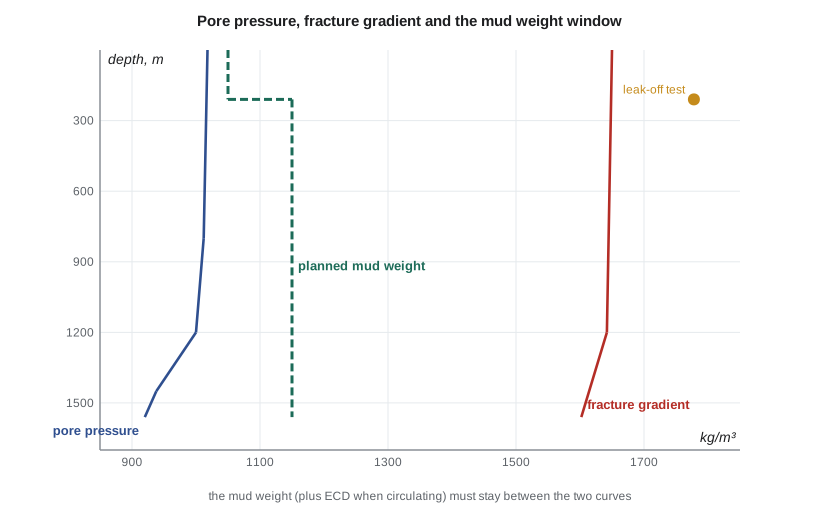
Plotted against depth as equivalent densities, the pore pressure and fracture gradient form the mud weight window. The planned mud weight must stay above the pore pressure with a trip margin, typically 35 to 60 kg/m³ (0.3 to 0.5 ppg), so that swab pressures do not let the well flow. The ECD, plus a margin for surge and kick tolerance, must stay below the fracture gradient. Where the mud needed at the bottom of a section would fracture the weakest rock above it, usually just below the last shoe, a new casing string must be set. Casing points are chosen from the bottom up: the deepest section's mud weight sets how strong the shoe above it must be, and so on to the surface.
# Pore pressure by Eaton's sonic method, fracture gradient and the mud weight window
SI = True
if SI:   # depth m, normal-trend shale transit time, observed shale transit time (microseconds per metre)
    pts = [(300, 420, 422), (800, 330, 331), (1200, 280, 280), (1450, 262, 258), (1560, 255, 250)]
    ob, normal = 22.6, 9.81                  # overburden and normal hydrostatic gradients, kPa/m
else:    # depth ft, trend and observed transit time (microseconds per foot)
    pts = [(2000, 130, 130), (5000, 105, 106), (8000, 88, 89), (9500, 81, 82), (10450, 77, 79.5)]
    ob, normal = 1.0, 0.465                  # psi/ft
nu = 0.33                                    # Poisson's ratio used in Eaton's fracture gradient (illustrative)
print("depth      trend  observed  pore gradient     fracture gradient")
for z, dtn, dt in pts:
    pg = ob - (ob - normal) * (dtn / dt) ** 3.0
    fg = nu / (1 - nu) * (ob - pg) + pg
    if SI: print(f"{z:5.0f} m {dtn:8.0f} {dt:8.0f}   {pg:5.2f} kPa/m ({pg*1000/9.81:5.0f} kg/m3)  {fg:5.2f} kPa/m ({fg*1000/9.81:5.0f} kg/m3)")
    else:  print(f"{z:6.0f} ft {dtn:6.0f} {dt:8.0f}   {pg:5.3f} psi/ft ({pg/0.052:5.2f} ppg)  {fg:5.3f} psi/ft ({fg/0.052:5.2f} ppg)")
if SI:   # leak-off test below the surface casing shoe
    shoe, rho, p_lo = 210.0, 1050.0, 1500.0
    emw = rho + p_lo * 1000 / (9.81 * shoe)
    print(f"leak-off at {shoe:.0f} m with {rho:.0f} kg/m3 mud and {p_lo:,.0f} kPa surface pressure: equivalent density {emw:,.0f} kg/m3")
else:
    shoe, mw, p_lo = 2100.0, 8.8, 760.0
    emw = mw + p_lo / (0.052 * shoe)
print(f"leak-off at {shoe:,.0f} ft with {mw} ppg mud and {p_lo:.0f} psi surface pressure: equivalent mud weight {emw:.1f} ppg")depth trend observed pore gradient fracture gradient 300 m 420 422 9.99 kPa/m ( 1018 kg/m3) 16.20 kPa/m ( 1652 kg/m3) 800 m 330 331 9.93 kPa/m ( 1012 kg/m3) 16.17 kPa/m ( 1648 kg/m3) 1200 m 280 280 9.81 kPa/m ( 1000 kg/m3) 16.11 kPa/m ( 1642 kg/m3) 1450 m 262 258 9.21 kPa/m ( 938 kg/m3) 15.80 kPa/m ( 1611 kg/m3) 1560 m 255 250 9.03 kPa/m ( 920 kg/m3) 15.71 kPa/m ( 1602 kg/m3) leak-off at 210 m with 1050 kg/m3 mud and 1,500 kPa surface pressure: equivalent density 1,778 kg/m3
In the offset sonic data, the shale transit times sit on the normal trend down to about 1,200 m, then become slightly faster than the trend in the Cardium interval, showing mild underpressure: about 9.0 kPa/m (920 kg/m³ equivalent) at 1,560 m. The fracture gradient is about 15.7 kPa/m (1,600 kg/m³). The leak-off test below the 210 m surface shoe in the offset well reached about 1,780 kg/m³. The planned 1,150 kg/m³ mud is therefore well inside the window for kicks and fractures, but 230 kg/m³ above the pore pressure in the depleted Cardium, a large overbalance that Ethan marks as a differential sticking risk for lesson 11.
Uncertainty and real-time updating
Pore pressure predictions carry real uncertainty, especially in exploration wells. Good practice is to show a range rather than one line, to calibrate with every pressure measurement, and to update the prediction while drilling using logging-while-drilling data, gas readings and drilling parameters. In development drilling such as the Tamarack Lake field, many offset wells make the profile well known, but local depletion from nearby producing wells, or pressure from nearby water injection, can change it. Marcus asks the reservoir team for the latest pressure map before finalizing the mud program.
Worked problem
Leak-off test equivalent mud weight
A leak-off test below a shoe at 600 m TVD uses 1,100 kg/m³ mud and leaks off at a surface pressure of 4,500 kPa. Find the equivalent mud density and the maximum allowable surface pressure with 1,250 kg/m³ mud in the hole.
Show solution
- Added density = 4,500,000/(9.81 × 600) = 765 kg/m³; EMW = 1,100 + 765 = 1,865 kg/m³.
- With 1,250 kg/m³ mud: maximum surface pressure = (1,865 − 1,250) × 9.81 × 600 = 3,620 kPa.
Answer: EMW about 1,865 kg/m³; about 3,620 kPa allowable at surface with 1,250 kg/m³ mud.
Overburden from density logs
The overburden pressure at a depth is the integral of bulk density from surface to that depth, multiplied by gravity. It is calculated from density logs in offset wells, with estimates for the shallow section where logs are seldom run. Near surface, where sediments are loose, the overburden gradient may be well below 22.6 kPa/m (1.0 psi/ft); in deep, well-compacted rock it may be above it. Using an accurate overburden curve matters because both Eaton's pore pressure equation and the fracture gradient equation depend on it.
Drilling indicators of pressure
Before logging-while-drilling tools were common, drillers watched the rate of penetration for signs of overpressure. In normally pressured shale, compaction makes the rock harder with depth and the rate of penetration slowly falls for the same drilling parameters. In overpressured shale, the higher porosity and lower effective stress make the rock easier to drill, so the rate rises. The d-exponent normalizes the rate of penetration for weight on bit, rotary speed and bit size, and its departure from the normal trend was an early quantitative method. It is still used as one line of evidence alongside gas readings, cuttings observations and logs.
Gas readings are especially useful. Background gas is the gas released from the rock being drilled. Connection gas appears after each connection, when the pumps are off and the ECD falls to the static mud weight, and rising connection gas suggests the static mud weight is close to the pore pressure. Trip gas appears after a round trip. A steady increase in connection gas is one of the clearest warnings that mud weight should be raised.
The window in narrow-margin wells
In some wells, especially deepwater wells and depleted reservoirs below overpressured shales, the window between pore pressure and fracture gradient is very narrow. Managed pressure drilling (MPD) handles such wells by closing the annulus at surface with a rotating control device and adjusting a surface backpressure with an automated choke, so the bottomhole pressure stays nearly constant whether the pumps are on or off. MPD can let a well reach its target with fewer casing strings and fewer losses or kicks. It needs special equipment, procedures and training, and its well control arrangements must be approved by the regulator.
For the 03-22 well, the window is wide and conventional drilling is suitable. Marcus notes that some deeper wells in Alberta use MPD where depleted zones and higher pressures meet in the same open hole.
Communicating the pressure profile
The pressure profile is drawn as a single chart in the drilling program, like the figure in this lesson, with pore pressure, fracture gradient, overburden, planned mud weights, casing points and the leak-off results from offset wells. Uncertainty bands are shown around the predictions, and the depths where the prediction is least certain are marked so that the wellsite team watches the indicators closely there. During drilling, the mud logger and the operator's geologist update the chart daily with gas readings, cuttings observations and logging-while-drilling data. Any departure from the prediction is reported to the drilling engineer at once, because it may change the mud weight or the casing plan.
Ethan adds one more line to the chart for the 03-22 well: the expected ECD while drilling the lateral, from lesson 5. Seeing the circulating density on the same chart as the fracture gradient makes the margin obvious to everyone who reads the program.
Common mistakes
MistakeUsing a single normal gradient everywhere.
InsteadNormal pressure depends on formation water salinity; use local values.
MistakeChecking static mud weight against the fracture gradient.
InsteadCheck ECD plus surge and kick tolerance margins.
MistakeIgnoring depletion in development fields.
InsteadUse current reservoir pressures; depleted zones raise loss and sticking risk.
MistakeChoosing casing points from the top down.
InsteadWork from the deepest section upward, using the mud weight each section needs.
Summary and key terms
- Overburden, pore pressure and fracture pressure define the drilling window.
- Overpressure comes mainly from undercompaction and fluid expansion; underpressure from depletion or uplift.
- Eaton's method estimates shale pore pressure from the departure of sonic or resistivity data from the normal compaction trend.
- Fracture gradient depends on overburden, pore pressure and Poisson's ratio, and is checked by leak-off or formation integrity tests.
- Mud weight plus a trip margin must exceed pore pressure, and ECD plus margins must stay below the fracture gradient; casing points follow from this.
- Overburden pressure
- The pressure from the weight of the overlying rock and fluids.
- Pore pressure
- The pressure of fluid in the pores of a formation.
- Normal pressure
- Pore pressure equal to the hydrostatic pressure of formation water.
- Fracture gradient
- The pressure gradient at which a formation fractures and takes fluid.
- Leak-off test (LOT)
- A test that pressures up below a new shoe until the formation starts to take fluid.
- Formation integrity test (FIT)
- A test that pressures the shoe to a planned value without fracturing it.
- Trip margin
- Extra mud weight above pore pressure to offset swab during trips.
Practice problems
Work each problem on paper first, then reveal the answer to check.
Why is the weakest point of an open-hole section usually just below the last casing shoe?
Show answer
Fracture gradient generally increases with depth, so the shallowest open rock is weakest.
Normal pressure is 9.8 kPa/m. What is the pore pressure at 2,500 m?
Show answer
24,500 kPa.
Name three signs while drilling that pore pressure may be rising.
Show answer
Higher background and connection gas, larger splintery shale cavings, drilling breaks, rising torque and drag.
Why is underpressure also a drilling problem?
Show answer
A large overbalance raises the risk of lost circulation and differential sticking.
Lesson quiz · 5 questions
Score 60% or more to complete this lesson.
Create a free account to save your progress, take quizzes and earn a certificate.