
PET-310 · Lesson 4 of 12 · 19 min
Drilling fluids
The mud engineer for the 03-22 well, Rosa Delgado, meets Ethan at the mud tanks of the offset rig in Drayton Valley. She hands him a cup of mud from the suction tank and a funnel. 'Forty-two seconds,' she says after timing it. 'That tells me something, but not much. The real numbers come from the balance and the viscometer.' She weighs a sample on a mud balance, then runs it in the rotational viscometer at six speeds. 'Mud is the first barrier against the well and the conveyor belt that brings the hole to surface. If it's wrong, nothing else in your program works.'
What drilling fluid must do
Drilling fluid has a long list of jobs. It controls formation pressure through its hydrostatic head. It carries cuttings out of the hole and suspends them when circulation stops. It cools and lubricates the bit and string. It forms a thin, low-permeability filter cake on permeable formations, which limits fluid loss into the rock and supports the wall. It stabilizes shales, which can swell, soften or break apart when they meet the wrong fluid. It transmits hydraulic power to the bit and to downhole motors and carries the pressure pulses that send MWD data to surface. And it should do all of this without damaging the reservoir, harming the crew or the environment, or costing too much.
These jobs conflict. A heavier mud controls pressure better but raises the risk of losses and differential sticking and slows drilling. A thicker mud carries cuttings better but needs more pump pressure and raises the equivalent circulating density. Mud design is a compromise for each section of the well.
Types of drilling fluid
Water-based muds (WBM) use water as the continuous phase, with bentonite clay for viscosity and filtration control, polymers, thinners, weighting material and chemicals such as potassium chloride to inhibit shale. They are cheaper and easier to dispose of. Oil-based or invert emulsion muds (OBM) use a base oil or synthetic fluid as the continuous phase with brine droplets emulsified in it. They stabilize reactive shales, lubricate well, resist contamination and tolerate high temperatures, so they are common for intermediate sections through difficult shales and salts and for long horizontal wells, but they cost more and their cuttings need special handling. Air, mist, foam and aerated fluids are used for underbalanced and managed-pressure drilling in suitable rocks. Clear brines with polymers are used in some laterals and reservoir sections.
For the 03-22 well, the surface hole is drilled with fresh water and gel, and the main hole and lateral with a potassium-chloride polymer water-based mud weighted to about 1,150 kg/m³, a common choice for Cardium horizontals where the shales are only mildly reactive.
Mud weight and hydrostatic pressure
Mud density, called mud weight in the field, sets the hydrostatic pressure at any depth. In SI units, pressure is density times gravity times true vertical depth; in oilfield units the constant 0.052 converts pounds per gallon and feet to psi. Mud weight is measured with a mud balance; pressurized balances remove entrained air, which otherwise makes the mud read light.
Mud weight is raised with barite, a dense barium sulphate mineral with a specific gravity of about 4.2, or with hematite or dissolved salts. It is lowered by diluting with base fluid and removing solids. A mass balance gives the weighting material needed: the density rises as the dense solid displaces lighter fluid, so each increment of density costs more barite as the mud gets heavier.
Rheology
Rheology describes how a fluid flows under shear. Water is Newtonian: its shear stress is proportional to shear rate, so it has one viscosity. Drilling muds are non-Newtonian: they are shear-thinning, thinner at the high shear rates inside the pipe and at the bit and thicker at the low shear rates in the annulus, which is exactly what hole cleaning needs. Many also have a yield stress and form gels when they stop moving, so they suspend cuttings during connections.
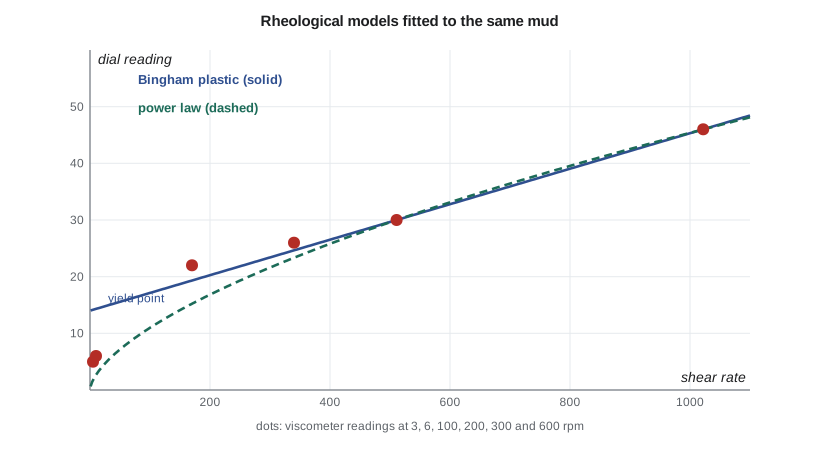
The standard field instrument is the rotational viscometer, which measures the torque on a bob inside a rotating sleeve at 600, 300, 200, 100, 6 and 3 rpm. API recommended practice 13B gives the field test procedures. Two simple models are fitted to the readings. The Bingham plastic model describes the mud as a straight line with an intercept, the yield point (YP), and a slope, the plastic viscosity (PV). The power-law model describes it as a curve with a flow behaviour index n, below 1 for shear-thinning fluids, and a consistency index K. The Herschel-Bulkley model combines a yield stress with a power-law curve and fits most muds best.
Plastic viscosity reflects the solids content and the viscosity of the base fluid; rising PV usually means fine drilled solids are building up and solids control or dilution is needed. Yield point reflects the attractive forces between particles and is what carries cuttings in the annulus. Gel strengths, the readings at 3 rpm after 10 seconds and 10 minutes at rest, measure how well the mud suspends cuttings and how much pressure is needed to break circulation after a connection.
# Mud rheology from viscometer readings, hydrostatic pressure and barite needed to raise mud weight
import math
SI = True
r600, r300 = 46.0, 30.0                 # rotational viscometer dial readings at 600 and 300 rpm
pv = r600 - r300                        # plastic viscosity, cP
yp = r300 - pv                          # yield point, lb/100 ft2
n = 3.32 * math.log10(r600 / r300)      # power-law flow behaviour index
K = 510 * r300 / 511 ** n               # consistency index, equivalent cP units
print(f"PV {pv:.0f} mPa·s, YP {yp*0.4788:.1f} Pa" if SI else f"PV {pv:.0f} cP, YP {yp:.0f} lb/100 ft2")
print(f"power-law n {n:.3f}, K {K:.0f} eq. cP")
if SI:
    rho, tvd = 1150.0, 1560.0
    p = rho * 9.81 * tvd / 1000
    print(f"hydrostatic pressure of {rho:.0f} kg/m3 mud at {tvd:,.0f} m TVD: {p:,.0f} kPa")
    V, r1, r2 = 160.0, 1150.0, 1250.0                  # m3 of mud, from and to density
    m_bar = V * 4200 * (r2 - r1) / (4200 - r2)         # barite density 4,200 kg/m3
    print(f"barite to raise {V:.0f} m3 from {r1:.0f} to {r2:.0f} kg/m3: {m_bar/1000:,.1f} tonnes")
else:
    mw, tvd = 10.2, 10450.0
    p = 0.052 * mw * tvd
    print(f"hydrostatic pressure of {mw} ppg mud at {tvd:,.0f} ft TVD: {p:,.0f} psi")
    V, w1, w2 = 1000.0, 10.2, 11.0
    sx = 1470 * (w2 - w1) / (35 - w2)                  # 100 lb sacks of barite per 100 bbl
print(f"barite to raise {V:.0f} bbl from {w1} to {w2} ppg: {sx*V/100:,.0f} sacks (100 lb)")PV 16 mPa·s, YP 6.7 Pa power-law n 0.616, K 328 eq. cP hydrostatic pressure of 1150 kg/m3 mud at 1,560 m TVD: 17,599 kPa barite to raise 160 m3 from 1150 to 1250 kg/m3: 22.8 tonnes
Rosa's readings of 46 and 30 give a plastic viscosity of 16 mPa·s, a yield point of 6.7 Pa and a power-law index of 0.62, typical of a polymer mud. The 1,150 kg/m³ mud exerts about 17,600 kPa at the 1,560 m landing depth. Raising 160 m³ of mud to 1,250 kg/m³ would need about 23 tonnes of barite, which is why Marcus wants the weight-up material and its plan on location before drilling into any zone that might be overpressured.
Filtration and filter cake
Where the mud is in contact with a permeable formation and its pressure is higher than the formation pressure, liquid filtrate flows into the rock and the solids build a filter cake on the wall. A thin, tough, low-permeability cake is good: it limits further losses and invasion. A thick, soft cake narrows the hole, increases the risk of differential sticking (lesson 11) and causes swab and surge problems. Filtration is measured in the API low-pressure test, the volume of filtrate in 30 minutes at room temperature, and in a high-temperature, high-pressure test for deeper wells.
Solids control
Drilled solids ground into fine particles are the main enemy of mud performance. They raise density and plastic viscosity, thicken the filter cake and slow drilling. Solids control equipment removes them in stages: shale shakers with fine screens remove most cuttings, then hydrocyclones (desanders and desilters) and centrifuges remove finer particles. Good solids control reduces the amount of dilution needed, and therefore the volume of waste mud, which matters for cost and the environment.
Mud testing and the mud report
The mud engineer tests the mud several times a day and records the results on the daily mud report: density, funnel viscosity, rheology readings, gel strengths, filtration, pH, solids and liquid contents from a retort, sand content, chlorides and, for oil-based mud, the oil-water ratio and electrical stability. Trends in these numbers tell the drilling engineer what is happening downhole. Rising chlorides in a water-based mud may mean salt or saltwater is entering; rising low-gravity solids mean the solids control is falling behind; a falling density at the flowline may mean gas cut.
Environment and waste
Drilling waste, including used mud and cuttings, must be handled under the AER' Directive 050, which sets methods such as landspraying, mix-bury-cover, or disposal at approved facilities depending on the waste's composition. Oil-based cuttings usually go to a waste management facility. Reducing dilution and reusing mud between wells on a pad cuts both cost and waste volumes.
Worked problem
Rheology from viscometer readings
A mud gives θ600 = 58 and θ300 = 36. Find the plastic viscosity, the yield point and the power-law flow behaviour index.
Show solution
- PV = 58 − 36 = 22 mPa·s (cP).
- YP = 36 − 22 = 14 lb/100 ft² (about 6.7 Pa).
- n = 3.32 log10(58/36) = 3.32 × 0.2071 = 0.688.
Answer: PV 22, YP 14 lb/100 ft², n about 0.69.
Choosing the mud for each section
Mud selection starts with the formations and hazards in each section. Surface holes through unconsolidated sediments need a simple, cheap fluid that cleans large holes and can be disposed of easily, usually fresh water with bentonite. Sections through reactive shales need inhibition, either potassium salts and polymers in a water-based mud or an oil-based mud. Salt sections need a fluid saturated with salt, or oil-based mud, so the salt does not dissolve and enlarge the hole. Reservoir sections need a fluid that minimizes damage to the rock's permeability: low solids, sized bridging particles that form an easily removed filter cake, and filtrate compatible with the formation water. Long horizontal sections favour fluids that lubricate well and carry cuttings at low shear rates.
The mud program states, for each section, the fluid type, the density range, the target rheology and filtration values, the chemical concentrations, the solids control equipment, and the contingency materials kept on site, such as barite for weighting up and lost-circulation material. It also sets triggers: for example, raise the density if connection gas exceeds a given level, or reduce it if losses begin. Rosa's draft for the 03-22 well uses a density range rather than a single value, so the crew can respond to conditions within limits approved in advance.
Mud cost and reuse
Mud is a significant part of the well cost, especially for oil-based systems. On pads, operators transfer mud from one well to the next, treating it as needed instead of mixing new fluid, and some rent oil-based mud from the supplier and return it at the end. Good solids control and a careful choice of when to dilute are the main levers on mud cost. The daily mud report includes the cost of products used, so trends in consumption show where money is going.
Mud and the reservoir
Drilling fluid can damage the very rock the well is meant to produce. Fine solids can plug pore throats near the wellbore, filtrate can swell clays or form emulsions with the oil, and incompatible water can precipitate scale. In conventional wells this damage shows as a positive skin in well tests. In tight, hydraulically fractured reservoirs, the fractures usually bypass the damaged zone, so damage matters less, but it still matters in open-hole completions and in naturally fractured rock. PET-330 covers formation damage in detail; the mud engineer's part is to keep solids low and filtrate compatible in the reservoir section.
Common mistakes
MistakeJudging mud by funnel viscosity alone.
InsteadUse viscometer readings for PV, YP, gels and model parameters.
MistakeWeighing gas-cut mud with an unpressurized balance.
InsteadUse a pressurized balance; entrained gas makes mud read light.
MistakeRaising mud weight to solve every problem.
InsteadExtra weight raises loss, sticking and ECD risks; diagnose the cause first.
MistakeDiluting instead of removing solids.
InsteadRun solids control efficiently; dilution adds cost and waste.
Summary and key terms
- Drilling fluid controls pressure, cleans the hole, cools the bit, stabilizes the wall and transmits power and data.
- Water-based muds are cheaper; oil-based muds stabilize shales and lubricate long wells; air and aerated fluids suit special cases.
- Hydrostatic pressure is ρgh, or 0.052 × MW × TVD in oilfield units; barite raises density.
- Muds are shear-thinning; PV and YP come from the 600 and 300 rpm readings, and n describes the power-law curve.
- Filtration, solids control and daily testing keep the mud performing and the waste volume low.
- Mud weight
- The density of the drilling fluid.
- Plastic viscosity (PV)
- The slope of the Bingham plastic model, related to solids and base fluid viscosity.
- Yield point (YP)
- The stress intercept of the Bingham plastic model, related to cuttings carrying ability.
- Gel strength
- The stress needed to start a mud moving after it has rested.
- Filter cake
- The layer of mud solids deposited on a permeable wall as filtrate enters the rock.
- Barite
- Barium sulphate, the most common weighting material.
- Invert emulsion
- An oil-based mud with brine droplets dispersed in oil.
Practice problems
Work each problem on paper first, then reveal the answer to check.
Find the hydrostatic pressure of 1,200 kg/m³ mud at 2,000 m TVD.
Show answer
1,200 × 9.81 × 2,000 = 23.5 MPa.
A mud's PV has risen from 14 to 24 over two days with the same weight. What is the likely cause?
Show answer
Fine drilled solids are building up; improve solids control or dilute.
Why are shear-thinning properties useful in drilling?
Show answer
The mud is thin where shear is high (pipe and bit) and thicker where it is low (annulus), helping cleaning without excess pressure.
Give two advantages and one disadvantage of oil-based mud.
Show answer
Advantages: shale stability, lubricity, contamination and temperature tolerance. Disadvantage: cost and waste handling.
Lesson quiz · 5 questions
Score 60% or more to complete this lesson.
Create a free account to save your progress, take quizzes and earn a certificate.