
PET-250 · Lesson 2 of 12 · 19 min
Porosity: types, measurement and compressibility
The first batch of results from the Tamarack Lake field core arrives as a spreadsheet: 170 rows of porosity, permeability and grain density. Most of the porosities sit between 0.10 and 0.18, but a handful are suspiciously high, and three plugs from the conglomerate cap report porosities near 0.24. Lena asks Ethan to find out how the laboratory measured each number before anyone uses it. 'Porosity looks like the simplest property we have,' she says, 'and it is the one people misuse most.'
Defining porosity
Porosity is the fraction of the bulk volume of a rock that is not solid. If a rock has a bulk volume Vb, a grain volume Vg and a pore volume Vp, then Vp = Vb − Vg and porosity is Vp/Vb. It is reported as a fraction or a percentage, and the context should make clear which. A porosity of 0.15 and a porosity of 15 percent are the same thing; confusing 15 with 0.15 in a calculation is a common and expensive mistake.
Total porosity counts all the void space, whether connected or not. Effective porosity counts only the interconnected pore space through which fluids can move. In clean sandstones the two are nearly equal, because almost all pores are connected. In shaly sandstones the difference can be large: water bound to clay surfaces and held in tiny clay micropores is part of total porosity but contributes nothing to flow and holds no hydrocarbon. Log analysts and core analysts sometimes use different definitions of effective porosity, so every porosity value should come with a note of how it was measured and what it includes.
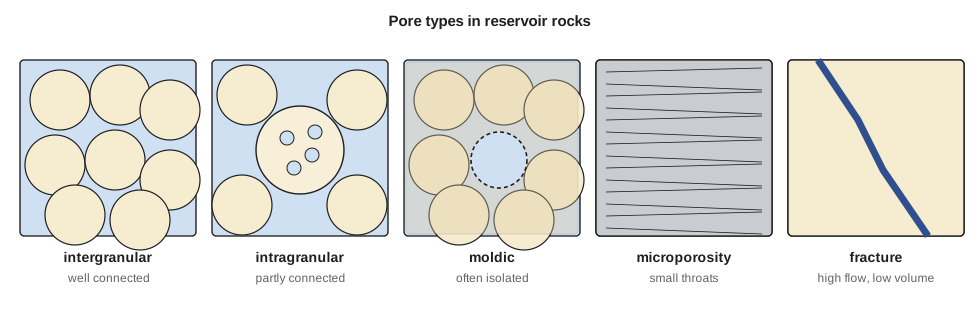
Primary and secondary porosity
Primary porosity is the space left between grains when the sediment was deposited. Its amount depends on sorting, grain shape and packing, as PET-210 explained: well-sorted sands start with 35 to 45 percent porosity, while poorly sorted sands start lower because small grains fill the gaps. Burial then reduces primary porosity by compaction and cementation.
Secondary porosity forms after deposition. Dissolution of unstable grains such as feldspar, or of carbonate cements, creates new pores. In carbonates, dissolution can create vugs, pores larger than the grains, and in extreme cases caves. Fractures form when the rock breaks under stress. Fracture porosity is usually small, often less than 1 percent of bulk volume, but fractures can carry most of the flow because they are so well connected. A reservoir with both matrix and fracture porosity is called dual porosity, and it behaves very differently from a simple matrix reservoir.
Measuring bulk volume
Every porosity measurement needs two of the three volumes. Bulk volume is the easiest to imagine but surprisingly easy to get wrong. For a well-cut cylindrical plug, calipers give the diameter and length, and bulk volume is πd²L/4. For irregular or damaged samples, bulk volume is found by immersion: the sample is lowered into mercury, which does not enter pores at low pressure because it is non-wetting, and the displaced volume is measured. Mercury is now avoided where possible because of its toxicity; alternatives include immersion in a liquid after the pores are saturated, or optical scanning.
Measuring grain volume: Boyle's law
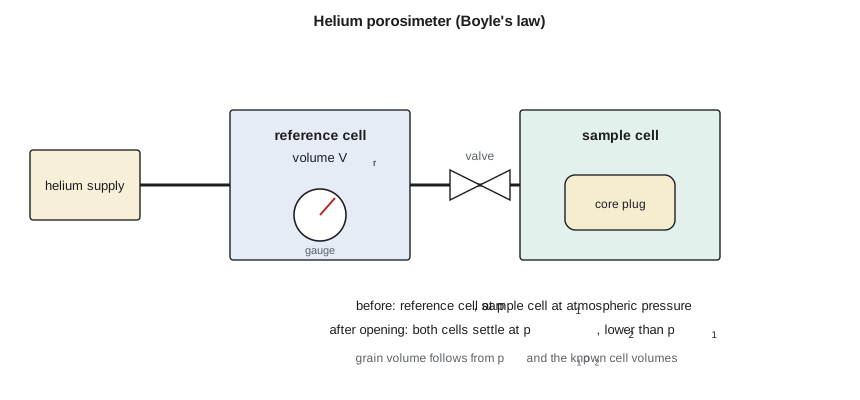
The standard method for grain volume uses helium and Boyle's law. The apparatus has two chambers of known volume: a reference cell and a sample cell that holds the plug. Helium is admitted to the reference cell at a known pressure, about 700 kPa (100 psi), and then a valve is opened so that the gas expands into the sample cell. The gas fills every connected pore and every bit of empty space in the sample cell, but not the grains. The lower the final pressure, the more empty volume there was, and therefore the smaller the grain volume. Helium is used because its small atoms enter very fine pores and it does not adsorb onto clay surfaces the way nitrogen or air can.
In the equation, p₁ and p₂ are absolute pressures before and after expansion, which assumes the gas temperature is the same at both readings. Laboratories calibrate the cell volumes with steel discs of known volume and allow time for the temperature to settle after expansion, because the gas cools as it expands. Small errors matter: the program below shows that a 3 kPa error in the final pressure shifts porosity by almost a full porosity unit.
# Boyle's law grain volume, porosity and pore-volume change with depletion
# Step 1: helium porosimeter. A reference cell at P1 is opened to the sample cell holding the plug.
V_ref, V_cell = 50.00, 80.00          # cm3, calibrated volumes
P1, P2 = 689.5, 391.7                 # kPa gauge readings before and after opening the valve
P_ATM = 101.3
p1, p2 = P1 + P_ATM, P2 + P_ATM       # Boyle's law needs absolute pressure
# helium expands into the empty part of the sample cell: p1*V_ref = p2*(V_ref + V_cell - Vg)
Vg = V_ref + V_cell - p1 * V_ref / p2
Vb = 57.92                            # cm3, bulk volume from calipers
phi = (Vb - Vg) / Vb
print(f"grain volume {Vg:.2f} cm3, porosity {phi:.3f}")
p2_bad = p2 - 3.0                     # a 3 kPa gauge error
Vg_bad = V_ref + V_cell - p1 * V_ref / p2_bad
print(f"with a 3 kPa error in P2: porosity {(Vb - Vg_bad) / Vb:.3f}")

# Step 2: pore volume compressibility measured on plugs (illustrative laboratory values)
tests = {0.08: 9.0e-6, 0.14: 5.5e-6, 0.20: 4.0e-6}   # porosity: cf per psi
dp = 1500                             # psi drop in reservoir pressure during depletion
for phi0, cf in tests.items():
    phi_new = phi0 * (1 - cf * dp)    # pore volume shrinks as effective stress rises
    print(f"phi {phi0:.2f}, cf {cf * 1e6:.1f}e-6/psi -> {phi_new:.4f} after {dp} psi "
f"({(phi_new / phi0 - 1) * 100:.2f} % pore volume)")grain volume 49.80 cm3, porosity 0.140 with a 3 kPa error in P2: porosity 0.149 phi 0.08, cf 9.0e-6/psi -> 0.0789 after 1500 psi (-1.35 % pore volume) phi 0.14, cf 5.5e-6/psi -> 0.1388 after 1500 psi (-0.82 % pore volume) phi 0.20, cf 4.0e-6/psi -> 0.1988 after 1500 psi (-0.60 % pore volume)
Other porosity methods
Pore volume can also be measured directly. In the summation-of-fluids method, used on fresh samples, the volumes of water, oil and gas in a plug are measured separately and added. In the saturation method, a clean dry plug is weighed, saturated with brine of known density under vacuum and pressure, and weighed again; the gain in mass divided by brine density gives the connected pore volume. Saturation porosity can be lower than helium porosity if the brine fails to enter the finest pores.
Porosity from a full-diameter or whole-core sample is measured in the same way with larger cells. It captures vugs and small fractures that a plug may miss or that make plug-drilling impossible, which is why carbonate and fractured reservoirs often rely on whole-core analysis.
Logs estimate porosity in every well. The density log measures bulk density, which depends on the grain density and on the density of the fluid in the pores; the neutron log responds mainly to hydrogen, which is in water, oil and gas; and the sonic log measures the speed of sound, which falls as porosity rises. Each needs core to calibrate it. The density-porosity equation, for example, needs the grain density measured in routine core analysis.
Worked problem
Density-log porosity calibrated to core
Core from a clean sandstone interval has an average grain density of 2.66 g/cm³. The density log reads a bulk density of 2.41 g/cm³ in the same interval, and the mud filtrate in the zone the tool reads has a density of 1.03 g/cm³. Estimate the porosity, and the error if the analyst had assumed a limestone matrix of 2.71 g/cm³.
Show solution
- φ = (2.66 − 2.41)/(2.66 − 1.03) = 0.25/1.63 = 0.153.
- With a limestone matrix: φ = (2.71 − 2.41)/(2.71 − 1.03) = 0.30/1.68 = 0.179.
- Difference = 0.179 − 0.153 = 0.026, or about 17 percent too high in relative terms.
Answer: The core-measured grain density gives a porosity of about 0.153. Using the wrong matrix density would overstate porosity by 2.6 porosity units, which would inflate the oil in place by a similar proportion. This is why log analysts insist on core grain density before finalizing porosity.
Porosity in shales and tight rocks
Clean sandstones like the Cardium give consistent porosity by any method. Shales and tight rocks do not. In clay-rich rock, the result depends on how the sample is dried, because heating to 110 °C drives off water bound to clay surfaces that gentler humidity-controlled drying leaves in place. Shale samples may also contain organic matter with its own nanometre-scale pores. For these rocks, laboratories often crush the sample to expose more pores to the helium, a method described in lesson 10, and report both total and effective porosity with the drying method stated. When the Tamarack Lake field team later evaluates the shale above the reservoir as a seal, Ethan will need those definitions.
Pore volume compressibility
Porosity measured in the laboratory at room pressure is not quite the porosity in the reservoir. Underground, the rock carries the weight of the overlying sediment, the overburden stress, while the fluid pressure in the pores pushes back. The difference, called effective stress, squeezes the grains together. When a plug is brought to surface the stress is removed, the rock relaxes slightly and porosity increases. Laboratories therefore often measure porosity under a confining pressure that represents reservoir conditions, and the in-situ porosity can be a few percent lower than the room-condition value, more in poorly consolidated rock.
During production the same effect works in reverse. As reservoir pressure falls, effective stress rises and the pore volume shrinks. The pore volume compressibility, cf, describes how much the pore volume changes per unit change in pore pressure. It is small, typically 3 to 10 × 10⁻⁶ per psi (about 0.4 to 1.5 × 10⁻⁶ per kPa) for consolidated sandstones, but larger in friable sands and chalks. Lower-porosity consolidated rocks often show higher pore volume compressibility per unit pore volume, because their small pore volume is more sensitive to a given strain, though measured values scatter widely and should come from tests on the actual rock.
Why does such a small number matter? Because in an undersaturated oil reservoir, with no free gas, the only things that expand to push oil toward the wells as pressure falls are the oil, the connate water and the pore space itself. Oil compressibility is perhaps 10 to 20 × 10⁻⁶ per psi, so rock compressibility can provide a third or more of the drive energy. Material balance calculations, covered in the later reservoir engineering course, include rock compressibility for this reason. In weak rocks, compaction can also cause the ground surface to sink, as it has over some large fields, and can damage well casings.
Averaging porosity
Because porosity is a volume fraction, averaging it is straightforward: weight each measurement by the thickness or volume it represents. For a set of plugs taken at equal spacing, the arithmetic mean is fine. For layers of different thickness, the thickness-weighted average is correct. What matters more is deciding which plugs to include. Plugs in shale beds or below a porosity cutoff should be excluded from the net reservoir average, and plugs from fractured or broken core may be biased. The geologist's description of each plug is essential.
Common mistakes
MistakeMixing fractional and percentage porosity in one calculation.
InsteadConvert everything to fractions before multiplying; a porosity of 15 percent is 0.15.
MistakeUsing gauge pressure in Boyle's law.
InsteadBoyle's law needs absolute pressure; add atmospheric pressure to gauge readings.
MistakeAssuming room-condition porosity equals reservoir porosity.
InsteadRock relaxes when stress is removed; correct to reservoir effective stress, especially in weak rocks.
MistakeIgnoring the drying method for shaly samples.
InsteadReport how samples were dried; clay-bound water changes total and effective porosity.
Summary and key terms
- Porosity is pore volume divided by bulk volume; effective porosity counts only connected pores.
- Primary porosity forms at deposition; secondary porosity from dissolution and fracturing can dominate in carbonates and fractured rocks.
- Helium porosimeters use Boyle's law with absolute pressures to measure grain volume; small gauge errors cause noticeable porosity errors.
- Log porosity depends on core-derived grain density and other constants.
- Pore volume compressibility is small but contributes significant drive energy in undersaturated reservoirs.
- Total porosity
- All void space in a rock as a fraction of bulk volume.
- Effective porosity
- Connected pore space through which fluids can flow, as a fraction of bulk volume.
- Secondary porosity
- Pore space created after deposition, by dissolution or fracturing.
- Boyle's law porosimeter
- An instrument that measures grain volume from the expansion of helium between two cells.
- Effective stress
- The difference between overburden stress and pore pressure that compresses the rock frame.
- Pore volume compressibility
- The fractional change in pore volume per unit change in pore pressure.
- Dual porosity
- A reservoir with two connected pore systems, typically matrix pores and fractures.
Practice problems
Work each problem on paper first, then reveal the answer to check.
A helium porosimeter has V_ref = 50.0 cm³ and V_cell = 80.0 cm³. With absolute pressures p₁ = 790 kPa and p₂ = 490 kPa, what is the grain volume?
Show answer
Vg = 50 + 80 − 790 × 50/490 = 130 − 80.6 = 49.4 cm³.
A density log reads 2.35 g/cm³ in a sandstone with grain density 2.65 g/cm³ and fluid density 1.0 g/cm³. Find porosity.
Show answer
φ = (2.65 − 2.35)/(2.65 − 1.0) = 0.30/1.65 = 0.182.
A reservoir with porosity 0.18 and cf = 5 × 10⁻⁶ per psi is depleted by 2,000 psi. Estimate the new porosity.
Show answer
φ ≈ 0.18 × (1 − 0.01) = 0.1782.
Why is helium preferred to nitrogen for grain volume?
Show answer
Helium atoms are small, enter fine pores readily and do not adsorb significantly on clay surfaces.
Lesson quiz · 5 questions
Score 60% or more to complete this lesson.
Create a free account to save your progress, take quizzes and earn a certificate.