
PET-250 · Lesson 11 of 12 · 20 min
Rock mechanics for reservoir engineers
Ethan's next task comes from the completions team. Marcus Obi is designing hydraulic fracture treatments for the next wells, and he needs the minimum horizontal stress in the reservoir and in the rocks above and below it, together with elastic properties from core. 'Every number we have discussed so far, porosity, permeability, saturation, sits inside a rock that carries the weight of everything above it,' Lena tells Ethan. 'Change the pore pressure and you change the stress on the grains. Change the stress and you change the porosity and permeability. Fracture design, wellbore stability, compaction and sand production all come back to the same few ideas.' This lesson introduces those ideas from a reservoir engineer's point of view.
Stress underground
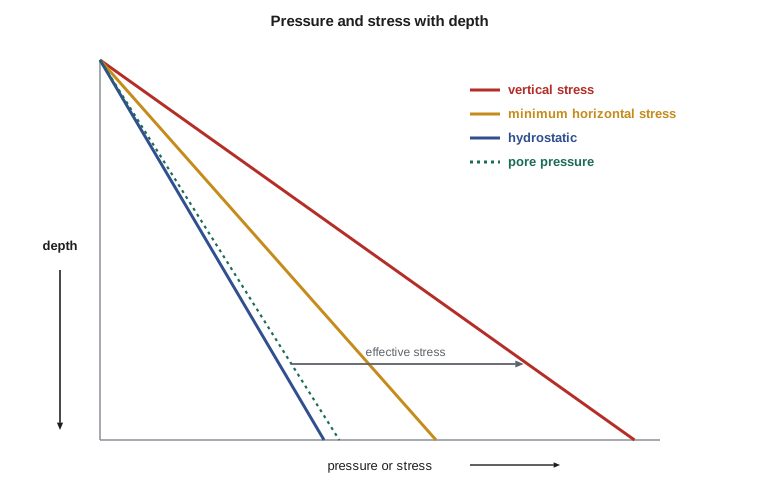
Stress is force per unit area, measured in megapascals or pounds per square inch. At any point underground, the state of stress can be described by three principal stresses acting at right angles to each other, with no shear stress on the planes they act on. In most sedimentary basins one principal stress is close to vertical and equal to the weight of the overlying rock and fluids. The other two are horizontal: the maximum horizontal stress and the minimum horizontal stress. Their relative sizes define the stress regime. When the vertical stress is largest, the regime is normal faulting; when the vertical stress is intermediate, it is strike-slip; and when it is smallest, it is reverse or thrust faulting. Much of the western Canada and Williston basins is in a normal or strike-slip regime at reservoir depth, although local conditions vary.
The vertical stress is found by integrating the bulk density log from the surface to the depth of interest. Shallow sediments are less dense, about 2.0 to 2.2 g/cm³, while deeply buried rocks approach 2.5 to 2.6 g/cm³, so the overburden gradient increases with depth. A common average is about 22 to 25 kPa/m, or roughly 1.0 psi/ft.
Pore pressure and effective stress
The fluids in the pores carry part of the load. Terzaghi recognized in the 1920s that the deformation of soils depends on the difference between total stress and pore pressure, called effective stress. Biot extended the idea to rocks, where the grains are themselves compressible and the cement takes part of the load. The Biot coefficient α, between the porosity and 1, describes how efficiently pore pressure counteracts total stress.
Here Kdry is the bulk modulus of the dry rock frame and Kgrain the bulk modulus of the minerals. Soft, poorly consolidated rock has α near 1; stiff, well-cemented rock with low porosity has a lower value, perhaps 0.5 to 0.8. Pore pressure that is higher than hydrostatic is called overpressure and lower than hydrostatic is underpressure. Both are common: many deep shale plays are overpressured because hydrocarbon generation raised the pore pressure, while some shallower reservoirs that have been uplifted are underpressured.
Effective stress controls most of the rock properties measured in earlier lessons. Pore volume compressibility from lesson 2 is the rate at which pore volume changes with effective stress. The stress sensitivity of permeability, especially strong in tight rock, depends on effective stress. Laboratory tests must therefore apply confining pressure and pore pressure that reproduce reservoir effective stress.
Elastic properties
For small strains, most rocks behave approximately elastically, and two constants describe their behaviour. Young's modulus E is the ratio of axial stress to axial strain in a test where the sides of the sample are free to move: a stiff rock has a high modulus. Poisson's ratio ν is the ratio of lateral expansion to axial shortening in the same test, typically 0.15 to 0.35 for reservoir rocks. Other moduli, such as the bulk modulus and the shear modulus, can be calculated from these two.
Static moduli come from triaxial tests on core, in which a cylindrical plug is loaded axially under confining pressure while strains are measured with gauges or displacement sensors. Dynamic moduli come from the velocities of compressional and shear waves, measured in the laboratory or by sonic logs. Dynamic Young's moduli are usually higher than static values, sometimes by a factor of two in soft rocks, because the very small, fast strains of a sound wave do not close cracks or move grains. Companies build correlations between static and dynamic values from core so that sonic logs can provide continuous profiles of mechanical properties along the well.
Estimating the minimum horizontal stress
The minimum horizontal stress matters most for hydraulic fracturing, because fractures open against it and grow perpendicular to it. In a normal faulting regime, fractures are vertical and grow in the direction of the maximum horizontal stress, which is why horizontal wells are usually drilled parallel to the minimum horizontal stress so that fractures form across the wellbore. A simple estimate assumes that the rock was buried under uniaxial strain, that is, it was compressed vertically but could not expand sideways.
The final term adds any tectonic stress from regional plate forces, which can be significant. Because Poisson's ratio enters the equation, shales with higher ν generally carry higher horizontal stress than the sandstones or carbonates between them. Those stress contrasts act as barriers to fracture height growth, which is why fractures in many plays remain within a few tens of metres of the target layer.
Direct measurement is better than estimation. A diagnostic fracture injection test, also called a minifrac, pumps a small volume of fluid to create a short fracture, then shuts in the well and watches the pressure fall. The pressure at which the fracture closes, found from changes in the slope of the decline, approximates the minimum horizontal stress. Extended leak-off tests in the casing shoe of vertical wells give similar information for the rocks above the reservoir. These measurements calibrate the uniaxial strain equation, usually by adjusting the tectonic term.
# Stresses at reservoir depth: overburden, pore pressure, Biot effective stress and minimum horizontal stress (SI)
import math
g = 9.81
layers = [(300, 2.10), (700, 2.40), (560, 2.55)]   # (thickness m, average bulk density g/cm3) down to the reservoir
depth, sv = 0.0, 0.0
for h, rho in layers:
    depth += h
    sv += rho * 1000 * g * h / 1e6                # MPa
print(f"depth {depth:.0f} m: vertical stress {sv:.1f} MPa ({sv / depth * 1000:.1f} kPa/m)")
pp = 14.0                                       # pore pressure, MPa (below hydrostatic)
nu, alpha = 0.25, 0.8                           # Poisson's ratio, Biot coefficient
sv_eff = sv - alpha * pp
sh = nu / (1 - nu) * sv_eff + alpha * pp        # uniaxial-strain estimate of minimum horizontal stress
print(f"pore pressure {pp:.1f} MPa ({pp / depth * 1000:.1f} kPa/m)")
print(f"effective vertical stress {sv_eff:.1f} MPa")
print(f"minimum horizontal stress {sh:.1f} MPa ({sh / depth * 1000:.1f} kPa/m)")
psi = 145.04
print(f"   in oilfield units: Sv {sv * psi:,.0f} psi, Sh {sh * psi:,.0f} psi, Pp {pp * psi:,.0f} psi")
# depletion: how the minimum horizontal stress follows pore pressure
path = alpha * (1 - 2 * nu) / (1 - nu)
for dp in (2.0, 5.0):
    print(f"deplete {dp:.0f} MPa: Sh falls {path * dp:.1f} MPa to {sh - path * dp:.1f} MPa; "
          f"effective vertical stress rises to {sv - alpha * (pp - dp):.1f} MPa")
# stress-sensitive permeability, k = k0 exp(-gamma * change in effective stress)
k0, gam = 0.05, 0.08                            # mD at initial conditions, 1/MPa (tight rock)
for dp in (2.0, 5.0, 8.0):
print(f"after {dp:.0f} MPa depletion: permeability {k0 * math.exp(-gam * alpha * dp):.3f} mD")depth 1560 m: vertical stress 36.7 MPa (23.5 kPa/m) pore pressure 14.0 MPa (9.0 kPa/m) effective vertical stress 25.5 MPa minimum horizontal stress 19.7 MPa (12.6 kPa/m) in oilfield units: Sv 5,319 psi, Sh 2,856 psi, Pp 2,031 psi deplete 2 MPa: Sh falls 1.1 MPa to 18.6 MPa; effective vertical stress rises to 27.1 MPa deplete 5 MPa: Sh falls 2.7 MPa to 17.0 MPa; effective vertical stress rises to 29.5 MPa after 2 MPa depletion: permeability 0.044 mD after 5 MPa depletion: permeability 0.036 mD after 8 MPa depletion: permeability 0.030 mD
The program uses three density layers down to the Cardium at 1,560 m. The vertical stress is 36.7 MPa, a gradient of 23.5 kPa/m. The pore pressure of 14.0 MPa is below hydrostatic, as in parts of the Cardium, so the effective vertical stress is large at 25.5 MPa. With ν of 0.25 and α of 0.8, the minimum horizontal stress is about 19.7 MPa, a gradient of 12.6 kPa/m. Depletion lowers the horizontal stress by about half of the pressure drop, and in tight rock the permeability falls as effective stress rises.
Stress changes during production
When pore pressure falls, effective stress increases. The rock compacts, which supplies energy that helps drive production and is included in material balance through pore volume compressibility. In weak reservoirs, compaction can be large enough to cause surface subsidence; the chalk fields of the North Sea and some heavy-oil fields in California are well-known examples. In tight rock, the closing of microcracks and the embedment of proppant into soft fracture faces lowers both matrix and fracture conductivity as the well is produced.
Depletion also changes horizontal stresses. Under uniaxial strain, the change in minimum horizontal stress is a fraction of the change in pore pressure, called the stress path. With α of 0.8 and ν of 0.25, the stress path is about 0.53. This has a practical effect on infill drilling: a new well next to a depleted parent well finds lower stress around the parent, so new fractures tend to grow toward the depleted region, a problem known as frac hits or parent-child interaction. Injection has the opposite effect, raising pore pressure and stress, and if pressure rises too far it can reopen fractures or reactivate faults.
Worked problem
Fracture gradient and a stress contrast
In a Tamarack Lake field well, sonic and density logs give Poisson's ratios of 0.24 in the Cardium sandstone and 0.32 in the overlying shale. Vertical stress is 36.7 MPa and pore pressure is 14.0 MPa in both, with α = 0.8 and no tectonic stress. Find the minimum horizontal stress in each layer and the stress contrast.
Show solution
- α pp = 0.8 × 14.0 = 11.2 MPa; σv − α pp = 36.7 − 11.2 = 25.5 MPa.
- Sandstone: ν/(1 − ν) = 0.24/0.76 = 0.316; σh = 0.316 × 25.5 + 11.2 = 8.1 + 11.2 = 19.3 MPa.
- Shale: ν/(1 − ν) = 0.32/0.68 = 0.471; σh = 0.471 × 25.5 + 11.2 = 12.0 + 11.2 = 23.2 MPa.
- Stress contrast = 23.2 − 19.3 = 3.9 MPa.
Answer: The shale carries about 3.9 MPa more horizontal stress than the sandstone. A fracture treatment with net pressure below that contrast will tend to stay within the sandstone, while higher net pressure lets the fracture grow up into the shale. Marcus will calibrate these values with a diagnostic fracture injection test before finalizing the design.
Rock strength and failure
Rocks fail when the shear stress on some plane exceeds the rock's shear strength. The Mohr-Coulomb criterion is the most common description: strength equals cohesion plus the effective normal stress on the plane times the tangent of the angle of internal friction. Triaxial tests at several confining pressures define the failure envelope. Unconfined compressive strength, the strength with no confining stress, ranges from a few megapascals in weak sands to more than 200 MPa in dense limestones and is often estimated from sonic logs by correlation.
Strength matters for wellbore stability, where the stress concentration around the hole can cause breakouts or collapse if mud weight is too low and fractures if it is too high. It matters for sand production in weak sandstones, where drawdown and depletion can raise the effective stress near the well beyond the strength of the rock. And it matters for natural fractures and faults, which slip when the shear stress on them reaches their frictional strength. Brittleness indices, based either on mineralogy or on Young's modulus and Poisson's ratio, are used in shale plays as a rough guide to how easily the rock fractures, although they are not a rigorous mechanical property.
Linking mechanics to the other rock properties
Ethan notices that every property in this course has a mechanical side. Porosity falls with effective stress through pore volume compressibility. Permeability falls with stress, more in tight rock than in the Cardium sandstone. Capillary pressure and relative permeability measured on unconfined plugs may not represent the reservoir. Fracture design, which turns the Cardium wells into economic producers, depends on stress contrasts that come from the same logs used to find porosity. The later well completions and stimulation courses build directly on these foundations.
Common mistakes
MistakeUsing total stress instead of effective stress for rock properties.
InsteadRock deformation and failure depend on effective stress, total stress minus the Biot coefficient times pore pressure.
MistakeUsing dynamic moduli from sonic logs directly in fracture design.
InsteadConvert dynamic to static moduli with correlations built from core triaxial tests.
MistakeAssuming horizontal stress is fixed during production.
InsteadDepletion lowers the horizontal stress by roughly half the pressure drop; account for it in infill and refracturing designs.
MistakeRelying on the uniaxial-strain equation alone.
InsteadCalibrate minimum horizontal stress with diagnostic fracture injection tests or leak-off tests.
Summary and key terms
- Three principal stresses act underground; the vertical stress comes from integrating bulk density.
- Effective stress, total stress minus α times pore pressure, controls deformation, compressibility and permeability changes.
- Young's modulus and Poisson's ratio describe elastic behaviour; static values from core differ from dynamic values from sonic logs.
- The minimum horizontal stress controls fracture opening; stress contrasts between layers control fracture height.
- Depletion raises effective stress, compacts the rock and lowers horizontal stress, affecting infill wells and permeability.
- Principal stresses
- Three mutually perpendicular stresses that act on planes with no shear stress.
- Effective stress
- Total stress minus the Biot coefficient times pore pressure.
- Biot coefficient
- A number between porosity and 1 describing how effectively pore pressure offsets total stress.
- Young's modulus
- The ratio of axial stress to axial strain in an unconfined loading test.
- Poisson's ratio
- The ratio of lateral strain to axial strain under axial loading.
- Diagnostic fracture injection test
- A small injection that creates a fracture and reveals the closure stress from the pressure decline.
- Stress path
- The change in horizontal stress divided by the change in pore pressure during depletion or injection.
Practice problems
Work each problem on paper first, then reveal the answer to check.
Compute ν/(1 − ν) for ν = 0.20 and ν = 0.30.
Show answer
0.25 and 0.43.
Effective vertical stress is 25 MPa with α = 1. If pore pressure falls by 3 MPa and total stress does not change, what is the new effective stress?
Show answer
28 MPa.
Why are horizontal wells usually drilled along the minimum horizontal stress?
Show answer
So that the vertical fractures, which grow perpendicular to the minimum stress, form across the wellbore.
With stress path 0.5, how much does the minimum horizontal stress change after 1,000 psi of depletion?
Show answer
It falls by about 500 psi.
Lesson quiz · 5 questions
Score 60% or more to complete this lesson.
Create a free account to save your progress, take quizzes and earn a certificate.