
PET-230 · Lesson 6 of 12 · 25 min
The first law for closed systems
Energy cannot be created or destroyed; it can only change form or move. This statement, the first law of thermodynamics, is so familiar that it is easy to underestimate. It cannot be proved from anything simpler. It rests on a vast body of experiment, starting with Joule's measurements in the 1840s, in which falling weights stirred water in an insulated vessel and the water warmed by an amount that depended only on the work done, not on how it was done. No experiment since has contradicted it. In this lesson we write the first law for closed systems, where a fixed mass of matter exchanges energy with its surroundings only as heat and work, and apply it to the tanks, cylinders and vessels of the plant.
The energy balance
For any system undergoing any process, the net change in the system's total energy equals the net energy transferred across its boundary:
For a closed system, energy crosses the boundary only as heat and work. With the sign convention of Lesson 2 (heat in and work out positive), and writing \(Q\) and \(W\) for the net heat and work, the balance becomes
Most closed systems in engineering, such as a gas in a cylinder or water in a tank, do not move or rise appreciably, so \(\Delta KE = \Delta PE = 0\), and the balance reduces to \(Q - W = \Delta U = m(u_2 - u_1)\). Here \(W\) includes every kind of work: boundary work, shaft work from a stirrer, electrical work through a heater. It is often clearer to write the balance with explicit directions, such as \(Q_{\text{in}} + W_{e,\text{in}} - W_{b,\text{out}} = \Delta U\), using positive magnitudes throughout. Per unit mass the balance is \(q - w = \Delta u\), and as a rate it is \(\dot{Q} - \dot{W} = dE/dt\).
For a cycle, the initial and final states are the same, so \(\Delta E = 0\) and the net heat equals the net work: \(Q_{\text{net}} = W_{\text{net}}\). A heat engine operating in a cycle can deliver net work only by taking in more heat than it rejects. The first law says nothing about how much of the heat can become work; that limit comes from the second law, in Lesson 10.
A procedure for closed-system problems
Elena's procedure for Tomás has six steps. Sketch the system and mark the boundary. List the known properties at each state and the process (constant pressure, constant volume, adiabatic, and so on). Decide how each property will be found: tables for water and refrigerants, the ideal-gas relations for gases. Write the energy balance in its general form, then cancel the terms that are zero. Evaluate the boundary work along the actual process path. Finally, solve, and check that the answer has the right sign and a sensible size.
Rigid tanks: no boundary work
When the volume of a closed system is fixed, no boundary work is done. If there is no other work, the heat transfer equals the change in internal energy directly: \(Q = m(u_2 - u_1)\). For steam and water, internal energy may be read from tables or found from enthalpy as \(u = h - Pv\).
Worked problem
Heating the relief-valve test vessel
In Lesson 3, the 0.050 m³ test vessel held 2.0 kg of water at 100 kPa (quality 0.0141) and was heated until the pressure reached 1 MPa (quality 0.124). How much heat was added? At 100 kPa: \(h_f = 417.5\), \(h_{fg} = 2257.5\ \text{kJ/kg}\). At 1 MPa: \(h_f = 762.5\), \(h_{fg} = 2014.6\ \text{kJ/kg}\).
Show solution
- System: the water in the sealed rigid vessel. No boundary work, no other work, negligible changes in kinetic and potential energy. The energy balance is \(Q_{\text{in}} = m(u_2 - u_1)\).
- Specific volume throughout: \(v = 0.025\ \text{m}^3/\text{kg}\).
- State 1: \(h_1 = 417.5 + 0.0141(2257.5) = 449.3\ \text{kJ/kg}\); \(u_1 = h_1 - P_1v = 449.3 - 100(0.025) = 446.8\ \text{kJ/kg}\).
- State 2: \(h_2 = 762.5 + 0.124(2014.6) = 1012.3\ \text{kJ/kg}\); \(u_2 = 1012.3 - 1000(0.025) = 987.3\ \text{kJ/kg}\).
- \[Q_{\text{in}} = 2.0(987.3 - 446.8) = 1081\ \text{kJ}\]
Answer: About 1.08 MJ. Note how little of the water has vaporized: only 12 percent by mass, even though the pressure is ten times higher. Most of the heat has gone into warming the liquid from 99.6 °C to 179.9 °C.
Constant-pressure processes and enthalpy
When a closed system expands or contracts at constant pressure, the boundary work is \(W_b = P(V_2 - V_1)\). Substituting this into the energy balance with no other work gives
So for a quasi-equilibrium constant-pressure process with only boundary work, the heat transfer equals the change in enthalpy. This is a second reason for defining enthalpy, and it is why the heat of a constant-pressure process can be read directly from the steam tables. If other work, such as an electric heater, is also present, it simply appears alongside: \(Q_{\text{in}} + W_{\text{other,in}} = H_2 - H_1\).
Worked problem
Boiling and superheating at constant pressure
A piston-cylinder device holds 0.20 kg of wet steam with quality 0.50 at 1 MPa. Heat is added at constant pressure until the temperature reaches 300 °C. Find the boundary work and the heat added.
Show solution
- State 1 (mixture): \(v_1 = 0.001127 + 0.50(0.19323) = 0.09774\ \text{m}^3/\text{kg}\); \(h_1 = 762.5 + 0.50(2014.6) = 1769.8\ \text{kJ/kg}\).
- State 2 (superheated, 1 MPa and 300 °C): \(v_2 = 0.25799\ \text{m}^3/\text{kg}\); \(h_2 = 3051.6\ \text{kJ/kg}\).
- \[W_b = mP(v_2 - v_1) = 0.20(1000)(0.25799 - 0.09774) = 32.1\ \text{kJ}\]
- \[Q_{\text{in}} = m(h_2 - h_1) = 0.20(3051.6 - 1769.8) = 256.4\ \text{kJ}\]
Answer: The internal energy rises by \(256.4 - 32.1 = 224.3\ \text{kJ}\). As a check, \(u_2 - u_1 = (3051.6 - 258.0) - (1769.8 - 97.7) = 1121.5\ \text{kJ/kg}\), times 0.20 kg gives 224.3 kJ. About one-eighth of the heat leaves again as boundary work pushing the piston out.
Ideal-gas processes
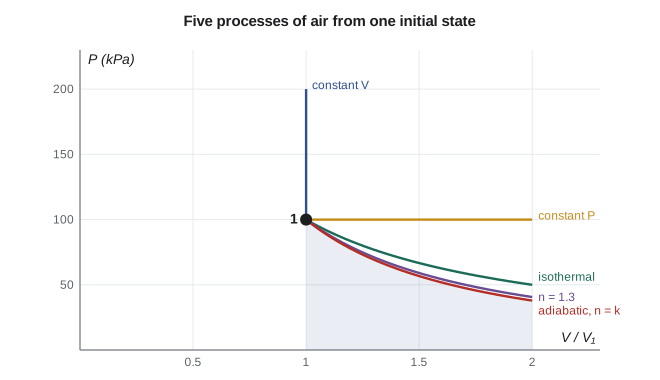
For an ideal gas, \(\Delta u = c_v\Delta T\) for any process, so closed-system problems reduce to finding the end temperatures and the boundary work. The program below takes 0.10 kg of air at 100 kPa and 300 K through five different processes, four of which double its volume, and applies the first law to each.
# First law for a closed system: Q - W = dU, for air (ideal gas, constant specific heats)
import math
R, cv = 0.287, 0.718                     # kJ/(kg.K)
m, P1, T1 = 0.10, 100.0, 300.0           # kg, kPa, K
V1 = m * R * T1 / P1                     # m3

def report(name, P2, V2, W):
    T2 = P2 * V2 / (m * R)
    dU = m * cv * (T2 - T1)
    Q = dU + W                           # first law: Q - W = dU
    print(f"{name:22s} T2 = {T2:6.1f} K  W = {W:7.3f} kJ  dU = {dU:7.3f} kJ  Q = {Q:7.3f} kJ")

print(f"initial state: P1 = {P1} kPa, T1 = {T1} K, V1 = {V1:.5f} m3")
V2 = 2 * V1                                            # expansions to double the volume
report("constant pressure", P1, V2, P1 * (V2 - V1))
report("isothermal", P1 * V1 / V2, V2, P1 * V1 * math.log(V2 / V1))
n = 1.3
P2 = P1 * (V1 / V2)**n
report("polytropic n = 1.3", P2, V2, (P2 * V2 - P1 * V1) / (1 - n))
k = 1.4
P2 = P1 * (V1 / V2)**k
report("adiabatic n = k = 1.4", P2, V2, (P2 * V2 - P1 * V1) / (1 - k))
report("constant volume, P x2", 2 * P1, V1, 0.0)initial state: P1 = 100.0 kPa, T1 = 300.0 K, V1 = 0.08610 m3 constant pressure T2 = 600.0 K W = 8.610 kJ dU = 21.540 kJ Q = 30.150 kJ isothermal T2 = 300.0 K W = 5.968 kJ dU = 0.000 kJ Q = 5.968 kJ polytropic n = 1.3 T2 = 243.7 K W = 5.388 kJ dU = -4.044 kJ Q = 1.344 kJ adiabatic n = k = 1.4 T2 = 227.4 K W = 5.212 kJ dU = -5.216 kJ Q = -0.004 kJ constant volume, P x2 T2 = 600.0 K W = 0.000 kJ dU = 21.540 kJ Q = 21.540 kJ
Several lessons hide in this table. At constant pressure the air does 8.6 kJ of work but needs 30.2 kJ of heat, because its temperature doubles. In the isothermal expansion all the heat added leaves as work, since \(\Delta U = 0\). In the adiabatic expansion the work comes entirely from the internal energy, so the temperature falls to 227 K; the tiny nonzero \(Q\) is a rounding effect, because the table value \(c_v = 0.718\) is not exactly \(R/(k - 1) = 0.7175\). The polytropic expansion with \(n = 1.3\) lies between: some heat enters, but not enough to keep the temperature up. And heating at constant volume raises the temperature as much as constant-pressure heating does, with 29 percent less heat, because no work is done.
These results show why \(c_p\) exceeds \(c_v\). Raising 0.10 kg of air by 300 K took 30.15 kJ at constant pressure and 21.54 kJ at constant volume. Dividing by \(m\Delta T = 30\) gives 1.005 and 0.718 kJ/(kg·K): exactly the tabulated \(c_p\) and \(c_v\).
Work that is not boundary work
Paddle wheels, electric heaters and other devices can transfer energy as work even when the boundary does not move. Such work is always done on the system, never by it; you cannot run a paddle wheel backwards by cooling the water. That one-way character is an early hint of the second law.
Worked problem
Restarting the deaerator
After a maintenance shutdown, the insulated deaerator storage tank holds 18,000 kg of water at 15 °C. Two electric immersion heaters, each rated at 60 kW, are switched on to warm it before steam is admitted, and a circulation pump adds 7.5 kW of work through friction. How long does it take to reach 60 °C if the tank loses 4 kW through its insulation? Take \(c = 4.18\ \text{kJ/(kg·K)}\).
Show solution
- System: the water in the tank (closed, rigid, at nearly constant pressure). Energy enters as electrical and pump work; energy leaves as heat loss.
- Rate form: \(\dot{W}_{e,\text{in}} + \dot{W}_{\text{pump,in}} - \dot{Q}_{\text{out}} = 120 + 7.5 - 4 = 123.5\ \text{kW} = dU/dt\).
- Energy needed: \(\Delta U = mc\Delta T = 18{,}000(4.18)(45) = 3.386 \times 10^6\ \text{kJ}\).
- Time: \(\Delta t = 3.386 \times 10^6/123.5 = 27{,}400\ \text{s} = 7.6\ \text{h}\).
Answer: Nearly eight hours. That is why the plant admits low-pressure steam to the deaerator as soon as one boiler is available: condensing steam can deliver several megawatts, and the restart then takes minutes. The heaters are kept for freeze protection and for the rare cold start with no steam at all.
Specific heats of liquids in closed systems
For incompressible substances, \(\Delta U = mc\Delta T\), and because the volume barely changes, boundary work is negligible. Heating or cooling a liquid or a solid therefore needs heat (or non-boundary work) equal to \(mc\Delta T\). The same relation governs how long a cold boiler takes to warm up: its 40 tonnes of steel, with \(c = 0.46\ \text{kJ/(kg·K)}\), need 18,400 kJ per degree, in addition to the water inside. Warming steel too fast causes thermal stresses, so start-up rates are limited by the boiler manufacturer, typically to a few degrees per minute.
Common pitfalls
Most errors in closed-system problems come from three sources. The first is using the wrong property: enthalpy where internal energy is needed, or vice versa. In a closed system, the energy stored is \(U\); enthalpy appears only because constant-pressure boundary work combines neatly with it. The second is forgetting boundary work when the volume changes, or including it when the volume is fixed. The third is sign confusion. Writing the balance with explicit in and out terms and positive magnitudes, then checking whether the system's energy should rise or fall, catches almost all of them.
Common mistakes
MistakeUsing h instead of u for a rigid tank.
InsteadIn a closed rigid system, Q = m(u₂ − u₁); use h only for constant-pressure processes.
MistakeForgetting boundary work when a piston moves.
InsteadEvaluate W_b = ∫P dV along the actual path.
MistakeAssuming an adiabatic process is isothermal.
InsteadIn an adiabatic expansion the work comes from internal energy, so T falls.
MistakeTreating paddle-wheel or heater work as heat.
InsteadEnergy crossing the boundary as shaft or electrical work is work, even if it heats the system.
MistakeApplying Q = mc_pΔT to an ideal gas in a rigid tank.
InsteadAt constant volume, Q = mc_vΔT.
Summary and key terms
- First law: E_in − E_out = ΔE_system; for a closed system, Q − W = ΔU + ΔKE + ΔPE.
- For a cycle, ΔE = 0 and the net heat equals the net work.
- In a rigid tank with no other work, Q = m(u₂ − u₁).
- In a constant-pressure process with only boundary work, Q = m(h₂ − h₁).
- For ideal gases, Δu = c_vΔT for any process; boundary work depends on the path.
- Shaft and electrical work can only be done on a closed system with a fixed boundary.
- For liquids and solids, ΔU = mcΔT.
- First law of thermodynamics
- Energy is conserved: it can change form but cannot be created or destroyed.
- Energy balance
- The net energy transferred to a system equals the change in its total energy.
- Closed-system energy balance
- Q − W = ΔU + ΔKE + ΔPE.
- Cycle
- A series of processes that returns a system to its initial state.
- Rigid tank
- A closed system of fixed volume, in which no boundary work is done.
- Isothermal process
- A process at constant temperature.
- Paddle-wheel work
- Shaft work done on a fluid by a rotating stirrer.
Practice problems
Work each problem on paper first, then reveal the answer to check.
A rigid tank holds 3 kg of air at 300 K. How much heat raises it to 400 K?
Show answer
215 kJ, with c_v = 0.718.
0.5 kg of saturated liquid water at 400 kPa is heated at constant pressure to saturated vapour. Find Q (h_fg = 2133.4 kJ/kg).
Show answer
1067 kJ.
Air expands isothermally from 600 kPa to 100 kPa. Per kilogram at 350 K, find w and q.
Show answer
w = q = 180 kJ/kg.
A gas loses 40 kJ of heat while 25 kJ of work is done on it. What is ΔU?
Show answer
−15 kJ.
A cycle receives 500 kJ of heat and rejects 320 kJ. What is its net work?
Show answer
180 kJ.
In the program, change the polytropic exponent to 1.2. Does heat flow in or out?
Show answer
In: Q = 2.8 kJ, with T₂ = 261 K.
Lesson quiz · 5 questions
Score 60% or more to complete this lesson.
Create a free account to save your progress, take quizzes and earn a certificate.