
PET-230 · Lesson 3 of 12 · 27 min
Pure substances, phase change and saturation
Water is the working fluid of the Northgate plant. It enters the boilers as liquid at about 105 °C, leaves as superheated steam at 400 °C, gives up its energy in the turbine and the building heat exchangers, condenses, and comes back as liquid. Most of the energy it carries is stored and released not by changing temperature but by changing phase: it takes about 2,000 kJ to turn a kilogram of boiling water into steam at the main's pressure, against about 4.2 kJ to warm it by one degree. To analyze any of this, we need to understand how a pure substance behaves as it passes between liquid and vapour, and how to describe a state when both phases are present at once.
Pure substances and phases
A pure substance has a fixed chemical composition throughout. Water is a pure substance, whether it is liquid, vapour, ice, or a mixture of liquid and vapour, because every part has the same composition. Air is a mixture of gases, but as long as it does not condense it can be treated as a pure substance too; liquid air in equilibrium with vapour cannot, because the liquid and vapour have different compositions.
A substance can exist in different phases: solid, liquid and gas, each with a distinct molecular structure and uniform throughout. In a solid the molecules are held in a lattice by strong forces and only vibrate. In a liquid they stay close together but move past one another. In a gas they are far apart and move almost freely, colliding occasionally. Changing phase means overcoming or establishing these intermolecular forces, which is why it takes so much energy. The term vapour is used for a gas that is not far from condensing; superheated steam in the main is a vapour, and so, by convention, is all steam.
Boiling at constant pressure
Imagine heating 1 kg of water in a piston-cylinder device that keeps the pressure constant at 1 MPa, the pressure of the district main. The heating curve below follows the water through five stages.
At first the water is a compressed liquid, or subcooled liquid: liquid that is not about to vaporize. Its temperature rises steadily as heat is added, and its volume increases only slightly. At 179.9 °C it becomes a saturated liquid: liquid on the point of vaporizing, so that any further heat starts to boil it. As heating continues, vapour forms and the cylinder holds a saturated liquid-vapour mixture. Throughout this stage the temperature stays at 179.9 °C, and all the heat goes into breaking molecules free of the liquid. The volume grows enormously, because a kilogram of vapour at this pressure occupies about 170 times as much space as a kilogram of liquid. When the last drop vaporizes, the water is a saturated vapour: vapour on the point of condensing. Further heating raises its temperature again, and it becomes superheated vapour, the condition of the steam leaving the boilers.
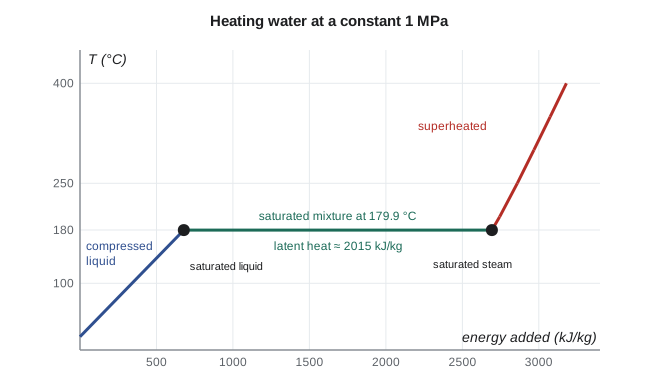
Reverse the process by cooling, and everything happens in the opposite order: the superheated vapour cools, condenses at 179.9 °C, and the liquid then cools below that temperature. This is what happens in each building's heat exchanger, where steam from the main condenses on the outside of tubes carrying the building's hot water. The energy released by condensation is the latent heat that heats the building.
Saturation temperature and pressure
The temperature at which a pure substance changes phase depends on the pressure. At a given pressure, the temperature at which it boils is the saturation temperature \(T_{\text{sat}}\); at a given temperature, the pressure at which it boils is the saturation pressure \(P_{\text{sat}}\). At one standard atmosphere, 101.325 kPa, water boils at 99.97 °C. At 1 MPa it boils at 179.9 °C, and at 4 MPa, the boiler pressure, at 250.4 °C. At 10 kPa, the pressure in the condenser of a large power station, it boils at only 45.8 °C.
The dependence of boiling point on pressure is everyday experience once you look for it. Water boils at about 95 °C in Banff, where the air pressure is lower, so food takes longer to cook. A pressure cooker raises the pressure to about 200 kPa and the boiling point to about 120 °C. The deaerator at Northgate holds a slight positive pressure, about 120 kPa absolute, so that its water is at about 105 °C and boils gently; dissolved oxygen and carbon dioxide, which would corrode the boiler, are driven out with the vented steam.
Energy absorbed during vaporization at constant pressure is the latent heat of vaporization, or enthalpy of vaporization \(h_{fg}\). It falls as pressure rises: 2,257 kJ/kg at one atmosphere, 2,015 kJ/kg at 1 MPa, 1,713 kJ/kg at 4 MPa, and zero at the critical point. The energy absorbed during melting is the latent heat of fusion, about 333.7 kJ/kg for ice at one atmosphere.
Property diagrams
Plotting many constant-pressure heating processes on a temperature-specific volume (T-v) diagram reveals the structure of the whole substance. Each process traces a line that rises through the liquid region, runs horizontally across the two-phase region, and rises again in the vapour region. Joining the saturated-liquid points gives the saturated liquid line, and joining the saturated-vapour points gives the saturated vapour line. Together they form a dome. To the left of the dome lies the compressed-liquid region, to the right the superheated-vapour region, and under the dome the saturated liquid-vapour mixture region.
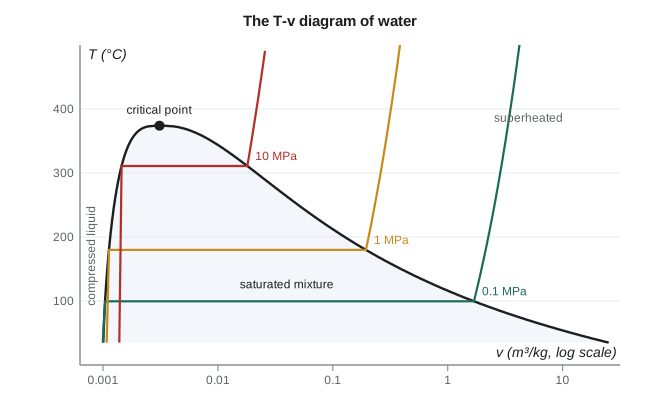
As pressure rises, the horizontal boiling segments get shorter, because the saturated liquid expands and the saturated vapour gets denser. At one pressure they shrink to a point: the critical point, where saturated liquid and saturated vapour become identical. For water it lies at 22.064 MPa and 373.95 °C, with a specific volume of 0.003106 m³/kg. Above the critical pressure there is no distinct boiling process: a substance heated at constant pressure changes gradually from liquid-like to vapour-like without ever forming two phases. Some large power stations run their boilers above this pressure, in what is called a supercritical cycle.
The pressure-specific volume (P-v) diagram looks similar, with the dome in the same place, but lines of constant temperature now slope downward through it. The pressure-temperature (P-T) diagram, called the phase diagram, shows the three single-phase regions separated by three lines: the sublimation line between solid and vapour, the fusion (melting) line between solid and liquid, and the vaporization line between liquid and vapour. The vaporization line ends at the critical point. All three meet at the triple point, where solid, liquid and vapour coexist in equilibrium; for water it lies at 0.01 °C and 0.6117 kPa. Water is unusual in that its fusion line slopes slightly backward, because ice is less dense than liquid water, which is why ice floats and why pipes burst when they freeze.
The saturation line on the phase diagram is the relation between \(P_{\text{sat}}\) and \(T_{\text{sat}}\). For water it is known very precisely, and the International Association for the Properties of Water and Steam (IAPWS) publishes equations that reproduce it, together with the properties of saturated liquid and vapour, to a few parts in ten thousand. The program below uses one of these sets of equations to compute a small saturation table, the same kind of numbers found in the steam tables at the back of every thermodynamics text.
# Saturation properties of water from the IAPWS auxiliary equations (Wagner and Pruss)
import math

Tc, pc, rhoc = 647.096, 22064.0, 322.0           # critical point: K, kPa, kg/m3
A = [(-7.85951783, 1), (1.84408259, 1.5), (-11.7866497, 3), (22.6807411, 3.5),
     (-15.9618719, 4), (1.80122502, 7.5)]
B = [(1.99274064, 1/3), (1.09965342, 2/3), (-0.510839303, 5/3), (-1.75493479, 16/3),
     (-45.5170352, 43/3), (-6.74694450e5, 110/3)]
C = [(-2.03150240, 2/6), (-2.68302940, 4/6), (-5.38626492, 8/6), (-17.2991605, 18/6),
     (-44.7586581, 37/6), (-63.9201063, 71/6)]
D = [-5.65134998e-8, 2690.66631, 127.287297, -135.003439, 0.981825814]

def p_sat(T):
    t = 1 - T / Tc
    return pc * math.exp(Tc / T * sum(a * t**e for a, e in A))

def dpdT(T):
    t = 1 - T / Tc
    S = sum(a * t**e for a, e in A)
    dS = sum(-a * e * t**(e - 1) / Tc for a, e in A)
    return p_sat(T) * (-Tc / T**2 * S + Tc / T * dS)

def T_sat(p):
    lo, hi = 273.16, Tc - 1e-9                   # bisection: p_sat rises with T
    for _ in range(80):
        mid = (lo + hi) / 2
        lo, hi = (mid, hi) if p_sat(mid) < p else (lo, mid)
    return (lo + hi) / 2

def saturation(T):
    """Return P (kPa), vf, vg (m3/kg), hf, hg (kJ/kg), sf, sg (kJ/kg.K) at T (K)."""
    t, th = 1 - T / Tc, T / Tc
    rf = rhoc * (1 + sum(b * t**e for b, e in B))
    rg = rhoc * math.exp(sum(c * t**e for c, e in C))
    alpha = (-1135.905627715 + D[0] * th**-19 + D[1] * th + D[2] * th**4.5
             + D[3] * th**5 + D[4] * th**54.5)
    phi = (2319.5246 + 19 / 20 * D[0] * th**-20 + D[1] * math.log(th) + 9 / 7 * D[2] * th**3.5
           + 5 / 4 * D[3] * th**4 + 109 / 107 * D[4] * th**53.5) / Tc
    dp = dpdT(T)
    return p_sat(T), 1 / rf, 1 / rg, alpha + T / rf * dp, alpha + T / rg * dp, phi + dp / rf, phi + dp / rg

print(f"{'P kPa':>7s} {'Tsat C':>7s} {'vf m3/kg':>9s} {'vg m3/kg':>9s} {'hf':>7s} {'hfg':>7s} {'hg':>7s}")
for p in (10, 100, 101.325, 400, 1000, 4000, 10000):
    T = T_sat(p)
    P, vf, vg, hf, hg, sf, sg = saturation(T)
    print(f"{p:7.1f} {T - 273.15:7.2f} {vf:9.6f} {vg:9.4f} {hf:7.1f} {hg - hf:7.1f} {hg:7.1f}")

# Quality of a wet mixture in the district main: 1 MPa, specific volume 0.180 m3/kg
P, vf, vg, hf, hg, sf, sg = saturation(T_sat(1000))
v = 0.180
x = (v - vf) / (vg - vf)
print(f"\nat 1 MPa, v = {v} m3/kg: x = {x:.4f}, h = {hf + x * (hg - hf):.1f} kJ/kg")P kPa Tsat C vf m3/kg vg m3/kg hf hfg hg 10.0 45.81 0.001010 14.6700 191.8 2392.1 2583.9 100.0 99.61 0.001043 1.6941 417.5 2257.6 2675.1 101.3 99.97 0.001043 1.6734 419.1 2256.7 2675.7 400.0 143.61 0.001084 0.4624 604.6 2133.6 2738.2 1000.0 179.88 0.001127 0.1944 762.4 2014.7 2777.1 4000.0 250.35 0.001252 0.0498 1087.3 1713.4 2800.7 10000.0 311.00 0.001452 0.0180 1407.8 1317.3 2725.2 at 1 MPa, v = 0.18 m3/kg: x = 0.9257, h = 2627.3 kJ/kg
Compare the printed values with any published steam table: they agree to the last figure shown, apart from tiny differences near the critical point. Note how \(v_g\) falls from 14.67 m³/kg at 10 kPa to 0.018 m³/kg at 10 MPa, while \(v_f\) barely changes, and how \(h_g\) peaks at around 3 MPa and then falls. That peak is one reason boiler designers superheat the steam, rather than send saturated steam to a turbine.
Saturated mixtures and quality
Under the dome, pressure and temperature are not independent: specifying 1 MPa fixes the temperature at 179.9 °C, and vice versa. To fix the state we need a second property that tells us how far the boiling has progressed. That property is the quality \(x\), the mass fraction of vapour in the mixture.
Quality ranges from 0 for saturated liquid to 1 for saturated vapour, and it has meaning only under the dome. In a saturated mixture, the liquid is always saturated liquid and the vapour always saturated vapour, at the same temperature and pressure. The mixture's properties are therefore mass-weighted averages of the saturated values. For specific volume,
and the same form holds for internal energy, enthalpy and entropy: \(u = u_f + x u_{fg}\), \(h = h_f + x h_{fg}\), \(s = s_f + x s_{fg}\). The subscript \(fg\) denotes the difference between saturated vapour and saturated liquid values. Graphically, the quality is the fraction of the horizontal line under the dome that lies to the left of the state point, which is why this relation is sometimes called the lever rule.
Worked problem
Quality of steam in the district main
A sample of steam drawn from a long, poorly drained section of the district main at 1 MPa has a specific volume of 0.180 m³/kg. Is it superheated, saturated or wet? Find its quality and enthalpy. At 1 MPa: \(v_f = 0.001127\), \(v_g = 0.19436\ \text{m}^3/\text{kg}\), \(h_f = 762.5\), \(h_{fg} = 2014.6\ \text{kJ/kg}\).
Show solution
- Compare with the saturation values: \(v_f < 0.180 < v_g\), so the state lies under the dome. The steam is a wet mixture at 179.9 °C.
- \[x = \frac{v - v_f}{v_g - v_f} = \frac{0.180 - 0.001127}{0.19436 - 0.001127} = \frac{0.17887}{0.19323} = 0.926\]
- Enthalpy: \(h = h_f + x h_{fg} = 762.5 + 0.926(2014.6) = 2627\ \text{kJ/kg}\).
Answer: The steam is about 92.6 percent vapour by mass, so each kilogram carries about 74 g of water droplets. Wet steam erodes valves, causes water hammer and delivers less energy per kilogram than dry steam, which is why the main has steam traps at every low point to drain condensate. Graham's crew found a failed trap at this location the following week.
To locate any state in practice, compare a given property with the saturation values at the given pressure or temperature. If a temperature is below \(T_{\text{sat}}\) at the given pressure (or a pressure above \(P_{\text{sat}}\) at the given temperature), the substance is a compressed liquid. If it is above \(T_{\text{sat}}\), it is superheated. If a property such as \(v\), \(h\) or \(s\) lies between its \(f\) and \(g\) values, the state is a mixture, and the quality follows from the lever rule. This decision is the first step of nearly every problem in the course, and Lesson 4 turns it into a routine.
Worked problem
Water heated in a rigid tank
A sealed 0.050 m³ rigid vessel, used to test pressure-relief valves, contains 2.0 kg of water at 100 kPa. It is heated until the pressure reaches 1 MPa. What is the initial quality, and what is the state at the end?
Show solution
- Specific volume, constant throughout because the tank is rigid and sealed: \(v = 0.050/2.0 = 0.025\ \text{m}^3/\text{kg}\).
- At 100 kPa, \(v_f = 0.001043\) and \(v_g = 1.6941\): the water is a mixture with \(x_1 = (0.025 - 0.001043)/1.6931 = 0.0141\). Most of the mass is liquid; the vapour fills most of the volume.
- At 1 MPa, \(v_g = 0.19436\). Since \(0.025 < v_g\), the state is still under the dome: \(x_2 = (0.025 - 0.001127)/0.19323 = 0.124\), at 179.9 °C.
Answer: Heating a rigid tank moves the state vertically on the T-v diagram. Because this tank's specific volume (0.025 m³/kg) is larger than the critical value (0.0031 m³/kg), continued heating would eventually vaporize all the liquid; a tank with a smaller specific volume would instead fill with liquid, as the liquid expands and the vapour condenses, a dangerous situation if the tank has no relief valve.
Why the plant cares
Phase change is how the plant moves large amounts of energy with small flows. A kilogram of steam at 1 MPa condensing in a building heat exchanger releases about 2,000 kJ; the same kilogram of hot water cooled from 90 °C to 70 °C releases only 84 kJ. That is why older district systems, like Northgate's, distribute steam. Newer systems often prefer hot water at lower temperatures, which loses less heat from the pipes and can use waste heat and heat pumps, at the cost of much larger flows and pipe sizes. Northgate's own plan is to convert its system to hot water over the next fifteen years, and many later lessons will touch on what that change means thermodynamically.
Common mistakes
MistakeAssuming water always boils at 100 °C.
InsteadBoiling temperature depends on pressure: 179.9 °C at 1 MPa, 45.8 °C at 10 kPa.
MistakeUsing pressure and temperature to fix a state under the dome.
InsteadIn a mixture they are dependent; you need a second property such as quality or specific volume.
MistakeDefining quality as a volume fraction.
InsteadQuality is the mass fraction of vapour.
MistakeApplying quality to a superheated vapour or compressed liquid.
InsteadQuality has meaning only for saturated mixtures, 0 ≤ x ≤ 1.
MistakeThinking the critical point is just a very high boiling point.
InsteadAbove the critical pressure there is no distinct phase change at all.
Summary and key terms
- A pure substance has a uniform, fixed chemical composition, in one phase or more.
- Heating at constant pressure takes a liquid from compressed to saturated liquid, through a saturated mixture at constant temperature, to saturated and then superheated vapour.
- Saturation temperature and pressure are linked: each pressure has one boiling temperature.
- The latent heat of vaporization h_fg falls with pressure and vanishes at the critical point (22.064 MPa, 373.95 °C for water).
- On T-v and P-v diagrams the saturated liquid and vapour lines form a dome; the phase diagram shows the triple point and critical point.
- Quality x is the vapour mass fraction; mixture properties follow y = y_f + x y_fg.
- Locate a state by comparing a given property with its saturation values.
- Pure substance
- A substance with a fixed and uniform chemical composition.
- Compressed liquid
- Liquid below its saturation temperature at the given pressure; not about to vaporize.
- Saturated liquid
- Liquid on the point of vaporizing.
- Saturated vapour
- Vapour on the point of condensing.
- Superheated vapour
- Vapour above its saturation temperature at the given pressure.
- Saturation temperature
- The temperature at which a pure substance changes phase at a given pressure.
- Latent heat of vaporization
- The energy needed to vaporize a unit mass of saturated liquid at constant pressure, h_fg.
- Critical point
- The state at which saturated liquid and saturated vapour become identical.
- Triple point
- The state at which solid, liquid and vapour phases coexist in equilibrium.
- Quality
- The mass fraction of vapour in a saturated liquid-vapour mixture.
- Phase diagram
- A pressure-temperature diagram showing the regions of solid, liquid and vapour.
Practice problems
Work each problem on paper first, then reveal the answer to check.
What is the saturation temperature of water at 400 kPa?
Show answer
143.6 °C.
A mixture of water at 200 kPa has a quality of 0.85. Find its specific volume and enthalpy (v_f = 0.001061, v_g = 0.88578, h_f = 504.7, h_fg = 2201.6).
Show answer
v = 0.753 m³/kg; h = 2376 kJ/kg.
Water at 1 MPa and 150 °C: what phase?
Show answer
Compressed liquid, since 150 °C is below T_sat = 179.9 °C.
Steam at 4 MPa has a specific volume of 0.060 m³/kg. Is it wet or superheated?
Show answer
Superheated, since v > v_g = 0.0498 m³/kg.
Why does a pressure cooker cook faster than an open pot?
Show answer
Its higher pressure raises the boiling temperature to about 120 °C.
Use the program to find T_sat at 2 MPa and 15 MPa.
Show answer
About 212.4 °C and 342.2 °C.
Lesson quiz · 5 questions
Score 60% or more to complete this lesson.
Create a free account to save your progress, take quizzes and earn a certificate.