
PET-230 · Lesson 5 of 12 · 25 min
Ideal gases, real gases and specific heats
Steam tables are indispensable for water, but many of the fluids at Northgate are gases far from condensing: combustion air drawn into the boiler burners, the flue gas leaving the stacks, natural gas arriving through the utility's supply line, and the compressed air in the instrument-air receiver. For these, a single simple equation relates pressure, volume and temperature with good accuracy, and internal energy and enthalpy depend on temperature alone. This lesson develops the ideal-gas model, shows when it fails and how to correct it, and introduces the specific heats that link energy to temperature for gases, liquids and solids.
The ideal-gas equation of state
An equation of state relates the pressure, temperature and specific volume of a substance. The simplest and best known is the ideal-gas equation, which grew out of the experiments of Boyle, Charles and Gay-Lussac: at low density, the pressure of a gas is proportional to its absolute temperature and inversely proportional to its specific volume.
Here \(R\) is the gas constant of the particular gas, \(m\) its mass, \(N\) the number of moles, and \(R_u = 8.314\ \text{kJ/(kmol·K)}\) the universal gas constant, the same for all gases. The two are related through the molar mass \(M\): \(R = R_u/M\). For air, \(M = 28.97\ \text{kg/kmol}\) and \(R = 0.287\ \text{kJ/(kg·K)}\); for methane, the main component of natural gas, \(M = 16.04\) and \(R = 0.5183\); for steam, \(M = 18.02\) and \(R = 0.4615\). Pressure must be absolute and temperature in kelvins. With pressure in kPa and volume in m³, \(PV\) comes out in kJ, which matches \(R\) in kJ/(kg·K).
A convenient consequence: for a fixed mass of ideal gas, \(P_1V_1/T_1 = P_2V_2/T_2\). This combined gas law lets us find a third property after a change in two others, without knowing the gas constant at all.
Worked problem
The instrument-air receiver
Northgate's instrument-air receiver is a 2.0 m³ tank charged to 800 kPa gauge at 25 °C, with the barometer at 99.0 kPa. How much air does it hold? Overnight, with the compressor off and no draw on the system, the compressor room cools to 10 °C. What does the gauge read in the morning?
Show solution
- Absolute pressure: \(P_1 = 800 + 99 = 899\ \text{kPa}\); \(T_1 = 298.15\ \text{K}\).
- \[m = \frac{P_1V}{RT_1} = \frac{899(2.0)}{0.287(298.15)} = 21.0\ \text{kg}\]
- Rigid tank, fixed mass, so \(P_2/T_2 = P_1/T_1\): \(P_2 = 899(283.15/298.15) = 854\ \text{kPa}\) absolute, or 755 kPa gauge.
Answer: A 15 °C drop in temperature lowers the gauge reading by 45 kPa without any leak. Graham's crew once spent an hour chasing a phantom leak on a cold morning before Elena pointed this out; the fix was to compare readings at the same temperature, or to correct them with the ideal-gas law.
When is a gas ideal?
The ideal-gas model assumes the molecules occupy negligible volume and exert no forces on one another except during collisions. Both assumptions hold well when the gas is at low density, that is, at low pressure or high temperature compared with its critical values. Air at room conditions, at a pressure far below its critical pressure of about 3.8 MPa and a temperature far above its critical temperature of about 133 K, is ideal to within a fraction of a percent. Combustion gases in the boiler stack, at high temperature and atmospheric pressure, are also nearly ideal.
Steam is a different matter. Close to the saturated vapour line, or at high pressures, the ideal-gas equation can be wrong by many percent; at 4 MPa and 400 °C the error in specific volume is about 6 percent, and near the critical point it can exceed 100 percent. At low pressures, below about 10 kPa, steam is ideal to better than 0.1 percent at any temperature, which is why water vapour in the atmosphere can be treated as an ideal gas in air-conditioning calculations. For steam in power plants and district systems, always use the steam tables or software.
The compressibility factor
The deviation from ideal-gas behaviour is measured by the compressibility factor \(Z\), defined as
For an ideal gas \(Z = 1\). For real gases \(Z\) can be smaller than 1, when attractive forces between molecules pull them closer than in an ideal gas, or larger than 1, at very high pressures where the molecules' own volume dominates. Remarkably, when pressure and temperature are expressed as fractions of their critical values, as reduced pressure \(P_R = P/P_{cr}\) and reduced temperature \(T_R = T/T_{cr}\), the compressibility factor of all gases is approximately the same function of \(P_R\) and \(T_R\). This principle of corresponding states lets one generalized compressibility chart serve for any gas.
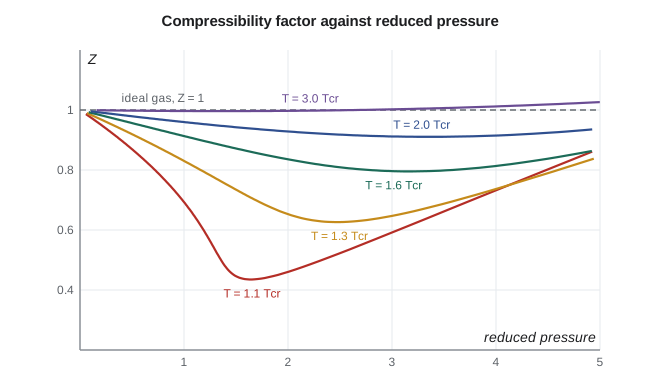
The chart gives three useful rules. At very low reduced pressure, \(P_R \ll 1\), gases behave ideally whatever the temperature. At high reduced temperature, \(T_R > 2\), the ideal-gas model is good up to fairly high pressures, \(P_R\) of about 4. The largest deviations occur near the critical point, \(P_R \approx 1\) and \(T_R \approx 1\). For methane at 15 °C, \(T_R = 288/190.6 = 1.51\); in the utility's transmission main at 5 MPa, \(P_R = 1.09\), and the generalized chart gives \(Z \approx 0.89\), an 11 percent deviation that the gas company must account for when it bills by volume.
Other equations of state
Many equations of state improve on the ideal-gas law. The first and simplest was proposed by van der Waals in 1873:
The term \(a/v^2\) accounts for intermolecular attraction, and \(b\) for the volume occupied by the molecules. The constants follow from the requirement that the critical isotherm has a horizontal inflection at the critical point. Van der Waals' equation captures the qualitative behaviour of real gases, including condensation, but it is not very accurate. Later equations, such as Redlich-Kwong, Peng-Robinson and the many-constant Benedict-Webb-Rubin equation, are far better and are used in process simulation software and in the natural-gas industry.
The program below compares the ideal-gas and van der Waals specific volumes for methane at 15 °C over a range of pipeline pressures. At 100 kPa they agree within 0.2 percent; at 5 MPa van der Waals gives \(Z = 0.887\), close to the chart value; at 10 MPa it gives 0.786, rather lower than the chart's 0.83, illustrating that the simple equation exaggerates the deviation at high pressure. It also repeats the air-receiver calculation.
# Ideal gas versus van der Waals for natural gas (taken as methane) in the plant's supply line
Ru = 8.314                          # kJ/(kmol.K)
M = 16.04                           # kg/kmol, methane
R = Ru / M                          # kJ/(kg.K)
Tc, Pc = 190.6, 4599.0              # K, kPa
a = 27 * R**2 * Tc**2 / (64 * Pc)   # van der Waals constants on a mass basis
b = R * Tc / (8 * Pc)

def v_vdw(P, T):
    """Solve P = RT/(v - b) - a/v^2 for the gas-like root by Newton's method."""
    v = R * T / P
    for _ in range(50):
        f = R * T / (v - b) - a / v**2 - P
        df = -R * T / (v - b)**2 + 2 * a / v**3
        v -= f / df
    return v

T = 288.15                          # K (15 C)
print(f"R = {R:.4f} kJ/kg.K, a = {a:.4f} kPa.m6/kg2, b = {b:.6f} m3/kg")
print(f"{'P kPa':>7s} {'v ideal':>9s} {'v vdW':>9s} {'Z = Pv/RT':>10s}")
for P in (100, 400, 2000, 5000, 10000):
    v = v_vdw(P, T)
    print(f"{P:7d} {R * T / P:9.5f} {v:9.5f} {P * v / (R * T):10.4f}")

# Mass of air in the instrument-air receiver: 2.0 m3 at 800 kPa gauge, 25 C
Rair, Patm = 0.287, 99.0
P, V, Tair = 800 + Patm, 2.0, 298.15
m = P * V / (Rair * Tair)
print(f"\nair receiver: m = {m:.2f} kg at {P:.0f} kPa abs")
# Pressure after the room cools the air to 10 C (rigid tank, same mass)
print(f"cooled to 10 C: P = {m * Rair * 283.15 / V:.0f} kPa abs")R = 0.5183 kJ/kg.K, a = 0.8953 kPa.m6/kg2, b = 0.002685 m3/kg
P kPa v ideal v vdW Z = Pv/RT
100 1.49357 1.49025 0.9978
400 0.37339 0.37007 0.9911
2000 0.07468 0.07132 0.9551
5000 0.02987 0.02648 0.8865
10000 0.01494 0.01174 0.7859
air receiver: m = 21.01 kg at 899 kPa abs
cooled to 10 C: P = 854 kPa absSpecific heats
The specific heat is the energy needed to raise the temperature of a unit mass of a substance by one degree. Its value depends on how the heating is done. The specific heat at constant volume, \(c_v\), is the energy needed per degree when the volume is held fixed; the specific heat at constant pressure, \(c_p\), is the energy needed when the pressure is held fixed, so that the substance also does boundary work as it expands. Precisely, they are defined as partial derivatives of properties, which makes them properties too:
Because \(c_p\) includes the energy that goes into boundary work, it is always at least as large as \(c_v\). Both are in kJ/(kg·K), which is numerically the same as kJ/(kg·°C) because a kelvin and a Celsius degree are the same size.
Internal energy and enthalpy of ideal gases
Joule showed experimentally, and statistical mechanics confirms, that the internal energy of an ideal gas depends on temperature only. Since \(h = u + Pv = u + RT\), enthalpy also depends on temperature only. The partial derivatives above then become ordinary derivatives, and changes in \(u\) and \(h\) follow from integrating the specific heats over temperature. Over moderate temperature ranges, constant average values give good accuracy:
These relations hold for any process of an ideal gas, not only constant-volume or constant-pressure ones, because \(u\) and \(h\) are functions of temperature alone. That is a powerful simplification. Differentiating \(h = u + RT\) gives the relation between the two specific heats, and their ratio defines the specific heat ratio \(k\):
| Gas | R (kJ/kg·K) | c_p (kJ/kg·K) | c_v (kJ/kg·K) | k |
|---|---|---|---|---|
| Air | 0.2870 | 1.005 | 0.718 | 1.400 |
| Nitrogen | 0.2968 | 1.039 | 0.743 | 1.400 |
| Carbon dioxide | 0.1889 | 0.846 | 0.657 | 1.289 |
| Methane | 0.5183 | 2.254 | 1.735 | 1.299 |
| Steam (low pressure) | 0.4615 | 1.872 | 1.410 | 1.327 |
| Helium | 2.0769 | 5.193 | 3.116 | 1.667 |
Monatomic gases such as helium and argon have nearly constant specific heats with \(k = 5/3\). For diatomic and polyatomic gases the specific heats rise with temperature, as molecular rotation and vibration absorb more energy. For air, \(c_p\) rises from 1.005 kJ/(kg·K) at 300 K to about 1.14 at 1000 K. When temperature changes are large, as in the boiler furnace or a gas turbine, use variable specific heats from ideal-gas tables, which list \(h\) and \(u\) against temperature; for the modest changes in compressors and heat exchangers at Northgate, constant values at the average temperature are accurate to a percent or so.
Worked problem
Heating combustion air
Combustion air for boiler 2 is preheated from −20 °C to 180 °C in an air heater that recovers energy from the flue gas. The air flow is 14 kg/s. Find the rate of energy transfer to the air, using \(c_p = 1.01\ \text{kJ/(kg·K)}\), an average over the range.
Show solution
- The air flows at nearly constant pressure, so the heat transfer equals the enthalpy rise (Lesson 8 will justify this).
- \[\dot{Q} = \dot{m}\,c_p(T_2 - T_1) = 14(1.01)(180 - (-20)) = 2828\ \text{kW}\]
Answer: About 2.8 MW recovered from flue gas that would otherwise carry it up the stack. On the coldest winter mornings the air heater can make a difference of several percentage points in boiler efficiency.
Liquids and solids
Liquids and solids are nearly incompressible: their specific volumes change very little with pressure. For such substances \(c_p\) and \(c_v\) are essentially equal, and a single specific heat \(c\) is used. Internal energy depends almost entirely on temperature, \(\Delta u \approx c_{\text{avg}}\Delta T\). Enthalpy picks up a small pressure term:
For liquid water, \(c \approx 4.18\ \text{kJ/(kg·K)}\), and the pressure term is small unless the pressure change is large: raising water by 4 MPa in the feedwater pump adds \(v\Delta P \approx 0.00105(4000) = 4.2\ \text{kJ/kg}\), the same as a 1 °C temperature rise. That small number is the work needed per kilogram to pump water into a boiler, and Lesson 12 will show why it is so much smaller than the work a turbine extracts from the steam. For steel, \(c \approx 0.46\ \text{kJ/(kg·K)}\), which matters when estimating how long a cold boiler takes to warm up.
Common mistakes
MistakeUsing gauge pressure or Celsius in PV = mRT.
InsteadUse absolute pressure and kelvins.
MistakeApplying the ideal-gas law to steam near saturation or at high pressure.
InsteadUse steam tables; check Z or the reduced properties first.
MistakeUsing R_u where the gas constant R of a specific gas is needed.
InsteadR = R_u/M; for air, 0.287 kJ/(kg·K).
MistakeThinking Δu = c_v ΔT applies only at constant volume.
InsteadFor an ideal gas it applies to any process, since u depends on T only.
MistakeUsing constant room-temperature specific heats for a furnace or turbine.
InsteadUse average values or ideal-gas tables when temperature changes are large.
Summary and key terms
- The ideal-gas law is Pv = RT, with R = R_u/M and R_u = 8.314 kJ/(kmol·K).
- Gases are nearly ideal at low pressure or high temperature compared with their critical values.
- The compressibility factor Z = Pv/RT measures deviation; by corresponding states it depends mainly on P_R and T_R.
- Van der Waals and later equations of state correct for molecular attraction and size.
- c_v = (∂u/∂T)_v and c_p = (∂h/∂T)_p are properties.
- For ideal gases, u and h depend on T only; c_p = c_v + R, and k = c_p/c_v.
- For liquids and solids, c_p ≈ c_v = c, Δu ≈ cΔT and Δh ≈ cΔT + vΔP.
- Equation of state
- A relation between pressure, temperature and specific volume of a substance.
- Ideal gas
- A gas that obeys Pv = RT, with internal energy depending on temperature only.
- Universal gas constant
- R_u = 8.314 kJ/(kmol·K), the same for all gases.
- Compressibility factor
- Z = Pv/RT, the ratio of actual to ideal-gas specific volume.
- Reduced pressure
- Pressure divided by the critical pressure.
- Principle of corresponding states
- Gases at the same reduced pressure and temperature have about the same Z.
- Specific heat at constant volume
- c_v, the rate of change of u with T at constant v.
- Specific heat at constant pressure
- c_p, the rate of change of h with T at constant P.
- Specific heat ratio
- k = c_p/c_v; about 1.4 for air.
- Incompressible substance
- A substance whose specific volume is essentially constant, such as most liquids and solids.
Practice problems
Work each problem on paper first, then reveal the answer to check.
Find the density of air at 150 kPa and 40 °C.
Show answer
1.67 kg/m³.
A 0.5 m³ cylinder holds methane at 3 MPa and 20 °C. Find the mass assuming ideal-gas behaviour.
Show answer
9.87 kg (a real-gas correction with Z ≈ 0.94 would raise it to about 10.5 kg).
Find c_v for a gas with c_p = 1.10 kJ/(kg·K) and R = 0.30 kJ/(kg·K), and its k.
Show answer
c_v = 0.80 kJ/(kg·K); k = 1.375.
How much energy does it take to heat 2 kg of air from 20 °C to 220 °C at constant volume?
Show answer
About 287 kJ, with c_v = 0.718.
Water flows through a pump from 120 kPa to 4.2 MPa with no temperature change. Estimate Δh.
Show answer
About 4.3 kJ/kg, with v = 0.00105 m³/kg.
In the program, at what pressure does van der Waals predict Z = 0.95 for methane at 15 °C?
Show answer
About 2.2 MPa.
Lesson quiz · 5 questions
Score 60% or more to complete this lesson.
Create a free account to save your progress, take quizzes and earn a certificate.