
PET-210 · Lesson 4 of 12 · 20 min
Carbonate reservoir rocks
Below the Cardium sandstones lie older rocks of a completely different kind. Nadia shows Ethan a slab of Devonian limestone from the Leduc Formation, cut from a core taken decades ago. It is pale grey and full of holes, some the size of peas, lined with crystals. 'This is a reef,' she says. 'Not sand washed in from somewhere else, but rock that grew where it sits, built by organisms in a warm, shallow sea. The holes are where oil was.' Carbonate rocks, limestone and dolomite, hold roughly half of the world's conventional oil, including the largest fields in the Middle East, and they behave very differently from sandstones.
How carbonates form
Carbonate sediment is made mostly by living things. Corals, algae, mollusks, foraminifera and many other organisms build shells and skeletons of calcium carbonate from the calcium and bicarbonate dissolved in seawater. When they die, their remains become sediment, from whole shells and reef frameworks to fine lime mud made by algae and by the breakdown of larger grains. Some carbonate also precipitates directly from warm, saturated water as tiny spheres called ooids, which roll around in shallow tidal channels and grow layer by layer like snowballs.
Because organisms do most of the work, carbonate factories are most productive in warm, clear, shallow water with good light and little mud from rivers. Today they thrive in places like the Bahamas, the Persian Gulf and the Great Barrier Reef, mostly within about 30 degrees of the equator and in water less than about 20 metres deep. In the past, plate motions carried continents through these latitudes, which is why North America has thick carbonate sequences of Paleozoic age when it lay near the equator.
Carbonate sediment is produced where it accumulates, unlike sand, which may travel hundreds of kilometres. As a result, carbonate grains are often angular and poorly sorted, their sizes reflect the organisms that made them rather than the energy of the current, and their geometry follows the shape of the factory: reefs, banks, platforms and ramps. Where sea level falls, the platform is exposed to rain and fresh groundwater, which dissolves and recrystallizes the carbonate and can create or destroy porosity, as discussed below.
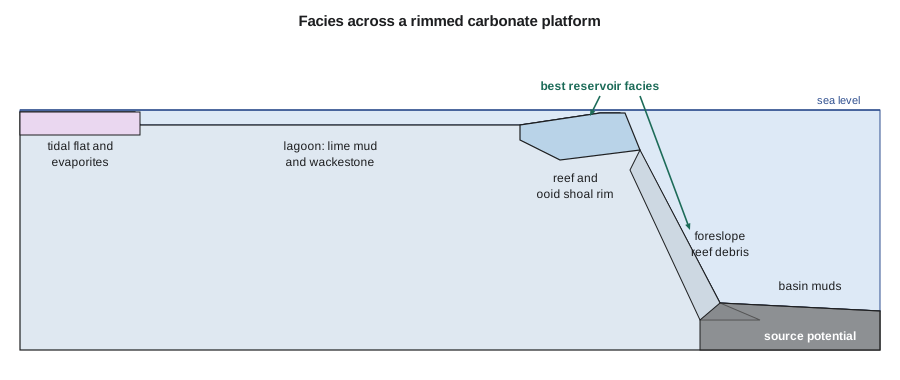
Carbonate rocks and their classification
Limestone is made of calcite, a form of calcium carbonate. Dolomite is calcium magnesium carbonate, CaMg(CO₃)₂, and usually forms when magnesium-rich water replaces the calcite of an existing limestone, a process called dolomitization. The two look similar, but dolomite does not fizz readily in dilute hydrochloric acid, which is the classic field test. Dolomites are especially important reservoirs because the replacement can create porosity and because dolomite resists compaction and pressure solution better than limestone.
The Dunham classification, used by most petroleum geologists, sorts carbonates by their depositional texture: whether the grains support each other or float in lime mud. A mudstone is mostly lime mud with few grains; a wackestone has more than 10 percent grains floating in mud; a packstone has grains touching each other with mud between them; a grainstone has touching grains and no mud, its spaces open or filled with cement. A boundstone is a rock whose components were bound together as they grew, such as a reef framework. In general, grainstones and boundstones have the best primary porosity, because high-energy water removed the mud, while mudstones and wackestones are tighter.
| Dunham class | Texture | Typical setting | Primary reservoir potential |
|---|---|---|---|
| Mudstone | Mud-supported, under 10 percent grains | Quiet lagoon or deep basin | Poor unless fractured or dolomitized |
| Wackestone | Mud-supported, over 10 percent grains | Low-energy shelf or lagoon | Generally poor |
| Packstone | Grain-supported with mud | Moderate energy | Moderate |
| Grainstone | Grain-supported, no mud | Ooid shoals, beaches, high-energy rims | Good to excellent |
| Boundstone | Organically bound framework | Reefs and mounds | Good to excellent, often with large pores |
Carbonate porosity
Carbonate pores are far more varied than sandstone pores. Primary pores include interparticle pores between grains, as in a sandstone, and intraparticle pores inside shells and corals. Secondary pores, formed after deposition, are often more important. Moldic pores form when grains such as shells or ooids dissolve and leave their shapes behind. Vugs are irregular cavities larger than the grains, made by dissolution. Intercrystalline pores lie between dolomite crystals. Fractures cut across everything. At the largest scale, dissolution by groundwater can open caves and collapse breccias, called karst, sometimes metres across.
Choquette and Pray divided carbonate porosity into fabric-selective types, which follow the rock's grains and crystals, such as interparticle, moldic and intercrystalline pores, and non-fabric-selective types, which cut across the fabric, such as vugs, channels, caves and fractures. The distinction matters because fabric-selective porosity can be mapped from facies, while non-fabric-selective porosity often cannot and must be found with logs, seismic or production behaviour.
The pore system strongly controls the porosity-permeability relationship. A grainstone with connected interparticle pores may have 15 percent porosity and 500 mD permeability. A moldic limestone with the same porosity may have only 1 mD, because the molds are isolated and connected only through tight matrix. A vuggy dolomite may show modest matrix porosity but enormous effective permeability through fractures and connected vugs. Lucia's petrophysical classes, based on particle size and pore type, group carbonates by their flow behaviour and are widely used to build carbonate reservoir models.
Dolomitization and diagenesis
Diagenesis is even more important in carbonates than in sandstones, because calcium carbonate dissolves and reprecipitates easily. Early marine cements can fill pores within thousands of years. Exposure to fresh water during sea-level falls dissolves unstable aragonite grains and creates moldic and vuggy porosity while also precipitating calcite cement elsewhere. Burial brings compaction and pressure solution, where grains dissolve at contacts under stress, forming wavy seams called stylolites and releasing carbonate that cements nearby pores.
Dolomitization can increase porosity. When dolomite replaces calcite molecule for molecule, the dolomite crystal lattice is denser, so the solid volume shrinks by about 13 percent, leaving extra pore space if the rock holds its shape. In practice, dolomitization creates porosity in some rocks and destroys it in others, depending on whether extra dolomite is added as cement, but many of the best carbonate reservoirs in the world are dolomites. Hydrothermal dolomites formed by hot fluids rising along faults can also create porous bodies that follow fault trends, a pattern known in several North American basins.
# Porosity created when dolomite replaces calcite, molecule for molecule, at constant bulk volume
V_CALCITE = 36.93     # molar volume of calcite, cm3/mol
V_DOLOMITE = 64.34    # molar volume of dolomite, cm3/mol (2 CaCO3 -> CaMg(CO3)2)

shrink = 1 - V_DOLOMITE / (2 * V_CALCITE)
print(f"solid volume lost on replacement: {shrink:.1%}")

def porosity_after(phi0, fraction_replaced=1.0):
    solid = 1 - phi0
    replaced = solid * fraction_replaced
    return 1 - (solid - replaced + replaced * (1 - shrink))

print("\nstarting porosity   replaced   porosity after")
for phi0 in (0.02, 0.05, 0.10, 0.15):
    for f in (0.5, 1.0):
print(f" {phi0:5.0%} {f:4.0%} {porosity_after(phi0, f):6.1%}")solid volume lost on replacement: 12.9%
starting porosity replaced porosity after
2% 50% 8.3%
2% 100% 14.6%
5% 50% 11.1%
5% 100% 17.2%
10% 50% 15.8%
10% 100% 21.6%
15% 50% 20.5%
15% 100% 26.0%The program shows the theoretical gain. A limestone with 10 percent porosity, completely replaced by dolomite with no material added or removed, ends with about 22 percent porosity. Real rocks rarely achieve this, because magnesium-rich water usually carries carbonate in with it and dolomite cement fills some of the new space, but the calculation explains why dolomites so often outperform the limestones around them.
Worked problem
Estimating porosity gain from dolomitization
A limestone platform has 8 percent porosity where it is still calcite. In a fault-bounded zone it has been partly dolomitized: core shows that 60 percent of the calcite has been replaced. Assuming the rock kept its bulk volume, that the replacement was molecule for molecule and that no cement was added, estimate the porosity in the dolomitized zone.
Show solution
- Solid volume per unit bulk volume before replacement: 1 − 0.08 = 0.92.
- Calcite replaced: 0.60 × 0.92 = 0.552; calcite remaining: 0.368.
- Replacement shrinks the replaced solid by about 12.9 percent: dolomite volume = 0.552 × (1 − 0.129) = 0.481.
- New solid volume: 0.368 + 0.481 = 0.849, so porosity = 1 − 0.849 = 0.151.
Answer: About 15 percent, nearly double the original 8 percent. In practice some of the gain is lost to dolomite cement, so core data must confirm it, but the zone is a sensible drilling target.
Reefs, platforms and famous carbonate reservoirs
Western Canada's modern oil industry began in carbonates. Imperial Oil's Leduc No. 1 well, which came in on 13 February 1947 south of Edmonton, found oil in a Devonian reef of the Leduc Formation after many dry holes had been drilled in Alberta. The discovery revealed a chain of buried reefs, including Redwater, Swan Hills and Rainbow, that became some of the province's largest fields. These reefs grew on the edges of Devonian platforms and were later surrounded and buried by shales, including the Duvernay, which sourced their oil and sealed them. The pattern of reef, source and seal is one of the textbook petroleum systems of the world.
Elsewhere, carbonate reservoirs include the Jurassic Arab Formation of Ghawar in Saudi Arabia, the largest conventional oil field ever found, the Cretaceous rudist-bearing limestones of the Middle East and Mexico, the karsted Ordovician carbonates of western China, and the presalt lacustrine carbonates found offshore Brazil since 2006. Their variety illustrates how carbonate reservoirs can form in reefs, shoals, lakes and karst systems, each with a different pore system.
Evaporites: the carbonate factory's partner
Where shallow seas or lagoons are cut off from the open ocean in a hot, dry climate, evaporation concentrates the water until minerals precipitate in sequence: first carbonate, then gypsum or anhydrite (calcium sulfate), then halite (rock salt), and finally potassium and magnesium salts. These evaporites are rarely reservoirs themselves, but they matter enormously to petroleum. Anhydrite and salt are the best seals known, because they have almost no permeability and salt flows under pressure to heal any fractures. Salt is also mobile over geological time: it rises as domes, walls and sheets that deform the rocks around them and create traps, as Lesson 7 shows. Thick evaporite sequences sit above many carbonate platforms, from the Middle East to the Prairie Evaporite of Saskatchewan and the Permian salts of West Texas.
Evaporites also complicate drilling. Salt creeps into the borehole, anhydrite can be hard to drill, and soluble salts dissolve in water-based mud, enlarging the hole. Drilling engineers often switch to salt-saturated or oil-based muds through these intervals and design casing to resist the squeezing salt.
Studying a carbonate reservoir
Because carbonate pore systems are so varied, a carbonate reservoir study usually combines more data types than a sandstone study. Thin sections stained to distinguish calcite from dolomite show the grains, cements and pore types. Mercury injection tests measure the distribution of pore throat sizes. Image logs, which map the borehole wall electrically or acoustically, reveal vugs, fractures and bedding. Production logs and well tests show which zones actually flow. The geologist's task is to link these observations into rock types that can be predicted from facies and diagenetic history and then mapped between wells.
Why carbonates are hard to predict
Carbonate reservoirs present engineers with particular challenges. Porosity and permeability often change sharply over short distances, because diagenesis does not follow depositional patterns neatly. Fractures and vugs can produce extremely high permeability in thin zones, leading to early water breakthrough. Many carbonates are oil-wet or mixed-wet, meaning oil clings to the rock surfaces, which lowers recovery during waterflooding. Logs can be harder to interpret because the rock matrix, pore types and mineralogy vary. For these reasons, carbonate fields typically recover a smaller fraction of their oil than comparable sandstone fields, and their development relies heavily on core studies, image logs, well tests and careful monitoring.
Understanding carbonate geology still pays. Mapping platform margins, exposure surfaces and dolomitization fronts lets geologists predict where the best porosity is likely to be, and placing horizontal wells to follow those zones can raise recovery substantially. In tight carbonates and mixed carbonate-clastic rocks, the same knowledge guides where to land wells and how to design fracture treatments.
Common mistakes
MistakeAssuming carbonate grains were transported like sand.
InsteadMost carbonate grains formed where they were deposited; grain size reflects the organisms, not current energy alone.
MistakeTreating all porosity as equally useful.
InsteadMoldic and intraparticle pores may be isolated; vugs and fractures can dominate flow. Pore type controls permeability.
MistakeExpecting dolomitization always to improve a reservoir.
InsteadReplacement can create porosity, but added dolomite cement can also destroy it. Core data must confirm the effect.
MistakeUsing sandstone recovery factors for carbonate fields.
InsteadHeterogeneity, fractures and oil-wet behaviour often make carbonate recoveries lower.
Summary and key terms
- Carbonate sediment is produced mostly by organisms in warm, clear, shallow seas and accumulates where it forms.
- Limestone is calcite; dolomite, CaMg(CO₃)₂, usually replaces limestone and is often more porous.
- The Dunham classification groups carbonates by depositional texture, from mudstone to grainstone and boundstone.
- Carbonate porosity includes interparticle, moldic, vuggy, intercrystalline, fracture and karst pores; pore type controls permeability.
- Diagenesis, including early cementation, freshwater dissolution, pressure solution and dolomitization, can create or destroy porosity.
- Reefs and platform margins make classic reservoirs, such as the Devonian reefs of Alberta and the Permian reefs of West Texas, but carbonate fields are often heterogeneous and harder to predict.
- Limestone
- A sedimentary rock made mostly of calcite, calcium carbonate.
- Dolomite
- Calcium magnesium carbonate, CaMg(CO₃)₂, usually formed by replacing limestone.
- Grainstone
- A carbonate rock of touching grains with no lime mud.
- Boundstone
- A carbonate rock whose components were bound together as they grew, such as a reef.
- Moldic porosity
- Pores left where grains such as shells or ooids have dissolved.
- Vug
- An irregular dissolution cavity larger than the surrounding grains.
- Stylolite
- A wavy seam formed by pressure solution during burial.
Practice problems
Work each problem on paper first, then reveal the answer to check.
A carbonate core has grains in contact with lime mud between them. What is its Dunham class?
Show answer
Packstone.
Why do moldic limestones often have low permeability despite high porosity?
Show answer
The molds are isolated pores connected only through tight matrix, so pore throats are small.
Calculate the porosity of a limestone with 12 percent porosity after complete molecule-for-molecule dolomitization at constant bulk volume.
Show answer
Solid 0.88 shrinks by 12.9 percent to 0.766; porosity = 1 − 0.766 = 0.234, about 23 percent.
Give two reasons carbonate fields often have lower waterflood recoveries than sandstone fields.
Show answer
Strong heterogeneity, with fractures and vugs causing early breakthrough, and oil-wet or mixed-wet behaviour that holds oil on the rock surfaces.
Lesson quiz · 5 questions
Score 60% or more to complete this lesson.
Create a free account to save your progress, take quizzes and earn a certificate.