
PET-210 · Lesson 3 of 12 · 19 min
Clastic reservoir rocks
With the core described, Ethan has a new question. The clean shoreface sandstone in the Tamarack Lake field well is only a few metres thick, yet some wells nearby produce far more oil than others from what looks like the same rock. Lena, the reservoir engineer, hands him a spreadsheet of core plug measurements. 'Porosity tells you how much oil the rock can hold,' she says. 'Permeability tells you how fast it will give it up. Geology tells you why they change from one well to the next.' This lesson looks at sandstones and conglomerates, the clastic reservoirs that hold a large share of the world's conventional oil, and at what controls their quality.
What a sandstone is made of
A sandstone has four components: framework grains, matrix, cement and pores. The framework grains are the sand-sized particles that carry the load. Most are quartz, because quartz is hard and chemically stable, but feldspar and fragments of older rocks are common in sands deposited close to their source. Matrix is the fine silt and clay that fills spaces between grains, either deposited with the sand or formed later from altered grains. Cement is mineral material, typically quartz, calcite, dolomite or clay, that grew in the pores after deposition. Pores are whatever space remains, and they hold the water, oil and gas.
Geologists classify sandstones by their framework composition and the amount of matrix. A quartz arenite is almost all quartz, often a well-washed beach or dune sand. An arkose contains abundant feldspar, typical of sands shed quickly from granite highlands. A litharenite is rich in rock fragments, common in foreland basins next to young mountain belts. A wacke contains more than about 15 percent matrix and is usually a poor reservoir. The classification is not just labelling: composition controls how a sand responds to burial. Feldspars and rock fragments are soft and chemically unstable, so they deform, dissolve and turn to clay, while quartz-rich sands tend to keep their pores longer.
Porosity
Porosity is the fraction of a rock's bulk volume that is pore space. Total porosity counts every pore; effective porosity counts only the connected pores that fluids can flow through, which is the value engineers use. An idealized pack of equal spheres has a porosity of 47.6 percent in the loosest cubic packing and 26 percent in the tightest rhombohedral packing, regardless of sphere size. Real fresh sand has porosities of about 35 to 45 percent; most sandstone reservoirs have 10 to 30 percent. The difference is caused by poorer sorting, compaction and cementation.
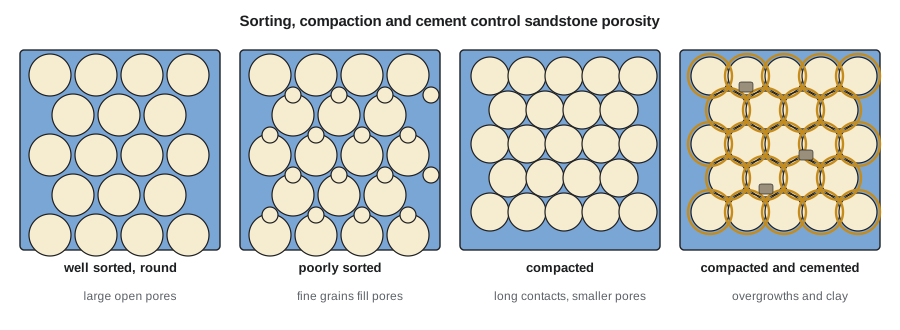
Sorting has a large effect. In a well-sorted sand, all the grains are similar and the spaces between them stay open. In a poorly sorted sand, small grains fill the spaces between large ones and porosity can fall to 20 percent or less before any burial at all. Grain size, in contrast, has little effect on porosity, as the sphere-packing result suggests, but a large effect on permeability, because small grains make small pore throats.
Pores come in several kinds. Primary intergranular pores are the original spaces between grains. Secondary pores form later, when grains or cements dissolve, leaving moldic pores shaped like the vanished grain, or when the rock fractures. Microporosity, pores less than a few micrometres across, occurs between clay flakes and inside altered grains; it can make up a large share of porosity in tight rocks but holds water tightly and contributes little to flow.
Permeability
Permeability measures how easily a fluid flows through a rock. It is defined by Darcy's law, introduced in PET-200, and measured in darcies or, more usefully for reservoirs, millidarcies (mD). Unlike porosity, permeability depends strongly on the size of the pore throats, the narrow connections between pores, and on how well they connect. Excellent sandstones exceed 1,000 mD; good reservoirs have 10 to 1,000 mD; tight sands have 0.001 to 0.1 mD; and the shale and siltstone reservoirs of unconventional plays have permeabilities measured in microdarcies or nanodarcies.
Porosity and permeability are related, but loosely. Plotting core measurements of the logarithm of permeability against porosity usually gives a cloud of points with a rough straight-line trend for each rock type. Lena uses such a plot to estimate permeability in wells that have porosity logs but no core. The scatter around the line is large, often a factor of ten, because rocks with the same porosity can have very different pore throat sizes. Grouping samples by facies, as Lesson 2 described, tightens the trend considerably.
Gross, net and pay
Not every metre of a reservoir interval counts. Geologists and engineers distinguish gross thickness, the whole interval from the top of the reservoir unit to its base; net reservoir, the part with porosity and permeability above minimum values, called cutoffs, that allow useful flow; and net pay, the part of net reservoir that also contains enough hydrocarbon. The ratio of net to gross thickness, the net-to-gross ratio, is one of the key inputs to volume estimates. A shoreface sand may have a net-to-gross ratio near 0.9; a heterolithic delta front with many thin shale beds may be 0.4 or less.
| Term | Definition | Typical cutoff in a conventional sandstone |
|---|---|---|
| Gross thickness | Top to base of the reservoir unit | None |
| Net reservoir | Rock able to store and flow fluids | Porosity above about 8 percent; shale volume below about 40 percent |
| Net pay | Net reservoir containing producible hydrocarbon | Water saturation below about 50 to 60 percent |
| Net-to-gross ratio | Net reservoir thickness divided by gross thickness | Varies from below 0.3 to above 0.9 |
The pore volume of a reservoir, the space available for fluids, is the product of area, gross thickness, net-to-gross ratio and average porosity. Multiplying by the hydrocarbon saturation, one minus the water saturation, gives the hydrocarbon pore volume. PET-200 used these terms in the volumetric equation for oil and gas in place; here the emphasis is on where the numbers come from geologically.
# Net-to-gross, net porosity and hydrocarbon pore volume from core-calibrated layers
# Each layer: (thickness m, porosity, shale volume, water saturation)
layers = [(0.8, 0.06, 0.55, 0.90), (1.2, 0.11, 0.30, 0.62), (2.4, 0.16, 0.08, 0.28),
          (0.5, 0.04, 0.70, 1.00), (1.6, 0.14, 0.12, 0.35), (0.9, 0.07, 0.20, 0.70)]
PHI_CUT, VSH_CUT, SW_CUT = 0.08, 0.40, 0.55
AREA_HA = 260                         # mapped area of the pool, hectares

gross = sum(h for h, *_ in layers)
net = [(h, p, s) for h, p, v, s in layers if p >= PHI_CUT and v <= VSH_CUT]
pay = [(h, p, s) for h, p, s in net if s <= SW_CUT]
h_net = sum(h for h, *_ in net); h_pay = sum(h for h, *_ in pay)
phi_net = sum(h * p for h, p, _ in net) / h_net
phi_all = sum(h * p for h, p, *_ in layers) / gross
hcpv = sum(h * p * (1 - s) for h, p, s in pay)        # m of hydrocarbon per m2 of area

print(f"gross {gross:.1f} m, net {h_net:.1f} m, pay {h_pay:.1f} m, net-to-gross {h_net / gross:.2f}")
print(f"average porosity: whole interval {phi_all:.3f}, net interval {phi_net:.3f}")
print(f"hydrocarbon pore thickness {hcpv:.3f} m")
vol = hcpv * AREA_HA * 10_000
print(f"hydrocarbon pore volume over {AREA_HA} ha: {vol:,.0f} m3 ({vol * 6.29:,.0f} bbl at reservoir conditions)")
print(f"error from using gross thickness with net porosity: {gross * phi_net / (h_net * phi_net) - 1:+.0%} pore volume")gross 7.4 m, net 5.2 m, pay 4.0 m, net-to-gross 0.70 average porosity: whole interval 0.118, net interval 0.142 hydrocarbon pore thickness 0.422 m hydrocarbon pore volume over 260 ha: 1,097,408 m3 (6,902,696 bbl at reservoir conditions) error from using gross thickness with net porosity: +42% pore volume
The program shows how cutoffs change the answer. Shale layers and tight sandstones are excluded from net reservoir, so the average porosity of the net interval is higher than the average of the whole interval, but the net thickness is smaller. Using the gross thickness with the net porosity, a common error, would overstate the volume.
Worked problem
Choosing a porosity cutoff
Ethan has core plugs from the Tamarack Lake field well with porosity and permeability. Lena says the field's minimum useful permeability is 0.5 mD, and the porosity-permeability trend for the shoreface facies is log₁₀k = 0.20φ − 2.10, with φ in percent and k in mD. What porosity cutoff corresponds to 0.5 mD?
Show solution
- Set k = 0.5 mD, so log₁₀(0.5) = −0.301.
- Solve −0.301 = 0.20φ − 2.10 for φ: φ = (2.10 − 0.301)/0.20 = 9.0 percent.
- Check: at φ = 15 percent, log₁₀k = 0.90, so k = 7.9 mD, a reasonable value for a clean shoreface sand.
- Because the trend has scatter, Lena also checks plugs near 9 percent porosity: most have permeabilities between 0.1 and 2 mD, so the cutoff is reasonable but approximate.
Answer: A porosity cutoff of about 9 percent. The cutoff is a judgment tied to the field's economics and the rock type, and it should be revisited as production data arrive.
What controls reservoir quality
Reservoir quality in clastic rocks is set first by the environment of deposition and then modified by burial. Depositional controls include grain size, sorting, and the amount of detrital clay: a well-sorted, coarse, clay-free beach or channel sand starts with excellent porosity and permeability; a muddy, bioturbated shelf sand starts poor. Burial controls include compaction, which squeezes ductile grains such as rock fragments and mica into the pores; quartz cementation, which becomes rapid above about 80 to 100 °C as quartz dissolves at grain contacts under stress and reprecipitates as overgrowths; carbonate cementation, often patchy, which can seal off parts of a reservoir; and clay minerals that grow in the pores.
Clay minerals deserve special attention because small amounts can damage permeability out of proportion to their volume. Kaolinite forms booklets that can detach and plug pore throats when fluids flow fast near a well. Illite grows as hairy fibres that bridge pores and can cut permeability by a factor of ten or more while hardly changing porosity. Chlorite coats grains, and where it forms an early, continuous coat it can actually preserve porosity by blocking quartz overgrowths. Smectite swells when it contacts fresh water, so drilling and completion fluids must be chosen carefully.
Some deep sandstones keep surprisingly good porosity. Early oil filling can slow cementation by displacing the water that carries dissolved silica. Overpressure, fluid pressure above the hydrostatic gradient, reduces the stress on grains and slows compaction. Grain coats of chlorite or microquartz block overgrowths. Recognizing these conditions lets geologists predict porosity at depths where a simple compaction trend would rule out a reservoir.
The Cardium sandstones show these controls clearly. Clean, well-sorted shoreface sands with little clay make the best reservoirs, with porosities of 12 to 18 percent. Where the sand is finer and more burrowed, clay content rises and permeability falls. The conglomerates that cap some sequences can be extremely permeable, several darcies, but they are thin and patchy, so wells that cut them may produce strongly at first and then decline quickly as water or gas arrives through the high-permeability streak.
Heterogeneity and anisotropy
No reservoir is uniform. Heterogeneity, the variation of rock properties from place to place, exists at every scale: grain laminae within a single bed, shale layers between beds, facies changes across a field, and faults that break it into blocks. Heterogeneity controls how fluids move during production. A thin, highly permeable layer can carry most of the flow and let water break through early, while tighter layers are bypassed. Vertical permeability is usually much lower than horizontal permeability, because thin shale and mica layers lie flat, so a reservoir may behave almost like a stack of separate layers.
Geologists describe heterogeneity with facies models and statistics, and reservoir engineers include it in simulation models. A good geological model does not try to place every shale layer exactly; it captures the patterns, proportions and connectivity that matter for flow. This is one of the main places where geologists and engineers must work closely together, because the geological model is the foundation of every production forecast.
Common mistakes
MistakeUsing gross thickness with net porosity in a volume estimate.
InsteadUse net thickness with the average porosity of the net interval, or gross thickness with net-to-gross and net porosity consistently.
MistakeAssuming finer grains mean lower porosity.
InsteadGrain size has little effect on porosity in well-sorted sands but a large effect on permeability.
MistakeTreating the porosity-permeability trend as exact.
InsteadScatter of a factor of ten is normal. Group samples by facies and use the trend as an estimate.
MistakeIgnoring small amounts of pore-filling clay.
InsteadFibrous illite or migrating kaolinite can reduce permeability far more than their volume suggests.
Summary and key terms
- Sandstones consist of framework grains, matrix, cement and pores; composition controls how they respond to burial.
- Effective porosity, the connected pore space, is typically 10 to 30 percent in sandstone reservoirs; sorting, compaction and cementation reduce it.
- Permeability depends on pore throat size and connectivity; it correlates loosely with porosity on a log-linear plot.
- Gross thickness, net reservoir and net pay are distinguished by cutoffs; the net-to-gross ratio enters every volume estimate.
- Reservoir quality is set by deposition and modified by compaction, quartz and carbonate cementation, clay minerals and dissolution.
- Heterogeneity and low vertical permeability control how fluids move and must be captured in geological models.
- Effective porosity
- The fraction of rock volume made up of connected pores that fluids can flow through.
- Permeability
- A measure of how easily fluid flows through a rock, usually in millidarcies.
- Pore throat
- The narrow connection between pores that controls permeability.
- Cutoff
- A minimum value of porosity, permeability or saturation used to define net reservoir or pay.
- Net-to-gross ratio
- The fraction of a reservoir interval that qualifies as net reservoir.
- Quartz overgrowth
- Quartz cement grown on a sand grain, reducing pore space.
- Heterogeneity
- Variation of rock properties from place to place within a reservoir.
Practice problems
Work each problem on paper first, then reveal the answer to check.
A reservoir interval is 20 m gross, with 13 m of net sand averaging 16 percent porosity. What is the net-to-gross ratio, and what is the porosity-thickness (φh) of the net sand?
Show answer
N/G = 13/20 = 0.65; φh = 0.16 × 13 = 2.08 m of pore space per unit area.
Two sandstones both have 18 percent porosity. One has 500 mD and the other 5 mD. Suggest two geological reasons for the difference.
Show answer
The tight one may be finer grained with smaller pore throats, or contain pore-bridging illite or more matrix clay; the permeable one is likely coarser and cleaner.
Why can an early chlorite coat preserve porosity in a deep sandstone?
Show answer
It covers grain surfaces and blocks quartz overgrowths from nucleating, so the pores are not cemented shut.
Using log₁₀k = 0.20φ − 2.10, estimate k for φ = 12 percent.
Show answer
log₁₀k = 0.30, so k ≈ 2.0 mD.
Lesson quiz · 5 questions
Score 60% or more to complete this lesson.
Create a free account to save your progress, take quizzes and earn a certificate.