
MEC-380 · Lesson 8 of 12 · 21 min
Two-degree-of-freedom systems and vibration absorbers
Shediac Bay Seafoods, a seafood processor in Shediac, runs a TP-80 as its brine circulation pump on a steel platform above the brine tanks. The platform was added during an expansion and is lighter than the original floor. Since then, the platform has shaken enough to loosen bolts, and a weld on a handrail post has cracked. Lucie's measurements show the platform's first vertical mode at 29.8 Hz, almost exactly at the pump's running speed. Moving the pump is not possible, the platform cannot easily be stiffened without closing the line for a week, and the pump must run at fixed speed. Lucie proposes a tuned vibration absorber: a small spring-mass system bolted to the platform and tuned to the running speed. To design it, Owen needs a model with two degrees of freedom.
Equations of motion for two degrees of freedom
A system of two masses, m₁ and m₂, connected by springs, has two coordinates x₁ and x₂. Applying Newton's law to each mass gives two coupled equations, which are compactly written in matrix form:
for the arrangement in which spring k₁ connects m₁ to ground and spring k₂ connects m₂ to m₁. The off-diagonal terms of K are the coupling: motion of one mass produces a force on the other. Coupling may appear in the stiffness matrix, in the mass matrix, or both, depending on the coordinates chosen. A rigid package on two springs, described by the motion of its centre of gravity and its rotation, has coupled stiffness unless the springs are placed so that their stiffness centre lies directly under the centre of gravity, which is why isolator layouts are arranged symmetrically (Lesson 5).
Natural frequencies and mode shapes
Without damping or force, try a solution in which both masses move harmonically at the same frequency: \(\mathbf{x} = \boldsymbol{\phi}\cos\omega t\). Substituting gives the eigenvalue problem
For two degrees of freedom, the determinant gives a quadratic in ω², with two roots: the two natural frequencies. For each, the ratio of the amplitudes φ₂/φ₁ is fixed; this ratio, the mode shape, describes how the masses move relative to each other. In the lower mode of a chain of two masses, they move in phase; in the higher mode, out of phase, with a node, a point that does not move, somewhere on the spring between them. Any free vibration is a combination of the two modes, each oscillating at its own frequency. Lesson 9 generalizes this to many degrees of freedom.
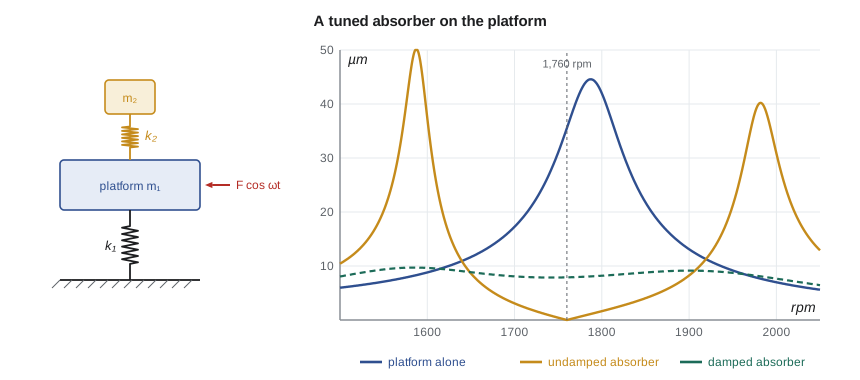
The undamped vibration absorber
Attach a small mass m₂ on a spring k₂ to a main mass m₁ that is driven by a harmonic force F₀cos ωt. Solving the steady-state equations gives the main mass amplitude
The numerator vanishes when \(\omega = \sqrt{k_2/m_2}\): if the absorber is tuned to the forcing frequency, the main mass does not move at all. The absorber moves with amplitude \(X_2 = -F_0/k_2\), so that its spring force exactly cancels the applied force at every instant. The absorber does not dissipate energy; it simply provides an equal and opposite force, which is why it works only at one frequency.
# Two-degree-of-freedom model: the Shediac Bay Seafoods platform and a tuned vibration absorber
import math
f_op = 1760 / 60                    # brine pump running speed, Hz
m1 = 640.0                          # modal mass of the platform with the pump package, kg
f1 = 29.8                           # measured platform natural frequency, Hz
k1 = m1 * (2 * math.pi * f1)**2
c1 = 2 * 0.02 * math.sqrt(k1 * m1)
F0 = 40.0                           # unbalance force of the fouled brine impeller, N (about 1,200 g mm)
w = 2 * math.pi * f_op
def single(w):
    return F0 / abs(complex(k1 - m1 * w**2, c1 * w))
print(f"Platform alone at {f_op:.2f} Hz: {single(w)*1e6:.1f} um, {single(w)*w/math.sqrt(2)*1e3:.2f} mm/s RMS")
# Absorber tuned to the running speed with mass ratio mu
mu = 0.05; m2 = mu * m1
k2 = m2 * w**2
def two_dof(w, k2, c2):
    a11 = complex(k1 + k2 - m1 * w**2, (c1 + c2) * w); a12 = complex(-k2, -c2 * w)
    a22 = complex(k2 - m2 * w**2, c2 * w)
    det = a11 * a22 - a12 * a12
    return abs(F0 * a22 / det), abs(-F0 * a12 / det)
x1, x2 = two_dof(w, k2, 0.0)
print(f"Undamped absorber m2 = {m2:.0f} kg, k2 = {k2/1e6:.2f} MN/m: platform {x1*1e6:.3f} um, absorber {x2*1e6:.0f} um")
print(f"  absorber spring force {k2*x2:.1f} N balances the {F0} N unbalance force")
# New natural frequencies of the coupled system (undamped): roots of the frequency equation
a = m1 * m2; b = -(m1 * k2 + m2 * (k1 + k2)); c = k1 * k2
for root in sorted(((-b + s * math.sqrt(b*b - 4*a*c)) / (2*a)) for s in (-1, 1)):
    print(f"  coupled natural frequency {math.sqrt(root)/2/math.pi:.2f} Hz")
# Speed sensitivity: a VFD or line-frequency drift moves the forcing off the notch
print(" speed rpm  platform alone um  with absorber um")
for rpm in (1700, 1730, 1760, 1790, 1820):
    ww = 2 * math.pi * rpm / 60
    print(f"{rpm:10d} {single(ww)*1e6:18.1f} {two_dof(ww, k2, 0.0)[0]*1e6:16.2f}")
# Den Hartog optimum damped absorber for broadband use
f_ratio = 1 / (1 + mu); z_opt = math.sqrt(3 * mu / (8 * (1 + mu)**3))
k2o = m2 * (2 * math.pi * f1 * f_ratio)**2; c2o = 2 * z_opt * math.sqrt(k2o * m2)
peak = max(two_dof(2 * math.pi * f, k2o, c2o)[0] for f in [20 + 0.01 * i for i in range(2000)])
print(f"\nDen Hartog tuning: f2/f1 = {f_ratio:.3f}, zeta2 = {z_opt:.3f}; worst platform amplitude {peak*1e6:.1f} um"
f" versus {F0/(c1*2*math.pi*f1)*1e6:.1f} um at resonance without it")Platform alone at 29.33 Hz: 35.5 um, 4.63 mm/s RMS
Undamped absorber m2 = 32 kg, k2 = 1.09 MN/m: platform 0.000 um, absorber 37 um
absorber spring force 40.0 N balances the 40.0 N unbalance force
coupled natural frequency 26.46 Hz
coupled natural frequency 33.04 Hz
speed rpm platform alone um with absorber um
1700 17.3 3.08
1730 23.9 1.35
1760 35.5 0.00
1790 44.4 1.22
1820 32.8 2.50
Den Hartog tuning: f2/f1 = 0.952, zeta2 = 0.127; worst platform amplitude 9.7 um versus 44.6 um at resonance without itThe program uses a modal mass of 640 kg for the platform at the pump location, its measured frequency of 29.8 Hz and 2 percent damping. The brine impeller, fouled with salt deposits, has an unbalance of about 1,200 g·mm and produces 40 N. Alone, the platform responds with 35.5 µm, 4.63 mm/s RMS. An absorber with a mass ratio μ = m₂/m₁ = 0.05, that is 32 kg, on a spring of 1.09 MN/m, tuned exactly to 1,760 rpm, cancels the platform motion completely. The absorber itself moves 37 µm, and its spring carries 40 N, balancing the unbalance force.
The price of an absorber: two new resonances
Adding a degree of freedom adds a natural frequency. The original single resonance at 29.8 Hz splits into two, at 26.5 and 33.0 Hz. The pump does not run at either, but it passes through 26.5 Hz on every start and stop, and any change in running speed moves the forcing off the notch. The program shows that an induction motor's speed, which changes slightly with load, matters: 30 rpm either side of 1,760 rpm, the platform amplitude rises from zero to about 1.3 µm; at 1,700 rpm it is about 3 µm. Still far better than the 35 µm without the absorber, but a reminder that the undamped absorber is a narrow-band device. The separation of the two new frequencies grows with the mass ratio, so a heavier absorber is more forgiving of speed changes. Mass ratios of 0.02 to 0.10 are typical.
Worked problem
Absorber mass and stroke
For a 0.05 mass ratio, the absorber moves 37 µm. If Owen chose a mass ratio of 0.02 instead, what would the absorber mass, spring stiffness and stroke be?
Show solution
- m₂ = 0.02 × 640 = 12.8 kg.
- k₂ = m₂ω² = 12.8 × 184.3² = 0.435 MN/m.
- Stroke X₂ = F₀/k₂ = 40/0.435×10⁶ = 92 µm.
Answer: A lighter absorber moves further, and its spring is more highly stressed for the same force. Its new natural frequencies are closer together, so it is more sensitive to speed changes. The 32 kg absorber was preferred.
Damped absorbers
If the forcing frequency varies, or if the aim is to reduce a resonance over a range of frequencies rather than at one, a damped absorber is used. Den Hartog's classic analysis showed that, for a lightly damped main system, there is an optimum tuning and an optimum absorber damping that make the two peaks of the main mass response equal and as low as possible:
For μ = 0.05 these give a tuning ratio of 0.952 and an absorber damping ratio of 0.127. The program's sweep from 20 to 40 Hz shows the worst platform amplitude falls from 44.6 µm at resonance without the absorber to 9.7 µm with the damped absorber: not zero anywhere, but low everywhere. Damped absorbers, often called tuned mass dampers, are used on tall buildings, footbridges, chimneys and long pipe spans, where the excitation is broad-band, from wind or footsteps, rather than from one rotating machine.
Design and installation
Owen's absorber is a 32 kg steel block on four short cantilevered flat bars, with slotted holes that allow the effective length, and therefore the stiffness, to be adjusted. The arrangement is bolted under the platform beam directly below the pump, where the platform's mode shape has its largest motion: an absorber placed at a node would do nothing. After installation, the tuning is checked by measuring the platform vibration while sliding the clamps a few millimetres at a time, which is easier than calculating the final stiffness exactly. Lucie insists on a fatigue check of the flat bars, since they carry 40 N of alternating force at 29 Hz for every hour the pump runs: about 2.5 million cycles a day.
When the brine impeller is cleaned, the unbalance force falls, and the absorber's stroke falls with it; the absorber continues to work, since cancellation does not depend on the force amplitude. When Shediac Bay Seafoods later wants to run the pump on a variable-frequency drive to save energy, the undamped absorber will no longer be suitable, and the platform will need permanent stiffening. Owen's report says so plainly.
Two degrees of freedom in other forms
Many pump problems are naturally two-degree-of-freedom systems. A package on springs bounces and rocks; a motor and pump connected by a flexible coupling have a torsional mode in which they twist against each other; a pipe with a heavy valve has two bending modes in which the valve and the pipe span move together or against each other. In each, the natural frequencies come from the same determinant, and the mode shapes tell the engineer where to measure, where to add stiffness and where an absorber or damper would be effective. Lesson 9 handles larger systems with the same ideas and a matrix method.
Common mistakes
MistakeTuning an absorber to the structure's natural frequency.
InsteadFor an undamped absorber, tune to the forcing frequency, here 1,760 rpm.
MistakeForgetting the two new resonances.
InsteadCheck start-up, shutdown and speed changes against the split frequencies.
MistakeMounting the absorber where the mode has little motion.
InsteadPlace it at the antinode, where the structure moves most.
MistakeUsing an undamped absorber with a variable-speed drive.
InsteadUse a damped absorber or change the structure.
MistakeIgnoring fatigue of the absorber's spring.
InsteadThe spring carries the full alternating force for millions of cycles per day.
Summary and key terms
- Two-degree-of-freedom systems obey Mẍ + Cẋ + Kx = F; the off-diagonal terms are coupling.
- Natural frequencies come from det(K − ω²M) = 0; each has a mode shape, the ratio of the amplitudes.
- An undamped absorber tuned to the forcing frequency cancels the main mass motion; its spring force balances the applied force.
- The Shediac Bay Seafoods platform at 29.8 Hz is fixed by a 32 kg absorber tuned to 1,760 rpm, cutting 35.5 µm to almost zero.
- The absorber splits the original resonance into two, here at 26.5 and 33.0 Hz.
- Damped absorbers with Den Hartog tuning reduce response over a band; for μ = 0.05 the worst case falls from 44.6 to 9.7 µm.
- Coupling
- The dependence of the motion of one coordinate on another through shared springs, dampers or masses.
- Mass matrix
- The matrix of inertia terms in the equations of motion.
- Stiffness matrix
- The matrix of spring terms relating forces to displacements.
- Eigenvalue problem
- The equation (K − ω²M)φ = 0 whose solutions are natural frequencies and mode shapes.
- Mode shape
- The pattern of relative amplitudes of the coordinates in a natural mode.
- Node
- A point that does not move in a particular mode.
- Antinode
- A point of maximum motion in a particular mode.
- Tuned vibration absorber
- An added spring-mass tuned to cancel vibration at a given frequency.
- Mass ratio
- The absorber mass divided by the modal mass of the main system.
- Tuned mass damper
- A damped vibration absorber designed to reduce response over a frequency band.
Practice problems
Work each problem on paper first, then reveal the answer to check.
Two equal masses m are joined by a spring k, with the first also attached to ground by k. Find the natural frequencies.
Show answer
ω² = (3 ∓ √5)k/(2m): 0.618√(k/m) and 1.618√(k/m).
An absorber must be tuned to 50 Hz with a mass of 10 kg. Find its stiffness.
Show answer
10 × (2π·50)² = 0.99 MN/m.
A 100 N force at the tuned frequency acts on a system whose absorber spring is 2 MN/m. Find the absorber stroke.
Show answer
50 µm.
Find the Den Hartog damping ratio for μ = 0.10.
Show answer
√(0.3/(8 × 1.331)) = 0.168.
In the program, raise the mass ratio to 0.10. What happens to the two coupled frequencies?
Show answer
They spread further apart, to about 25.3 and 34.6 Hz.
Why is the undamped absorber unsuitable once the pump is on a variable-frequency drive?
Show answer
It cancels motion at one frequency only, and creates two new resonances in the speed range.
Lesson quiz · 5 questions
Score 60% or more to complete this lesson.
Create a free account to save your progress, take quizzes and earn a certificate.