
MEC-380 · Lesson 7 of 12 · 22 min
Transient forcing: steps, impulses and shock
Not every force is a steady sinusoid. A check valve slams shut when a pump trips, loading its pipe supports suddenly. A forklift bumps a crated pump against a loading dock. A truck crossing a railway track jolts its load. Lucie has two such problems on her desk. The first is a pipe support on the discharge of a TM-4 boiler feed pump at a customer's plant, which cracked after a series of pump trips. The second is a shipping damage claim: a TM-4 multistage pump arrived at a customer with brinelled bearings, the small dents that appear when a stationary bearing is shocked, and the carrier says its handling was normal. Both problems involve transient forces, and this lesson gives Owen the tools to analyse them: the step response, the impulse response, the convolution integral, and the shock response spectrum.
Response to a step load
If a force F₀ is applied suddenly to an undamped spring-mass system at rest and then held, the mass oscillates about the new static position:
The peak displacement is twice the static deflection. A suddenly applied load is twice as severe as the same load applied slowly. With damping the overshoot is a little less: for ζ = 0.03, the program finds a peak of 1.91 times static. This factor of two explains many failures of supports and brackets designed only for static loads. When the check valve slams, the pressure surge applies an almost instant force to the elbow at the pump discharge, and the support behind it sees close to twice the force a static calculation predicts.
Response to an impulse
A force that acts for a very short time compared with the natural period delivers an impulse \(\hat F = \int F\,dt\), which changes the momentum of the mass suddenly from zero to \(\hat F\). The mass starts from rest at x = 0 with velocity \(\hat F/m\), and the resulting free vibration, the impulse response function, is
The shape of the pulse does not matter, only its area, as long as it is short. The program compares a 2 ms rectangular pulse on an 18 Hz system (period 56 ms) with the impulse formula: 8.35 mm against 8.84 mm, the difference coming from damping and the finite pulse length. The instrumented hammer used in the bump test of Lesson 3 is an impulse source: a short tap excites all frequencies up to roughly the inverse of its contact time, which is why a hard tip is used to excite high-frequency modes and a soft tip for low ones.
Arbitrary forces: the convolution integral
Any force history can be divided into a sequence of short impulses \(F(\tau)\,d\tau\). Because the system is linear, the response at time t is the sum of the impulse responses to all the earlier impulses. This is Duhamel's integral, or the convolution integral:
For simple forces, the integral can be evaluated by hand; for measured or complicated forces, it is computed numerically. In practice engineers often integrate the equation of motion directly with a step-by-step method, which is what the program does using the fourth-order Runge-Kutta method with a time step of 0.1 ms, far shorter than any period of interest. The direct method also handles nonlinear systems, such as a support that lifts off or a gap that closes, where convolution does not apply.
# Response of a single-degree-of-freedom model to a step, an impulse and a half-sine shock
import math
def simulate(fn, zeta, force, t_end, dt=1e-4):
    """Integrate x'' + 2 zeta wn x' + wn^2 x = force(t) (force per unit mass) with RK4; return max |x|."""
    wn = 2 * math.pi * fn; x = v = 0.0; t = 0.0; xmax = 0.0
    def acc(t, x, v): return force(t) - 2 * zeta * wn * v - wn**2 * x
    while t < t_end:
        k1x, k1v = v, acc(t, x, v)
        k2x, k2v = v + dt/2*k1v, acc(t + dt/2, x + dt/2*k1x, v + dt/2*k1v)
        k3x, k3v = v + dt/2*k2v, acc(t + dt/2, x + dt/2*k2x, v + dt/2*k2v)
        k4x, k4v = v + dt*k3v, acc(t + dt, x + dt*k3x, v + dt*k3v)
        x += dt/6*(k1x + 2*k2x + 2*k3x + k4x); v += dt/6*(k1v + 2*k2v + 2*k3v + k4v); t += dt
        xmax = max(xmax, abs(x))
    return xmax
# 1. Step load: a check valve slams shut and the pipe support sees a sudden constant force
fn, z = 18.0, 0.03
wn = 2 * math.pi * fn
F_over_m = 1.0
x_static = F_over_m / wn**2
print(f"Step load: peak/static = {simulate(fn, z, lambda t: F_over_m, 0.5)/x_static:.2f} (undamped theory 2.00)")
# 2. Short rectangular impulse versus the impulse formula x_max = I/(m wn)
I = 1.0; td = 0.002               # impulse per unit mass, duration s
xm = simulate(fn, z, lambda t: I/td if t < td else 0.0, 0.3)
print(f"Short pulse ({td*1000:.0f} ms): x_max = {xm*1000:.2f} mm, impulse formula {I/wn*1000:.2f} mm")

# 3. Half-sine shock of 10 g, 11 ms on the TM-4 shipping skid (base excitation, relative motion)
A = 10 * 9.81; td = 0.011
pulse = lambda t: -A * math.sin(math.pi * t / td) if t < td else 0.0
print("\nShock response spectrum (relative displacement as equivalent static acceleration, in g):")
print("   fn Hz   td/Tn   max relative x mm   wn^2 x_max (g)")
for fn in (5, 10, 20, 45, 90, 180, 400):
    xm = simulate(fn, 0.05, pulse, max(0.05, 3 / fn))
    print(f"{fn:8.0f} {td*fn:7.2f} {xm*1000:17.3f} {xm*(2*math.pi*fn)**2/9.81:14.1f}")
# The pump on its shipping isolators: fn = 12 Hz
fs = 12.0
xm = simulate(fs, 0.05, pulse, 0.5)
print(f"\nTM-4 on 12 Hz shipping mounts: relative motion {xm*1000:.1f} mm, mount force equivalent {xm*(2*math.pi*fs)**2/9.81:.1f} g")Step load: peak/static = 1.91 (undamped theory 2.00)
Short pulse (2 ms): x_max = 8.35 mm, impulse formula 8.84 mm
Shock response spectrum (relative displacement as equivalent static acceleration, in g):
fn Hz td/Tn max relative x mm wn^2 x_max (g)
5 0.05 20.207 2.0
10 0.11 10.018 4.0
20 0.22 4.841 7.8
45 0.49 1.777 14.5
90 0.99 0.498 16.2
180 1.98 0.093 12.2
400 4.40 0.016 10.3
TM-4 on 12 Hz shipping mounts: relative motion 8.3 mm, mount force equivalent 4.8 gBase shock and the shock response spectrum
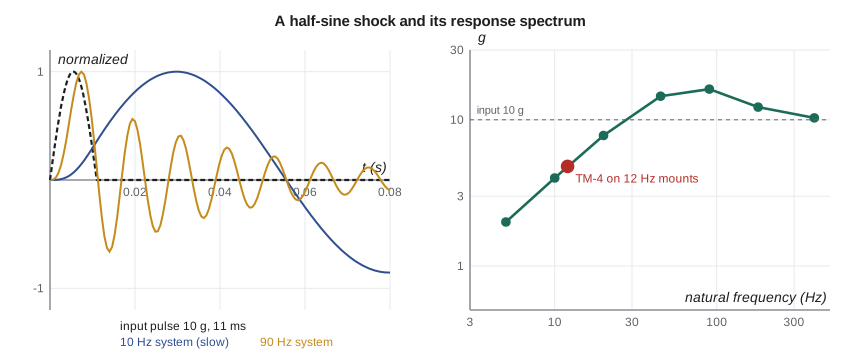
Shipping and handling shocks are base excitations: the ground or truck bed accelerates suddenly, and the equipment responds through its mounts. Writing z = x − y for the motion of the mass relative to its base, the equation of motion becomes \(m\ddot z + c\dot z + kz = -m\ddot y\), so the base acceleration acts like a force per unit mass. A common idealization of a drop or bump is a half-sine acceleration pulse of amplitude A and duration t_d. The program uses 10 g for 11 ms, a pulse often used in shock testing of equipment.
The shock response spectrum (SRS) plots the peak response of a family of single-degree-of-freedom systems with different natural frequencies to the same pulse. It is usually expressed as the equivalent static acceleration \(\omega_n^2 z_{max}\), which is the acceleration that, applied statically, would produce the same peak spring deflection, and hence the same peak force in the mounts and stress in the parts. The program's table shows the classic shape. For systems with natural periods much longer than the pulse (5 Hz, with t_d/T_n = 0.05), the response is small: the pulse is over before the system can respond, and it behaves like an impulse. For systems with periods near twice the pulse length (around 90 Hz here), the response peaks at about 1.6 times the input, 16 g. For very stiff systems (400 Hz), the response follows the input, about 10 g, because the mass simply moves with its base.
The shipping damage claim
The TM-4 is shipped bolted to a skid on four elastomer mounts, which give it a natural frequency of about 12 Hz. On those mounts, the program shows a 10 g, 11 ms shock produces 8.3 mm of relative motion and an equivalent static load of 4.8 g, less than half the input. The mounts are doing their job: they turn a short, sharp shock into a longer, gentler motion. But the rotor inside sits in rolling-element thrust bearings and journal bearings (MEC-360), and the bearing contacts are stiff. If the pump were shipped without mounts, bolted rigidly to the skid, the rotor would see the full input or more, and the high contact stress in a stationary ball bearing produces exactly the brinelling the customer found.
Lucie asks the customer for photographs of the crate. They show that the skid was shipped with the mounts' transit locks still engaged, bolts that the factory fits to stop the pump swaying during crating and that the loading crew should have removed. With the locks in, the TM-4 was rigidly attached, and its bearings saw the full shock. The fix is procedural: shipping locks are now painted red with a tag, and the crate carries a shock indicator, a small device that changes colour above a set acceleration, so that rough handling can be proved or disproved. Tidewater also adds a rotor lock, a clamp that holds the shaft axially and keeps the bearings loaded so that the balls cannot hammer their races.
Worked problem
The slamming check valve
When the TM-4 trips, the check valve closes and a pressure surge applies a force of 8 kN to the discharge elbow in about 3 ms. The elbow and its support have a natural frequency of 18 Hz and ζ = 0.03. The support was designed for a static force of 10 kN with a safety factor of 1.5. Is it adequate?
Show solution
- The natural period is 56 ms, so a 3 ms rise is effectively sudden: treat the load as a step.
- Peak dynamic force ≈ 1.9 × 8 = 15.2 kN, from the program's step result.
- Design capacity is 10 × 1.5 = 15 kN, about equal to the peak; the margin is gone and each trip is a full fatigue cycle.
Answer: The support failed by fatigue after repeated trips. The fixes are a slower-closing (non-slam) check valve, which turns the step into a ramp longer than the natural period, and a stronger support. Lesson 10 checks the pipe spans.
Ramps, pulses and the importance of rise time
A load that rises over a time t_r rather than instantly gives less overshoot. If t_r is longer than about twice the natural period, the response follows the load almost statically; if t_r is shorter than about a quarter of the period, it behaves like a step. This is the principle behind slow-closing valves, soft starters on motors and the ramped speed changes of variable-frequency drives. In all of them, spreading the change over a time longer than the relevant natural periods removes the dynamic amplification. Owen notes that the same principle explains why the TP-80's drive is set with a ten-second acceleration ramp: it limits torsional shocks to the coupling (Lesson 9) as well as pressure surges.
Random vibration in brief
Road transport subjects equipment to a continuous random vibration rather than a single shock, described statistically by a power spectral density (PSD): the mean-square acceleration per unit bandwidth, in g²/Hz, over a range of frequencies. Packaging standards define test profiles of this kind. The response of a lightly damped system to broad-band random excitation is dominated by the frequencies near its own natural frequency, and its RMS response can be estimated from the input PSD at that frequency by Miles' equation, \(a_{rms} \approx \sqrt{\tfrac{\pi}{2} f_n Q\, \text{PSD}(f_n)}\). Lucie keeps such calculations for the occasional customer who ships pumps overseas; for most shipments, the shock case controls.
Common mistakes
MistakeDesigning supports for the static value of a sudden load.
InsteadA step load can double the deflection and force.
MistakeTreating a pulse longer than the natural period as an impulse.
InsteadThe impulse approximation needs t_d much shorter than T_n.
MistakeAssuming soft mounts always protect equipment from shock.
InsteadSoft mounts reduce peak acceleration but need room for large relative motion.
MistakeShipping with isolator transit locks engaged.
InsteadLocks make the mounting rigid; remove or design them for transport.
MistakeUsing convolution for a system with gaps or lift-off.
InsteadIntegrate the nonlinear equations directly, step by step.
Summary and key terms
- A suddenly applied step load produces up to twice the static deflection.
- A short impulse gives x_max ≈ F̂/(mω_n); only its area matters.
- The convolution integral sums impulse responses to give the response to any force; direct integration handles nonlinear cases.
- The shock response spectrum gives the peak response of systems of different natural frequency to one pulse.
- For a 10 g, 11 ms half-sine, the spectrum peaks at about 16 g near 90 Hz; the TM-4 on 12 Hz mounts sees about 4.8 g.
- The shipping damage came from engaged transit locks that made the mounts rigid.
- Step load
- A force applied suddenly and then held constant.
- Impulse
- The integral of force over a short time; the change of momentum it produces.
- Impulse response function
- The free vibration that follows a unit impulse.
- Convolution integral
- The sum of impulse responses that gives the response to an arbitrary force.
- Half-sine pulse
- An idealized shock pulse shaped like half a sine wave.
- Shock response spectrum
- The peak responses of a family of single-degree-of-freedom systems to a given shock.
- Equivalent static acceleration
- The acceleration which, applied slowly, produces the same peak spring force.
- Brinelling
- Permanent dents in bearing races caused by shock or overload while stationary.
- Transit lock
- A bolt or clamp that locks an isolated machine during shipping.
- Power spectral density
- Mean-square value per unit bandwidth of a random signal.
Practice problems
Work each problem on paper first, then reveal the answer to check.
A 400 kg machine on a 2 MN/m mount receives a sudden 4 kN load. Estimate the peak deflection without damping.
Show answer
2 × 4000/2×10⁶ = 4 mm.
An impulse of 50 N·s strikes a 100 kg mass on a spring with ω_n = 100 rad/s. Find x_max.
Show answer
50/(100 × 100) = 5 mm.
A half-sine pulse lasts 6 ms. Near what natural frequency is its response spectrum highest?
Show answer
Near T_n ≈ 2t_d: about 80 Hz.
A valve closes in 200 ms on a support with f_n = 18 Hz. Is the load a step?
Show answer
No: 200 ms is over three periods, so the response is nearly static.
In the program, change the shipping mount frequency to 6 Hz. What is the equivalent static acceleration?
Show answer
About 2.4 g, with larger relative motion of about 17 mm.
Why does a hard hammer tip excite higher frequencies than a soft one?
Show answer
A shorter contact time spreads the impulse's energy to higher frequencies.
Lesson quiz · 5 questions
Score 60% or more to complete this lesson.
Create a free account to save your progress, take quizzes and earn a certificate.