
MEC-380 · Lesson 5 of 12 · 21 min
Base excitation, transmissibility and vibration isolation
The next call comes from Codiac Regional Hospital. A new TP-80 heating water pump has been installed on the fourth-floor mechanical room, directly above an imaging suite, and the hospital's facilities manager reports a faint hum in the suite and a vibration that the imaging technicians can feel in the floor. The consulting engineer's specification asked for vibration isolation, but the contractor set the package on the same kind of rubber pads that caused trouble in Lesson 2. Lucie sends Owen to design a proper isolation system. He must decide how soft the mounts must be, whether to use an inertia base, how much damping is wanted, and what happens while the pump starts and stops, when it passes through the natural frequency of its own mounts.
Two problems, one formula
Isolation has two forms. In force isolation, a vibrating machine is mounted so that less of its force reaches the structure: the hospital's problem. In motion isolation, sensitive equipment is mounted so that less of the structure's motion reaches it: the imaging equipment's problem, or a precision balancing machine on a factory floor. For the single-degree-of-freedom model, the two problems give exactly the same ratio, called the transmissibility.
For force isolation, the force transmitted to the foundation is the sum of the spring and damper forces, \(F_T = kx + c\dot x\). Its amplitude, divided by the applied force amplitude, is
For motion isolation, a base moving as \(y = Y\cos\omega t\) drives the mass through the spring and damper: \(m\ddot x + c(\dot x - \dot y) + k(x - y) = 0\). The ratio of the mass's amplitude to the base amplitude, X/Y, is the same expression. This symmetry is convenient: one curve serves both cases.
Reading the transmissibility curve
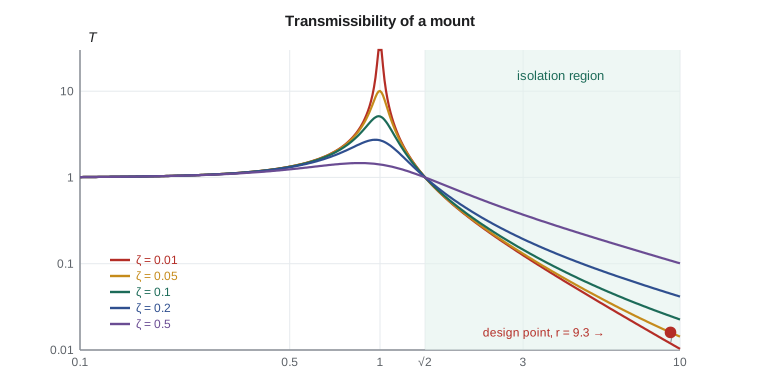
Every curve passes through T = 1 at \(r = \sqrt2\), whatever the damping. Below that ratio, mounting the machine on springs makes things worse; at r = 1 it makes them much worse. Above \(r = \sqrt2\), the mount isolates, and the transmissibility falls roughly as \(1/r^2\). The isolation efficiency is \(1 - T\), often quoted as a percentage. Two surprises follow from the curve. First, isolation requires mounts that are soft compared with the machine's mass: the natural frequency on the mounts must be well below the forcing frequency. Second, in the isolation region, more damping makes isolation worse, because the damper transmits force in proportion to velocity. Damping is needed only to limit motion when the machine passes through resonance during start and stop.
For design, damping is often neglected and the required frequency ratio found from \(T = 1/(r^2 - 1)\), so \(r = \sqrt{1 + 1/T}\). The required isolator natural frequency follows, and then the static deflection from Lesson 2. Isolator manufacturers publish their products by static deflection under rated load, so this is the number Owen takes to the catalogue.
# Vibration isolation of a TP-80 package on the mechanical floor of Codiac Regional Hospital
import math
g = 9.81
f_op = 1760 / 60                   # forcing frequency, Hz
m_pkg = 310.0                      # pump, motor and baseplate, kg
m_base = 520.0                     # concrete inertia base, kg
m = m_pkg + m_base
def T(r, z):                       # force (or motion) transmissibility
    return math.sqrt((1 + (2 * z * r)**2) / ((1 - r**2)**2 + (2 * z * r)**2))
# Required isolator natural frequency for a target isolation efficiency (undamped estimate)
for eff in (0.80, 0.90, 0.95):
    Tt = 1 - eff
    r = math.sqrt(1 + 1 / Tt)
    fn = f_op / r
    d = g / (2 * math.pi * fn)**2
    print(f"{eff:.0%} isolation: r >= {r:.2f}, fn <= {fn:.2f} Hz, static deflection >= {d*1000:.1f} mm ({d/0.0254:.2f} in)")
# Chosen springs: four steel springs with 25 mm static deflection, as is common for upper floors
d_sel = 0.025
k_total = m * g / d_sel; k_each = k_total / 4
fn = math.sqrt(k_total / m) / 2 / math.pi
r = f_op / fn
print(f"\nSelected: k = {k_each/1e3:.0f} kN/m per spring ({k_each/175.13:.0f} lbf/in), fn = {fn:.2f} Hz, r = {r:.1f}")
for z in (0.01, 0.05, 0.10):
    Tr = T(r, z)
    print(f"  zeta {z:.2f}: transmissibility {Tr:.4f}, isolation {1-Tr:.2%}, peak at resonance {T(1, z):.1f}")
# Force transmitted to the slab from the unbalance force at running speed
U = 325e-6; w = 2 * math.pi * f_op
F0 = U * w**2
print(f"\nUnbalance force {F0:.1f} N; transmitted with springs {F0*T(r, 0.05):.2f} N; bolted rigidly it would be the full {F0:.1f} N")
# Start-up: the package passes through its 3 Hz resonance; motion amplitude for a slow run-up
X_static_equiv = F0 * (fn / f_op)**2 / k_total        # unbalance force at 3 Hz is much smaller
print(f"Peak amplitude passing resonance (zeta 0.05): about {X_static_equiv/(2*0.05)*1e6:.1f} um")
# Base excitation: floor motion of 20 um at 29.3 Hz is reduced at the package
print(f"Floor motion 20 um -> package motion {20*T(r, 0.05):.2f} um")
# Why the inertia base helps: above resonance the motion is mass-controlled, X ~ F0/(m w^2)
for name, mm in (("package alone", m_pkg), ("package on inertia base", m)):
print(f"{name:24s}: running-speed motion about {F0/(mm*w**2)*1e6:.3f} um from the unbalance force")80% isolation: r >= 2.45, fn <= 11.98 Hz, static deflection >= 1.7 mm (0.07 in) 90% isolation: r >= 3.32, fn <= 8.84 Hz, static deflection >= 3.2 mm (0.13 in) 95% isolation: r >= 4.58, fn <= 6.40 Hz, static deflection >= 6.1 mm (0.24 in) Selected: k = 81 kN/m per spring (465 lbf/in), fn = 3.15 Hz, r = 9.3 zeta 0.01: transmissibility 0.0119, isolation 98.81%, peak at resonance 50.0 zeta 0.05: transmissibility 0.0160, isolation 98.40%, peak at resonance 10.0 zeta 0.10: transmissibility 0.0247, isolation 97.53%, peak at resonance 5.1 Unbalance force 11.0 N; transmitted with springs 0.18 N; bolted rigidly it would be the full 11.0 N Peak amplitude passing resonance (zeta 0.05): about 3.9 um Floor motion 20 um -> package motion 0.32 um package alone : running-speed motion about 1.048 um from the unbalance force package on inertia base : running-speed motion about 0.392 um from the unbalance force
The first lines of output set the scale. To isolate 90 percent of a 29.3 Hz force needs a mount natural frequency below 8.8 Hz and a static deflection of at least 3.2 mm; 95 percent needs 6.1 mm. The rubber pads deflected 0.35 mm, which is why they amplified rather than isolated. Owen selects steel springs with 25 mm static deflection, which gives a mount frequency of 3.15 Hz and a frequency ratio of 9.3. With 5 percent damping, the transmissibility at running speed is 0.016: 98.4 percent isolation. The unbalance force of 11 N is reduced to under 0.2 N at the slab.
Why such a large deflection on an upper floor?
A theoretical 98 percent isolation looks generous for a pump. The reason for the generous figure is that the transmissibility formula assumes a rigid foundation. A long-span floor slab is itself a spring and has its own natural frequencies, often between 6 and 15 Hz for concrete floors in commercial buildings. If the floor is flexible, the isolator and the floor act as two springs in series with two masses, and the simple formula overestimates isolation, sometimes badly. Guidance for building services equipment, such as the ASHRAE handbook's chapter on noise and vibration control, therefore recommends larger static deflections for equipment on upper floors and long spans than for equipment on grade, with deflections of 25 mm (1 in) or more being common for pumps on upper floors. The goal is to keep the isolator's frequency well below the floor's frequencies, so that the floor sees almost no dynamic force.
The hospital's consultant also refers to CSA Z8000, the Canadian standard for health care facilities, which addresses noise and vibration in sensitive areas; Owen's design is checked against the consultant's criterion for the imaging suite rather than against a general number.
Inertia bases
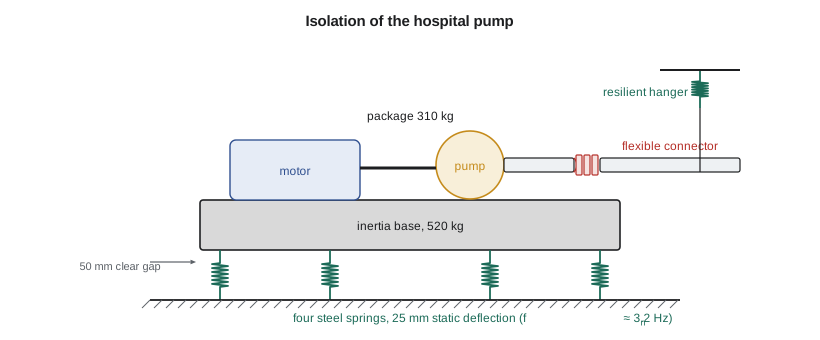
An inertia base is a concrete-filled steel frame on which the pump and motor are mounted, with the springs under the frame. Owen's design uses a 520 kg base under the 310 kg package. The base does not change the frequency ratio if the springs are sized for the total weight, since frequency depends on static deflection. It helps in four other ways. It lowers the centre of gravity, so the package rocks less on soft springs. It reduces the motion of the package caused by its own forces: above resonance the motion is mass controlled, so the program's running-speed motion falls from 1.05 µm with the package alone to 0.39 µm on the base. It resists the reaction forces from the pipe connections, which matter on a pump with soft springs. And it keeps the pump and motor in alignment, because the concrete is far stiffer than a fabricated baseplate.
Flanking paths
An isolator only works if it is the only path from the machine to the building. Vibration bypasses springs through rigid pipe connections, conduit, drain lines and anything that touches the base. Owen's design adds flexible connectors at the pump suction and discharge, resilient hangers on the first three pipe supports, a flexible conduit to the motor, and a clear gap of at least 50 mm (2 in) around the inertia base. Lucie's experience is that most isolation failures are flanking paths: a rigid pipe brace added by a well-meaning contractor, or a housekeeping pad poured up against the springs. The installation manual now shows these details with photographs.
Passing through resonance
A pump on 3.15 Hz springs passes through its mount resonance every time it starts and stops. During the run-up, the forcing frequency sweeps through 3.15 Hz in a fraction of a second, but during coast-down after a power failure it may pass slowly. Because the unbalance force at 3.15 Hz is only \((3.15/29.33)^2 = 1.2\) percent of its running value, the motion at resonance is small, about 4 µm with 5 percent damping. Larger effects come from the starting torque and from pressure surges, which can rock the base. Springs with built-in damping, or separate viscous dampers, limit this motion; Owen specifies housed springs with neoprene inserts, which add damping without much stiffness. The output also shows that damping of 1, 5 or 10 percent hardly changes the isolation at running speed (98.8, 98.4 and 97.5 percent), while it reduces the resonant transmissibility from 50 to 10 to 5.
Worked problem
Motion isolation for a balancing machine
Tidewater's new balancing machine (Lesson 6) sits near a large press, and the floor moves 20 µm at 29.3 Hz. The balancing machine on its own mounts has a natural frequency of 3.15 Hz and ζ = 0.05. What floor motion reaches the machine?
Show solution
- The frequency ratio is r = 29.33/3.15 = 9.3.
- Transmissibility, from the same formula: T = 0.016.
- Machine motion \(20 \times 0.016 = 0.32\) µm.
Answer: The machine sees about a third of a micrometre of floor motion, well below the resolution its measurements need. The same curve serves force and motion isolation.
Beyond the single-degree-of-freedom model
A real package on four springs has six rigid-body modes, not one. Vertical bounce is usually the highest-frequency mode; horizontal and rocking modes are lower, because springs are usually softer sideways. Each must be well below the forcing frequency, and the rocking modes are coupled to horizontal translation if the springs are not placed symmetrically about the centre of gravity. Isolator suppliers size springs so that each carries its share of the load and the static deflections are equal, which keeps the package level and decouples the modes as far as possible. Lesson 8 analyses coupled bounce and rocking with two degrees of freedom. For very soft systems on upper floors, a two-stage design with a floating floor may be needed.
Owen's final report to Codiac Regional Hospital gives the spring stiffness, 81 kN/m per spring (465 lbf/in), the inertia base design, the flexible connections and a commissioning check: measure the vibration on the floor below the pump with the pump running and stopped. The difference should be invisible. When it is installed, the floor velocity drops by a factor of more than 20, and the hum in the imaging suite disappears.
Common mistakes
MistakeChoosing a mount natural frequency near the forcing frequency.
InsteadIsolation needs r above √2; aim for r of 3 or more.
MistakeAdding damping to improve isolation at running speed.
InsteadDamping worsens isolation above r = √2; use it only to control resonance.
MistakeIgnoring the flexibility of an upper floor.
InsteadUse larger static deflections on long spans and upper floors.
MistakeLeaving rigid pipe and conduit connections.
InsteadUse flexible connectors and resilient hangers; remove flanking paths.
MistakeUsing rubber noise pads as vibration isolators.
InsteadPads with small deflection have high natural frequencies and can amplify.
Summary and key terms
- Force and motion transmissibility of a single-degree-of-freedom mount follow the same formula in r and ζ.
- Isolation occurs only above r = √2; transmissibility then falls roughly as 1/r².
- For 90 percent isolation at 29.3 Hz, the mount frequency must be below 8.8 Hz, a static deflection of 3.2 mm or more.
- The Codiac Regional Hospital design uses 25 mm springs (3.15 Hz) on a 520 kg inertia base for about 98 percent isolation.
- Damping limits resonance during start and stop but slightly reduces isolation at running speed.
- Flanking paths through pipes and conduit must be broken with flexible connectors and resilient hangers.
- Transmissibility
- The ratio of transmitted to applied force, or of transmitted to input motion.
- Force isolation
- Reducing the force a machine transmits to its supporting structure.
- Motion isolation
- Reducing the motion transmitted from a structure to sensitive equipment.
- Base excitation
- Vibration of a system driven by motion of its support.
- Isolation efficiency
- One minus the transmissibility.
- Inertia base
- A heavy concrete-filled frame that carries a machine on isolators.
- Flanking path
- A connection that carries vibration around an isolator.
- Static deflection
- The compression of an isolator under its share of the supported weight.
- Flexible connector
- A rubber or braided pipe section that breaks the vibration path along piping.
- Resilient hanger
- A pipe hanger with a spring or elastomer element.
Practice problems
Work each problem on paper first, then reveal the answer to check.
A fan runs at 20 Hz on mounts with f_n = 5 Hz. Find T, ignoring damping.
Show answer
1/(16 − 1) = 0.067: 93 percent isolation.
What static deflection gives f_n = 5 Hz?
Show answer
9.81/(2π·5)² = 9.9 mm.
At what frequency ratio does a mount give no isolation and no amplification?
Show answer
r = √2.
A 600 kg machine needs four springs with 12 mm deflection. Find the stiffness of each.
Show answer
600 × 9.81/(4 × 0.012) = 123 kN/m.
In the program, change the damping to 0.20. What isolation remains at running speed?
Show answer
About 95 percent (T ≈ 0.045).
Why does an inertia base reduce the running-speed motion of the package?
Show answer
Above resonance the motion is mass controlled, X ≈ F₀/(mω²); more mass, less motion.
Lesson quiz · 5 questions
Score 60% or more to complete this lesson.
Create a free account to save your progress, take quizzes and earn a certificate.