
MCAT-120 · Lesson 6 of 12 · 37 min
Thermochemistry: enthalpy, entropy and Gibbs free energy
▶ Video coming soon A video version of this lesson is on the way.
Thandiwe opened with a question she said she had asked every group she had coached. 'Ice melts on a warm day even though melting absorbs heat. Water freezes on a cold night even though freezing releases heat. What decides which way it goes?' Elliot said temperature. Ezequiel said energy. Devika, who had read ahead, said "both, through ΔG". 'All three of you are right,' Thandiwe said, 'and that is the lesson. Enthalpy tells you about heat, entropy tells you about spreading out, and temperature decides how much the spreading counts.'
This lesson covers systems and state functions, the first law of thermodynamics, enthalpy and Hess's law, heats of formation and bond energies, calorimetry, entropy and the second law, Gibbs free energy and spontaneity, and the link between ΔG and the equilibrium constant. On the AAMC outline this is content category 5E (principles of chemical thermodynamics and kinetics), with links to the bioenergetics in MCAT-110. The core idea that thermodynamics says whether a process can happen but not how fast is tested every year.
Systems, surroundings and state functions
The system is the part of the universe being studied, such as the contents of a flask; the surroundings are everything else. An open system exchanges matter and energy with its surroundings (a living cell), a closed system exchanges energy but not matter (a sealed flask), and an isolated system exchanges neither (an ideal insulated container). Processes can occur at constant temperature (isothermal), constant pressure (isobaric), constant volume (isochoric) or with no heat exchange (adiabatic).
A state function depends only on the current state of the system, not on how it got there. Enthalpy (H), entropy (S), Gibbs free energy (G), internal energy (U), pressure, volume and temperature are state functions. Heat (q) and work (w) are not; they depend on the path. Because ΔH, ΔS and ΔG are state functions, you can calculate them by any convenient route, which is the logic behind Hess's law.
The first law and enthalpy
The first law of thermodynamics states that energy is conserved: the change in a system's internal energy equals the heat added to it plus the work done on it, ΔU = q + w. With the sign convention used by most chemistry texts, heat absorbed by the system and work done on the system are positive. When a gas expands against a constant external pressure, it does work on the surroundings equal to PΔV, so w = −PΔV.
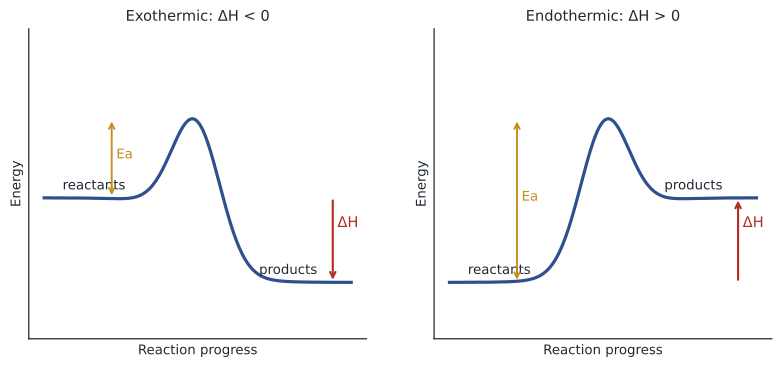
Most chemistry happens at constant pressure, open to the atmosphere. Enthalpy is defined so that its change equals the heat exchanged at constant pressure: ΔH = q_p. A negative ΔH means the reaction releases heat (exothermic) and the surroundings warm up; a positive ΔH means it absorbs heat (endothermic) and the surroundings cool, as in an instant cold pack in which ammonium nitrate dissolves.
Hess's law
Because enthalpy is a state function, the enthalpy change for a reaction is the same whether it occurs in one step or several. If a reaction can be written as the sum of other reactions, its ΔH is the sum of their ΔH values. Two rules make this work: reversing a reaction changes the sign of ΔH, and multiplying a reaction by a factor multiplies ΔH by the same factor.
Worked problem
Hess's law
Given C(s) + O₂(g) → CO₂(g), ΔH = −394 kJ, and CO(g) + ½ O₂(g) → CO₂(g), ΔH = −283 kJ, find ΔH for C(s) + ½ O₂(g) → CO(g).
Show solution
- Keep the first reaction as written: C + O₂ → CO₂, −394 kJ.
- Reverse the second: CO₂ → CO + ½ O₂, +283 kJ.
- Add them: C + O₂ + CO₂ → CO₂ + CO + ½ O₂. Cancel CO₂ and half an O₂: C + ½ O₂ → CO.
- ΔH = −394 + 283 = −111 kJ.
Answer: −111 kJ. This reaction is hard to measure directly because some CO₂ always forms, which is why Hess's law is useful.
Standard heats of formation
The standard enthalpy of formation, ΔH°f, is the enthalpy change when one mole of a compound forms from its elements in their standard states at 25 °C and 1 atm (or 1 bar). By definition ΔH°f is zero for an element in its standard state, such as O₂(g), C(graphite), H₂(g) or Fe(s). It is not zero for ozone (O₃), diamond or gaseous bromine, because those are not the most stable forms at 25 °C; the standard state of bromine is the liquid. Any reaction's standard enthalpy can be found from formation enthalpies.
Worked problem
Enthalpy of combustion of methane from formation data
Use ΔH°f values of CH₄(g) −75, CO₂(g) −394 and H₂O(l) −286 kJ/mol to find ΔH° for CH₄ + 2 O₂ → CO₂ + 2 H₂O(l).
Show solution
- Products: −394 + 2(−286) = −394 − 572 = −966 kJ.
- Reactants: −75 + 2(0) = −75 kJ, since O₂ is an element in its standard state.
- ΔH° = −966 − (−75) = −891 kJ.
Answer: About −890 kJ per mole of methane, which is why natural gas is a good fuel.
Bond energies
Bond dissociation energies give an estimate of ΔH for gas-phase reactions. Energy is absorbed to break bonds in the reactants and released when bonds form in the products. The order of subtraction is the reverse of the formation-enthalpy equation, a frequent source of sign errors. Because tabulated bond energies are averages over many compounds, this method gives approximate values.
Worked problem
Estimating ΔH from bond energies
Estimate ΔH for H₂ + Cl₂ → 2 HCl using bond energies H–H 436, Cl–Cl 243 and H–Cl 431 kJ/mol.
Show solution
- Bonds broken: 436 + 243 = 679 kJ.
- Bonds formed: 2 × 431 = 862 kJ.
- ΔH ≈ 679 − 862 = −183 kJ.
Answer: About −183 kJ: exothermic, because the bonds formed are stronger in total than the bonds broken.
Calorimetry
Calorimetry measures heat flow. In a constant-pressure (coffee-cup) calorimeter, the heat released by a reaction in solution warms the water, and q = mcΔT gives the heat. Because the calorimeter is at constant pressure, this heat equals ΔH. A bomb calorimeter is a sealed steel vessel in a water bath. It operates at constant volume, so it measures ΔU rather than ΔH, and its heat capacity as a whole (in joules per kelvin) is determined by calibration. Food energy values are measured by bomb calorimetry. For reactions involving only solids and liquids, or no change in moles of gas, ΔH and ΔU are nearly equal.
Worked problem
A coffee-cup calorimeter
50 millilitres of 1.0 M HCl and 50 millilitres of 1.0 M NaOH, both at 22.0 °C, are mixed in a coffee-cup calorimeter. The temperature rises to 28.8 °C. Assume the solution has a mass of 100 grams and a specific heat of 4.2 J/(g·K). Estimate ΔH per mole of water formed.
Show solution
- Heat absorbed by the solution: q = 100 × 4.2 × 6.8. Estimate 420 × 6.8 ≈ 2,860 joules, or about 2.9 kilojoules.
- Moles of water formed: 0.050 L × 1.0 M = 0.050 mole.
- The reaction released the heat, so ΔH is negative: −2.9 ÷ 0.050 ≈ −57 kJ/mol.
Answer: About −57 kJ per mole of water, the standard value for neutralization of a strong acid by a strong base.
Entropy and the second law
Entropy (S) measures how many ways energy and matter can be arranged in a system, informally its disorder or dispersal of energy. Entropy increases when a solid melts or a liquid vaporizes, when a gas expands, when a solid dissolves (usually), when the number of moles of gas increases in a reaction, and when temperature rises. Gases have much higher entropies than liquids, and liquids higher than solids. Unlike enthalpy, absolute entropies can be measured, and the standard molar entropy of an element in its standard state is not zero; the third law of thermodynamics sets the entropy of a perfect crystal at absolute zero to zero.
The second law of thermodynamics states that the entropy of the universe increases in every spontaneous process. A process can decrease the entropy of the system, as when water freezes or a protein folds, provided the entropy of the surroundings increases more. Freezing releases heat, which spreads into the surroundings and raises their entropy. For processes at constant temperature, ΔS of the surroundings equals −ΔH of the system divided by T. That connection is what leads to Gibbs free energy.
Worked problem
Predicting the sign of ΔS
Predict the sign of ΔS for (a) 2 H₂O₂(l) → 2 H₂O(l) + O₂(g); (b) N₂(g) + 3 H₂(g) → 2 NH₃(g); (c) NaCl(s) → Na⁺(aq) + Cl⁻(aq).
Show solution
- (a) A gas is produced from liquids, so entropy increases: ΔS > 0.
- (b) Four moles of gas become two, so entropy decreases: ΔS < 0.
- (c) An ordered solid becomes mobile ions in solution, so entropy usually increases: ΔS > 0, although the ordering of water around the ions offsets part of the gain.
Answer: (a) positive, (b) negative, (c) positive.
Gibbs free energy and spontaneity
Gibbs free energy combines enthalpy and entropy into a single test for spontaneity at constant temperature and pressure.
A negative ΔG means the process is spontaneous (exergonic) in the forward direction; a positive ΔG means it is nonspontaneous (endergonic) and the reverse is spontaneous; ΔG equal to zero means the system is at equilibrium. "Spontaneous" means thermodynamically favourable, not fast. Diamond turning into graphite is spontaneous at room temperature and pressure, but it is immeasurably slow. Rates are a matter of activation energy and kinetics, lesson 7.
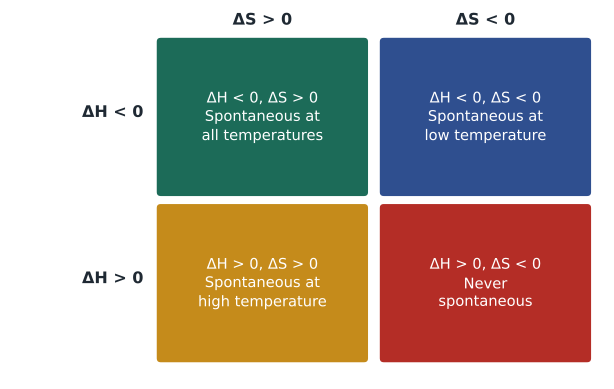
The signs of ΔH and ΔS determine how temperature affects spontaneity, and the four combinations form a classic MCAT table.
| ΔH | ΔS | ΔG | Example |
|---|---|---|---|
| − | + | Negative at all temperatures | Combustion of glucose |
| − | − | Negative at low temperature only | Water freezing |
| + | + | Negative at high temperature only | Ice melting |
| + | − | Positive at all temperatures | Making glucose from CO₂ and water without an energy input |
When ΔH and ΔS have the same sign, the crossover temperature where ΔG = 0 is T = ΔH ÷ ΔS. For a phase change at its transition temperature, this gives a link between the enthalpy and entropy of the transition: ΔS of vaporization equals ΔH of vaporization divided by the boiling point.
Worked problem
Crossover temperature
A reaction has ΔH = +30 kJ/mol and ΔS = +100 J/(mol·K). Above what temperature is it spontaneous?
Show solution
- Convert units so they match: ΔH = 30,000 J/mol.
- T = ΔH ÷ ΔS = 30,000 ÷ 100 = 300 K.
- Above 300 K the TΔS term exceeds ΔH, so ΔG is negative.
Answer: Above about 300 K (27 °C). A frequent error is to divide kilojoules by joules and get 0.3 K.
Free energy and equilibrium
The standard free energy change, ΔG°, refers to all species in their standard states (1 M solutions, 1 atm gases, 25 °C). Under any other conditions, the actual ΔG depends on the reaction quotient Q, which has the same form as the equilibrium constant but uses current concentrations (lesson 8). At equilibrium, ΔG = 0 and Q = K, which gives a direct relationship between ΔG° and K.
You do not need to calculate natural logarithms on the MCAT, but you should know the relationships. If ΔG° is negative, K is greater than 1 and products are favoured at equilibrium. If ΔG° is positive, K is less than 1 and reactants are favoured. If ΔG° is zero, K equals 1. At 25 °C each change of about 5.7 kilojoules per mole in ΔG° changes K by a factor of 10. Biochemistry uses a modified standard state, ΔG°′, at pH 7, because a 1 M proton concentration is not biological.
The equation for ΔG also explains coupling in metabolism. A reaction with a positive ΔG° can proceed in a cell if the cell keeps Q very small by removing product quickly, or if the reaction is coupled to ATP hydrolysis (ΔG°′ about −30 kilojoules per mole) so that the combined ΔG is negative. This is the logic behind the irreversible steps of glycolysis covered in MCAT-110.
Passage-style practice
Passage. A student studied the dissolution of two salts used in commercial instant hot and cold packs. She dissolved 0.10 mole of each salt in 100 grams of water in a coffee-cup calorimeter and recorded the temperature change. She also looked up standard entropy changes of solution. Data invented for this course, though the signs match real behaviour.
| Salt | Temperature change of the water (°C) | ΔS° of solution (J/(mol·K)) |
|---|---|---|
| Calcium chloride, CaCl₂ | +19 | −45 |
| Ammonium nitrate, NH₄NO₃ | −6 | +110 |
Practice problems
Work each problem on paper first, then reveal the answer to check.
Which salt dissolves exothermically, and how do you know? (Skill 4: data-based reasoning)
Show answer
Calcium chloride. The water warmed, so the dissolving salt released heat and ΔH is negative.
Estimate ΔH of solution for ammonium nitrate per mole. Use c = 4.2 J/(g·K) and ignore the mass of the salt. (Skill 4)
Show answer
q absorbed from the water = 100 × 4.2 × 6 ≈ 2,500 joules for 0.10 mole, so ΔH ≈ +25 kJ/mol.
Ammonium nitrate dissolves spontaneously even though the process is endothermic. Explain. (Skill 2: scientific reasoning)
Show answer
Its entropy of solution is large and positive, so at room temperature the −TΔS term outweighs the positive ΔH and ΔG is negative.
Calcium chloride has a negative entropy of solution. Suggest a molecular reason. (Skill 2)
Show answer
The small, doubly charged Ca²⁺ ion organizes many water molecules tightly around itself, and that ordering outweighs the entropy gained from breaking up the crystal.
Predict how the solubility of calcium chloride would change at a much higher temperature, based only on ΔG = ΔH − TΔS. (Skill 2)
Show answer
Dissolution would become less favourable, because with ΔS negative, raising T makes the −TΔS term more positive.
Common mistakes
MistakeA spontaneous reaction happens quickly.
InsteadSpontaneity is about thermodynamics; rate depends on activation energy.
MistakeExothermic reactions are always spontaneous.
InsteadAn exothermic reaction with a large negative ΔS can be nonspontaneous at high temperature.
MistakeΔH°f of O₂(g) is not zero because oxygen is reactive.
InsteadEvery element in its standard state has a formation enthalpy of zero.
MistakeWith bond energies, subtract reactants from products.
InsteadWith bond energies, use bonds broken minus bonds formed.
MistakeMixing kilojoules and joules in T = ΔH ÷ ΔS is harmless.
InsteadConvert to matching units first, usually joules.
Summary and key terms
- State functions (H, S, G, U) depend only on the state; heat and work depend on the path.
- At constant pressure ΔH equals heat exchanged; negative ΔH is exothermic.
- Hess's law sums the ΔH of steps; formation enthalpies give ΔH as products minus reactants; bond energies give broken minus formed.
- Coffee-cup calorimeters measure ΔH at constant pressure; bomb calorimeters measure ΔU at constant volume.
- The entropy of the universe increases in spontaneous processes; more moles of gas and higher temperature raise entropy.
- ΔG = ΔH − TΔS decides spontaneity; ΔG° = −RT ln K links free energy to equilibrium.
- State function
- A property that depends only on the current state of a system.
- Enthalpy
- Heat content at constant pressure; ΔH equals the heat exchanged at constant pressure.
- Exothermic
- Releasing heat to the surroundings (ΔH negative).
- Hess's law
- The enthalpy change of a reaction equals the sum of the enthalpy changes of steps that add up to it.
- Standard enthalpy of formation
- ΔH for forming one mole of a compound from its elements in their standard states.
- Entropy
- A measure of the dispersal of energy and the number of arrangements available to a system.
- Gibbs free energy
- G = H − TS; its change at constant temperature and pressure decides spontaneity.
- Exergonic
- Having a negative ΔG; spontaneous.
Practice problems
Work each problem on paper first, then reveal the answer to check.
What is the sign of ΔS for the condensation of steam?
Show answer
Negative: gas becomes liquid.
If ΔG° for a reaction is positive, is K greater or less than 1?
Show answer
Less than 1; reactants are favoured at equilibrium.
A reaction has ΔH = −100 kJ and ΔS = −200 J/K. Is it spontaneous at 400 K?
Show answer
ΔG = −100 − 400(−0.200) = −100 + 80 = −20 kJ, so yes.
Why does a bomb calorimeter measure ΔU rather than ΔH?
Show answer
It works at constant volume, so no pressure-volume work is done and the heat equals ΔU.
Reverse a reaction with ΔH = −50 kJ and double it. What is the new ΔH?
Show answer
+100 kJ.
Lesson quiz · 5 questions
Score 60% or more to complete this lesson.
Create a free account to save your progress, take quizzes and earn a certificate.