
MCAT-120 · Lesson 10 of 12 · 32 min
Solutions and solubility
▶ Video coming soon A video version of this lesson is on the way.
Devika brought a question from her Thursday pharmacy shift. A customer had asked why her doctor had told her to drink plenty of water while taking a particular medicine. The pharmacist had explained that the drug could crystallize in the kidneys if urine became too concentrated. 'That,' Thandiwe said, 'is a Ksp problem in a real body. The kidney is a beaker. When the product of the ion concentrations passes the solubility product, crystals form. Kidney stones work the same way.' She showed a slide titled "Will it dissolve, and how much?" and said those were the two questions of the lesson.
This lesson covers the dissolution process and solvation, "like dissolves like", solubility rules, the solubility product Ksp and molar solubility, the ion product and precipitation, the common-ion effect, complex ion formation, the effects of temperature and pressure on solubility (including Henry's law), and the colligative properties: vapour pressure lowering, boiling point elevation, freezing point depression and osmotic pressure. On the AAMC outline these topics belong to content category 5A (the unique nature of water and its solutions), with osmotic pressure linking to 5E and to membrane transport in MCAT-111.
What happens when something dissolves
A solution is a homogeneous mixture of a solute dissolved in a solvent. Dissolving involves three steps. Solute particles must be separated from each other (which costs energy), solvent molecules must be pushed apart to make room (which also costs energy), and solute and solvent particles then attract each other (which releases energy). The surrounding of solute particles by solvent molecules is solvation, or hydration when the solvent is water. The overall enthalpy of solution can be negative (the solution warms, as with calcium chloride) or positive (it cools, as with ammonium nitrate), and lesson 6 showed that entropy often decides whether dissolving is spontaneous.
The rule "like dissolves like" summarizes which combinations work. Polar and ionic solutes dissolve in polar solvents such as water, because the solute-solvent attractions (ion-dipole, hydrogen bonding, dipole-dipole) can replace the attractions that held each pure substance together. Nonpolar solutes dissolve in nonpolar solvents such as hexane, where dispersion forces are similar in solute and solvent. Oil does not dissolve in water mainly because water molecules would have to give up their hydrogen bonds and arrange themselves into ordered cages around the oil, which lowers entropy. That same hydrophobic effect drives membrane formation and protein folding.
Molecules with a polar head and a long nonpolar tail, such as soaps, detergents and bile salts, form micelles in water, with tails pointing inward and heads facing the water. Micelles carry nonpolar substances, from grease on dishes to dietary fats in the gut, into aqueous solution. Phospholipids form bilayers rather than micelles because their two tails make them roughly cylindrical in shape.
Electrolytes
Solutes that produce ions in solution are electrolytes, and their solutions conduct electricity. Strong electrolytes, such as soluble salts and strong acids, dissociate completely. Weak electrolytes, such as acetic acid and ammonia, ionize only partly. Nonelectrolytes, such as glucose and ethanol, dissolve as intact molecules. The number of particles each formula unit produces is the van 't Hoff factor, i, used in the colligative property equations below: i is about 1 for glucose, 2 for NaCl, 3 for CaCl₂ and 4 for FeCl₃. Real solutions give slightly lower values because some oppositely charged ions pair up, but the MCAT almost always uses the ideal values.
Solubility rules
A few rules predict which ionic compounds dissolve in water, and they appear in precipitation passages.
| Generally soluble | Important exceptions |
|---|---|
| Salts of group 1 metals (Li⁺, Na⁺, K⁺) and ammonium (NH₄⁺) | None common |
| Nitrates (NO₃⁻), acetates (CH₃COO⁻) and perchlorates (ClO₄⁻) | None common |
| Chlorides, bromides and iodides | Ag⁺, Pb²⁺ and Hg₂²⁺ salts are insoluble |
| Sulfates (SO₄²⁻) | Ba²⁺, Pb²⁺, Ca²⁺ (sparingly), Sr²⁺ salts are insoluble or poorly soluble |
Most hydroxides, carbonates, phosphates and sulfides are insoluble, except with group 1 metals or ammonium. Calcium phosphate is the main mineral of bone and tooth enamel, and calcium oxalate and calcium phosphate are the most common components of kidney stones. Barium sulfate is so insoluble that it can be swallowed safely as a contrast agent for X-ray imaging of the gut, even though dissolved barium ions are toxic.
The solubility product
For a sparingly soluble salt in equilibrium with its saturated solution, the equilibrium constant is the solubility product, Ksp. The solid is omitted from the expression, as in lesson 8. For a salt MₐXᵦ, Ksp = [M]ᵃ[X]ᵇ.
Molar solubility, s, is the number of moles of the salt that dissolve per litre of saturated solution. To relate s to Ksp, write the ion concentrations in terms of s using the formula of the salt.
| Salt type | Example | Ion concentrations | Ksp in terms of s |
|---|---|---|---|
| MX | AgCl | [Ag⁺] = s, [Cl⁻] = s | s² |
| MX₂ | CaF₂ | [Ca²⁺] = s, [F⁻] = 2s | 4s³ |
| M₂X | Ag₂CrO₄ | [Ag⁺] = 2s, [CrO₄²⁻] = s | 4s³ |
| M₃X₂ | Ca₃(PO₄)₂ | [Ca²⁺] = 3s, [PO₄³⁻] = 2s | 108s⁵ |
Worked problem
Molar solubility from Ksp
The Ksp of calcium fluoride, CaF₂, is about 4 × 10⁻¹¹. What is its molar solubility, and what is the fluoride concentration in a saturated solution?
Show solution
- CaF₂(s) ⇌ Ca²⁺ + 2 F⁻, so Ksp = [Ca²⁺][F⁻]² = (s)(2s)² = 4s³.
- 4s³ = 4 × 10⁻¹¹, so s³ = 1 × 10⁻¹¹.
- The cube root of 10⁻¹¹ is about 2.2 × 10⁻⁴ (because 2.2³ ≈ 10.6 and 10⁻¹² has cube root 10⁻⁴). So s ≈ 2 × 10⁻⁴ M.
- [F⁻] = 2s ≈ 4 × 10⁻⁴ M.
Answer: Molar solubility about 2 × 10⁻⁴ M; fluoride about 4 × 10⁻⁴ M.
Ksp values can be compared directly only for salts of the same formula type. Silver bromide (Ksp about 5 × 10⁻¹³) is less soluble than silver chloride (Ksp about 1.8 × 10⁻¹⁰), because both are MX salts and AgBr has the smaller Ksp. For salts of different types, such as AgCl and Ag₂CrO₄, you must calculate the molar solubility of each before comparing, because the exponents differ. This is a frequent trap.
Will a precipitate form?
To predict precipitation, compare the ion product Q (the reaction quotient for dissolution, written like Ksp but with the current concentrations) with Ksp. If Q is less than Ksp, the solution is unsaturated and more solid can dissolve. If Q equals Ksp, the solution is saturated and at equilibrium. If Q is greater than Ksp, the solution is supersaturated and a precipitate forms until Q falls to Ksp. Remember to account for dilution when two solutions are mixed: each concentration falls in proportion to the increase in total volume.
Worked problem
Predicting precipitation
Equal volumes of 2 × 10⁻⁴ M silver nitrate and 2 × 10⁻⁴ M sodium chloride are mixed. Will silver chloride precipitate? (Ksp = 1.8 × 10⁻¹⁰.)
Show solution
- Mixing equal volumes halves each concentration: [Ag⁺] = [Cl⁻] = 1 × 10⁻⁴ M.
- Q = (1 × 10⁻⁴)(1 × 10⁻⁴) = 1 × 10⁻⁸.
- 1 × 10⁻⁸ is greater than 1.8 × 10⁻¹⁰.
Answer: Yes. Q exceeds Ksp by a factor of about 50, so AgCl precipitates.
The common-ion effect and complex ions
A salt is less soluble in a solution that already contains one of its ions. Adding chloride to a saturated AgCl solution raises Q above Ksp and drives the dissolution equilibrium to the left, so more solid forms. The solubility of AgCl in 0.10 M NaCl is about 1.8 × 10⁻⁹ M, roughly ten thousand times lower than in pure water. Note that Ksp itself has not changed, only the molar solubility.
Solubility can also be increased by removing one of the ions. Silver chloride dissolves in aqueous ammonia because silver ions form the complex ion Ag(NH₃)₂⁺, with a large formation constant, Kf. Removing free Ag⁺ pulls the dissolution equilibrium forward. Similarly, salts whose anions are bases, such as carbonates, hydroxides, phosphates and fluorides, become more soluble in acid, because the acid converts the anion to its conjugate acid. That is why acidic foods and drinks erode tooth enamel (calcium hydroxyapatite) and why fluoride, which forms the less soluble and less basic fluorapatite, protects teeth.
Temperature, pressure and solubility
The solubility of most solids in water increases with temperature, although some salts, such as cerium sulfate, become less soluble. The solubility of gases in liquids always decreases as temperature rises, because gas molecules gain enough kinetic energy to escape. Warm water holds less oxygen than cold water, which matters for fish and for the oxygen supply in warm-water lakes.
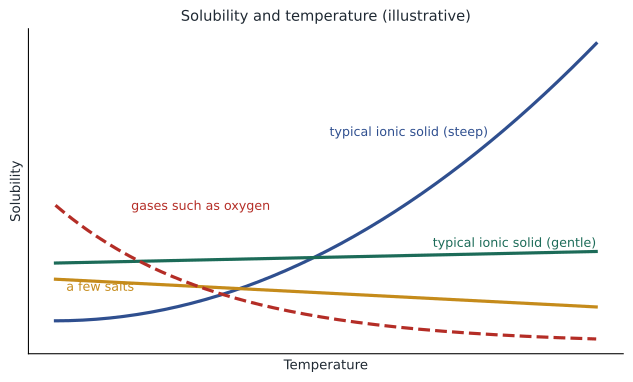
Pressure has little effect on the solubility of solids and liquids, but a large effect on gases. Henry's law states that the concentration of a dissolved gas is proportional to its partial pressure above the solution: C = kH × P, where kH is the Henry's law constant for that gas in that solvent at that temperature. Opening a carbonated drink lowers the CO₂ pressure above it, and the dissolved gas comes out as bubbles. Breathing compressed air at depth dissolves more nitrogen in the blood, and rising too quickly releases it as bubbles, causing decompression sickness. Lesson 5's hyperbaric oxygen passage applied the same law.
Colligative properties
Colligative properties depend on the number of dissolved particles, not on their identity. All four arise because solute particles lower the tendency of solvent molecules to escape from the solution or to freeze. Each uses the van 't Hoff factor to count particles.
Vapour pressure lowering follows Raoult's law: the vapour pressure of the solvent above a solution equals its mole fraction times the vapour pressure of the pure solvent. A nonvolatile solute lowers the solvent's mole fraction and so its vapour pressure. Because the solution needs a higher temperature to reach a vapour pressure of 1 atm, its boiling point rises.
Boiling point elevation and freezing point depression are proportional to molality (moles of solute per kilogram of solvent) times i. For water, Kb is about 0.51 °C per molal and Kf about 1.86 °C per molal. Salt is spread on icy roads because it lowers the freezing point of water; antifreeze in car radiators lowers the freezing point and raises the boiling point of the coolant. Freezing point depression is also used to measure the osmolality of blood and urine in clinical laboratories.
Worked problem
Freezing point of a salt solution
Estimate the freezing point of a solution of 0.50 mole of NaCl in 1.0 kilogram of water. (Kf = 1.86 °C/m.)
Show solution
- Molality = 0.50 m. NaCl gives two ions, so i = 2.
- ΔTf = 2 × 1.86 × 0.50 = 1.86 °C.
Answer: About −1.9 °C. The same number of moles of glucose would lower the freezing point by only about 0.93 °C.
Osmotic pressure is the pressure needed to stop the net flow of solvent across a semipermeable membrane from pure solvent (or a dilute solution) into a more concentrated solution. It is the colligative property most important in biology. The equation Π = iMRT resembles the ideal gas law, with molarity in place of n/V. A 0.30 osmolar solution (about the osmolarity of blood plasma) has an osmotic pressure of about 0.30 × 0.0821 × 310, or roughly 7.6 atmospheres at body temperature, a striking pressure for a mild-tasting solution.
Solutions with the same osmotic pressure as cells are isotonic; lower, hypotonic; higher, hypertonic. Red blood cells swell and may burst (lyse) in hypotonic solutions, and they shrink (crenate) in hypertonic ones. That is why intravenous fluids are made isotonic, as with 0.9 percent saline (about 0.15 M NaCl, or 0.30 osmolar) and 5 percent dextrose. Tonicity depends on solutes that cannot cross the membrane; urea, which crosses cell membranes freely, contributes to osmolarity but not to tonicity. MCAT-111 covers osmosis at the cell membrane in more depth.
| Solution | Approximate osmolarity | Effect on red blood cells |
|---|---|---|
| Pure water | 0 | Swell and lyse (hypotonic) |
| 0.9 percent NaCl (0.15 M) | 0.30 osmolar | No change (isotonic) |
| 0.30 M glucose | 0.30 osmolar | No change at first (isotonic) |
| 3 percent NaCl (about 0.51 M) | About 1.0 osmolar | Shrink (hypertonic) |
Passage-style practice
Passage. A clinical team studied why some patients taking a sulfonamide antibiotic developed crystals in their urine. The drug's solubility in urine depends on pH, because its un-ionized form is much less soluble than its ionized (anionic) form. The drug has a pKa of 7.4. The team measured crystal formation in urine samples at three pH values and two urine volumes. Data invented for this course.
| Urine pH | Daily urine volume | Crystals observed? |
|---|---|---|
| 5.4 | 1.0 litre | Yes, heavy |
| 5.4 | 3.0 litres | Yes, light |
| 7.4 | 1.0 litre | Occasionally |
| 8.4 | 1.0 litre | No |
Practice problems
Work each problem on paper first, then reveal the answer to check.
At pH 5.4, what is the ratio of ionized to un-ionized drug? (Skill 4: data-based reasoning)
Show answer
pH − pKa = −2, so the ratio [A⁻]/[HA] is 10⁻², about 1 to 100. Almost all the drug is in the poorly soluble un-ionized form.
Why does raising the urine pH to 8.4 prevent crystals? (Skill 2: scientific reasoning)
Show answer
At pH 8.4 the ratio of ionized to un-ionized drug is 10 to 1, so most of the drug is in the soluble anionic form.
Why did increasing urine volume reduce crystal formation at pH 5.4? (Skill 2)
Show answer
A larger volume dilutes the drug, lowering its concentration and so the ion product (or concentration of un-ionized drug) below the solubility limit more often.
Which colligative property would a laboratory most likely use to measure the total solute concentration of these urine samples? (Skill 1: knowledge of scientific concepts)
Show answer
Freezing point depression, which is how osmometers commonly measure urine osmolality.
A second drug forms crystals only in alkaline urine. What can you infer about it? (Skill 2)
Show answer
It is likely a weak base, whose un-ionized (neutral) form predominates and is poorly soluble at high pH.
Common mistakes
MistakeA smaller Ksp always means a less soluble salt.
InsteadThat comparison works only for salts of the same formula type; otherwise calculate molar solubility.
MistakeThe common-ion effect lowers Ksp.
InsteadKsp is unchanged; the molar solubility falls.
MistakeGases become more soluble in warm water.
InsteadGas solubility decreases as temperature rises.
MistakeColligative properties depend on what the solute is.
InsteadThey depend on the number of dissolved particles; use the van 't Hoff factor.
MistakeAny solution with the same osmolarity as cells is isotonic.
InsteadTonicity depends on nonpenetrating solutes; a penetrating solute such as urea does not hold water outside the cell.
Summary and key terms
- Dissolving balances the energy of breaking solute and solvent attractions against forming solute-solvent attractions; "like dissolves like".
- Electrolytes produce ions; the van 't Hoff factor counts particles per formula unit.
- Ksp is the equilibrium constant for dissolving a sparingly soluble salt; relate it to molar solubility using the formula.
- Compare Q with Ksp to predict precipitation; common ions lower solubility; complex formation and acid can raise it.
- Most solids dissolve better when warm; gases dissolve less when warm and more under higher partial pressure (Henry's law).
- Vapour pressure lowering, boiling point elevation, freezing point depression and osmotic pressure depend on particle count.
- Solvation
- The surrounding of solute particles by solvent molecules.
- Electrolyte
- A solute that produces ions in solution.
- Van 't Hoff factor
- The number of particles a solute produces per formula unit in solution.
- Solubility product
- The equilibrium constant for the dissolution of a sparingly soluble ionic solid.
- Molar solubility
- The moles of a solute that dissolve per litre of saturated solution.
- Henry's law
- The concentration of a dissolved gas is proportional to its partial pressure.
- Colligative property
- A solution property that depends on the number of solute particles.
- Osmotic pressure
- The pressure needed to stop net flow of solvent into a solution across a semipermeable membrane.
- Isotonic
- Having the same effective osmotic pressure as a cell, so there is no net water flow.
Practice problems
Work each problem on paper first, then reveal the answer to check.
Which is more soluble in water, ethanol or octane?
Show answer
Ethanol, which is polar and forms hydrogen bonds with water.
Write the Ksp expression for PbI₂.
Show answer
Ksp = [Pb²⁺][I⁻]².
A salt MX has Ksp = 1 × 10⁻¹⁰. What is its molar solubility?
Show answer
s = √(10⁻¹⁰) = 1 × 10⁻⁵ M.
Which solution has the lowest freezing point: 0.1 m glucose, 0.1 m NaCl or 0.1 m CaCl₂?
Show answer
0.1 m CaCl₂, which gives three particles per formula unit.
Why does a can of soda go flat faster when warm?
Show answer
CO₂ is less soluble at higher temperature, so it escapes from solution more readily.
What happens to a red blood cell placed in distilled water?
Show answer
The surroundings are hypotonic, so water flows into the cell by osmosis, and the cell swells and may lyse.
Lesson quiz · 5 questions
Score 60% or more to complete this lesson.
Create a free account to save your progress, take quizzes and earn a certificate.