
MCAT-110 · Lesson 8 of 12 · 23 min
Bioenergetics
▶ Video coming soon A video version of this lesson is on the way.
Devika's weak spot was calculation, and she had dreaded this session. 'Delta G, natural logs, reduction potentials. It is physics pretending to be biology.' Thandiwe disagreed. 'It is accounting. Cells have income and expenses, and ATP is the currency. The MCAT will not ask you to compute a natural log to three decimals. It will ask whether a reaction can go, which way, and what pays for it.'
Bioenergetics is the study of how living things capture, store and spend energy. The AAMC outline lists the principles of bioenergetics at the start of content category 1D, and the same thermodynamics appears in Chem/Phys under category 5E, on the principles of chemical thermodynamics and kinetics. This lesson covers free energy and spontaneity, standard and actual free-energy changes, the link between free energy and equilibrium, the role of ATP and energy coupling, and biological oxidation and reduction. Lessons 9 to 11 then apply these ideas to metabolic pathways.
Free energy and spontaneity
The Gibbs free-energy change, delta G, tells you whether a process can occur on its own at constant temperature and pressure. It combines the change in enthalpy, delta H, roughly the heat released or absorbed, with the change in entropy, delta S, a measure of disorder: delta G equals delta H minus the temperature times delta S. A negative delta G means the process is spontaneous, or exergonic, in the direction written. A positive delta G means it is non-spontaneous, or endergonic, as written, and spontaneous in reverse. A delta G of zero means the system is at equilibrium.
Spontaneous does not mean fast. The burning of glucose has a large negative delta G, yet a spoonful of sugar sits on the table unchanged for years, because the activation energy is high. Delta G describes whether a reaction can go; kinetics, and enzymes, decide how fast. Questions that mix these ideas are common: an enzyme can make a spontaneous reaction fast, but it cannot make a non-spontaneous one go.
| Delta H | Delta S | Delta G | Spontaneity |
|---|---|---|---|
| Negative | Positive | Always negative | Spontaneous at all temperatures |
| Positive | Negative | Always positive | Non-spontaneous at all temperatures |
| Negative | Negative | Negative at low temperature | Spontaneous only below a certain temperature |
| Positive | Positive | Negative at high temperature | Spontaneous only above a certain temperature |
Protein folding is a good example of the third row. Folding releases heat as weak bonds form, but the chain becomes more ordered, so the protein's own entropy falls. At body temperature the overall delta G is negative, largely because burying nonpolar groups increases the entropy of water, as lesson 1 explained. At high temperatures, the entropy term wins, and proteins unfold.
Standard and actual free-energy changes
Biochemists use a standard free-energy change, written delta G prime zero (delta G with a degree sign and a prime), measured under standard biochemical conditions: 1 molar concentrations of reactants and products, pH 7, 25 degrees Celsius and 1 atmosphere. It is a fixed property of the reaction. The actual free-energy change in a cell, delta G, depends on the real concentrations, through the relation delta G equals delta G prime zero plus RT times the natural log of Q, where Q is the reaction quotient, the ratio of product to reactant concentrations at that moment, R is the gas constant and T the absolute temperature.
The relationship has two practical consequences. First, a reaction with a positive standard free-energy change can still run forward in a cell if the products are kept scarce or the reactants plentiful, making Q small enough. Many steps of metabolic pathways work this way: the next enzyme in the pathway removes the product as soon as it forms. Second, when the system reaches equilibrium, delta G is zero and Q equals the equilibrium constant, K. Substituting gives delta G prime zero equals negative RT times the natural log of K.
You do not need to compute logarithms on the test, but one rule makes estimation easy. At 25 degrees Celsius, RT is about 2.5 kilojoules per mole, and multiplying by the natural log of 10, about 2.3, gives about 5.7. So each tenfold change in K corresponds to about 5.7 kilojoules per mole in the standard free-energy change. A reaction with K equal to 1 has a standard free-energy change of zero; K equal to 1,000 corresponds to about negative 17; K equal to 0.01 corresponds to about positive 11.
Worked problem
Estimating free energy from an equilibrium constant
At 25 degrees Celsius, the isomerization of dihydroxyacetone phosphate to glyceraldehyde 3-phosphate has an equilibrium constant of about 0.05. Estimate its standard free-energy change and explain how glycolysis keeps the reaction moving forward.
Show solution
- 0.05 lies between 0.1 and 0.01: about 1.3 factors of ten below 1.
- Each factor of ten is about 5.7 kilojoules per mole, so the standard free-energy change is about positive 7.5.
- The positive value means that at equilibrium, dihydroxyacetone phosphate is favoured.
- In cells, the next enzyme of glycolysis consumes glyceraldehyde 3-phosphate quickly, keeping Q far below K, so the actual delta G is negative.
Answer: About positive 7.5 kilojoules per mole. Removal of product by the next step makes the actual delta G negative, so the reaction runs forward.
Metabolic reactions can be grouped by how far they are from equilibrium in cells. Most steps operate near equilibrium, with actual delta G close to zero; they can run in either direction depending on small changes in concentration. A few steps are held far from equilibrium, with large negative actual delta G values. These are effectively irreversible, and they are where pathways are regulated, because controlling the enzyme of an irreversible step controls the flow through the whole pathway. A pathway that runs in the opposite direction, such as gluconeogenesis against glycolysis, must bypass those steps with different enzymes.
ATP: the energy currency
Adenosine triphosphate, ATP, links energy-releasing processes to energy-requiring ones. Hydrolysis of ATP to ADP and inorganic phosphate has a standard free-energy change of about negative 30.5 kilojoules per mole, or about negative 7.3 kilocalories per mole. In cells, where ATP is kept far above its equilibrium concentration relative to ADP and phosphate, the actual value is larger, often negative 50 to negative 60 kilojoules per mole.
Why is ATP hydrolysis so favourable? Three features of the molecule contribute. The negative charges on its three phosphate groups repel one another, and hydrolysis relieves some of that repulsion. The products, ADP and phosphate, are more stabilized by resonance than ATP. And the products are more extensively hydrated by water. The phrase "high-energy bond" is a shorthand; the energy is not stored in a single bond but in the difference between the reactants and the products.
ATP sits in the middle of a scale of phosphoryl group transfer potential. Compounds with a more negative standard free energy of hydrolysis than ATP can transfer their phosphate to ADP to make ATP; ATP, in turn, can phosphorylate compounds lower on the scale.
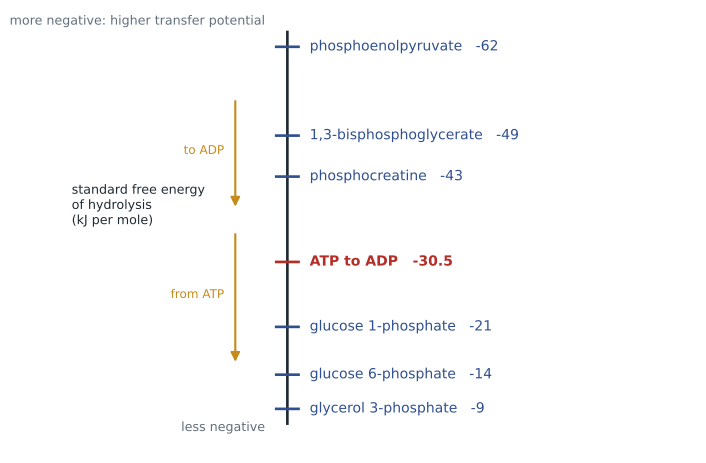
This scale explains substrate-level phosphorylation, in which ATP is made directly by transferring a phosphate from a high-energy metabolite to ADP. Two steps of glycolysis do this, using 1,3-bisphosphoglycerate and phosphoenolpyruvate. It also explains phosphocreatine, a reserve in muscle and brain that regenerates ATP from ADP within seconds when demand spikes.
Energy coupling
Free-energy changes are additive. When two reactions share an intermediate, the delta G of the combined reaction equals the sum of the two. A cell can therefore drive an unfavourable reaction by coupling it to a favourable one, most often ATP hydrolysis.
Phosphorylating glucose with free phosphate has a standard free-energy change of about positive 13.8 kilojoules per mole, so it does not proceed on its own. Hexokinase instead transfers a phosphate from ATP to glucose. Adding positive 13.8 and negative 30.5 gives about negative 16.7 kilojoules per mole for the coupled reaction, which is favourable. The coupling is real only because a single enzyme carries out both parts at once; ATP hydrolysis happening elsewhere in the cell would not help.
Cells also couple reactions to ion gradients. The proton gradient across the inner mitochondrial membrane stores energy that ATP synthase uses to make ATP, and the sodium gradient across the plasma membrane drives secondary active transport, as lesson 6 described.
Biological oxidation and reduction
Most of the energy cells capture from food comes from oxidation. Oxidation is the loss of electrons, and reduction is the gain of electrons; the two always occur together. In organic molecules, oxidation often means losing hydrogen atoms or gaining bonds to oxygen, and reduction means gaining hydrogen. A useful mnemonic is "OIL RIG": oxidation is loss, reduction is gain. Fatty acids, with long chains of carbon-hydrogen bonds, are highly reduced and therefore release more energy per carbon when oxidized than glucose, which already carries many bonds to oxygen.
Cells transfer electrons from fuels using electron carriers. NAD-positive accepts two electrons and one proton, a hydride ion, to become NADH. FAD accepts two electrons and two protons to become FADH2. NADH and FADH2 then deliver their electrons to the electron transport chain, where they reduce oxygen to water. NADPH, a closely related carrier with an extra phosphate, supplies electrons for building molecules, such as fatty acids and cholesterol, and for antioxidant defences; lesson 9 explains where it comes from.
The tendency of a molecule to accept electrons is measured by its standard reduction potential, E prime zero, in volts. Electrons flow spontaneously from a carrier with a more negative reduction potential to one with a more positive potential. The free-energy change of an electron transfer is delta G prime zero equals negative n times F times delta E prime zero, where n is the number of electrons transferred and F is the Faraday constant, about 96,500 coulombs per mole. A positive delta E gives a negative delta G.
| Half-reaction (written as reduction) | Approximate E prime zero (volts) |
|---|---|
| NAD-positive plus a proton plus 2 electrons to NADH | Negative 0.32 |
| FAD plus 2 protons plus 2 electrons to FADH2 (in enzymes, varies) | About 0, varies with the protein |
| Ubiquinone to ubiquinol | Positive 0.05 |
| Cytochrome c (iron 3 plus to iron 2 plus) | Positive 0.25 |
| Half an oxygen molecule plus 2 protons plus 2 electrons to water | Positive 0.82 |
Electrons passing from NADH to oxygen fall across a difference of about 1.14 volts. With two electrons, the standard free-energy change is about negative 2 times 96.5 times 1.14, or about negative 220 kilojoules per mole, enough in principle to make several ATP. The electron transport chain releases this energy in steps, using it to pump protons, as lesson 10 explains.
Worked problem
Deciding the direction of electron flow
Ubiquinone has a reduction potential of about positive 0.05 volts and cytochrome c about positive 0.25 volts. In which direction will electrons flow spontaneously, and what is the sign of delta G?
Show solution
- Electrons flow toward the carrier with the more positive reduction potential.
- Cytochrome c is more positive, so electrons flow from ubiquinol to cytochrome c.
- Delta E for that direction is positive 0.25 minus positive 0.05, or positive 0.20 volts.
- Since delta G equals negative n F delta E, a positive delta E gives a negative delta G.
Answer: From ubiquinol to cytochrome c, with a negative delta G. That is the direction in the electron transport chain, through complex III.
Passage-style practice
Passage. A metabolic pathway converts compound A to compound D in three steps catalyzed by enzymes 1, 2 and 3. Researchers measured the standard free-energy change of each step and, in liver cells, the actual free-energy change under fed conditions. Data invented for this course.
| Step | Standard free-energy change (kilojoules per mole) | Actual delta G in cells (kilojoules per mole) |
|---|---|---|
| 1: A to B | Positive 4 | Negative 1 |
| 2: B to C | Negative 25 | Negative 22 |
| 3: C to D | Positive 2 | Negative 0.5 |
Practice problems
Work each problem on paper first, then reveal the answer to check.
What is the overall standard free-energy change for A to D? (Skill 4: data-based reasoning)
Show answer
Positive 4 minus 25 plus 2, which is negative 19 kilojoules per mole.
Step 1 has a positive standard free-energy change but a negative actual delta G. How is that possible? (Skill 1: concepts)
Show answer
In cells, the ratio of B to A is kept low, so the reaction quotient is small enough that the RT ln Q term makes delta G negative.
Which enzyme is the most likely site of regulation? (Skill 2: scientific reasoning)
Show answer
Enzyme 2, because its step is far from equilibrium and effectively irreversible; steps 1 and 3 are near equilibrium.
If a reverse pathway made A from D, which step would need a different enzyme? (Skill 2)
Show answer
Step 2, because its large negative delta G makes the reverse direction strongly unfavourable; it would have to be bypassed, for example by coupling to ATP hydrolysis.
What is the approximate equilibrium constant of step 3 at 25 degrees Celsius? (Skill 4)
Show answer
A standard free-energy change of positive 2 is about one-third of 5.7, so K is about 10 to the power negative one-third, roughly 0.45.
Common mistakes
MistakeA spontaneous reaction happens quickly.
InsteadDelta G tells you whether a reaction can occur; its rate depends on activation energy and catalysis.
MistakeA reaction with a positive standard free-energy change cannot occur in cells.
InsteadActual delta G depends on concentrations; a positive standard value can be overcome by a small reaction quotient.
MistakeATP's energy is stored in one high-energy bond.
InsteadThe favourable delta G comes from charge repulsion, resonance and hydration differences between ATP and its products.
MistakeElectrons flow toward more negative reduction potentials.
InsteadElectrons flow spontaneously toward the carrier with the more positive reduction potential.
MistakeCoupling works if ATP is hydrolyzed anywhere in the cell.
InsteadCoupling requires a shared intermediate, usually within one enzyme's reaction.
Summary and key terms
- Delta G equals delta H minus T delta S; negative delta G means spontaneous, but not necessarily fast.
- The standard free-energy change is fixed; the actual delta G depends on concentrations through RT ln Q, and equals zero at equilibrium.
- Each tenfold change in K corresponds to about 5.7 kilojoules per mole at 25 degrees Celsius.
- Irreversible steps far from equilibrium are where pathways are regulated and where opposing pathways need bypass enzymes.
- ATP hydrolysis releases about 30.5 kilojoules per mole under standard conditions and more in cells; ATP links high-energy donors to lower acceptors.
- Free-energy changes add, so favourable reactions can drive unfavourable ones through shared intermediates.
- NADH and FADH2 carry electrons from fuels to oxygen; electrons flow toward more positive reduction potentials, and delta G equals negative n F delta E.
- Gibbs free energy
- The energy available to do work at constant temperature and pressure; its change predicts spontaneity.
- Exergonic
- Having a negative delta G; spontaneous as written.
- Endergonic
- Having a positive delta G; non-spontaneous as written.
- Reaction quotient (Q)
- The ratio of product to reactant concentrations at a given moment.
- Energy coupling
- Driving an unfavourable reaction with a favourable one through a shared intermediate.
- Substrate-level phosphorylation
- Making ATP by direct transfer of a phosphate from a high-energy metabolite to ADP.
- Reduction potential
- A measure, in volts, of a molecule's tendency to accept electrons.
Lesson quiz · 5 questions
Score 60% or more to complete this lesson.
Create a free account to save your progress, take quizzes and earn a certificate.