
MCAT-110 · Lesson 10 of 12 · 21 min
The citric acid cycle and oxidative phosphorylation
▶ Video coming soon A video version of this lesson is on the way.
Ezequiel had always thought of oxygen in physical terms: airway, breathing, saturation. 'In the ambulance, everything was about getting oxygen to the tissues,' he said. 'I never really asked what the tissues did with it.' Thandiwe gave him the one-line answer: 'They use it as a place to dump electrons. Everything else in this lesson is about why that dump is worth so much ATP.'
This lesson follows the carbon and electrons from pyruvate to carbon dioxide and water. It covers the pyruvate dehydrogenase complex, the citric acid cycle and its regulation, the electron transport chain, chemiosmosis and ATP synthase, the ATP yield of complete glucose oxidation, and the inhibitors and uncouplers that passages use to probe the system. These topics are listed in AAMC content category 1D under the citric acid cycle and oxidative phosphorylation. All of them take place in the mitochondria, so keep the geography in mind: the matrix inside the inner membrane, the inner membrane itself, and the intermembrane space between the inner and outer membranes.
Pyruvate to acetyl-CoA
Pyruvate made by glycolysis in the cytosol enters the mitochondrial matrix through a carrier. There, the pyruvate dehydrogenase complex, a large assembly of three enzymes, removes one carbon as carbon dioxide, oxidizes the remaining two-carbon unit and attaches it to coenzyme A, forming acetyl-CoA and one NADH. The complex needs five coenzymes, derived largely from B vitamins: thiamine pyrophosphate (from thiamine), lipoic acid, coenzyme A (from pantothenic acid), FAD (from riboflavin) and NAD-positive (from niacin). Thiamine deficiency, seen in severe malnutrition and chronic alcohol use, impairs this complex and related enzymes and particularly affects the brain, which relies heavily on glucose oxidation.
The reaction is irreversible and tightly regulated. Its products, acetyl-CoA and NADH, inhibit it, and so does a high ratio of ATP to ADP. A kinase inactivates the complex by phosphorylation when energy is plentiful, and a phosphatase reactivates it. Insulin promotes the active form in fat tissue, directing glucose carbon toward fat synthesis.
The citric acid cycle
The citric acid cycle, also called the Krebs cycle or tricarboxylic acid cycle, oxidizes the two carbons of acetyl-CoA to two molecules of carbon dioxide and captures the energy as reduced electron carriers. It is called a cycle because its first step joins acetyl-CoA to a four-carbon molecule, oxaloacetate, and its last step regenerates oxaloacetate.
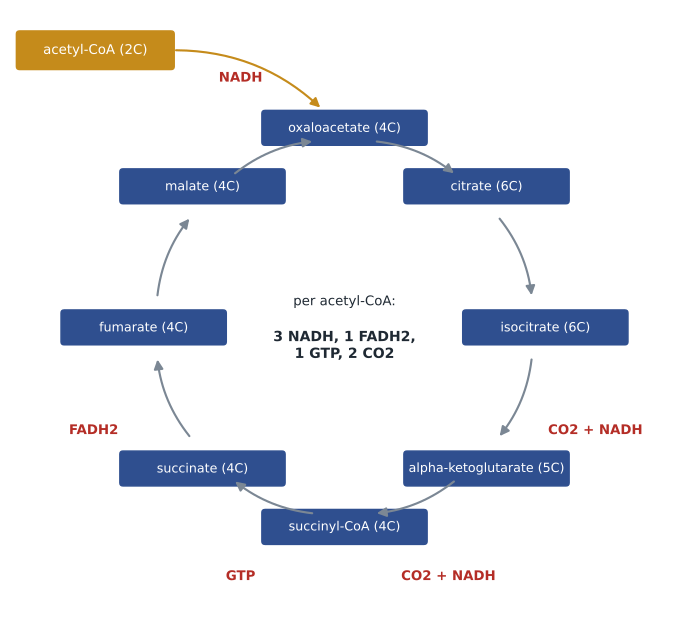
| Step | Enzyme | Product made |
|---|---|---|
| Acetyl-CoA plus oxaloacetate to citrate | Citrate synthase | None; this is the entry step |
| Citrate to isocitrate | Aconitase | None; an isomerization |
| Isocitrate to alpha-ketoglutarate | Isocitrate dehydrogenase | NADH and carbon dioxide; the main rate-limiting step |
| Alpha-ketoglutarate to succinyl-CoA | Alpha-ketoglutarate dehydrogenase complex | NADH and carbon dioxide; uses the same coenzymes as pyruvate dehydrogenase |
| Succinyl-CoA to succinate | Succinyl-CoA synthetase | GTP (or ATP), by substrate-level phosphorylation |
| Succinate to fumarate | Succinate dehydrogenase | FADH2; this enzyme is also complex II of the electron transport chain |
| Fumarate to malate | Fumarase | None; adds water |
| Malate to oxaloacetate | Malate dehydrogenase | NADH |
Per molecule of acetyl-CoA, the cycle produces 3 NADH, 1 FADH2, 1 GTP and 2 carbon dioxide. Because each glucose gives two pyruvate and therefore two acetyl-CoA, the cycle turns twice per glucose. The cycle itself uses no oxygen. It depends on oxygen indirectly, because it needs a steady supply of NAD-positive and FAD, which are regenerated only when the electron transport chain passes electrons to oxygen. When oxygen runs out, the cycle stops too.
The cycle is regulated mainly at three steps: citrate synthase, isocitrate dehydrogenase and alpha-ketoglutarate dehydrogenase. High levels of ATP and NADH inhibit them, signalling that energy is plentiful, while ADP and calcium, which rises in contracting muscle, activate isocitrate dehydrogenase. The cycle also supplies building blocks for biosynthesis. Citrate exported to the cytosol provides acetyl-CoA for fatty acid synthesis; alpha-ketoglutarate and oxaloacetate supply carbon skeletons for amino acids; succinyl-CoA is used to make heme. Because it both breaks down fuel and builds molecules, the cycle is called amphibolic. Intermediates drawn off for synthesis must be replaced by anaplerotic reactions, the most important of which is pyruvate carboxylase, which makes oxaloacetate from pyruvate.
The electron transport chain
The NADH and FADH2 from glycolysis, pyruvate dehydrogenase and the citric acid cycle carry high-energy electrons. The electron transport chain, a series of protein complexes and mobile carriers in the inner mitochondrial membrane, passes these electrons step by step to oxygen, each carrier having a more positive reduction potential than the one before. At three of the complexes, the energy released is used to pump protons from the matrix into the intermembrane space, building a gradient.
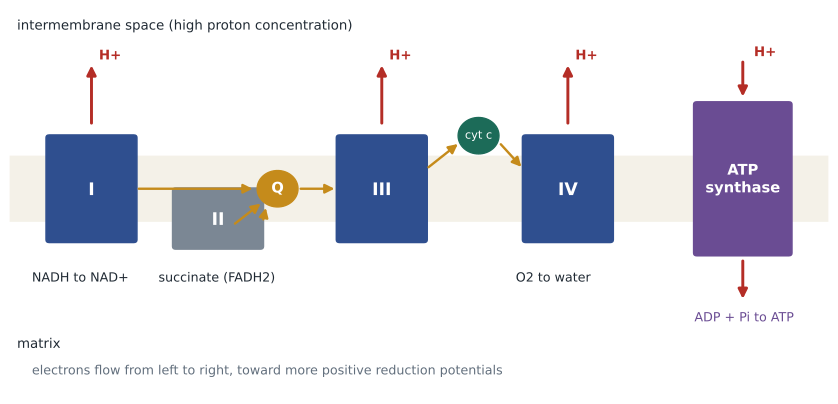
| Component | Electrons from | Electrons to | Protons pumped per pair of electrons |
|---|---|---|---|
| Complex I (NADH dehydrogenase) | NADH | Ubiquinone | 4 |
| Complex II (succinate dehydrogenase) | Succinate, through FADH2 | Ubiquinone | 0 |
| Ubiquinone (coenzyme Q) | Complexes I and II | Complex III | Mobile carrier within the membrane |
| Complex III (cytochrome bc1) | Ubiquinol | Cytochrome c | 4 |
| Cytochrome c | Complex III | Complex IV | Small mobile protein on the intermembrane side |
| Complex IV (cytochrome c oxidase) | Cytochrome c | Oxygen, forming water | 2 |
Electrons from NADH enter at complex I and pass through three pumping sites, so they move 10 protons in all. Electrons from FADH2 enter at complex II, which does not pump, and pass only complexes III and IV, moving 6 protons. That is why FADH2 yields less ATP than NADH. Oxygen is the final electron acceptor; at complex IV, four electrons and four protons reduce one oxygen molecule to two water molecules. Without oxygen, electrons back up along the chain, carriers stay reduced and no more NADH can be oxidized.
Chemiosmosis and ATP synthase
How does a proton gradient make ATP? Peter Mitchell proposed the chemiosmotic theory in 1961: the energy of electron transport is stored as an electrochemical gradient of protons across the inner membrane, and that gradient drives ATP synthesis. The gradient has two parts, a difference in proton concentration (the matrix is more basic) and a difference in charge (the matrix is more negative). Together they are called the proton-motive force. Mitchell received the Nobel Prize in Chemistry in 1978.
ATP synthase is a rotary machine. Its F0 part spans the membrane and forms a channel through which protons flow back into the matrix, down their gradient. That flow turns a ring of subunits and a central stalk, like water turning a turbine. The stalk rotates inside the F1 part, which sits in the matrix, and the rotation forces its catalytic subunits through a sequence of shapes that bind ADP and phosphate, join them into ATP and release it. Roughly three protons pass through the synthase for each ATP made, and about one more is used to bring phosphate into the matrix and exchange ATP for ADP across the membrane.
Because electron transport and ATP synthesis are linked through the gradient, they are said to be coupled. In healthy mitochondria, electron transport slows when ATP synthase has little ADP to work with, because the gradient builds up and resists further pumping. This respiratory control matches oxygen consumption to the cell's demand for ATP.
How much ATP per glucose?
Using current estimates of about 2.5 ATP per NADH and 1.5 per FADH2, complete oxidation of one glucose yields about 30 to 32 ATP. Older textbooks give 36 to 38, based on whole-number assumptions that have since been revised; the MCAT generally follows the newer values.
| Source (per glucose) | Directly made | Reduced carriers | ATP equivalent |
|---|---|---|---|
| Glycolysis | 2 ATP | 2 NADH (cytosolic) | 2 plus 3 to 5 = 5 to 7 |
| Pyruvate dehydrogenase (2 pyruvate) | None | 2 NADH | 5 |
| Citric acid cycle (2 turns) | 2 GTP | 6 NADH and 2 FADH2 | 2 plus 15 plus 3 = 20 |
| Total | 4 | 10 NADH, 2 FADH2 | About 30 to 32 |
The range comes from cytosolic NADH. The inner mitochondrial membrane is impermeable to NADH, so its electrons enter through shuttles. The malate-aspartate shuttle, used in liver, kidney and heart, delivers them to mitochondrial NADH, worth 2.5 ATP each. The glycerol 3-phosphate shuttle, used in skeletal muscle and brain, delivers them to FAD and then to ubiquinone, bypassing complex I, so each is worth about 1.5.
Inhibitors and uncouplers
Passages often test the chain by adding a poison and asking what happens to oxygen consumption, ATP synthesis and the proton gradient. There are two kinds of effects to separate.
| Agent | Target | Effect on electron flow and oxygen use | Effect on ATP synthesis |
|---|---|---|---|
| Rotenone | Complex I | Stops flow from NADH; succinate can still feed in through complex II | Falls |
| Antimycin A | Complex III | Stops flow beyond ubiquinone | Falls |
| Cyanide, azide, carbon monoxide | Complex IV | Stops electron transfer to oxygen; oxygen consumption stops | Stops |
| Oligomycin | ATP synthase (F0 proton channel) | Gradient builds up, so electron transport and oxygen use slow sharply | Stops |
| Uncouplers such as 2,4-dinitrophenol | Inner membrane, carrying protons across | Gradient collapses, so electron transport and oxygen use speed up | Falls; energy is released as heat |
The contrast between oligomycin and an uncoupler is the classic test. Both stop ATP synthesis. But oligomycin blocks the proton exit, so the gradient grows and slows electron transport, while an uncoupler gives protons a path back into the matrix that bypasses ATP synthase, so electron transport runs freely and oxygen consumption rises. If an uncoupler is added after oligomycin, oxygen consumption recovers, which shows that the slowdown was caused by the gradient, not by damage to the chain. Brown adipose tissue uses a natural uncoupler, the protein thermogenin, also called UCP1, to produce heat, which is important in newborns and in hibernating mammals.
The chain also produces small amounts of reactive oxygen species when electrons leak and partially reduce oxygen, forming superoxide. Cells defend against them with enzymes such as superoxide dismutase and catalase and with antioxidants such as glutathione, which depends on NADPH from the pentose phosphate pathway.
Worked problem
Following electrons when a complex is blocked
Isolated mitochondria are supplied with malate, which generates NADH, and treated with rotenone. Oxygen consumption stops. Then succinate is added. Predict what happens and explain.
Show solution
- Rotenone blocks complex I, so electrons from NADH cannot enter the chain; oxygen consumption stops.
- Succinate is oxidized by complex II, which passes electrons to ubiquinone, downstream of the block.
- From ubiquinone, electrons flow through complex III, cytochrome c and complex IV to oxygen.
- Oxygen consumption resumes, and some ATP is made, because complexes III and IV still pump protons.
Answer: Oxygen consumption resumes after succinate is added, at a lower ATP yield per electron pair, because complex I is bypassed.
Passage-style practice
Passage. Researchers measured oxygen consumption by isolated mitochondria in a sealed chamber. They added substrates and drugs in sequence: first pyruvate and malate, then ADP, then oligomycin, then 2,4-dinitrophenol (DNP), then cyanide. Data invented for this course.
| Addition | Oxygen consumption (nanomoles per minute per milligram) |
|---|---|
| Pyruvate and malate | 10 |
| Plus ADP | 60 |
| Plus oligomycin | 12 |
| Plus DNP | 95 |
| Plus cyanide | 1 |
Practice problems
Work each problem on paper first, then reveal the answer to check.
Why does adding ADP raise oxygen consumption? (Skill 1: concepts)
Show answer
ADP lets ATP synthase run, which uses the proton gradient; as the gradient is relieved, electron transport and oxygen use speed up. This is respiratory control.
Why does oligomycin lower oxygen consumption almost to the starting level? (Skill 2: scientific reasoning)
Show answer
It blocks the proton channel of ATP synthase, so the gradient builds up and opposes further pumping, slowing electron transport.
Why does DNP raise oxygen consumption above the ADP level, even with oligomycin present? (Skill 2)
Show answer
DNP carries protons across the membrane, collapsing the gradient, so electron transport runs at its maximum rate without being limited by ATP synthesis.
What is the effect of cyanide, and why does it work even after DNP? (Skill 2)
Show answer
Cyanide blocks complex IV, so electrons cannot reach oxygen; uncoupling does not bypass that block, so oxygen consumption stops.
During the DNP stage, is ATP being made by oxidative phosphorylation? (Skill 4: data-based reasoning)
Show answer
No. Oligomycin blocks ATP synthase, and DNP dissipates the gradient; the energy is released as heat.
Mitochondrial DNA
Mitochondria have their own small circular genome. In humans, mitochondrial DNA encodes 13 proteins, all of them subunits of the electron transport chain complexes or ATP synthase, along with 22 transfer RNAs and 2 ribosomal RNAs used to make those proteins inside the mitochondrion. All other mitochondrial proteins, including most subunits of the same complexes, are encoded in the nucleus and imported. Because mitochondria in the embryo come almost entirely from the egg, mitochondrial DNA is inherited from the mother. A cell contains many copies, and a mutation may be present in only some of them, a state called heteroplasmy; the share of mutant copies in a tissue helps explain why mitochondrial diseases vary so much in severity and tend to affect tissues with high energy demands, such as brain, muscle and heart.
Common mistakes
MistakeThe citric acid cycle uses oxygen directly.
InsteadThe cycle uses no oxygen, but it stops without oxygen because NAD-positive and FAD are not regenerated.
MistakeComplex II pumps protons.
InsteadComplex II does not pump, which is why FADH2 yields about 1.5 ATP and NADH about 2.5.
MistakeUncouplers stop electron transport.
InsteadUncouplers speed up electron transport and oxygen use while preventing ATP synthesis.
MistakeOxygen accepts electrons at complex I.
InsteadOxygen is the final acceptor, at complex IV.
MistakeOne glucose always makes 38 ATP.
InsteadCurrent estimates are about 30 to 32, depending on the shuttle used for cytosolic NADH.
Summary and key terms
- Pyruvate dehydrogenase irreversibly converts pyruvate to acetyl-CoA, making NADH and carbon dioxide; it needs five coenzymes, including thiamine pyrophosphate.
- Each turn of the citric acid cycle yields 3 NADH, 1 FADH2, 1 GTP and 2 carbon dioxide; isocitrate dehydrogenase is the main control point.
- The cycle is amphibolic, supplying intermediates for biosynthesis that anaplerotic reactions replace.
- The electron transport chain passes electrons to oxygen; complexes I, III and IV pump protons, and complex II does not.
- Protons flowing back through ATP synthase drive its rotation and ATP synthesis, as the chemiosmotic theory describes.
- Complete oxidation of glucose yields about 30 to 32 ATP.
- Inhibitors of the chain or ATP synthase lower oxygen use; uncouplers raise oxygen use but stop ATP synthesis.
- Pyruvate dehydrogenase complex
- The mitochondrial enzyme assembly that converts pyruvate to acetyl-CoA.
- Citric acid cycle
- The cycle that oxidizes acetyl-CoA to carbon dioxide, producing NADH, FADH2 and GTP.
- Anaplerotic reaction
- A reaction that replenishes citric acid cycle intermediates.
- Electron transport chain
- The series of carriers in the inner mitochondrial membrane that passes electrons to oxygen.
- Proton-motive force
- The combined concentration and charge gradient of protons across the inner membrane.
- Chemiosmosis
- The use of a proton gradient across a membrane to drive ATP synthesis.
- Uncoupler
- A substance that dissipates the proton gradient, separating electron transport from ATP synthesis.
Lesson quiz · 5 questions
Score 60% or more to complete this lesson.
Create a free account to save your progress, take quizzes and earn a certificate.