
MBA-611 · Lesson 3 of 12 · 23 min
Trade policy, agreements and the WTO in a fragmenting world
Daniel arrives at the third session with a binder of customs rulings. In the past eighteen months, he says, the duty on Northfield's products crossing the border has changed five times, under four different legal authorities, and each change came with a new set of forms. Dr. Tan tells him that his binder is the best possible introduction to the topic. Trade theory explains why countries gain from trade; trade policy explains why governments nonetheless restrict it, and how the rules they agree to limit what they can do. For managers, trade policy has become one of the largest and least predictable costs of doing business across borders.
The instruments of trade policy
A tariff is a tax on imports. Most are ad valorem, a share of the customs value of the goods, such as 18 per cent of the value of a jacket; some are specific, a fixed amount per unit, such as a set charge per kilogram of cheese. A quota limits the quantity that may be imported, and a tariff-rate quota combines the two: a low tariff applies up to a set quantity and a much higher one above it, as with dairy and poultry in Canada and sugar in the United States. Subsidies help domestic producers compete with imports or win export markets. Local content requirements oblige firms to use a share of domestic inputs. Product standards, testing and labelling rules can protect consumers, and they can also be designed to keep out foreign products.
Governments also restrict exports and investment. Export controls limit the sale of sensitive goods and technologies, such as advanced semiconductors, to particular countries. Investment screening allows governments to block foreign takeovers on grounds of national security. Sanctions prohibit dealings with designated countries, companies or people. These instruments were once peripheral to most firms; since 2018 they have become central for any company dealing with technology, energy or China and Russia.
The economics of a tariff
A tariff raises the domestic price of the imported good. Domestic producers gain because they can sell more at a higher price; the government gains tariff revenue; consumers lose because they pay more and buy less. Standard analysis shows that the consumers' loss exceeds the gains to producers and government combined, leaving two deadweight losses: a production loss, because some goods are now made at home at higher cost than they could be imported, and a consumption loss, because some consumers who valued the good above its world price no longer buy it. The question of who actually pays the tariff, the incidence, depends on how responsive supply and demand are. Studies of the American tariffs of 2018 and 2019 found that almost the entire cost was passed through to American importers and consumers, rather than absorbed by foreign exporters.
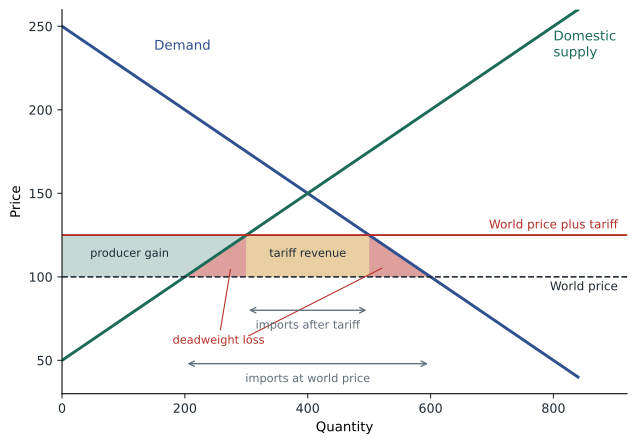
# Welfare effects of a tariff with linear demand and supply (small importing country)
a, b = 1000.0, 4.0     # demand: Q = a - b * P
c, d = -200.0, 4.0     # domestic supply: Q = c + d * P
world, tariff = 100.0, 25.0
def demand(p): return a - b * p
def supply(p): return c + d * p
p0, p1 = world, world + tariff
qd0, qs0, qd1, qs1 = demand(p0), supply(p0), demand(p1), supply(p1)
consumer_loss = tariff * (qd0 + qd1) / 2
producer_gain = tariff * (qs0 + qs1) / 2
revenue = tariff * (qd1 - qs1)
dwl = consumer_loss - producer_gain - revenue
print(f"imports fall from {qd0 - qs0:.0f} to {qd1 - qs1:.0f} units")
print(f"consumer loss {consumer_loss:,.0f}; producer gain {producer_gain:,.0f}; tariff revenue {revenue:,.0f}")
print(f"deadweight loss {dwl:,.0f} ({dwl / consumer_loss:.0%} of the consumer loss)")imports fall from 400 to 200 units consumer loss 13,750; producer gain 6,250; tariff revenue 5,000 deadweight loss 2,500 (18% of the consumer loss)
Why governments protect
If tariffs reduce national welfare, why are they so common? Some arguments have economic merit in particular cases. The infant industry argument holds that a new industry may need temporary protection to reach the scale and experience at which it can compete; the difficulty is that protection rarely proves temporary. National security arguments hold that a country should not depend on rivals for defence equipment, critical minerals, semiconductors or medicines; the pandemic and Russia's use of gas supplies as a weapon made this argument far more persuasive than it was a decade ago. Strategic trade arguments hold that in industries with very large economies of scale, such as commercial aircraft, subsidies can help a country's firm capture profits that would otherwise go to a foreign rival.
Politics explains much of the rest. The benefits of protection are concentrated on particular firms and workers who know who they are and lobby hard, while the costs are spread thinly across millions of consumers who barely notice them. Trade policy is also used for goals that have little to do with trade: to pressure other governments on migration, drugs or security, or to raise revenue. Since 2025 American tariff policy has combined all of these motives, which is one reason it has changed so often.
The World Trade Organization
The WTO, founded in 1995 as the successor to the General Agreement on Tariffs and Trade, has 166 members and administers rules covering most world trade. Its core principles are most-favoured-nation treatment, under which a member must offer every other member the best tariff it offers any; national treatment, under which imported goods must be treated no worse than domestic goods once they have entered; and bound tariffs, ceilings that members commit not to exceed. Exceptions allow free trade agreements, preferences for developing countries, safeguards against import surges, duties against dumping and subsidies, and measures needed for national security.
The WTO's dispute settlement system was long its most important feature: members could bring cases against one another, and panels and an Appellate Body issued binding rulings. Since December 2019, however, the Appellate Body has been unable to hear appeals because the United States has blocked the appointment of new members, arguing that the body overstepped its mandate. A losing party can now appeal into the void, leaving the dispute unresolved. Canada, the European Union, China and others created a Multi-Party Interim Appeal Arbitration Arrangement as a substitute among themselves; the United States has not joined. Negotiations have also stalled: the Doha Round, launched in 2001, never concluded, and recent progress has come mainly through smaller agreements among groups of members, such as one on investment facilitation.
Dr. Tan, who spent years at WTO meetings, tells the cohort that the organization still matters more than its critics suggest. Most of the world's tariffs remain at or below their bound rates; most countries still apply most-favoured-nation treatment to most partners; and the WTO's committees resolve many problems quietly. But the rules no longer bind the largest economies as firmly as they once did, and firms can no longer assume that a trade measure will be challenged or removed if it breaks the rules.
Free trade agreements and rules of origin
Free trade agreements remove most tariffs between members while each keeps its own tariffs on outsiders. To prevent outsiders' goods from entering through the member with the lowest tariff, every agreement contains rules of origin that define which goods qualify for preferential treatment. A good may qualify if it is wholly obtained in a member country, if its non-originating inputs undergo a specified change in tariff classification, or if a minimum share of its value is added in the region. Rules for clothing are often strict: some agreements require yarn-forward origin, meaning the yarn, fabric and sewing must all take place in the region. Rules for cars under CUSMA require 75 per cent regional value content for core parts and a share of content made by workers earning at least a set hourly wage.
For managers, rules of origin are where trade agreements become operational. A company that cannot prove origin pays the full most-favoured-nation tariff, however many agreements its country has signed. Studies of North American trade have found that many eligible shipments did not claim preferences at all, because the paperwork cost more than the duty saved or because companies did not know they qualified. Since 2025, however, preferences have become far more valuable: goods that qualify under CUSMA are exempt from many of the new US tariffs, so Canadian firms have rushed to document origin for products they once shipped without claiming it.
# Regional value content (transaction value method) for a product under a trade agreement
price = 180.0                       # transaction value of the finished assembly
inputs = {"steel coil (in region)": 52.0, "fasteners (Asia)": 9.0,
          "electronic module (Asia)": 31.0, "paint and coatings (in region)": 6.0}
originating = {"steel coil (in region)", "paint and coatings (in region)"}
non_orig = sum(v for k, v in inputs.items() if k not in originating)
rvc = (price - non_orig) / price
print(f"value of non-originating inputs: {non_orig:.2f}")
print(f"regional value content: {rvc:.1%}")
for threshold in (0.60, 0.70, 0.75):
    status = "qualifies" if rvc >= threshold else "does not qualify"
    print(f"  against a {threshold:.0%} requirement: {status}")
# What if the electronic module were sourced in the region?
rvc2 = (price - inputs["fasteners (Asia)"]) / price
print(f"with a regional electronic module: {rvc2:.1%}")value of non-originating inputs: 40.00 regional value content: 77.8% against a 60% requirement: qualifies against a 70% requirement: qualifies against a 75% requirement: qualifies with a regional electronic module: 95.0%
The agreements that matter
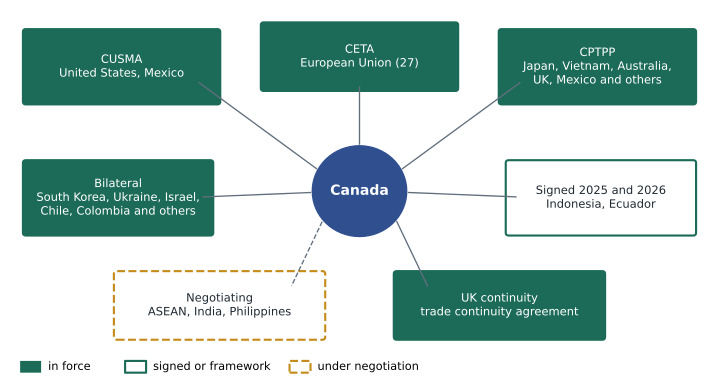
Canada has one of the broadest networks of trade agreements in the world, covering about two-thirds of world output. CUSMA, in force since July 2020, governs trade with the United States and Mexico. The Comprehensive Economic and Trade Agreement with the European Union has applied provisionally since 2017 and removed duties on almost all goods. The Comprehensive and Progressive Agreement for Trans-Pacific Partnership, in force for Canada since 2018, links it with Japan, Vietnam, Australia, Mexico, Malaysia, Singapore, the United Kingdom and others. Canada also has agreements with South Korea, Ukraine, Israel and several countries in Latin America. Since 2025 it has moved quickly to add more: it signed a comprehensive economic partnership agreement with Indonesia in September 2025, which is expected to take effect once both countries complete ratification, and a free trade agreement with Ecuador in July 2026, and it is negotiating with ASEAN, India and the Philippines.
North American trade since 2025
The past two years have shown how quickly trade policy can change. In 2025 the United States imposed tariffs on most of its trading partners under the International Emergency Economic Powers Act, including tariffs on Canadian and Mexican goods that did not qualify under CUSMA. On 20 February 2026 the Supreme Court held that the act does not authorize tariffs, and importers began seeking refunds. The administration then imposed a temporary 15 per cent global tariff under section 122 of the Trade Act of 1974, which expired on 24 July 2026. It was replaced by tariffs under section 301 following an investigation into forced labour, applying to sixty economies at rates of about 10 to 12.5 per cent, with goods qualifying under CUSMA exempt. Tariffs under section 232 on steel, aluminum, copper, autos and parts, lumber and some furniture remained in place.
Two further developments matter most for Canadian firms. From 22 August 2026 the United States applied tariffs of 50 per cent under section 338 to many Canadian goods, including textiles, sporting goods, wood products and machinery, with no exemption for goods that qualify under CUSMA; their scope was changed on 30 October, and a challenge was filed at the Court of International Trade. Canada responded with surtaxes of 15, 25 or 50 per cent on about 27.6 billion dollars of US goods from 8 September 2026, with a remission order allowing relief for some importers until 30 June 2027. And at the first joint review of CUSMA on 1 July 2026, the United States declined to confirm a further sixteen-year term, so the agreement now moves to annual reviews while remaining in force until 2036.
Elsewhere, trade policy is being used for environmental goals. The European Union's Carbon Border Adjustment Mechanism moved into its definitive phase on 1 January 2026. Importers of iron and steel, aluminum, cement, fertilizers, electricity and hydrogen must now account for the carbon emitted in producing those goods and will buy certificates priced in line with the EU's carbon market, with declarations for 2026 imports due in 2027. Simplifications adopted in 2025 exempt importers bringing in less than 50 tonnes a year of the covered goods. Other countries, including the United Kingdom, are preparing similar measures.
How companies respond
Firms have several legitimate ways to manage trade policy. They can classify products correctly and, where the design allows, engineer them so that they fall into lower-duty categories, a practice known as tariff engineering. They can redesign supply chains so that products qualify under the rules of origin of an agreement. They can use customs procedures that defer or refund duties, such as bonded warehouses, duty deferral and drawback programs, and remission orders where governments offer them. They can value goods correctly, separating the cost of design, royalties and assists in the way customs rules require. And they can build scenario plans so that a change in tariffs triggers a prepared response rather than a scramble. All of these depend on good data about what the company buys, where it comes from and what it contains, which many firms discovered in 2025 they did not have.
Dr. Tan draws a distinction between legitimate planning and evasion. Transshipping goods through a third country without substantial transformation to disguise their origin, undervaluing goods or misdescribing them is illegal, and enforcement has become far tougher. Customs authorities now share data, use algorithms to flag suspicious shipments and impose heavy penalties, and companies found to be evading duties can lose their trusted-trader status, which slows every future shipment.
Worked problem
Is it worth qualifying for the agreement?
Northfield ships 40,000 welded brackets a year across the border at 180 dollars each. With an Asian electronic module, regional value content is about 78 per cent; the duty on brackets that do not qualify is 25 per cent. Documenting origin costs about 60,000 dollars a year in systems, supplier certificates and staff time. Is it worth claiming preferential treatment? What if the rule required 80 per cent regional content?
Show solution
- Customs value of the exports: 40,000 × 180 = 7.2 million dollars.
- Duty avoided by qualifying: 25 per cent of 7.2 million = 1.8 million dollars a year, far more than the 60,000-dollar cost of documentation.
- If the rule required 80 per cent, Northfield would fall short at about 78 per cent. Sourcing the module in the region would raise content to 95 per cent, as the code shows; if a regional module costs 4 dollars more, the extra cost is 160,000 dollars a year, still far below the duty saved.
Answer: Claiming preference is clearly worthwhile, and so is redesigning sourcing if a stricter rule applies. The calculation was trivial before 2025, when duties were near zero; since then it has become one of the most valuable analyses in many exporters' finance departments.
Common mistakes
MistakeTariffs are paid by foreign exporters.
InsteadIncidence depends on supply and demand; studies of recent American tariffs found that importers and consumers bore most of the cost.
MistakeA trade agreement automatically removes duties.
InsteadGoods must meet rules of origin and the importer must claim the preference with proper documentation.
MistakeThe WTO can no longer constrain trade policy.
InsteadMost members still follow most rules, but appeals are blocked and the largest economies are harder to discipline.
MistakeRouting goods through a third country changes their origin.
InsteadOrigin changes only with substantial transformation under the rules; disguising origin is illegal evasion.
Summary and key terms
- Trade policy instruments include tariffs, quotas, tariff-rate quotas, subsidies, local content rules, standards, export controls, investment screening and sanctions.
- A tariff transfers income from consumers to producers and government and creates deadweight losses; incidence depends on supply and demand.
- Governments protect for reasons of infant industries, security and strategy, and because the benefits are concentrated while the costs are spread.
- The WTO's principles of most-favoured-nation treatment, national treatment and bound tariffs still shape most trade, but its Appellate Body has been unable to hear appeals since 2019.
- Free trade agreements work through rules of origin; preferences must be documented and claimed.
- Since 2025, North American trade policy has changed repeatedly; firms respond with origin planning, customs procedures, correct classification and scenario plans, never with evasion.
- Ad valorem tariff
- A tariff charged as a share of the customs value of imported goods.
- Tariff-rate quota
- A low tariff up to a set import quantity and a higher tariff above it.
- Most-favoured-nation treatment
- The WTO principle that a member must give all members its best tariff treatment.
- Rules of origin
- The criteria that determine whether a good qualifies for preferential treatment under an agreement.
- Regional value content
- The share of a good's value added within the members of a trade agreement.
- Tariff engineering
- Legally designing or classifying a product so that it falls into a lower-duty category.
Practice problems
Work each problem on paper first, then reveal the answer to check.
A product sells for 200 dollars and contains 70 dollars of non-originating inputs. What is its regional value content by the transaction value method?
Show answer
(200 − 70) / 200 = 65 per cent.
In the tariff example, why does the deadweight loss rise faster than the tariff rate?
Show answer
Both deadweight triangles grow with the square of the price increase, so doubling the tariff roughly quadruples the deadweight loss.
Why might a firm not claim preferential treatment for which its goods qualify?
Show answer
When the duty saved is small relative to the cost of documenting origin, or when the firm does not know it qualifies.
Name two legitimate ways a company can reduce the cost of tariffs.
Show answer
Examples: redesign sourcing to meet rules of origin; use duty deferral, drawback or bonded warehouses; classify and value goods correctly; use remission orders.
Lesson quiz · 5 questions
Score 60% or more to complete this lesson.
Create a free account to save your progress, take quizzes and earn a certificate.