
MATH-447 · Lesson 5 of 12 · 27 min
Separation axioms and metrizability
The definition of a topological space is so general that it allows spaces in which points cannot be told apart, sequences converge to several limits at once, and closed sets cannot be pulled away from each other. The separation axioms are a ladder of conditions that exclude these pathologies step by step. Metric spaces satisfy all of them, which is why they never arose in MATH-341. This lesson climbs the ladder, proves the key facts about each rung, and ends with the theorems of Urysohn that answer a natural question: when does a topology come from a metric?
The ladder
A space \(X\) is T0 if for any two distinct points, some open set contains one but not the other. It is T1 if for any two distinct points \(x, y\), there is an open set containing \(x\) but not \(y\), and one containing \(y\) but not \(x\). It is T2, or Hausdorff, if any two distinct points have disjoint open neighbourhoods. It is regular if it is T1 and every closed set \(C\) and point \(x \notin C\) have disjoint open neighbourhoods. It is normal if it is T1 and any two disjoint closed sets have disjoint open neighbourhoods. Regular spaces are sometimes called T3 and normal spaces T4.
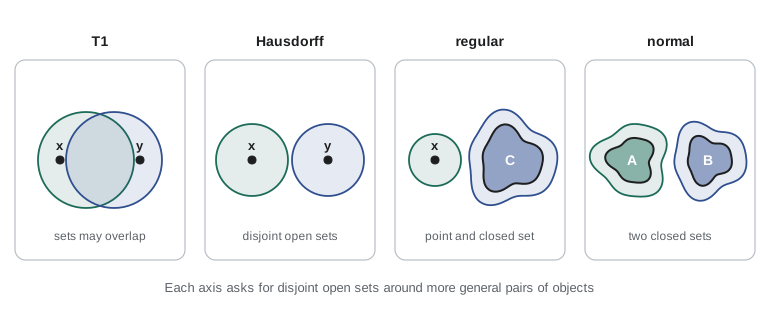
Each condition implies the one before it, once T1 is assumed in the definitions of regular and normal: in a T1 space points are closed, so normal implies regular, and regular implies Hausdorff. Without the T1 assumption the implications can fail, since an indiscrete space separates disjoint closed sets trivially, there being only two closed sets. Sierpiński space is T0 but not T1. The cofinite topology on an infinite set is T1 but not Hausdorff. The line with two origins of lesson 4 is T1 but not Hausdorff. Examples of Hausdorff spaces that are not regular, and of regular spaces that are not normal, exist but take more work; the Sorgenfrey plane below is regular but not normal.
Theorem. A space is T1 if and only if every one-point set is closed.
Proof. If points are closed and \(x \ne y\), then \(X \setminus \{y\}\) is open, contains \(x\) and misses \(y\), and symmetrically. Conversely, if \(X\) is T1, then for each \(x \ne y\) there is an open \(U_x\) containing \(x\) and not \(y\); the union of the \(U_x\) over all \(x \ne y\) is \(X \setminus \{y\}\), which is therefore open.
A finite T1 space is discrete, since every subset is a finite union of closed points and hence closed, so every subset is also open. This explains why the finite spaces of lessons 2 and 3 were so far from metric: the only metrizable topology on a finite set is the discrete one.
Hausdorff spaces
Theorem. In a Hausdorff space, a sequence has at most one limit.
Proof. Suppose \(x_n \to x\) and \(x_n \to y\) with \(x \ne y\). Choose disjoint open sets \(U \ni x\) and \(V \ni y\). For large \(n\), \(x_n\) lies in \(U\), and for large \(n\) it lies in \(V\), so for some \(n\) it lies in \(U \cap V = \varnothing\), a contradiction.
Theorem. Every metric space is Hausdorff. Subspaces and products of Hausdorff spaces are Hausdorff. A space \(X\) is Hausdorff if and only if the diagonal \(\Delta = \{(x, x)\}\) is closed in \(X \times X\).
Proof. In a metric space, the balls of radius \(d(x, y)/2\) about \(x\) and \(y\) are disjoint by the triangle inequality. For a subspace, intersect the separating open sets with it. For a product, two distinct points differ in some coordinate \(\alpha\), and the preimages under \(\pi_\alpha\) of separating sets in \(X_\alpha\) separate them. For the diagonal, a point \((x, y)\) with \(x \ne y\) has a basic neighbourhood \(U \times V\) missing \(\Delta\) exactly when \(U \cap V = \varnothing\); so \(X \times X \setminus \Delta\) is open precisely when distinct points can be separated.
The diagonal criterion has a useful consequence: if \(f, g : X \to Y\) are continuous and \(Y\) is Hausdorff, then the set where \(f = g\) is closed, being the preimage of \(\Delta\) under \((f, g)\). So two continuous maps into a Hausdorff space that agree on a dense set agree everywhere. This fails for non-Hausdorff targets: the two maps from the real line to the line with two origins that send 0 to the two different origins and agree elsewhere are both continuous.
Metric spaces are normal
For a nonempty set \(A\) in a metric space, define \(d(x, A) = \inf_{a \in A} d(x, a)\). Then \(|d(x, A) - d(y, A)| \le d(x, y)\), so \(x \mapsto d(x, A)\) is continuous, and \(d(x, A) = 0\) exactly when \(x \in \overline{A}\).
Theorem. Every metric space is normal.
Proof. Let \(A\) and \(B\) be disjoint nonempty closed sets. Define \(f(x) = \frac{d(x, A)}{d(x, A) + d(x, B)}\). The denominator is never zero, because a point with \(d(x, A) = d(x, B) = 0\) would lie in \(\overline{A} \cap \overline{B} = A \cap B\). So \(f\) is continuous, takes the value 0 exactly on \(A\) and 1 exactly on \(B\). The sets \(U = f^{-1}([0, 1/2))\) and \(V = f^{-1}((1/2, 1])\) are disjoint, open, and contain \(A\) and \(B\).
The proof did more than separate \(A\) and \(B\) by open sets: it produced a continuous function equal to 0 on one and 1 on the other. In a general normal space there is no metric to build such a function from. Urysohn's lemma shows that one exists anyway.
Urysohn's lemma
Theorem (Urysohn, 1925). If \(X\) is normal and \(A, B\) are disjoint closed subsets, there is a continuous \(f : X \to [0, 1]\) with \(f = 0\) on \(A\) and \(f = 1\) on \(B\).
Proof. First a reformulation of normality: if \(C\) is closed, \(U\) open and \(C \subseteq U\), there is an open \(V\) with \(C \subseteq V \subseteq \overline{V} \subseteq U\). Indeed, separate \(C\) and \(X \setminus U\) by disjoint open sets \(V\) and \(W\); then \(\overline{V} \subseteq X \setminus W \subseteq U\). Now let \(D\) be the set of dyadic rationals \(k/2^n\) in \([0, 1]\). We build open sets \(U_r\) for \(r \in D\) such that \(A \subseteq U_0\), \(U_1 = X \setminus B\), and \(\overline{U_r} \subseteq U_s\) whenever \(r < s\). Start with \(U_1 = X \setminus B\), and use the reformulation to choose \(U_0\) with \(A \subseteq U_0 \subseteq \overline{U_0} \subseteq U_1\). Having defined \(U_r\) for all dyadics with denominator \(2^n\), for each new \(r = (2k + 1)/2^{n+1}\) apply the reformulation to \(\overline{U_{k/2^n}} \subseteq U_{(k+1)/2^n}\) to get \(U_r\) between them. By induction all \(U_r\) are defined with the nesting property.
Define \(f(x) = \inf\{r \in D : x \in U_r\}\), with \(f(x) = 1\) if \(x\) lies in no \(U_r\). Then \(f = 0\) on \(A \subseteq U_0\) and \(f = 1\) on \(B\), which misses every \(U_r\). For continuity, observe two facts that follow from the nesting and the density of \(D\): if \(x \in \overline{U_r}\) then \(f(x) \le r\), and if \(x \notin U_r\) then \(f(x) \ge r\). It suffices to show that the preimages of the subbasic sets \([0, a)\) and \((b, 1]\) are open. First, \(f(x) < a\) exactly when \(x \in U_r\) for some dyadic \(r < a\), so \(f^{-1}([0, a)) = \bigcup_{r < a} U_r\), which is open. Second, \(f(x) > b\) exactly when \(x \notin \overline{U_s}\) for some dyadic \(s > b\): if \(f(x) > b\), pick dyadics \(b < s < s' < f(x)\); then \(x \notin U_{s'} \supseteq \overline{U_s}\). Conversely if \(x \notin \overline{U_s}\) with \(s > b\), then \(x \notin U_s\) and \(f(x) \ge s > b\). So \(f^{-1}((b, 1]) = \bigcup_{s > b} (X \setminus \overline{U_s})\), which is open.
Urysohn's lemma has a powerful extension, the Tietze extension theorem: in a normal space, every continuous real function on a closed subset extends to a continuous function on the whole space. Heinrich Tietze proved it for metric spaces in 1915, and Urysohn's lemma yields the general case by building the extension as a uniformly convergent series of Urysohn functions, using the Weierstrass M-test from MATH-341.
Countability and sequences
A space is first countable if each point \(x\) has a countable family of open sets \(B_1 \supseteq B_2 \supseteq \cdots\) containing \(x\) such that every open set containing \(x\) contains some \(B_n\). Metric spaces are first countable, with \(B_n = B(x, 1/n)\). A space is second countable if it has a countable basis, and separable if it has a countable dense subset. Second countable implies both first countable and separable.
Theorem. In a first countable space, \(x \in \overline{A}\) if and only if some sequence in \(A\) converges to \(x\). Consequently a function out of a first countable space is continuous if and only if it preserves limits of sequences.
Proof. If \(a_n \to x\) with \(a_n \in A\), every open set around \(x\) contains some \(a_n\), so \(x \in \overline{A}\). Conversely, if \(x \in \overline{A}\), choose \(a_n \in B_n \cap A\), possible because \(B_n\) is open and contains \(x\). Any open \(U \ni x\) contains some \(B_N\), hence every \(B_n\) with \(n \ge N\), so \(a_n \in U\) for \(n \ge N\). For the consequence, if \(f\) preserves sequential limits and \(x \in \overline{A}\), take \(a_n \to x\); then \(f(a_n) \to f(x)\), so \(f(x) \in \overline{f(A)}\), which is form (3) of continuity from lesson 3.
Theorem. A separable metric space is second countable. Hence the Sorgenfrey line, which is separable, first countable and not second countable, is not metrizable.
Proof. If \(\{d_k\}\) is a countable dense set, the balls \(B(d_k, 1/n)\) form a countable basis: given \(x \in U\) open, choose \(n\) with \(B(x, 2/n) \subseteq U\) and \(d_k\) with \(d(x, d_k) < 1/n\); then \(x \in B(d_k, 1/n) \subseteq B(x, 2/n) \subseteq U\). For the Sorgenfrey line, the rationals are dense since every \([a, b)\) contains one, and the sets \([x, x + 1/n)\) give first countability. If \(\mathcal{B}\) were any basis, then for each real \(x\) some \(B_x \in \mathcal{B}\) satisfies \(x \in B_x \subseteq [x, x + 1)\). Then \(x = \min B_x\), so \(x \mapsto B_x\) is injective and \(\mathcal{B}\) is uncountable.
The Sorgenfrey plane is not normal
The Sorgenfrey line is normal; the proof is an exercise with half-open intervals. But its square is not, so normality is not preserved by products. The proof is a counting argument due to F. B. Jones in 1937.
Lemma (Jones). If \(X\) is separable and normal, and \(D\) is a closed subspace with the discrete topology, then \(2^{|D|} \le 2^{\aleph_0}\).
Proof. Let \(Q\) be a countable dense set. For each subset \(S \subseteq D\), the sets \(S\) and \(D \setminus S\) are closed in \(D\), which is discrete, and hence closed in \(X\) because \(D\) is closed. By normality choose disjoint open \(U_S \supseteq S\) and \(V_S \supseteq D \setminus S\). Map \(S\) to \(Q \cap U_S\). This map is injective: if \(S \ne T\), say \(p \in S \setminus T\), then \(p \in U_S \cap V_T\), a nonempty open set, which contains a point \(q \in Q\). Then \(q \in U_S\), while \(q \in V_T\) forces \(q \notin U_T\). So \(Q \cap U_S \ne Q \cap U_T\). The map sends the \(2^{|D|}\) subsets of \(D\) injectively into the \(2^{\aleph_0}\) subsets of \(Q\).
In the Sorgenfrey plane the rational points are dense, and the antidiagonal \(L = \{(x, -x)\}\) is closed and discrete, as lesson 4 showed. It has \(|L| = 2^{\aleph_0}\) points, so normality would give \(2^{2^{\aleph_0}} \le 2^{\aleph_0}\), contradicting Cantor's theorem that every set has strictly more subsets than elements. The Sorgenfrey plane is therefore not normal, although it is regular, being a product of regular spaces.
Urysohn's metrization theorem
Theorem (Urysohn metrization). Every regular second countable space is metrizable.
Pavel Urysohn proved the theorem in 1924 for normal spaces, shortly before he drowned while swimming off the coast of Brittany at the age of 26; the paper appeared in 1925. Andrey Tychonoff observed in 1926 that every regular second countable space is normal, which gives the statement above. The proof idea is to embed the space in the cube \([0, 1]^\omega\), which is metrizable with \(D(x, y) = \sum_n 2^{-n}|x_n - y_n|\) and whose metric topology is the product topology. Using normality and a countable basis \(\{B_n\}\), for each pair \((n, m)\) with \(\overline{B_n} \subseteq B_m\) Urysohn's lemma gives a function \(f_{nm}\) equal to 1 on \(\overline{B_n}\) and 0 off \(B_m\). There are countably many such functions, and together they separate points from closed sets. The map \(x \mapsto (f_{nm}(x))\) into the cube is then continuous by the universal property of products, injective because the space is Hausdorff, and a homeomorphism onto its image because the functions separate points from closed sets. The space inherits the metric \(D\).
Second countability is not necessary for metrizability, since an uncountable discrete space is metrizable but not second countable. The complete answer, the Nagata–Smirnov metrization theorem of 1950 and 1951, replaces a countable basis by a basis that is a countable union of locally finite families. In practice Urysohn's theorem is the one used: manifolds, for instance, are defined to be Hausdorff and second countable, and are locally Euclidean, so they are regular, and Urysohn's theorem makes every manifold metrizable.
Experiments
The program classifies all topologies on three points by the separation axioms, confirming that the only T1 topology on a finite set is the discrete one, and then evaluates the metric Urysohn function \(f = d(x, A)/(d(x, A) + d(x, B))\) for two disjoint closed sets in the plane.
from itertools import combinations
import math

def subsets(n):
    return [frozenset(c) for k in range(n + 1) for c in combinations(range(n), k)]

def topologies(n):
    middle = [s for s in subsets(n) if 0 < len(s) < n]
    for mask in range(1 << len(middle)):
        T = {frozenset(), frozenset(range(n))} | {middle[i] for i in range(len(middle)) if mask >> i & 1}
        if all(A | B in T and A & B in T for A in T for B in T):
            yield T

def t0(T, n):
    return all(any((x in U) != (y in U) for U in T) for x in range(n) for y in range(n) if x < y)
def t1(T, n):
    return all(any(x in U and y not in U for U in T) for x in range(n) for y in range(n) if x != y)
def t2(T, n):
    return all(any(x in U and y in V and not U & V for U in T for V in T)
               for x in range(n) for y in range(n) if x < y)

counts = {'all': 0, 'T0': 0, 'T1': 0, 'T2': 0}
for T in topologies(3):
    counts['all'] += 1
    counts['T0'] += t0(T, 3)
    counts['T1'] += t1(T, 3)
    counts['T2'] += t2(T, 3)
print("topologies on 3 points:", counts)

# metric Urysohn function in the plane: A = closed unit disc, B = the line x = 3
def dA(p):
    return max(0.0, math.hypot(*p) - 1)
def dB(p):
    return abs(p[0] - 3)
def f(p):
    return dA(p) / (dA(p) + dB(p))
for p in [(0, 0), (1, 0), (1.5, 0), (2, 0), (2.5, 0), (3, 5), (-4, 0), (0, 10)]:
print("f", p, "=", round(f(p), 4))topologies on 3 points: {'all': 29, 'T0': 19, 'T1': 1, 'T2': 1}
f (0, 0) = 0.0
f (1, 0) = 0.0
f (1.5, 0) = 0.25
f (2, 0) = 0.5
f (2.5, 0) = 0.75
f (3, 5) = 1.0
f (-4, 0) = 0.3
f (0, 10) = 0.75Of the 29 topologies on three labelled points, 19 are T0, and exactly one, the discrete topology, is T1, and it is also Hausdorff. The Urysohn function is 0 on the closed disc, 1 on the line, and strictly between elsewhere; its level set at one half is a curve separating the two sets, and the regions where it is below or above one half are the disjoint open sets of the proof. Far to the left along the axis both distances grow at the same rate and the values approach one half, while straight up from the origin the distance to the disc grows and the distance to the line stays 3, so the values approach 1.
Worked problem
Using the diagonal criterion
Show that if \(f : X \to Y\) is continuous and \(Y\) is Hausdorff, then the graph \(G = \{(x, f(x))\}\) is closed in \(X \times Y\).
Show solution
- Consider \(F : X \times Y \to Y \times Y\), \(F(x, y) = (f(x), y)\). Its components \(f \circ \pi_1\) and \(\pi_2\) are continuous, so \(F\) is continuous.
- A point \((x, y)\) lies in \(G\) exactly when \(f(x) = y\), that is, when \(F(x, y)\) lies in the diagonal \(\Delta_Y\).
- So \(G = F^{-1}(\Delta_Y)\).
- Since \(Y\) is Hausdorff, \(\Delta_Y\) is closed, and the preimage of a closed set under a continuous map is closed.
Answer: The graph of a continuous map into a Hausdorff space is closed.
Common mistakes
MistakeAssuming regular or normal spaces are Hausdorff without the T1 condition.
InsteadAn indiscrete space separates its two closed sets vacuously but is not even T0; the T1 assumption is part of the definitions.
MistakeThinking products of normal spaces are normal.
InsteadThe Sorgenfrey plane is a product of two normal spaces and is not normal.
MistakeUsing sequences to compute closures in arbitrary spaces.
InsteadThis works in first countable spaces; in general one needs nets.
MistakeConcluding that a separable space is second countable.
InsteadThis holds for metric spaces; the Sorgenfrey line is separable and not second countable.
MistakeExpecting a finite space to be Hausdorff.
InsteadA finite T1 space is discrete, so the interesting finite topologies are all non-Hausdorff.
Summary and key terms
- The separation axioms T0, T1, Hausdorff, regular and normal ask how well open sets distinguish points and closed sets.
- A space is T1 exactly when points are closed; it is Hausdorff exactly when the diagonal is closed, and then limits are unique.
- Metric spaces are normal, using the distance function to a set.
- Urysohn’s lemma gives continuous functions separating disjoint closed sets in any normal space.
- In first countable spaces, sequences determine closures and continuity.
- Regular second countable spaces are metrizable; the Sorgenfrey line is not metrizable and the Sorgenfrey plane is not normal.
- T1 space
- A space in which every one-point set is closed.
- Hausdorff space
- A space in which distinct points have disjoint neighbourhoods.
- regular space
- A T1 space in which points and closed sets not containing them have disjoint neighbourhoods.
- normal space
- A T1 space in which disjoint closed sets have disjoint neighbourhoods.
- first countable
- Every point has a countable neighbourhood basis.
- separable
- Having a countable dense subset.
- metrizable
- Having a topology that comes from some metric.
Practice problems
Work each problem on paper first, then reveal the answer to check.
Is the cofinite topology on the real line Hausdorff?
Show answer
No: any two nonempty open sets meet, since each misses only finitely many points.
Show that a subspace of a T1 space is T1.
Show answer
A point \(\{y\}\) of the subspace \(Y\) equals \(\{y\} \cap Y\), the intersection of a closed set of \(X\) with \(Y\), so it is closed in \(Y\).
Prove that the fixed point set of a continuous \(f : X \to X\) with \(X\) Hausdorff is closed.
Show answer
It is the set where \(f\) and the identity agree, the preimage of the closed diagonal under \(x \mapsto (x, f(x))\).
Why is \(d(x, A)\) continuous?
Show answer
For any \(a \in A\), \(d(x, a) \le d(x, y) + d(y, a)\); taking the infimum over \(a\) gives \(d(x, A) \le d(x, y) + d(y, A)\), and symmetrically, so \(|d(x, A) - d(y, A)| \le d(x, y)\).
Give an uncountable metrizable space that is not second countable.
Show answer
An uncountable set with the discrete metric: any basis must contain every one-point set.
Show that the Sorgenfrey line is Hausdorff.
Show answer
For \(x < y\), the sets \([x, y)\) and \([y, y + 1)\) are disjoint open sets containing \(x\) and \(y\).
Lesson quiz · 5 questions
Score 60% or more to complete this lesson.
Create a free account to save your progress, take quizzes and earn a certificate.