
MATH-447 · Lesson 1 of 12 · 26 min
Why topology: shape without distance
Topology is the part of mathematics that studies the properties of a shape that survive continuous deformation. Stretch a rubber band, twist it, knot it loosely in the air, and it is still a closed loop with one hole; it has not become a disc or a figure eight. Cut it and it becomes a segment, which is a different kind of object. Topology makes this intuition precise. It asks which features of a space depend only on which points are near which others, not on lengths, angles or curvature, and it builds tools that detect those features rigorously.
MATH-341 developed analysis in metric spaces: open balls, open and closed sets, convergence, completeness, compactness and continuity, all defined through a distance function. Many of those ideas turned out not to need the distance at all. A function between metric spaces is continuous exactly when the preimage of every open set is open, and two very different metrics can produce exactly the same open sets. This course takes that observation as its starting point. It throws away the metric, keeps only the open sets, and asks how much of analysis and geometry survives. The answer is: a surprising amount, together with a great deal that is new.
Rubber-sheet geometry
Two spaces are topologically the same, or homeomorphic, if there is a continuous bijection between them whose inverse is also continuous. Such a map can stretch and bend but cannot tear, because tearing breaks continuity, and cannot glue, because gluing breaks injectivity or the continuity of the inverse. A homeomorphism is the topologist's notion of sameness, just as an isomorphism is the algebraist's.
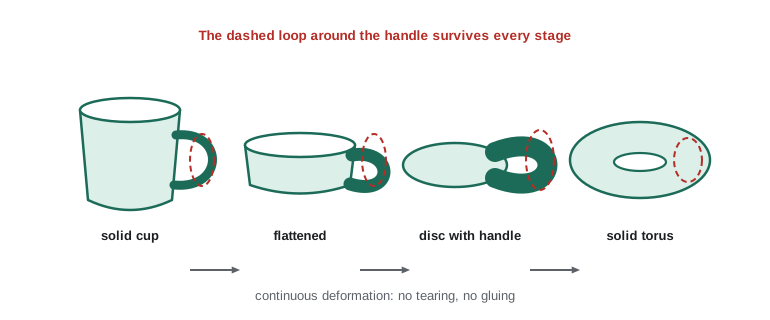
The standard joke says that a topologist cannot tell a coffee cup from a doughnut. A solid cup made of clay can be squashed down into a thick disc with a handle, and the handle can then be fattened while the disc shrinks, until the whole thing is a solid ring, a solid torus. At no stage was anything torn or glued. By contrast, no amount of squeezing turns a solid ball into a solid torus: the torus has a loop, around the handle, that cannot be shrunk to a point inside it, and the ball has no such loop. Lesson 9 turns that informal argument into the fundamental group, an algebraic object attached to each space.
Homeomorphism ignores size and shape in the everyday sense. A circle of radius 1 and a circle of radius 100 are homeomorphic, by scaling. A square and a circle are homeomorphic, by radial projection from the centre. The open interval \((0, 1)\) and the whole real line are homeomorphic, by the map \(x \mapsto \tan(\pi x - \pi/2)\), even though one has finite length and the other infinite. Length is not a topological property. What topology keeps is subtler: whether a space is in one piece, whether it has holes, whether it is bounded in a sense that does not mention distance, and how its pieces fit together.
Invariants: how to prove two spaces are different
Proving that two spaces are homeomorphic means exhibiting a homeomorphism. Proving they are not is harder, since one must rule out every possible map. The method is to find a topological invariant, a property or quantity preserved by homeomorphisms, that the two spaces do not share. The course develops a sequence of increasingly powerful invariants: connectedness in lesson 6, compactness in lessons 7 and 8, separation properties in lesson 5, the fundamental group in lessons 9 to 11, and the Euler characteristic in lesson 12.
Already the simplest invariant is useful. Removing a point from a space is a topological operation: if \(h : X \to Y\) is a homeomorphism, then \(h\) restricts to a homeomorphism from \(X \setminus \{p\}\) to \(Y \setminus \{h(p)\}\). So the number of pieces left after removing a point is an invariant. Remove any point from a circle and one piece remains; remove an interior point from a closed interval and two pieces remain. Hence a circle is not homeomorphic to an interval. Removing a point from the plane leaves one piece, but removing a point from the line leaves two, so the line is not homeomorphic to the plane. Lesson 6 makes the word piece precise.
Example: letters of the alphabet. Drawn as thin curves in a plain sans-serif font, the capital letters fall into a small number of homeomorphism classes. The letters C, I, L, M, N, S, U, V, W and Z are all homeomorphic to a segment. D and O are homeomorphic to a circle. E, F, T and Y are each three arcs meeting at a single point, since the corners of E and F are not branch points. K and X are four arcs meeting at a point. P and Q are each a circle with an arc attached, while A is a loop with two legs, R a loop with two arcs leaving the same point, B a figure eight and H two branch points joined by a bar. The invariants used are the number of pieces, the number of independent loops, and the number of arcs leaving each branch point, and the program at the end of the lesson computes them.
From distance to open sets
Recall from MATH-341 that in a metric space \((X, d)\) the open ball is \(B(x, r) = \{y : d(x, y) < r\}\) and a set \(U\) is open if every point of \(U\) is the centre of some ball inside \(U\). The open sets satisfy three rules: the empty set and \(X\) are open; any union of open sets is open; and the intersection of finitely many open sets is open. Lesson 2 takes these three rules as the definition of a topology.
Theorem. Let \(f : X \to Y\) be a function between metric spaces. Then \(f\) is continuous in the epsilon-delta sense at every point if and only if \(f^{-1}(V)\) is open in \(X\) for every open set \(V\) in \(Y\).
Proof. Suppose \(f\) is continuous and \(V\) is open in \(Y\). Take \(x \in f^{-1}(V)\). Since \(f(x) \in V\) and \(V\) is open, there is \(\varepsilon > 0\) with \(B(f(x), \varepsilon) \subseteq V\). By continuity at \(x\) there is \(\delta > 0\) such that \(d(x, x') < \delta\) implies \(d(f(x), f(x')) < \varepsilon\), that is, \(f(B(x, \delta)) \subseteq B(f(x), \varepsilon) \subseteq V\). So \(B(x, \delta) \subseteq f^{-1}(V)\), and \(f^{-1}(V)\) is open. Conversely, suppose preimages of open sets are open, and let \(x \in X\) and \(\varepsilon > 0\). The ball \(V = B(f(x), \varepsilon)\) is open, so \(f^{-1}(V)\) is an open set containing \(x\), and therefore contains some ball \(B(x, \delta)\). That says exactly that \(d(x, x') < \delta\) implies \(d(f(x), f(x')) < \varepsilon\).
The second half of the theorem never mentions a distance. It says that continuity is a statement about open sets only. That is the decisive observation: if we know which subsets of \(X\) and \(Y\) are open, we know which functions are continuous, even if we have forgotten the metrics.
Different metrics, same topology
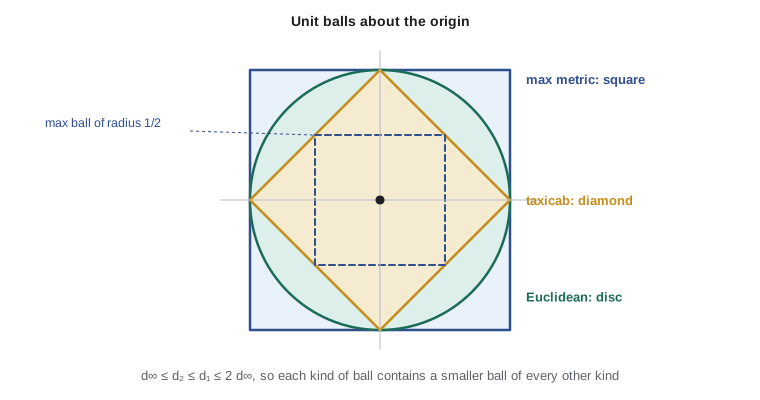
On the plane \(\mathbb{R}^2\) consider three metrics: the Euclidean metric \(d_2\), the taxicab metric \(d_1(p, q) = |p_1 - q_1| + |p_2 - q_2|\), and the maximum metric \(d_\infty(p, q) = \max(|p_1 - q_1|, |p_2 - q_2|)\). Their unit balls are a round disc, a diamond and a square. The distances they assign are different, yet they have exactly the same open sets.
The reason is the chain of inequalities \(d_\infty \le d_2 \le d_1 \le 2 d_\infty\), each of which is elementary. The first says a side of a right triangle is at most the hypotenuse; the second is the triangle inequality for the Euclidean norm applied to the two coordinate steps; the third holds because each of the two terms in \(d_1\) is at most the maximum. From the inequalities, every \(d_1\)-ball of radius \(r\) contains the \(d_\infty\)-ball of radius \(r/2\) about the same point, every \(d_\infty\)-ball of radius \(r\) contains the \(d_2\)-ball of radius \(r\), and so on around the cycle. Hence a set that contains a small ball of one kind about each of its points contains a small ball of every other kind too.
In general two metrics \(d\) and \(d'\) on a set are called topologically equivalent if they have the same open sets. A sufficient condition is that each is bounded by a constant multiple of the other, as above; MATH-341 proved that all norms on \(\mathbb{R}^n\) satisfy this. But topological equivalence is much weaker than such bounds. The metric \(d'(x, y) = \min(1, |x - y|)\) on the real line has the same open sets as the usual metric, since the two agree on balls of radius less than 1, yet in \(d'\) the whole line has diameter 1. Boundedness, like length, is a metric property and not a topological one.
So distance is a convenient way to describe a topology, but not part of it. Some topologies cannot be described by any metric at all. Lesson 5 gives examples and proves Urysohn's theorem, which says exactly which topologies come from metrics, under a countability assumption.
A short history
Topology grew from several roots. Euler's solution of the Königsberg bridge problem in 1736 showed that the possibility of a walk crossing each bridge once depends only on how land masses and bridges are connected, not on their sizes or positions. In 1758 Euler published his polyhedron formula \(V - E + F = 2\) for convex polyhedra, the first topological invariant. Johann Benedict Listing, a student of Gauss, introduced the word topology in his 1847 essay Vorstudien zur Topologie. August Möbius described the one-sided strip in work of 1858, published in 1865, and Riemann's study of multivalued complex functions in the 1850s led to Riemann surfaces and to the idea of classifying surfaces by their number of handles.
The point-set side came from analysis. Cantor's set theory in the 1870s and 1880s gave a language for open and closed sets of real numbers and for strange examples such as the Cantor set. Felix Hausdorff's book Grundzüge der Mengenlehre of 1914 defined a topological space through axioms on neighbourhoods; Kazimierz Kuratowski gave an equivalent definition by axioms for the closure operation in 1922; and the definition by open sets used today became standard in the following decades. The algebraic side began with Henri Poincaré's paper Analysis Situs of 1895 and its supplements, which introduced the fundamental group and homology. L. E. J. Brouwer's work of 1910 to 1912 proved the fixed point theorem and the invariance of dimension. Algebraic topology then developed rapidly through the twentieth century, culminating, for one famous problem, in Grigori Perelman's 2003 proof of the Poincaré conjecture about three-dimensional spheres.
What this course covers
The first half is point-set topology. Lesson 2 defines topological spaces, bases and subspaces; lesson 3 studies continuous maps and homeomorphisms; lesson 4 builds new spaces as products and quotients, including the torus, the Möbius strip, the Klein bottle and the projective plane by gluing the edges of a square. Lesson 5 studies how well a topology separates points and closed sets, and when a topology comes from a metric. Lesson 6 covers connectedness, lesson 7 compactness with the Heine–Borel theorem and its proof, and lesson 8 Tychonoff's theorem on products of compact spaces, one-point compactification and local compactness.
The second half is an introduction to algebraic topology. Lesson 9 defines homotopy and the fundamental group. Lesson 10 computes the fundamental group of the circle by lifting paths to the real line, and uses it to prove the fundamental theorem of algebra, the two-dimensional Brouwer fixed point theorem and the Borsuk–Ulam theorem. Lesson 11 studies covering spaces and the Seifert–van Kampen theorem for computing fundamental groups by cutting spaces into pieces. Lesson 12, the capstone, classifies closed surfaces by orientability and Euler characteristic. MATH-322 group theory is used from lesson 9 on; MATH-341 metric space theory is used throughout.
Experiments by computer
The program models capital letters as small graphs, with vertices at ends, corners and junctions, and computes three homeomorphism invariants: the number of pieces, the number of independent loops, and the list of branching degrees after smoothing away vertices of degree 2. Letters with different invariants cannot be homeomorphic. It also checks the metric inequalities numerically on random pairs of points.
import random
from collections import Counter

def invariants(edges):
    """edges: list of vertex pairs. Return (pieces, loops, branch degrees)."""
    verts = sorted({v for e in edges for v in e})
    parent = {v: v for v in verts}
    def find(v):
        while parent[v] != v:
            parent[v] = parent[parent[v]]
            v = parent[v]
        return v
    for a, b in edges:
        parent[find(a)] = find(b)
    pieces = len({find(v) for v in verts})
    loops = len(edges) - len(verts) + pieces        # independent cycles
    deg = Counter(v for e in edges for v in e)
    branch = tuple(sorted((d for d in deg.values() if d != 2), reverse=True))
    return pieces, loops, branch

letters = {
    'A': [(0, 5), (5, 1), (1, 6), (6, 2), (5, 6)],
    'B': [(0, 1), (1, 2), (0, 3), (3, 1), (1, 4), (4, 2)],
    'C': [(0, 1), (1, 2), (2, 3)],
    'D': [(0, 1), (1, 2), (2, 0)],
    'E': [(0, 1), (1, 2), (0, 3), (1, 4), (2, 5)],
    'F': [(0, 1), (1, 2), (0, 3), (1, 4)],
    'H': [(0, 1), (1, 2), (3, 4), (4, 5), (1, 4)],
    'K': [(0, 1), (1, 2), (1, 3), (1, 4)],
    'O': [(0, 1), (1, 2), (2, 3), (3, 0)],
    'P': [(0, 1), (1, 2), (2, 3), (3, 1)],
    'Q': [(0, 1), (1, 2), (2, 0), (2, 3)],
    'R': [(0, 1), (1, 2), (2, 3), (3, 1), (1, 4)],
    'T': [(0, 1), (1, 2), (1, 3)],
    'X': [(0, 1), (1, 2), (3, 1), (1, 4)],
    'Y': [(0, 1), (1, 2), (1, 3)],
}
classes = {}
for ch, e in letters.items():
    classes.setdefault(invariants(e), []).append(ch)
for inv, chs in sorted(classes.items()):
    print("pieces, loops, branch degrees", inv, "->", " ".join(chs))

random.seed(447)
worst = 0.0
for trial in range(10000):
    p = [random.uniform(-5, 5) for _ in range(2)]
    q = [random.uniform(-5, 5) for _ in range(2)]
    dmax = max(abs(p[0] - q[0]), abs(p[1] - q[1]))
    d2 = ((p[0] - q[0]) ** 2 + (p[1] - q[1]) ** 2) ** 0.5
    d1 = abs(p[0] - q[0]) + abs(p[1] - q[1])
    assert dmax <= d2 + 1e-12 and d2 <= d1 + 1e-12 and d1 <= 2 * dmax + 1e-12
    worst = max(worst, d1 / dmax)
print("chain dmax <= d2 <= d1 <= 2 dmax holds on 10000 random pairs")
print("largest ratio d1 / dmax seen:", round(worst, 4))pieces, loops, branch degrees (1, 0, (1, 1)) -> C pieces, loops, branch degrees (1, 0, (3, 1, 1, 1)) -> E F T Y pieces, loops, branch degrees (1, 0, (3, 3, 1, 1, 1, 1)) -> H pieces, loops, branch degrees (1, 0, (4, 1, 1, 1, 1)) -> K X pieces, loops, branch degrees (1, 1, ()) -> D O pieces, loops, branch degrees (1, 1, (3, 1)) -> P Q pieces, loops, branch degrees (1, 1, (3, 3, 1, 1)) -> A pieces, loops, branch degrees (1, 1, (4, 1, 1)) -> R pieces, loops, branch degrees (1, 2, (4,)) -> B chain dmax <= d2 <= d1 <= 2 dmax holds on 10000 random pairs largest ratio d1 / dmax seen: 1.9997
The output sorts the letters into classes. C is a single arc; D and O are circles; P and Q both have one loop and one branch point of degree 3, so they are candidates to be homeomorphic, and indeed they are, since the tail of Q and the stem of P are each an arc attached to a circle at one point. E, F, T and Y all have a single branch point of degree 3 and no loops, while K and X have one point of degree 4. A, B, H and R each stand alone: A and H have two branch points, with and without a loop, R has one loop and a point where four arcs meet, and B has two loops. The invariants prove that letters in different classes are not homeomorphic; to prove that letters in the same class are homeomorphic one must still describe the map, which here is easy because the graphs are the same after smoothing.
Worked problem
Proving two metrics give the same open sets
Show that \(d_1\) and \(d_\infty\) on \(\mathbb{R}^2\) have the same open sets.
Show solution
- First prove \(d_\infty \le d_1 \le 2 d_\infty\). The maximum of two nonnegative numbers is at most their sum, and their sum is at most twice their maximum.
- Let \(U\) be open for \(d_1\) and \(p \in U\). There is \(r > 0\) with \(B_1(p, r) \subseteq U\).
- If \(d_\infty(p, q) < r/2\) then \(d_1(p, q) \le 2 d_\infty(p, q) < r\), so \(B_\infty(p, r/2) \subseteq B_1(p, r) \subseteq U\). Hence \(U\) is open for \(d_\infty\).
- Conversely, let \(U\) be open for \(d_\infty\) and \(B_\infty(p, r) \subseteq U\). If \(d_1(p, q) < r\) then \(d_\infty(p, q) \le d_1(p, q) < r\), so \(B_1(p, r) \subseteq U\).
- Each kind of ball contains a ball of the other kind about the same point, so the two families of open sets coincide.
Answer: The two metrics are topologically equivalent: they define the same open sets, although their distances differ.
Common mistakes
MistakeThinking a homeomorphism must preserve length or area.
InsteadHomeomorphisms may stretch arbitrarily; the open interval is homeomorphic to the whole line.
MistakeProving two spaces are different by failing to find a homeomorphism.
InsteadFind an invariant that one space has and the other lacks, such as the number of pieces after removing a point.
MistakeAssuming a continuous bijection is automatically a homeomorphism.
InsteadThe inverse must be continuous too; lesson 3 shows that wrapping \([0, 2\pi)\) around the circle is a continuous bijection that is not a homeomorphism.
MistakeBelieving that boundedness is a topological property.
InsteadThe metric \(\min(1, |x - y|)\) makes the line bounded without changing its open sets.
MistakeTreating the coffee cup and the doughnut as surfaces and solids interchangeably.
InsteadThe solid cup is homeomorphic to the solid torus, and its surface to the torus surface; a solid is never homeomorphic to a surface.
Summary and key terms
- Topology studies properties preserved by homeomorphisms, continuous bijections with continuous inverses.
- A function between metric spaces is continuous if and only if preimages of open sets are open, so continuity depends only on the open sets.
- Different metrics can give the same open sets; length and boundedness are not topological properties.
- Spaces are shown to be different by topological invariants, beginning with the number of pieces left after removing a point.
- The course covers point-set topology first, then the fundamental group, covering spaces and the classification of surfaces.
- homeomorphism
- A continuous bijection whose inverse is also continuous.
- topological invariant
- A property or quantity that homeomorphic spaces share.
- topologically equivalent metrics
- Metrics on the same set that define the same open sets.
- open ball
- In a metric space, the set \(B(x, r)\) of points at distance less than \(r\) from \(x\).
- solid torus
- The solid ring obtained by rotating a disc about an axis in its plane that misses it.
- rubber-sheet geometry
- An informal name for topology, emphasizing deformations that stretch but do not tear or glue.
Practice problems
Work each problem on paper first, then reveal the answer to check.
Give an explicit homeomorphism from \((0, 1)\) to \((a, b)\) for \(a < b\).
Show answer
\(x \mapsto a + (b - a)x\), with continuous inverse \(y \mapsto (y - a)/(b - a)\).
Show that \([0, 1)\) is not homeomorphic to \((0, 1)\) by removing points.
Show answer
Removing \(0\) from \([0, 1)\) leaves one piece. Removing any point from \((0, 1)\) leaves two pieces. A homeomorphism would send \(0\) to some point and preserve the number of pieces.
Which capital letters, drawn as curves, are homeomorphic to the letter T?
Show answer
Those with one branch point of degree 3 and no loops, such as E, F and Y.
Prove that \(d'(x, y) = \min(1, |x - y|)\) is a metric on the real line.
Show answer
Only the triangle inequality needs care. If either \(d'(x, y)\) or \(d'(y, z)\) is 1 then \(d'(x, z) \le 1\) is at most their sum. Otherwise the sum is \(|x - y| + |y - z| \ge |x - z| \ge d'(x, z)\).
Show that the line and the plane are not homeomorphic.
Show answer
Removing a point from the line leaves two pieces; removing a point from the plane leaves one, because any two remaining points can be joined by a path avoiding the removed point.
Is the map \(x \mapsto x^3\) a homeomorphism of the real line? What about \(x \mapsto x^2\)?
Show answer
Yes: it is a continuous bijection with continuous inverse \(y \mapsto y^{1/3}\). The square map is not injective, so it is not a homeomorphism.
Lesson quiz · 5 questions
Score 60% or more to complete this lesson.
Create a free account to save your progress, take quizzes and earn a certificate.