
MATH-260 · Lesson 5 of 12 · 23 min
Recurrence relations
Many counting problems are easiest to solve not all at once but in terms of smaller versions of themselves. How many moves does it take to transfer a tower of 10 disks? Exactly twice as many as for 9 disks, plus one. How many bit strings of length 20 have no two consecutive 1s? As many as of length 19, plus as many as of length 18. Equations of this kind, which express each term of a sequence through earlier terms, are called recurrence relations. They are the discrete counterpart of differential equations, and they are the natural language for algorithms that work by breaking a problem into smaller pieces.
This lesson shows how to set up recurrences for counting problems and how to solve the simplest ones by unrolling them and proving the result by induction. Lesson 6 gives a general method for the important family of linear recurrences with constant coefficients.
Sequences defined by recurrence
A recurrence relation for a sequence \(a_0, a_1, a_2, \dots\) is an equation that expresses \(a_n\) in terms of one or more earlier terms, valid for all \(n\) from some point on. Initial conditions give the first few terms. Together they determine the sequence completely: the initial conditions fix the start, and the recurrence then computes each term from the ones before it. For example,
\[ a_n = 3a_{n-1} - 2, \qquad a_0 = 2 \]
gives \(a_1 = 4\), \(a_2 = 10\), \(a_3 = 28\), \(a_4 = 82\). The same recurrence with \(a_0 = 1\) gives the constant sequence 1, 1, 1, ..., so the initial conditions matter as much as the recurrence. A closed form is a formula for \(a_n\) directly in terms of \(n\), with no reference to earlier terms. Here the closed form is \(a_n = 3^n + 1\), which you can check satisfies both the recurrence and the initial condition. Finding closed forms is the main goal of the next two lessons, but a recurrence is already useful in itself: a computer can evaluate it quickly, and it often reveals the structure of a problem better than a formula does.
The Tower of Hanoi
The Tower of Hanoi puzzle, invented by the French mathematician Édouard Lucas in 1883, has three pegs and \(n\) disks of different sizes stacked on the first peg, largest at the bottom. The goal is to move the whole stack to the third peg, one disk at a time, never placing a larger disk on a smaller one. What is the least number of moves?
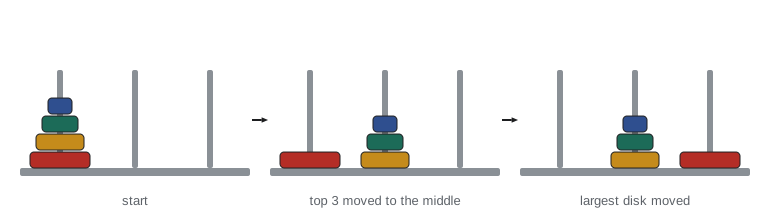
Let \(H_n\) be the least number of moves for \(n\) disks. The largest disk must move at some point, and when it does, the other \(n - 1\) disks must all be stacked on the remaining peg, because they cannot be on the peg the largest disk leaves or the peg it lands on. Getting them there takes at least \(H_{n-1}\) moves. After the largest disk moves, the \(n - 1\) smaller disks must be moved onto it, taking at least \(H_{n-1}\) more. So \(H_n \ge 2H_{n-1} + 1\), and the strategy just described achieves this. Therefore
\[ H_n = 2H_{n-1} + 1, \qquad H_1 = 1. \]
Unrolling the recurrence: \(H_1 = 1\), \(H_2 = 3\), \(H_3 = 7\), \(H_4 = 15\). These are one less than powers of 2, so we guess \(H_n = 2^n - 1\) and prove it by induction. The base case \(H_1 = 1 = 2^1 - 1\) holds. If \(H_{n-1} = 2^{n-1} - 1\), then \(H_n = 2(2^{n-1} - 1) + 1 = 2^n - 1\). A legend that accompanied the puzzle told of priests moving 64 golden disks; at one move per second, \(2^{64} - 1\) moves would take about 585 billion years.
def hanoi(n, source, target, spare, moves):
    if n == 0:
        return
    hanoi(n - 1, source, spare, target, moves)
    moves.append((n, source, target))
    hanoi(n - 1, spare, target, source, moves)

moves = []
hanoi(3, "A", "C", "B", moves)
for disk, s, t in moves:
    print(f"move disk {disk} from {s} to {t}")

for n in range(1, 11):
    m = []
    hanoi(n, "A", "C", "B", m)
print(n, len(m), 2 ** n - 1)move disk 1 from A to C move disk 2 from A to B move disk 1 from C to B move disk 3 from A to C move disk 1 from B to A move disk 2 from B to C move disk 1 from A to C 1 1 1 2 3 3 3 7 7 4 15 15 5 31 31 6 63 63 7 127 127 8 255 255 9 511 511 10 1023 1023
Unrolling a recurrence
For first-order recurrences, where each term depends only on the one before, we can often find the closed form by substituting the recurrence into itself repeatedly, a method called unrolling or iteration. For the Tower of Hanoi:
\[ H_n = 2H_{n-1} + 1 = 2(2H_{n-2} + 1) + 1 = 4H_{n-2} + 2 + 1 = 8H_{n-3} + 4 + 2 + 1 = \cdots = 2^{n-1}H_1 + (2^{n-2} + \cdots + 2 + 1). \]
With \(H_1 = 1\) this is the geometric sum \(1 + 2 + \cdots + 2^{n-1} = 2^n - 1\). Unrolling is reliable for recurrences of the form \(a_n = c\,a_{n-1} + f(n)\). The answer is a sum, which may or may not have a simple form. Once a closed form is found, an induction proof confirms it.
Worked problem
Lines cutting the plane
Draw \(n\) straight lines in the plane so that no two are parallel and no three meet at a point. Into how many regions \(L_n\) do they divide the plane?
Show solution
- With no lines there is 1 region, so \(L_0 = 1\).
- The \(n\)th line crosses each of the \(n - 1\) earlier lines at a different point, so it is cut into \(n\) pieces: \(n - 2\) segments and two rays. Each piece splits one region into two.
- So \(L_n = L_{n-1} + n\) for \(n \ge 1\).
- Unroll: \(L_n = L_0 + 1 + 2 + \cdots + n = 1 + \frac{n(n+1)}{2}\).
- Check: \(L_1 = 2\), \(L_2 = 4\), \(L_3 = 7\), \(L_4 = 11\), which matches drawings.
Answer: \(L_n = 1 + n(n+1)/2\). Three lines give 7 regions, not 8: once again, doubling stops.
Fibonacci numbers
In his book Liber Abaci of 1202, Leonardo of Pisa, later called Fibonacci, posed a problem about rabbits. A pair of newborn rabbits matures in one month and from then on produces a new pair every month; no rabbit dies. How many pairs are there after \(n\) months? The pairs alive in month \(n\) are the pairs alive in month \(n - 1\), plus the newborns, of which there is one for each pair at least a month old, that is, one for each pair alive in month \(n - 2\). So the number \(F_n\) of pairs satisfies
\[ F_n = F_{n-1} + F_{n-2}, \qquad F_1 = F_2 = 1, \]
giving 1, 1, 2, 3, 5, 8, 13, 21, 34, 55, 89, ... It is convenient to set \(F_0 = 0\), which is consistent with the recurrence. The rabbits are a fanciful model, but the Fibonacci numbers count a surprising number of things, and the recurrence is the reason. Whenever a structure of size \(n\) is built by adding either a piece of size 1 to a structure of size \(n - 1\) or a piece of size 2 to a structure of size \(n - 2\), the counts satisfy the Fibonacci recurrence.
Domino tilings. In how many ways \(T_n\) can a \(2 \times n\) strip be tiled with \(1 \times 2\) dominoes? Look at the left end. Either a single domino stands upright there, leaving a \(2 \times (n-1)\) strip, or two dominoes lie flat one above the other, leaving a \(2 \times (n - 2)\) strip. These cases are disjoint and cover everything, so \(T_n = T_{n-1} + T_{n-2}\), with \(T_1 = 1\) and \(T_2 = 2\). Hence \(T_n = F_{n+1}\).
Bit strings without consecutive 1s. Let \(b_n\) be the number of bit strings of length \(n\) with no two adjacent 1s. Such a string either ends in 0, preceded by any valid string of length \(n - 1\), or ends in 01, preceded by any valid string of length \(n - 2\). The string cannot end in 11. So \(b_n = b_{n-1} + b_{n-2}\), with \(b_1 = 2\) (0 and 1) and \(b_2 = 3\) (00, 01, 10). Hence \(b_n = F_{n+2}\). This count matters in coding theory, where a rule forbidding consecutive 1s is used in some ways of recording data.
from itertools import product
from functools import lru_cache

@lru_cache(maxsize=None)
def fib(n):
    return n if n < 2 else fib(n - 1) + fib(n - 2)

def no_adjacent_ones(n):
    return sum(1 for s in product("01", repeat=n) if "11" not in "".join(s))

def tilings(n):
    # count tilings of a 2-by-n strip by brute-force recursion
    if n <= 1:
        return 1
    return tilings(n - 1) + tilings(n - 2)

print(" n  F(n)  strings  F(n+2)  tilings  F(n+1)")
for n in range(1, 13):
    print(f"{n:2d} {fib(n):5d} {no_adjacent_ones(n):8d} {fib(n+2):7d} {tilings(n):8d} {fib(n+1):7d}")
print("F(100) =", fib(100))n F(n) strings F(n+2) tilings F(n+1) 1 1 2 2 1 1 2 1 3 3 2 2 3 2 5 5 3 3 4 3 8 8 5 5 5 5 13 13 8 8 6 8 21 21 13 13 7 13 34 34 21 21 8 21 55 55 34 34 9 34 89 89 55 55 10 55 144 144 89 89 11 89 233 233 144 144 12 144 377 377 233 233 F(100) = 354224848179261915075
A word of caution about computing recurrences. The definition of fib above calls itself twice, so without the cache line it would recompute the same values over and over, taking about \(F_n\) steps to compute \(F_n\), which is hopeless for \(n = 100\). With the cache, or with a simple loop that keeps the last two values, each value is computed once. This is the idea of dynamic programming, which CMPUT-204 studies in detail.
Setting up a recurrence
The skill in this lesson is setting up the recurrence, and the method is always the same. Describe the objects of size \(n\). Look at one end, or at one special element, and split the objects into cases according to what happens there. In each case, recognize what remains as an object of a smaller size. Check that the cases are disjoint and cover every object. Then write the recurrence and work out enough initial conditions to start it, being careful that the recurrence is valid for every \(n\) above them.
Worked problem
Climbing stairs
You climb a staircase of \(n\) steps taking 1, 2 or 3 steps at a time. In how many ways \(s_n\) can you reach the top?
Show solution
- Split by the size of the last stride: 1, 2 or 3 steps. Before it you have climbed \(n - 1\), \(n - 2\) or \(n - 3\) steps in any valid way.
- So \(s_n = s_{n-1} + s_{n-2} + s_{n-3}\) for \(n \ge 3\).
- Initial conditions: \(s_0 = 1\) (the empty climb), \(s_1 = 1\), \(s_2 = 2\) (1+1 or 2).
- Then \(s_3 = 4\), \(s_4 = 7\), \(s_5 = 13\), \(s_6 = 24\), \(s_7 = 44\).
Answer: \(s_n = s_{n-1} + s_{n-2} + s_{n-3}\) with \(s_0 = 1, s_1 = 1, s_2 = 2\); a 7-step staircase can be climbed in 44 ways.
Recurrences in algorithms
Recursive algorithms lead naturally to recurrences for their running times. Binary search on a sorted list of \(n\) items compares the target with the middle item and continues in one half, so the number of comparisons satisfies roughly \(C(n) = C(n/2) + 1\), giving about \(\log_2 n\) comparisons. Merge sort sorts each half recursively and merges the results with about \(n\) comparisons, so \(T(n) = 2T(n/2) + n\), whose solution grows like \(n \log_2 n\). These divide-and-conquer recurrences, which involve \(n/2\) rather than \(n - 1\), are studied in CMPUT-204. The recurrences in this course have the form \(a_n\) in terms of \(a_{n-1}, a_{n-2}, \dots\), which suits counting problems.
Common mistakes
MistakeWriting a recurrence without enough initial conditions.
InsteadA recurrence of order \(k\), using the previous \(k\) terms, needs \(k\) initial values.
MistakeSplitting into cases that overlap or miss some objects.
InsteadCheck that each object falls into exactly one case before adding the case counts.
MistakeUsing the recurrence for values of \(n\) where its derivation does not apply.
InsteadIf the argument needs \(n - 2\) to exist, the recurrence starts at \(n = 2\) and earlier values are initial conditions.
MistakeComputing a recurrence with naive recursion.
InsteadPlain recursion recomputes values exponentially often; use a loop or memoization.
MistakeAccepting a guessed closed form after checking a few terms.
InsteadProve the closed form by induction from the recurrence and initial conditions.
Summary and key terms
- A recurrence relation expresses each term of a sequence through earlier terms; with initial conditions it determines the sequence.
- The Tower of Hanoi needs \(H_n = 2H_{n-1} + 1\) moves, so \(H_n = 2^n - 1\).
- First-order recurrences \(a_n = c\,a_{n-1} + f(n)\) can be solved by unrolling, then confirmed by induction.
- Fibonacci numbers \(F_n = F_{n-1} + F_{n-2}\) count domino tilings, bit strings without consecutive 1s and many other structures built from pieces of size 1 and 2.
- Recurrences are set up by splitting objects of size \(n\) according to what happens at one end or at one special element.
- Computing recurrences needs a loop or memoization; naive recursion repeats work exponentially.
- recurrence relation
- An equation expressing a term of a sequence in terms of earlier terms.
- initial conditions
- The starting values that, with the recurrence, determine a sequence.
- closed form
- A formula for \(a_n\) that does not refer to earlier terms.
- order
- The number of earlier terms a recurrence uses.
- unrolling
- Substituting a recurrence into itself repeatedly to find a pattern.
- Tower of Hanoi
- The puzzle of moving a stack of disks under size restrictions; it needs \(2^n - 1\) moves.
- Fibonacci numbers
- \(F_0 = 0, F_1 = 1, F_n = F_{n-1} + F_{n-2}\).
- memoization
- Storing computed values so a recursive function never recomputes them.
Practice problems
Work each problem on paper first, then reveal the answer to check.
Find the first five terms of \(a_n = 2a_{n-1} + 3\), \(a_0 = 1\), and guess and prove a closed form.
Show answer
1, 5, 13, 29, 61. Guess \(a_n = 2^{n+2} - 3\): true at \(n = 0\), and \(2(2^{n+1} - 3) + 3 = 2^{n+2} - 3\).
Solve \(a_n = a_{n-1} + 2n - 1\), \(a_0 = 0\), by unrolling.
Show answer
\(a_n = \sum_{k=1}^{n} (2k - 1) = n^2\).
Let \(t_n\) be the number of ways to tile a \(1 \times n\) strip with \(1 \times 1\) and \(1 \times 2\) tiles. Find a recurrence and \(t_6\).
Show answer
\(t_n = t_{n-1} + t_{n-2}\), \(t_1 = 1\), \(t_2 = 2\); \(t_6 = 13\).
Let \(q_n\) count ternary strings (digits 0, 1, 2) of length \(n\) with no two consecutive 0s. Find a recurrence.
Show answer
A string ends in 1 or 2 after any valid string of length \(n - 1\), or ends in 0 preceded by 1 or 2 after a valid string of length \(n - 2\): \(q_n = 2q_{n-1} + 2q_{n-2}\), \(q_1 = 3\), \(q_2 = 8\).
A bank account starts at 1000 and earns interest at 4% per year, with 100 withdrawn at the end of each year. Write a recurrence for the balance.
Show answer
\(B_n = 1.04 B_{n-1} - 100\), \(B_0 = 1000\).
Prove by induction that \(F_1 + F_2 + \cdots + F_n = F_{n+2} - 1\).
Show answer
Base: \(F_1 = 1 = F_3 - 1\). Step: \(F_{n+2} - 1 + F_{n+1} = F_{n+3} - 1\).
Lesson quiz · 5 questions
Score 60% or more to complete this lesson.
Create a free account to save your progress, take quizzes and earn a certificate.