
MATH-201 · Lesson 6 of 12 · 32 min
Boundary value and eigenvalue problems
Most of this course so far has dealt with initial value problems: the state is known at one instant and the equation carries it forward in time. Many engineering problems are different. The temperature of a cooling fin is fixed at its base and the heat flow is fixed at its tip; a beam is held at both ends; a cable is anchored at two towers. Conditions are given at two different points, and the solution must satisfy both. These are boundary value problems (BVPs). Lesson 3 met one, the deflection of a simply supported beam. This lesson looks at them more closely. It shows that, unlike initial value problems, BVPs can have no solution or infinitely many, and that this apparent nuisance is the key to some of the most important results in engineering: buckling loads, natural frequencies and mode shapes. These are eigenvalue problems, and the same ideas lead directly to the Fourier series and partial differential equations of Lesson 11.
Initial versus boundary value problems
For a second-order equation, an initial value problem specifies \(y\) and \(y'\) at one point, and the existence and uniqueness theorem (Lesson 2) guarantees exactly one solution under mild conditions. A boundary value problem specifies one condition at each end of an interval, for example \(y(0) = A\) and \(y(L) = B\). There is no such guarantee. Consider \(y'' + y = 0\), whose general solution is \(y = C_1\cos x + C_2\sin x\):
- With \(y(0) = 0\) and \(y(\pi/2) = 1\): \(C_1 = 0\) and \(C_2 = 1\). Exactly one solution, \(y = \sin x\).
- With \(y(0) = 0\) and \(y(\pi) = 1\): \(C_1 = 0\), and then \(C_2\sin\pi = 0 \ne 1\). No solution at all.
- With \(y(0) = 0\) and \(y(\pi) = 0\): \(C_1 = 0\), and \(C_2\) can be anything. Infinitely many solutions, \(y = C\sin x\).
The difference comes from the interval length. On \(0 \le x \le \pi\), the homogeneous problem has a non-zero solution, \(\sin x\), that satisfies both zero boundary conditions. When that happens, the corresponding non-homogeneous problem generally has no solution, and the homogeneous one has infinitely many. For a column or a vibrating structure, this is not a mathematical defect: it signals buckling or resonance.
A well-posed BVP: the cooling fin
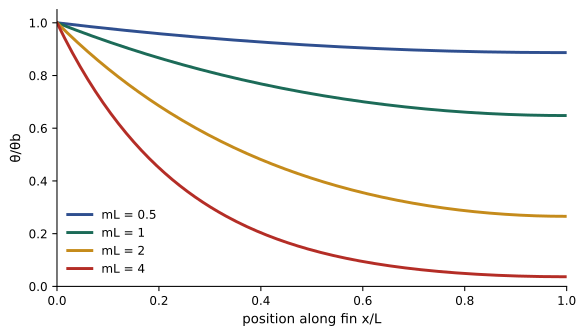
Fins extend a hot surface to shed heat: the ribs on a motorcycle engine, the plates on an electronics heat sink, the tubes of a car radiator. In a thin fin, heat conducts along the length and is lost from the surface by convection. An energy balance on a short slice gives, for the temperature excess \(\theta = T - T_\infty\) above the surroundings:
Here h is the convection coefficient, P the perimeter of the cross-section, k the thermal conductivity and A the cross-sectional area. The base is held at \(\theta(0) = \theta_b\), and if the tip loses little heat it can be treated as insulated, \(\theta'(L) = 0\). The general solution is a combination of \(\cosh mx\) and \(\sinh mx\), and fitting the two boundary conditions gives:
The heat rate q comes from Fourier's law at the base, \(q = -kA\,\theta'(0)\). The fin efficiency, the actual heat rate divided by the heat rate if the whole fin were at the base temperature, is \(\eta = \tanh(mL)/(mL)\).
Worked problem
An aluminium pin fin
A pin fin of diameter 5 mm and length 50 mm, with k = 200 W/(m·K), loses heat with h = 25 W/(m²·K). The base is 60 K above the air. Find the tip temperature excess, the heat rate and the efficiency.
Show solution
- \(P = \pi d = 0.01571\) m and \(A = \pi d^2/4 = 1.963 \times 10^{-5}\) m².
- \(m = \sqrt{25 \times 0.01571/(200 \times 1.963 \times 10^{-5})} = \sqrt{100} = 10\) m⁻¹, so \(mL = 0.5\).
- Tip: \(\theta(L) = 60/\cosh 0.5 = 60/1.128 = 53.2\) K.
- Heat rate: \(\sqrt{hPkA} = 0.0393\) W/K, so \(q = 0.0393 \times 60 \times \tanh 0.5 = 1.09\) W.
- Efficiency: \(\eta = 0.462/0.5 = 0.92\).
Answer: The tip is 53.2 K above the air, the fin sheds 1.09 W and its efficiency is 92%. Making the fin twice as long (mL = 1) raises the heat rate by only 65%, to 1.80 W, because the outer part is cooler: beyond mL of about 2, extra length adds almost nothing.
Nonlinear BVPs and the shooting idea
If the fin also loses heat by radiation, the loss term contains \(T^4\) and the equation is nonlinear. There is no formula, but there are two standard numerical strategies. The shooting method guesses the missing initial slope at the base, integrates as an initial value problem to the tip, checks the tip condition and adjusts the guess, using a root-finding method (MATH-300) to hit the target. Collocation methods, such as scipy's solve_bvp, instead represent the whole solution on a mesh and adjust it until the equation and both boundary conditions are satisfied at once.
import numpy as np
from scipy.integrate import solve_bvp

# Pin fin: 5 mm diameter, 50 mm long, aluminium
k, h, d, L = 200.0, 25.0, 0.005, 0.05
sigma = 5.67e-8
T_air, T_base = 293.0, 353.0
P, A = np.pi * d, np.pi * d**2 / 4

def solve_fin(eps):
    def rhs(x, y):
        T, dT = y
        loss = h * (T - T_air) + eps * sigma * (T**4 - T_air**4)
        return np.vstack([dT, P * loss / (k * A)])
    def bc(ya, yb):
        return np.array([ya[0] - T_base, yb[1]])
    x = np.linspace(0, L, 21)
    guess = np.vstack([np.full_like(x, T_base), np.zeros_like(x)])
    sol = solve_bvp(rhs, bc, x, guess, tol=1e-6)
    q = -k * A * sol.sol(0)[1]
    return sol.success, sol.sol(L)[0] - 273.15, q

for eps in [0.0, 0.1, 0.9]:
    ok, T_tip, q = solve_fin(eps)
print(f"emissivity {eps:.1f}: converged {ok}, tip {T_tip:.1f} C, heat {q:.3f} W")emissivity 0.0: converged True, tip 73.1 C, heat 1.089 W emissivity 0.1: converged True, tip 72.9 C, heat 1.119 W emissivity 0.9: converged True, tip 71.5 C, heat 1.356 W
The convection-only result matches the formula: a heat rate of 1.09 W and a tip 53.2 K above the 293 K air, or 73.1 °C. A bare, shiny aluminium surface (emissivity about 0.1) radiates little, but a high-emissivity surface (0.9) raises the heat rate by about 25% even at these modest temperatures, which is why heat sinks are often anodized black.
Eigenvalue problems: buckling of a column
A slender column carrying an axial load P stays straight until the load reaches a critical value, at which it suddenly bows sideways. For a pinned-pinned column of length L, a bent shape \(y(x)\) is possible if the bending moment \(-Py\) balances the internal moment \(EI\,y''\):
This homogeneous BVP always has the solution \(y = 0\), the straight column. The question is whether it has any other. With \(k^2 = P/(EI)\), the general solution is \(y = C_1\cos kx + C_2\sin kx\). The condition at \(x = 0\) gives \(C_1 = 0\); the condition at \(x = L\) gives \(C_2\sin kL = 0\). Either \(C_2 = 0\) (straight) or \(\sin kL = 0\), which needs \(kL = n\pi\). So a bent shape exists only at special loads, the eigenvalues:
The smallest, \(P_1 = \pi^2EI/L^2\), is the Euler buckling load, and \(\sin(\pi x/L)\) is the buckled shape, the eigenfunction. The amplitude of the shape is not determined: the linear theory says only that at this load the column can bend, not by how much. Higher modes would require bracing to prevent the first. The analysis is the same for other supports, except that the boundary conditions change the eigenvalues. Engineers express this as an effective length \(KL\):
| End conditions | Effective length factor K | Buckling load |
|---|---|---|
| Pinned at both ends | 1.0 | \(\pi^2EI/L^2\) |
| Fixed at one end, free at the other | 2.0 | \(\pi^2EI/(4L^2)\) |
| Fixed at one end, pinned at the other | 0.70 | \(2.05\,\pi^2EI/L^2\) |
| Fixed at both ends | 0.5 | \(4\pi^2EI/L^2\) |
Worked problem
Buckling of a steel column
A steel tube (E = 200 GPa) has second moment of area I = 2.0 × 10⁶ mm⁴ and cross-sectional area 1500 mm², and is 4.0 m long. Find the Euler buckling load if it is pinned at both ends, and if it is a flagpole fixed at the base and free at the top.
Show solution
- \(EI = 200 \times 10^9 \times 2.0 \times 10^{-6} = 4.0 \times 10^5\) N·m².
- Pinned-pinned: \(P_1 = \pi^2 \times 4.0 \times 10^5/4.0^2 = 247\) kN, an average stress of 247 000/1500 = 164 MPa.
- Fixed-free: effective length 8.0 m, so \(P = 247/4 = 61.7\) kN.
Answer: 247 kN pinned-pinned and 61.7 kN as a flagpole. The stress at buckling, 164 MPa, is below the yield strength of structural steel (about 350 MPa), so this column fails by buckling, not crushing: making it stockier, not stronger, is the remedy.
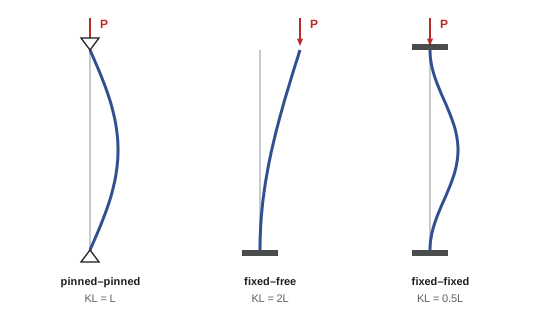
Buckling is the classic example of a bifurcation (Lesson 2): below the critical load the straight shape is the only equilibrium; at the critical load a bent family appears. Real columns have small initial curvature and eccentric loads, so they begin to bend before the Euler load and their deflection grows rapidly as the load approaches it, which is why codes reduce the allowable load well below \(P_1\).
Natural frequencies of a taut cable
A taut cable or string with tension T and mass per unit length \(\mu\), fixed at both ends, can vibrate in a shape \(X(x)\cos\omega t\). Lesson 11 derives the wave equation for it; substituting this form gives an eigenvalue problem for the shape:
This is the buckling problem again, with \(\mu\omega^2/T\) in place of \(P/(EI)\). So \(\sqrt{\mu/T}\,\omega_nL = n\pi\), giving the natural frequencies and mode shapes:
Worked problem
A bridge stay cable
A cable-stayed bridge has a stay 100 m long, with tension 3.0 MN and mass 60 kg/m. Find its first three natural frequencies.
Show solution
- Wave speed: \(\sqrt{T/\mu} = \sqrt{3.0 \times 10^6/60} = 224\) m/s.
- \(f_1 = 224/(2 \times 100) = 1.12\) Hz; \(f_2 = 2.24\) Hz; \(f_3 = 3.35\) Hz.
Answer: About 1.1, 2.2 and 3.4 Hz. These low frequencies can be excited by wind and rain, or by deck motion, so long stays are fitted with dampers near their anchorages, and engineers check that no cable frequency matches a deck frequency.
Eigenfunctions and orthogonality
The column and the cable share a model problem: \(X'' + \lambda X = 0\) on \(0 \le x \le L\) with homogeneous boundary conditions. Non-zero solutions exist only for particular values of \(\lambda\), the eigenvalues, and the corresponding solutions are the eigenfunctions. The boundary conditions decide which functions appear:
- Both ends fixed, \(X(0) = X(L) = 0\): \(\lambda_n = (n\pi/L)^2\), \(X_n = \sin(n\pi x/L)\), n = 1, 2, 3, …
- Both ends insulated (zero slope), \(X'(0) = X'(L) = 0\): \(\lambda_n = (n\pi/L)^2\), \(X_n = \cos(n\pi x/L)\), n = 0, 1, 2, …
- One end fixed, the other with zero slope: \(\lambda_n = \left(\tfrac{(2n - 1)\pi}{2L}\right)^2\), \(X_n = \sin\tfrac{(2n - 1)\pi x}{2L}\).
These eigenfunctions have a remarkable property. Any two different ones are orthogonal: the integral of their product over the interval is zero. For example:
This is the function version of perpendicular vectors (MATH-125), with the integral playing the role of the dot product, and it holds for the eigenfunctions of every problem of this type (the general theory is called Sturm-Liouville theory). Its practical value is that any reasonable function on the interval can be built from the eigenfunctions, and orthogonality makes finding the coefficients easy. That is the Fourier series, the main tool of Lesson 11, where the eigenfunctions found here become the building blocks of solutions to the heat and wave equations.
Worked problem
Checking orthogonality
Verify that \(\sin x\) and \(\sin 2x\) are orthogonal on \(0 \le x \le \pi\).
Show solution
- Use \(\sin A\sin B = \tfrac{1}{2}[\cos(A - B) - \cos(A + B)]\): the integrand is \(\tfrac{1}{2}(\cos x - \cos 3x)\).
- \(\int_0^\pi \tfrac{1}{2}(\cos x - \cos 3x)\,dx = \tfrac{1}{2}\left[\sin x - \tfrac{1}{3}\sin 3x\right]_0^\pi = 0\).
Answer: The integral is zero, so they are orthogonal. Physically, the first two modes of a string do not exchange energy in the linear theory: each vibrates independently.
Common mistakes
MistakeAssuming every boundary value problem has a unique solution.
InsteadBVPs can have none or infinitely many; check whether the homogeneous problem has a non-zero solution.
MistakeTreating the buckled amplitude as determined by the linear theory.
InsteadThe eigenvalue problem fixes only the critical load and the shape, not the size.
MistakeUsing the pinned-pinned Euler load for every column.
InsteadApply the effective length factor for the actual end conditions.
MistakeIgnoring yielding when the Euler load gives a stress above yield.
InsteadStocky columns fail by crushing; check the stress at the critical load.
MistakeAssuming a longer fin always sheds proportionally more heat.
InsteadGains fall off once mL exceeds about 2; the outer part is nearly at air temperature.
Summary and key terms
- Boundary value problems give conditions at two points and may have one, none or infinitely many solutions.
- A fin with an insulated tip has θ = θ_b cosh m(L − x)/cosh mL and efficiency tanh(mL)/mL.
- Nonlinear BVPs are solved numerically by shooting or collocation.
- Column buckling is an eigenvalue problem; the Euler load is π²EI/(KL)².
- A taut cable has natural frequencies fₙ = (n/2L)√(T/μ) and sine mode shapes.
- The eigenfunctions of X″ + λX = 0 with homogeneous boundary conditions are sines or cosines.
- Eigenfunctions are orthogonal, which makes them building blocks for Fourier series.
- Boundary value problem
- A differential equation with conditions given at two or more points.
- Fin efficiency
- Actual heat rate from a fin divided by the rate if it were entirely at base temperature.
- Shooting method
- Solving a BVP by adjusting an initial slope until the far boundary condition is met.
- Eigenvalue
- A parameter value for which a homogeneous BVP has a non-zero solution.
- Eigenfunction
- A non-zero solution of a homogeneous BVP at an eigenvalue.
- Euler buckling load
- The lowest eigenvalue load π²EI/L² of a pinned-pinned column.
- Effective length
- The length of an equivalent pinned-pinned column, KL.
- Mode shape
- The spatial pattern of a natural vibration.
- Orthogonal functions
- Functions whose product integrates to zero over an interval.
Practice problems
Work each problem on paper first, then reveal the answer to check.
Does \(y'' + 4y = 0\), y(0) = 0, y(π/2) = 0 have a unique solution?
Show answer
No: y = C sin 2x for any C.
Solve \(y'' + 4y = 0\), y(0) = 0, y(π/4) = 3.
Show answer
y = 3 sin 2x.
Find m for a square aluminium fin 4 mm × 4 mm with k = 200 W/(m·K) and h = 40 W/(m²·K).
Show answer
P/A = 16/16 = 1 mm⁻¹ = 1000 m⁻¹: m = √(40 × 1000/200) = 14.1 m⁻¹.
What is the efficiency of a fin with mL = 2?
Show answer
tanh 2/2 = 0.964/2 = 0.48.
Find the Euler load of a pinned-pinned column with EI = 1.0 × 10⁵ N·m² and L = 2.5 m.
Show answer
π² × 10⁵/6.25 = 158 kN.
The same column is fixed at both ends. Find its buckling load.
Show answer
Four times larger: 632 kN.
How does doubling a column's length change its Euler load?
Show answer
It falls to one quarter.
A guitar string 0.65 m long has tension 70 N and mass 0.40 g/m. Find f₁.
Show answer
√(70/0.0004) = 418 m/s; f₁ = 418/1.3 = 322 Hz.
Find the eigenvalues and eigenfunctions of \(X'' + \lambda X = 0\), X′(0) = 0, X′(2) = 0.
Show answer
λₙ = (nπ/2)², Xₙ = cos(nπx/2), n = 0, 1, 2, …
Show that cos x and cos 2x are orthogonal on [0, π].
Show answer
∫ ½(cos x + cos 3x) dx = 0 over [0, π].
Lesson quiz · 5 questions
Score 60% or more to complete this lesson.
Create a free account to save your progress, take quizzes and earn a certificate.