
LES-115 · Lesson 4 of 12 · 20 min
Trauma and its effects: crisis reactions, stress and recovery
▶ Video coming soon A video version of this lesson is on the way.
Daniel Ferreira was found sitting on the curb on Front Street at 01:18 by a taxi driver who called 911. When Officer Malhotra arrived he was holding his jaw, could not say clearly what had happened, and kept asking whether his manager knew he would not be at work the next day. In the ambulance he told the paramedic that two men had attacked him; at the hospital the next morning he told a detective it was one man, and that a second man had stood across the street. He remembered the attacker's white shoes in great detail but could not say whether the man was tall or short. Desjardins asks the class what they make of the changing account. Marco DiSanto says the first thought of many officers would be that Daniel was unreliable, or hiding something. Brooks says the first thought should be that he was traumatized, and that his account is exactly what trauma often looks like.
What trauma means
In everyday speech trauma means any bad experience. In psychology a traumatic event is one that involves actual or threatened death, serious injury or sexual violence, experienced directly, witnessed, or learned about when it happened to someone close. Many crimes meet that definition: assaults, robberies, sexual assaults, home invasions, serious collisions caused by impaired drivers, and the sudden violent death of a family member. But Brooks reminds the class that crimes outside that definition can still be deeply distressing. Ruth Lindqvist was not injured, but the break-in shook her sense that her shop was safe. Grace Whitford lost money she had saved over forty years, and with it some of her confidence in her own judgement.
Trauma is defined by the person's experience as well as the event. Two people can go through the same robbery and react very differently, depending on what happened during it, their history, their health, the support around them and what happens in the days that follow. That last point is the one police can influence most.
The stress response
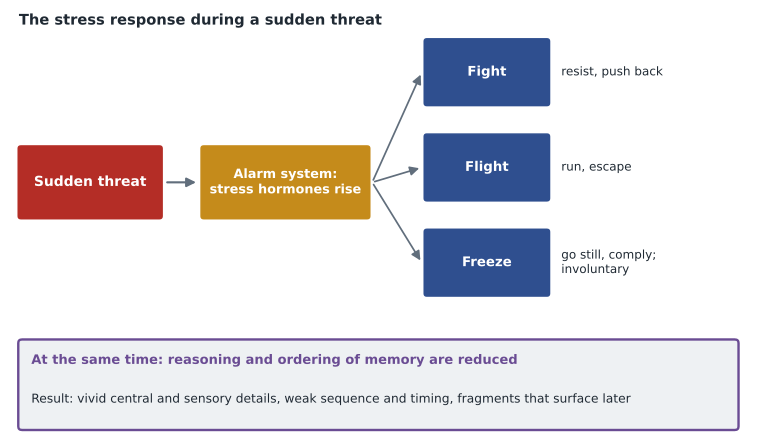
When a person faces a sudden threat, the brain's alarm systems take over. The amygdala, a small structure deep in the brain that detects danger, triggers the release of stress hormones such as adrenaline and cortisol. Heart rate and breathing speed up, muscles tense, digestion slows, and attention narrows on the threat. These changes prepare the body to fight or run, and they happen faster than conscious thought. At the same time, activity in the prefrontal cortex, the part of the brain responsible for planning, reasoning and putting experiences in order, is reduced. The brain trades careful thinking for speed.
Fight and flight are familiar. Less familiar, and more often misunderstood, is freezing. Many people facing an overwhelming threat, especially one they cannot escape, become still, go silent or comply. In some situations, particularly sexual assault, people experience tonic immobility, an involuntary state in which they cannot move or speak even though they are aware of what is happening. Brooks tells the class that freezing is a survival response, not a choice and not consent. Victims who froze often blame themselves afterward for not fighting back, and an officer who asks 'why didn't you run?' can deepen that self-blame.
Trauma and memory
The stress response explains a great deal about how victims remember. Under extreme stress, the brain records some details intensely and others not at all. Attention narrows on whatever seems most important for survival, so a victim may remember a weapon, a voice or a pair of shoes with great clarity while missing the offender's height or the colour of a car. This narrowing is sometimes called tunnel vision, and when a weapon is involved, researchers such as Elizabeth Loftus have described a weapon focus effect. Sensory details, such as smells, sounds and physical sensations, are often recorded strongly. The order of events and their timing are often recorded poorly, because putting experiences in sequence is one of the jobs the stressed brain sets aside.
The result is that traumatic memories are often fragmented. A victim may give an account that jumps around, leaves gaps, or changes as more fragments surface in the hours and days afterward, especially after sleep. Daniel's account fits this pattern: the vivid shoes, the uncertainty about height, the confusion about whether there were one or two men. None of this proves he is lying, and none of it proves he is accurate. Brooks is careful on this point. Memory is reconstructive for everyone, traumatized or not, and fragments that surface later can be accurate or can be shaped by suggestion. The officer's job is to record what the victim remembers, as the victim says it, without filling the gaps for them, and to look for evidence that can confirm or correct it. Lesson 5 explains how.
Common reactions after a crime
Brooks describes the range of reactions victims commonly show in the hours and days after a crime. Physical reactions include shaking, nausea, exhaustion, headaches, trouble sleeping and a racing heart. Emotional reactions include fear, anger, shame, guilt, sadness, and sometimes numbness or a strange calm. Cognitive reactions include confusion, trouble concentrating, difficulty making decisions and replaying the event over and over. Behavioural reactions include withdrawing from others, avoiding places or people that are reminders of the crime, and being easily startled.
She stresses that there is no right way to react. Some victims cry, some are angry, and some are calm, flat or even laughing. A victim who seems calm may be in shock. Officers who expect a real victim to look upset may wrongly doubt a person whose reaction does not fit, and research on how police and juries judge credibility shows that this expectation is common and misleading. Desjardins tells the class about a robbery victim he interviewed early in his career who made jokes throughout. He wrote in his notes that she did not seem affected. Two weeks later she was off work and unable to leave her apartment.
Victimologists have described a common pattern in how victims move through the aftermath, though Brooks cautions that real people rarely follow neat stages. In the 1979 book The Crime Victim's Book, Morton Bard and Dawn Sangrey described an impact phase, immediately after the crime, marked by shock, disbelief and disorganization; a recoil phase, over the following days and weeks, in which the victim struggles with fear, anger, self-blame and reminders of the crime; and a reorganization phase in which the experience is gradually absorbed and daily life returns. The first responding officer meets victims in the impact phase, when their ability to absorb information is lowest, which is why written information and follow-up calls matter so much.
Longer-term effects
Most people who experience a traumatic event recover without lasting psychological problems, especially if they have support. This natural recovery is the most common outcome, and Brooks wants officers to say so: telling a victim that what they are feeling is a normal reaction to an abnormal event, and that most people feel better over time, is one of the most helpful things anyone can say.
Some victims develop more lasting problems. Acute stress disorder describes severe symptoms in the first month after a trauma. Post-traumatic stress disorder, or PTSD, is diagnosed when symptoms last more than a month and cause significant distress or impairment. Its symptoms fall into four groups: intrusions such as nightmares, flashbacks and unwanted memories; avoidance of reminders; negative changes in thoughts and mood, such as persistent fear, guilt, shame or feeling detached from others; and changes in arousal and reactivity, such as being constantly on guard, startling easily, irritability and trouble sleeping. Depression, anxiety and increased use of alcohol or drugs are also common after violent victimization. Only qualified health professionals can diagnose these conditions; officers should recognize the signs and refer, not diagnose.
The risk of lasting problems is higher when the crime involved serious injury, a threat to life or sexual violence, when the offender was someone the victim knew and trusted, when the victim has experienced earlier trauma, and when support is lacking afterward. One risk factor stands out for this course: negative reactions from others, including police, medical staff and family, are consistently linked with worse recovery. Positive social support, being believed and regaining a sense of control are linked with better recovery.
Co-victims and complicated grief
Families of homicide victims face a particular form of trauma. They lose someone suddenly and violently, often learn the news from a police officer at their door, and then face months or years of investigation, court proceedings and media attention. Many experience what clinicians call traumatic or complicated grief, in which the normal process of mourning is disrupted by the circumstances of the death. Desjardins describes the death notification he delivered after the collision that killed a child, which the class heard about in LES-101. He tells them that the family still remembers, twenty years later, every word he said that night, and that he wishes he had known then what he knows now about how to say it. Death notification is a skill officers must learn, and many services now pair an officer with a trained victim services worker or chaplain for it.
Trauma and the people who respond
Brooks ends the lesson by turning the question around. Officers, dispatchers and victim services workers are exposed again and again to other people's trauma, and that exposure has effects of its own. Vicarious or secondary traumatic stress describes symptoms similar to those of trauma survivors that develop in people who work closely with them: intrusive images from calls, trouble sleeping, irritability, emotional numbness and a growing sense that the world is dangerous. Linh Tran, who now works part-time as a call-taker, says she still thinks about a call from a woman hiding in a closet. Brooks tells the class that this is not weakness. Peer support, debriefing after critical incidents, supervisors who check in, and access to confidential counselling are part of keeping responders well, and officers who look after themselves are better able to look after victims.
Measuring recovery
After his surgery, Daniel was referred to a counsellor through Victim Services Port Ardent and the province's Victim Quick Response Program+. His counsellor asked him to rate his distress each evening on a scale from 0 to 10. The program below summarizes his ratings by week for the first eight weeks.
# Daniel's nightly distress ratings (0 = none, 10 = worst), seven per week for eight weeks
weeks = [
    [9, 9, 8, 9, 8, 8, 9],
    [8, 8, 7, 9, 7, 7, 8],
    [7, 8, 6, 7, 7, 6, 6],
    [6, 7, 5, 6, 8, 5, 5],   # week 4: first court date adjourned
    [5, 5, 4, 5, 4, 5, 4],
    [4, 4, 5, 3, 4, 3, 4],
    [3, 4, 3, 3, 2, 3, 3],
    [3, 2, 3, 2, 3, 2, 2],
]
for n, w in enumerate(weeks, 1):
    avg = sum(w) / len(w)
    print(f"week {n}: average {avg:.1f}  worst night {max(w)}")
first, last = sum(weeks[0]) / 7, sum(weeks[-1]) / 7
print("change from week 1 to week 8:", round(last - first, 1))week 1: average 8.6 worst night 9 week 2: average 7.7 worst night 9 week 3: average 6.7 worst night 8 week 4: average 6.0 worst night 8 week 5: average 4.6 worst night 5 week 6: average 3.9 worst night 5 week 7: average 3.0 worst night 4 week 8: average 2.4 worst night 3 change from week 1 to week 8: -6.1
The ratings fell steadily, but with one bad night in week four, the night Daniel learned that the first court date had been adjourned. Brooks points to that night as a reminder that the justice process itself can set recovery back, and that a phone call explaining a delay before the victim hears about it some other way can soften the blow.
Worked problem
Responding to a changing account
At the second interview, Daniel says he now remembers that the attacker said something in Portuguese before hitting him, which he had not mentioned before. The detective's partner says this proves Daniel is making things up. How should the detective respond?
Show solution
- Recognize the pattern: fragments of traumatic memory often surface later, especially after sleep and once the person feels safer.
- Do not treat the new detail as proof of lying or of truth; record it exactly as Daniel gives it, with the time and circumstances in which he remembered it.
- Ask open questions about the new fragment without suggesting answers: 'Tell me more about what you heard.'
- Look for evidence that could confirm or correct it, such as video, witnesses on Front Street or the suspect's language.
- Disclose the change: the earlier and later accounts and the reason for the difference must be in the file, because the defence is entitled to know.
Answer: The detective records the new detail neutrally, explores it with open questions, seeks corroboration and documents the change, without treating it as proof of dishonesty.
Common mistakes
MistakeA victim who seems calm was not really affected.
InsteadReactions vary widely; calm, flat or joking behaviour can be shock.
MistakeFreezing during an assault means the victim consented.
InsteadFreezing and tonic immobility are involuntary survival responses.
MistakeAn account with gaps or changes is a sign of lying.
InsteadTraumatic memories are often fragmented and surface over time; record, explore and corroborate.
MistakeMost victims of violence develop PTSD.
InsteadMost people recover naturally, especially with support; a minority develop lasting problems.
Summary and key terms
- Traumatic events involve actual or threatened death, serious injury or sexual violence, but many other crimes are deeply distressing.
- The stress response prepares the body to fight, flee or freeze and reduces careful reasoning and memory organization.
- Traumatic memories are often vivid for central or sensory details and poor for sequence, timing and peripheral details.
- Reactions after a crime are physical, emotional, cognitive and behavioural, and there is no single right way to react.
- Most people recover naturally; PTSD, depression and substance use affect a minority, especially without support.
- Negative reactions from others worsen recovery, while being believed and regaining control help it.
- Traumatic event
- An event involving actual or threatened death, serious injury or sexual violence.
- Tonic immobility
- An involuntary state of being unable to move or speak during an overwhelming threat.
- Weapon focus
- The tendency of attention to narrow on a weapon, reducing memory for other details.
- Impact, recoil and reorganization
- The phases of reaction after a crime described by Bard and Sangrey.
- PTSD
- Post-traumatic stress disorder: lasting intrusions, avoidance, negative mood and arousal after trauma.
- Complicated grief
- Grief disrupted and prolonged by the traumatic circumstances of a death.
Practice problems
Work each problem on paper first, then reveal the answer to check.
Why might a victim remember an attacker's shoes clearly but not his height?
Show answer
Under stress, attention narrows and the brain records some details intensely and others poorly.
What are the three phases described by Bard and Sangrey?
Show answer
Impact, recoil and reorganization.
In the code example, by how much did Daniel's average distress fall from week 1 to week 8?
Show answer
By about 6.1 points, from about 8.6 to 2.4.
Name two factors linked with better recovery after a crime.
Show answer
Positive social support, being believed, and regaining a sense of control.
Lesson quiz · 5 questions
Score 60% or more to complete this lesson.
Create a free account to save your progress, take quizzes and earn a certificate.