
LES-115 · Lesson 10 of 12 · 19 min
Victims with particular needs: children, older adults, people with disabilities and newcomers
▶ Video coming soon A video version of this lesson is on the way.
Brooks begins with a principle she repeats so often that the class starts saying it with her: treat every victim as an individual, and know the patterns well enough to recognize what an individual might need. 'A seventy-nine-year-old fraud victim is not every seventy-nine-year-old,' she says. 'Grace is sharp, independent and proud. But if I did not know how often older people are targeted, how much shame they feel, and how often the offender is someone close to them, I would miss things.' This lesson looks at groups of victims who often need something more or different from the police and victim services, and at the laws and services designed for them.
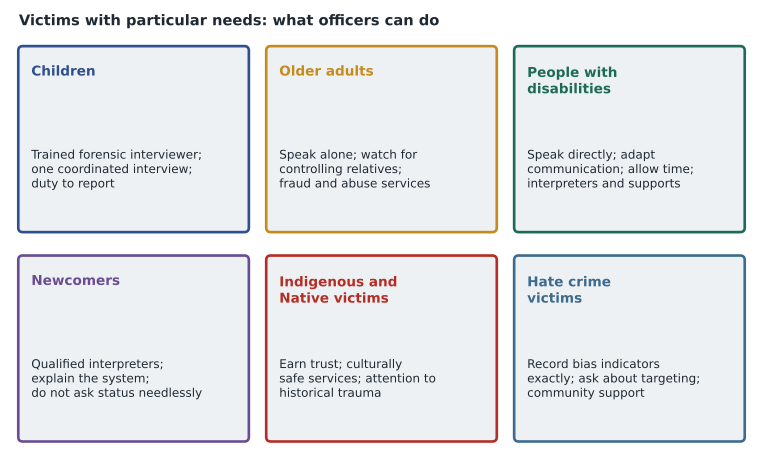
Children and youth
Children are victimized at high rates, mostly by people they know, and they depend on adults to notice and act. They may not understand that what happened to them was wrong, may not have words for it, may have been told to keep it secret, and may be afraid of what will happen to the adult who harmed them or to their family. Their memories can be accurate, but they are especially vulnerable to suggestion, which is why interviews of children should be done by specially trained interviewers using structured, non-leading methods. Finkelhor and colleagues have described polyvictimization: many children who are victimized experience several different kinds of victimization, such as bullying, witnessing violence at home and abuse, and these children face the most serious long-term effects.
Every officer has legal duties when a child may be at risk. In Ontario, the Child, Youth and Family Services Act requires anyone, including members of the public, who has reasonable grounds to suspect that a child is or may be in need of protection to report promptly and directly to a children's aid society, and professionals who fail to report can be prosecuted. Police and children's aid societies follow joint protocols for investigating child abuse. The duty to report sits alongside the police investigation, not instead of it.
Child advocacy centres were created to reduce the harm of the investigation itself. Before they existed, a child who disclosed abuse might be interviewed by a teacher, a police officer, a child protection worker, a doctor and a prosecutor, each in a different building. At a centre, police, child protection workers, medical staff, victim advocates and mental health workers work as a team, in a building designed for children, and the child is interviewed once by a trained forensic interviewer while other team members watch. Canada has a growing network of child and youth advocacy centres funded in part by the federal Victims Fund, and testimonial aids and video-recorded statements under the Criminal Code, discussed in Lesson 7, are routinely used for young witnesses.
Older adults
Older adults are victimized less often than young people by strangers, but they face particular risks: fraud and scams, and abuse by family members, caregivers and others they trust. Elder abuse takes several forms: financial abuse, such as theft, fraud and misuse of a power of attorney; physical abuse; psychological abuse, including threats, humiliation and isolation; sexual abuse; and neglect. Financial abuse is the most commonly reported. Victims may not report because they depend on the abuser for care, fear being moved into a care home, feel ashamed, or want to protect a family member, often an adult child.
Grace's case was a stranger fraud, but Brooks tells the class about another older client, a man in his eighties whose son had used a power of attorney to empty his accounts. He refused at first to make a statement, saying he did not want his son in prison. Brooks worked with him over several weeks on options that did not depend on prosecution, including revoking the power of attorney and getting his bank to block transfers, and he eventually decided to give a statement. Ontario does not have a general law requiring the reporting of elder abuse, though there are reporting duties for harm to residents of long-term care homes and retirement homes. The Canadian Anti-Fraud Centre collects reports of scams targeting older people. For police, the practical lessons are to speak with an older victim alone where possible, to watch for signs that a family member or caregiver is controlling the conversation, to avoid assuming confusion or incapacity, and to involve specialized services early.
People with disabilities
People with disabilities, including physical, sensory, intellectual, developmental and mental health disabilities, are victimized at much higher rates than others, as Lesson 2 showed. They may depend on caregivers for daily needs, live in group settings, face barriers to reporting and, too often, be disbelieved when they do report. Some offenders deliberately target people they believe will not be believed.
Officers can make a large difference by changing how they communicate. Speak directly to the person, not to their companion or caregiver. Ask how they prefer to communicate and what would help. Use plain language and short questions, check understanding, and allow more time. Arrange qualified sign language interpreters for deaf victims, and communication assistants or intermediaries where available for people with speech or cognitive disabilities. Do not assume that a person with an intellectual disability cannot give reliable evidence; assess what they can tell you, and make accommodations. And be alert to the possibility that the person accompanying the victim is the abuser. The Criminal Code allows testimonial aids and support persons for witnesses with physical or mental disabilities, and section 715.2 allows their video-recorded statements to be admitted in some cases.
Newcomers and people without secure status
Daniel's case raised issues that Brooks sees often among newcomers: language, unfamiliarity with the justice system, fear of authorities shaped by experiences in another country, and worry about immigration consequences. Daniel had a work permit and nothing to fear, but he did not know that, and his first question to the detective was whether reporting would affect his application for permanent residence. Many newcomers are also isolated from family and community supports and work in jobs, such as late restaurant shifts, that expose them to risk.
Immigration law offers some protections. Immigration, Refugees and Citizenship Canada can issue a temporary resident permit to victims of human trafficking, and to people without status who are experiencing family violence, so that they can leave an abuser without losing the right to stay in Canada. Police in Canada do not enforce immigration law as part of routine investigations, and Port Ardent's policy is that officers do not ask victims and witnesses about immigration status unless it is relevant to the offence. Brooks tells the class that the best protection for newcomer victims is trust: victims who believe they can report safely will report, and offenders who believe their targets will stay silent lose their advantage.
Language access runs through all of this. The service reviews how often victims whose preferred language is not English get a qualified interpreter. The program below shows the review for the last three years.
# Victim interviews where the victim's preferred language was not English
years = {
    2023: {"interviews": 148, "qualified interpreter": 81, "family or friend": 44, "none": 23},
    2024: {"interviews": 163, "qualified interpreter": 112, "family or friend": 33, "none": 18},
    2025: {"interviews": 171, "qualified interpreter": 149, "family or friend": 14, "none": 8},
}
for y, d in years.items():
    assert d["qualified interpreter"] + d["family or friend"] + d["none"] == d["interviews"]
    share = d["qualified interpreter"] / d["interviews"]
    print(y, "interviews:", d["interviews"], " qualified interpreter:", round(share, 2))
first, last = years[2023], years[2025]
print("change in share:", round(last["qualified interpreter"] / last["interviews"] - first["qualified interpreter"] / first["interviews"], 2))2023 interviews: 148 qualified interpreter: 0.55 2024 interviews: 163 qualified interpreter: 0.69 2025 interviews: 171 qualified interpreter: 0.87 change in share: 0.32
The improvement followed two changes: a contract with a telephone interpreting service available at any hour, and a rule that family members could not interpret except for urgent safety questions. Brooks notes that the remaining cases with no interpreter at all deserve a closer look, because each represents a victim who may not have understood their rights.
Indigenous victims
Indigenous people in Canada are victimized at higher rates than non-Indigenous people, and Indigenous women and girls are victims of homicide and violence at far higher rates. In 2019 the National Inquiry into Missing and Murdered Indigenous Women and Girls concluded that the violence amounted to a race-based genocide and issued 231 Calls for Justice, many directed at police services, including calls for culturally safe victim services, better communication with families and independent oversight. Jesse Morningstar tells the class that in Nimkii Bay, families of missing women describe the same experiences over and over: reports that were not taken seriously, searches that started late, and long silences from investigators. Indigenous-led victim services, such as family information liaison units and community programs that combine traditional healing with practical support, often reach victims that mainstream services do not, and the VQRP+ covers traditional Indigenous health services. Brooks adds that a trauma-informed approach, with its attention to historical trauma, is especially important here.
2SLGBTQI+ victims
As Lesson 3 showed, bisexual people in particular report much higher rates of violent victimization than heterosexual people, and transgender people face high rates of violence, harassment and intimate partner abuse. Many have had negative experiences with police, or know people who have, and some fear being outed, misgendered or disbelieved if they report. Victims of intimate partner violence in same-sex relationships sometimes find that services and officers assume abuse happens only between men and women, and miss the signs. Brooks's advice is practical: ask people what name and pronouns they use and use them consistently, including in reports where policy allows; do not assume the gender of a partner; avoid questions about a person's identity that have nothing to do with the offence; and know which community organizations offer support. Port Ardent's victim services agency works with a regional 2SLGBTQI+ community centre that offers counselling and peer support. Small signals of respect, she says, tell a victim that it is safe to say the rest.
Victims of hate crime
Hate crimes target people because of who they are, such as their race, religion, sexual orientation, gender identity or disability. They harm the individual victim and send a message of threat to everyone who shares the victim's identity. Victims often experience more severe and longer-lasting psychological effects than victims of similar crimes without a hate motive, because the attack was about something they cannot change. The Criminal Code makes evidence that an offence was motivated by bias, prejudice or hate an aggravating factor at sentencing under section 718.2(a)(i), and creates specific offences such as advocating genocide and mischief to religious property. Officers should record any words, symbols or other indicators of bias exactly, ask victims whether they believe they were targeted because of their identity, and connect them and, where appropriate, their community with support.
Worked problem
Supporting a victim with an intellectual disability
Officer Malhotra responds to a report that a 32-year-old man with an intellectual disability, who lives in a group home, has been pushed and had his bank card taken by another resident's visitor. The home's supervisor starts answering every question for him. What should Malhotra do?
Show solution
- Speak to the man directly, by name, and ask whether he would like to talk with the supervisor present or with someone else he trusts.
- Ask how he prefers to communicate, use short questions and plain words, and check that he understands.
- Allow time: let him tell what happened in his own way before asking specific questions, and avoid leading questions.
- Assess, do not assume: record what he can describe, and do not dismiss his account because of his disability.
- Consider safety and support: whether he is safe at the home, whether staff may be involved, and a referral to victim services and a disability advocacy organization.
Answer: Malhotra speaks directly to the man, adapts his communication, takes his account seriously and checks his safety and support needs.
Common mistakes
MistakeChildren's memories are too unreliable to use.
InsteadChildren can give accurate accounts when interviewed by trained interviewers using non-leading methods.
MistakeElder abuse is mostly committed by strangers.
InsteadMuch elder abuse, especially financial abuse, is committed by family members and caregivers.
MistakeIt is efficient to let a caregiver answer for a person with a disability.
InsteadSpeak directly to the person; the caregiver may not know what happened, and may be the abuser.
MistakeFamily members are the best interpreters because they know the victim.
InsteadFamily interpreters can change what is said and may be connected to the offender; use qualified interpreters.
Summary and key terms
- Treat each victim as an individual, and know the patterns that point to particular needs.
- Children need trained interviewers and coordinated responses such as child advocacy centres; officers have duties to report.
- Older adults face fraud and abuse by people they trust, and may not report out of dependence or shame.
- People with disabilities are victimized at high rates and need adapted communication and accommodation.
- Newcomers face language barriers and fears about status; qualified interpreters and clear policies build trust.
- Indigenous victims and victims of hate crime need culturally safe and identity-aware responses, as the MMIWG Calls for Justice emphasize.
- Polyvictimization
- Experiencing several different kinds of victimization.
- Forensic interview
- A structured, non-leading interview of a child by a trained interviewer.
- Child and youth advocacy centre
- A child-friendly centre where a team coordinates the investigation and support.
- Elder abuse
- Harm to an older adult by a person in a position of trust, including financial abuse.
- Temporary resident permit
- A federal permit that can allow victims of trafficking or family violence to stay in Canada.
- Calls for Justice
- The 231 recommendations of the National Inquiry into Missing and Murdered Indigenous Women and Girls.
Practice problems
Work each problem on paper first, then reveal the answer to check.
Why are child advocacy centres designed around a single interview?
Show answer
To reduce the harm of repeated interviews and the risk of suggestion.
Name two reasons an older adult might not report abuse.
Show answer
Dependence on the abuser, fear of being moved to care, shame, or a wish to protect a family member.
In the code example, what share of interviews had a qualified interpreter in 2025?
Show answer
149 of 171, about 0.87.
Why should family members not interpret for victims?
Show answer
They may change or omit what is said, may be connected to the offender, and learn private details.
Lesson quiz · 5 questions
Score 60% or more to complete this lesson.
Create a free account to save your progress, take quizzes and earn a certificate.