
LES-102 · Lesson 8 of 12 · 22 min
Critical, feminist and life-course perspectives
▶ Video coming soon A video version of this lesson is on the way.
Jesse Morningstar has waited seven weeks for this class. The belief he wrote on his card in week one was that the justice system is unfair to Indigenous people, and so far, he says, most of the theories they have studied looked for the causes of crime inside offenders or their neighbourhoods. None of them asked why the people who end up in custody look so different from the people who make the laws. Professor Desjardins says that is exactly the question critical criminology asks. This lesson covers three perspectives that broadened criminology from the 1970s onward: critical theories that examine power and inequality, feminist theories that examined the long neglect of women and girls, and life-course theories that follow people over decades to see how offending begins, continues and ends.
Conflict and critical criminology
Conflict theories, which you met briefly in lesson 1, see the law and the justice system as shaped by struggles between groups with unequal power. In the 1960s and 1970s, scholars such as Richard Quinney and William Chambliss argued that criminal law tends to criminalize the behaviour of the poor and powerless while treating the harms caused by the powerful, such as dangerous workplaces, pollution and financial fraud, as regulatory matters. Chambliss's study The Saints and the Roughnecks, published in 1973, followed two groups of high school boys in the same town. The middle-class Saints committed as many offences as the working-class Roughnecks, but were seen by teachers and police as basically good boys sowing wild oats, while the Roughnecks were seen as trouble, arrested repeatedly and went on to criminal careers. The study is often used to illustrate how class shapes both labels and outcomes.
Critical criminology is an umbrella term for perspectives that question how crime is defined and who benefits from the justice system's responses. Some critical scholars draw on Marxist theory; others focus on race, colonialism, gender or the state. Critics responded that early critical criminology romanticized offenders and ignored the fact that most victims of street crime are themselves poor and from the same communities as offenders. In the 1980s, British scholars such as Jock Young developed left realism, which took crime and its harm to working-class victims seriously while still arguing that relative deprivation, marginalization and poor policing were at its roots. Left realists supported police reforms that improved responsiveness to victims in poor neighbourhoods, alongside social reforms.
White-collar and corporate crime remain a major focus of critical work. The harms are large. Workplace injuries and deaths, environmental damage, product dangers and frauds against investors and consumers cause more financial loss and arguably more physical harm than street crime. Yet they are prosecuted far less often. After the 1992 Westray mine explosion in Nova Scotia killed 26 miners, Parliament passed the Westray amendments in 2004, which made it easier to hold organizations and their senior officers criminally liable for workplace deaths. Prosecutions under these provisions remain rare. Priya says this matches her experience, and that it is one reason she wants to work in financial crime.
Race, colonialism and the justice system
Critical perspectives have drawn particular attention to the overrepresentation of racialized and Indigenous people in the justice system. Indigenous people make up about 5% of Canada's adult population but about a third of people in federal custody, and Indigenous women make up roughly half of women in federal custody. Black Canadians are also overrepresented in federal custody relative to their share of the population. In R. v. Gladue (1999) and R. v. Ipeelee (2012), the Supreme Court of Canada recognized that the history of colonialism, displacement and residential schools contributes to higher rates of incarceration, and directed judges to consider these systemic and background factors, and alternatives to custody, when sentencing Indigenous offenders, as section 718.2(e) of the Criminal Code requires.
Explaining overrepresentation requires care. Part of it reflects differences in involvement in some kinds of crime, which are themselves linked to the poverty, trauma, family disruption and neighbourhood disadvantage that other theories describe. Part reflects decisions within the justice system that treat similar cases differently, such as where police patrol, whom they stop, who is held in custody before trial and how sentences are set. Researchers try to separate these by comparing similar cases at each decision point, the approach Linh learned in the last course. Critical theorists add that the two parts are connected: historical injustice produced the disadvantage that raises involvement in crime, and policing practices that concentrate on disadvantaged groups add to the disparities.
Jesse says he finds the Indigenous experience well described by the critical perspective, but he also notices that the theories they studied earlier help. The residential school system, the Sixties Scoop and the Indian Act broke family bonds across generations, which control theory says protect against crime. Poverty and the loss of land and culture produced strain and weakened community institutions, as social disorganization theory predicts. And intergenerational trauma affects health and development in the ways biosocial researchers describe. The professor says this is the best kind of criminological thinking, combining perspectives rather than choosing one.
Feminist criminology
For most of its history criminology was written by men about men. Women's offending was either ignored or explained by crude ideas about their biology or sexuality, and violence against women in the home was treated as a private matter rather than a crime. Feminist criminology, emerging in the 1970s, challenged both gaps. Freda Adler and Rita Simon argued in 1975 that women's crime would rise as women gained equality and entered the workforce, a prediction later research largely did not support: women's offending rose modestly in some categories, mainly minor property and fraud offences, without the large convergence the theory predicted.
Later feminist scholars, including Meda Chesney-Lind and Kathleen Daly, developed pathways research. Studying women and girls in the justice system, they found that many had histories of physical and sexual abuse, which led to running away, drug use and survival crimes such as theft and sex work, often followed by abusive relationships with men who involved them in crime. Their pathways differed from those of most men, and programs designed for men often failed them. Feminist scholars also showed how gender shapes victimization: women are far more likely than men to be victims of sexual assault and intimate partner violence, while men are more likely to be victims of violence by strangers. Their work changed police practice on domestic violence and sexual assault, from charging policies to specialized investigation units and trauma-informed interviewing.
Intersectionality, a term introduced by the legal scholar Kimberle Crenshaw in 1989, describes how race, gender, class and other identities combine to shape experience. In criminology it draws attention to groups whose experiences are missed when gender and race are studied separately, such as Indigenous women, who face sharply elevated rates of violent victimization. Canada's National Inquiry into Missing and Murdered Indigenous Women and Girls, which reported in 2019, documented the systemic causes of this violence and made 231 calls for justice, many directed at police.
Life-course and developmental criminology
Life-course criminology studies how offending develops over a person's life: when it starts, how it changes and why it stops. Its roots go back to Sheldon and Eleanor Glueck, who in the 1940s followed 500 delinquent boys and 500 non-delinquent boys from Boston for decades. In 1972 Marvin Wolfgang and his colleagues reported on all 9,945 boys born in 1945 who lived in Philadelphia between the ages of 10 and 18. About a third had at least one police contact, but just 6% of the cohort, the chronic offenders with five or more contacts, accounted for more than half of all the offences recorded. Similar concentrations have been found in cohorts around the world. Amara says her belief that most crime is committed by a few people looks correct. The professor says yes, but with two qualifications that this section will explain.
The first qualification comes from the psychologist Terrie Moffitt, who proposed in 1993 that there are two very different groups of young offenders. Life-course-persistent offenders, a small group, show behaviour problems from early childhood, rooted in a combination of neuropsychological difficulties and adverse environments, and continue offending into adulthood. Adolescence-limited offenders, a much larger group, begin offending in their teens, mainly through minor offences committed with peers to gain a sense of adult status during the maturity gap you studied in lesson 4, and stop as they reach adulthood and adult roles become available. Follow-up of the New Zealand cohort largely supported the distinction, while showing that some adolescence-limited offenders still had problems in their twenties.
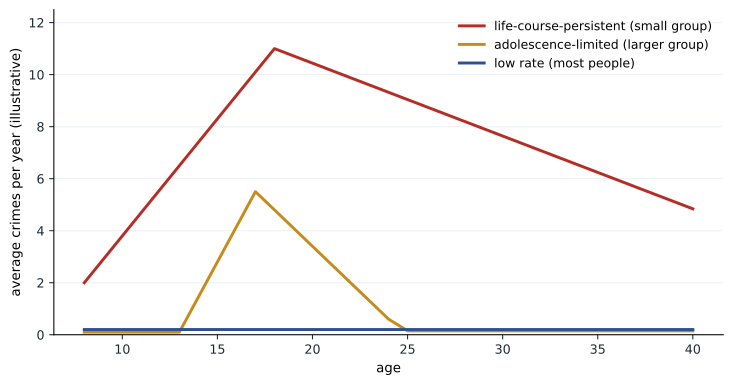
Linh models an illustrative cohort of 1,000 young people to see how the two groups combine. In her model, 6% follow a persistent path, 24% an adolescence-limited path and the remaining 70% commit at most a few minor offences. The code calculates each group's share of all offences between ages 12 and 30.
# Illustrative cohort of 1,000 people: average crimes per person in each age band
groups = {  # name: (people, crimes per person per year in bands 12-14, 15-17, 18-20, 21-25, 26-30)
    "persistent": (60, [2.5, 4.0, 3.6, 2.6, 1.8]),
    "adolescence-limited": (240, [0.6, 1.4, 0.7, 0.15, 0.05]),
    "low-rate": (700, [0.05, 0.10, 0.05, 0.02, 0.01]),
}
years = [3, 3, 3, 5, 5]   # years in each age band
total = {}
for name, (n, rates) in groups.items():
    total[name] = n * sum(r * y for r, y in zip(rates, years))
grand = sum(total.values())
for name, (n, _) in groups.items():
    print(f"{name:20s} {n / 1000:5.0%} of people  {total[name] / grand:5.0%} of crimes  {total[name]:7.0f} crimes")
by_band = [sum(n * rates[i] * years[i] for n, rates in groups.values()) / years[i] for i in range(5)]
print("crimes per year by age band:", [round(x) for x in by_band])persistent 6% of people 54% of crimes 3138 crimes adolescence-limited 24% of people 37% of crimes 2184 crimes low-rate 70% of people 9% of crimes 525 crimes crimes per year by age band: [329, 646, 419, 206, 127]
In this model the persistent group, 6% of people, commits about 54% of the offences, close to Wolfgang's finding that the chronic 6% accounted for more than half. The adolescence-limited group commits most of the rest, and the low-rate group adds a small share. Offences per year for the whole cohort peak at ages 15 to 17 and fall steadily afterward. The second qualification, then, is that although a few people commit much of the crime, a large share of young people offend at some point, and most of them stop on their own. Policies designed for the persistent few, such as long custodial terms, are a poor fit for the many who will grow out of crime if they are not pushed deeper into it.
Turning points and desistance
Robert Sampson and John Laub reanalyzed the Gluecks' data in the 1990s and later traced the original delinquent boys up to age 70. They found that even among persistent offenders, almost all eventually stopped. Their age-graded theory of informal social control argued that turning points in adulthood, especially a stable marriage, steady work and military service, can redirect a criminal path by creating new bonds, new routines and new identities. A good job or relationship gives a person something to lose, structures his day and separates him from former criminal associates. Their book Shared Beginnings, Divergent Lives, published in 2003, showed that the timing and quality of these turning points mattered more than childhood characteristics in explaining who stopped and when.
Desistance, the process of stopping offending, is now a major field of study. Shadd Maruna's interviews with former offenders in Liverpool found that those who desisted had constructed a redemption script, a story in which their true self was good, their past offending was a product of circumstances and they now wanted to give something back. Those who persisted told stories in which they had no control over their lives. Desistance is usually gradual, with lapses, rather than a single decision. Professor Desjardins tells the class that one of the most rewarding parts of his career was seeing young men he had arrested in his first years later coaching hockey, running businesses or, in one case, joining the service as a civilian employee. He says officers can support desistance by recognizing change, rather than treating every person with a record as permanently defined by it.
Worked problem
Reading a life history with several perspectives
In a Port Ardent youth court file, Sabrina, 17, has convictions for theft and breaching a release condition. She ran away from home at 14 after abuse by her mother's partner, began using drugs, stole to survive and is now in a relationship with a 24-year-old man who sells drugs. Her probation officer wants to understand her path and plan a response. How do feminist pathways, critical and life-course perspectives help?
Show solution
- Feminist pathways: her offending follows a common path for girls, from abuse to running away, drug use, survival crime and involvement with an older man. A response should address trauma and safety, not only the offences.
- Critical perspective: ask whether the system's responses, such as release conditions that are hard to meet without stable housing, are producing breaches and deepening her involvement.
- Life course: at 17, she is at the age when many young offenders desist; turning points such as stable housing, school or work and a safe relationship could redirect her path.
- Plan: trauma-informed counselling, safe housing, substance use treatment, realistic release conditions and support to end the exploitative relationship, with her own goals at the centre.
Answer: The perspectives together suggest that Sabrina's offending is better understood as a response to victimization and circumstance than as a fixed criminal disposition, and that her age and situation offer real chances of desistance if the response builds safety, stability and new bonds rather than punishing breaches alone.
Common mistakes
MistakeCritical criminology claims that offenders are blameless.
InsteadCritical perspectives examine how power shapes laws and responses; left realists stressed that street crime harms poor victims and must be taken seriously.
MistakeAs women gained equality, women's crime rose to match men's.
InsteadWomen's offending rose modestly in some minor categories, but the large convergence predicted in the 1970s did not occur.
MistakeA few offenders commit most crime, so long sentences for repeat offenders solve the problem.
InsteadMany young people offend at some point and most stop on their own; persistent offenders also usually desist, and turning points help.
MistakeOnce a person is a persistent offender, change is impossible.
InsteadSampson and Laub found almost all persistent offenders eventually stopped, often after turning points such as work or marriage.
Summary and key terms
- Conflict and critical criminology examine how power and inequality shape criminal law and the justice system's responses; left realism took working-class victimization seriously.
- Overrepresentation of Indigenous and racialized people reflects historical injustice, social disadvantage and decisions within the justice system, which researchers try to separate.
- Feminist criminology exposed the neglect of women and girls, developed pathways research linking victimization to offending and transformed responses to gendered violence.
- Intersectionality highlights groups such as Indigenous women whose experiences are missed when identities are studied separately.
- Life-course research shows a small group commits a large share of offences, while many young people offend mainly in adolescence, as Moffitt's typology describes.
- Sampson and Laub's turning points and Maruna's research on desistance show that almost all offenders eventually stop, aided by new bonds and identities.
- Critical criminology
- Perspectives that question how crime is defined and how power and inequality shape responses to it.
- Left realism
- A perspective that takes the harm of street crime to working-class victims seriously while tracing its causes to deprivation and marginalization.
- Pathways research
- Feminist research tracing how experiences such as abuse lead women and girls into offending.
- Intersectionality
- The way race, gender, class and other identities combine to shape experience.
- Chronic offender
- One of the small group of people who commit a large share of a cohort's offences.
- Desistance
- The process of stopping offending, usually gradual.
- Turning point
- A life event, such as stable work or marriage, that can redirect a person's path.
Practice problems
Work each problem on paper first, then reveal the answer to check.
What did Wolfgang's Philadelphia cohort study find?
Show answer
About a third of boys had a police contact, but 6% of the cohort accounted for more than half of all recorded offences.
Describe Moffitt's two groups of offenders.
Show answer
Life-course-persistent offenders, a small group with problems from early childhood who continue into adulthood; adolescence-limited offenders, a larger group who offend mainly in their teens.
Name two turning points Sampson and Laub linked to desistance.
Show answer
Stable marriage, steady work and military service.
What did Chambliss's study of the Saints and the Roughnecks illustrate?
Show answer
That similar offending by middle-class and working-class boys was labelled and treated very differently, shaping their later lives.
Lesson quiz · 5 questions
Score 60% or more to complete this lesson.
Create a free account to save your progress, take quizzes and earn a certificate.