
ITIL-150 · Lesson 11 of 12 · 22 min
People, skills and culture in transformation
Every transformation is, in the end, many people changing what they do every day. Larchmont's operating model, platform and AI governance will deliver nothing if service desk analysts do not trust the new workflows, if infrastructure engineers resist moving into a platform team, if managers keep demanding status reports in the old format, or if staff hide problems because they fear blame. This lesson covers how people experience change, how to lead it, how to build the skills a digital and AI-enabled organization needs, and how culture shapes whether any of it lasts.
How people experience change
People do not resist change as such; they resist loss, uncertainty and being changed without a say. A service desk analyst told that a virtual agent will handle a third of contacts may hear 'your job is at risk', even if leaders intend to redeploy people to more interesting work. An infrastructure engineer moving into a platform team may lose a familiar role and status. Understanding these reactions, rather than labelling them as resistance, is the starting point for leading change well.
William Bridges distinguished change (the external event, such as a reorganization) from transition (the internal psychological process people go through). Transition has three phases: an ending, in which people let go of the old way; a neutral zone of confusion and experimentation; and a new beginning, in which they commit to the new way. Leaders often announce the new beginning while people are still processing the ending. Acknowledging what is being lost, and supporting people through the neutral zone, makes adoption faster.
| Model | Core idea | Useful for |
|---|---|---|
| Kotter's eight steps | Create urgency, build a coalition, form a vision, communicate, remove obstacles, win short-term gains, sustain acceleration, anchor in culture | Leading large organizational change |
| ADKAR (Prosci) | Individuals need awareness, desire, knowledge, ability and reinforcement | Diagnosing where individuals are stuck |
| Bridges transitions | Endings, neutral zone, new beginnings | Supporting the emotional side of change |
| Lewin | Unfreeze, change, refreeze | A simple overview; less suited to continuous change |
These models complement each other. Larchmont used Kotter's steps to structure leadership activity, ADKAR to diagnose why particular teams were slow to adopt new practices, and Bridges to plan support for people whose roles were changing most. For example, ADKAR surveys showed that warehouse IT staff had awareness and desire but lacked knowledge of the new pipeline, so training, not more persuasion, was the fix.
Leading change
Leaders shape transformation more through what they do than through what they announce. People watch whether leaders use the new reports, attend product reviews, protect teams from old-style demands, and react calmly when experiments fail. A leader who praises 'fail fast' but punishes the first failed release teaches everyone to hide risk.
Communication must be frequent, two-way and honest. People want to know why the change is happening, what it means for them, what will stay the same, what is still undecided and how they can contribute. Communicating uncertainty openly ('we have not decided how the service desk will be organized in year three; here is how we will decide and when') builds more trust than false certainty. Larchmont's CIO held monthly open sessions with LTS staff, published every steering group decision within a week, and ran an anonymous question channel whose answers were posted publicly.
Skills for a digital and AI-enabled organization
The skills a service organization needs are shifting. Routine tasks are increasingly automated, while demand grows for product thinking, user research, data literacy, automation and scripting, cloud and platform engineering, security, and the ability to work with AI tools critically and safely. So-called durable skills, such as communication, collaboration, problem solving and adaptability, matter more as technical tools change faster.
AI literacy deserves special mention. Staff who use AI need to understand what it can and cannot do, how to check its outputs, what data must not be shared and when to escalate. The EU AI Act includes an obligation, applying since February 2025, for providers and deployers of AI systems to take measures to ensure a sufficient level of AI literacy among staff dealing with those systems. Even where no law requires it, AI literacy is a practical control against the risks covered in lessons 7 to 9.
| Role today | Role tomorrow | New skills needed |
|---|---|---|
| Service desk analyst handling routine tickets | Resolver of complex issues and owner of self-service and automation workflows | Workflow design, knowledge authoring, AI-assisted diagnosis, customer empathy |
| Infrastructure engineer | Platform engineer | Infrastructure as code, product thinking for internal customers, observability |
| Application support | Member of a stream-aligned product team | Collaboration with developers, SLOs, incident leadership |
| Change manager | Designer of automated controls and risk policy | Policy as code, data analysis, audit liaison |
| IT manager | Coach and leader of empowered teams | Outcome-based management, coaching, psychological safety |
# Skills gap analysis for LTS (invented ratings on a 0-4 scale)
required = {"workflow automation": 3, "infrastructure as code": 3, "observability and SLOs": 3,
            "product and UX thinking": 2, "data literacy": 3, "AI literacy": 3, "coaching": 2}
teams = {
    "service desk":   {"workflow automation": 1, "infrastructure as code": 0, "observability and SLOs": 1,
                       "product and UX thinking": 2, "data literacy": 1, "AI literacy": 1, "coaching": 1},
    "infrastructure": {"workflow automation": 2, "infrastructure as code": 2, "observability and SLOs": 2,
                       "product and UX thinking": 0, "data literacy": 2, "AI literacy": 1, "coaching": 1},
    "app support":    {"workflow automation": 1, "infrastructure as code": 1, "observability and SLOs": 2,
                       "product and UX thinking": 1, "data literacy": 2, "AI literacy": 1, "coaching": 1},
}
for team, have in teams.items():
    gaps = {s: max(0, required[s] - have[s]) for s in required}
    total = sum(gaps.values())
    top = sorted(gaps.items(), key=lambda kv: -kv[1])[:3]
    print(f"{team:<15} total gap {total:>2}  biggest: " + ", ".join(f"{s} ({g})" for s, g in top))
overall = {s: sum(max(0, required[s] - t[s]) for t in teams.values()) for s in required}
print("organization-wide priority:", max(overall, key=overall.get))service desk total gap 12 biggest: infrastructure as code (3), workflow automation (2), observability and SLOs (2) infrastructure total gap 9 biggest: product and UX thinking (2), AI literacy (2), workflow automation (1) app support total gap 10 biggest: workflow automation (2), infrastructure as code (2), AI literacy (2) organization-wide priority: infrastructure as code
The gap analysis, with invented ratings, suggests AI literacy and workflow automation as organization-wide priorities, with infrastructure as code concentrated in the service desk and product thinking in infrastructure. Larchmont turned this into learning paths: a mandatory two-hour AI literacy course for all staff, a six-week automation academy for service desk analysts, and pairing infrastructure engineers with designers during platform discovery.
Building capability, not just training
Courses alone rarely change practice. People learn most by doing real work with support. Effective approaches include learning on the job with coaching, pairing and rotation between teams, communities of practice where people with a shared skill meet to share methods, internal champions who help colleagues, and time explicitly protected for learning. Enabling teams, described in lesson 10, exist precisely to build capability in other teams and then step back.
Larchmont reserved 10 % of every team's capacity for learning and improvement, created communities of practice for automation, observability and product management, and trained 24 AI champions across the company who answered colleagues' questions and fed common problems back to the AI governance group. Champions were chosen for credibility with peers, not seniority.
Culture
Culture is the shared assumptions, values and habits that shape how people behave when nobody is telling them what to do. It is hard to change directly; it changes as people repeatedly experience new behaviours working. The sociologist Ron Westrum described three organizational cultures by how they handle information: pathological (power-oriented, information is hoarded, messengers are punished), bureaucratic (rule-oriented, information flows through channels) and generative (performance-oriented, information flows freely, failures lead to inquiry). DORA research has found generative cultures associated with better delivery and organizational performance.
Psychological safety, a concept developed by Amy Edmondson, is the shared belief that a team is safe for interpersonal risk-taking: people can ask questions, admit mistakes and raise concerns without fear of humiliation or punishment. It is essential for learning from incidents, for reporting AI problems and for honest measurement. Blameless post-incident reviews, which focus on how the system allowed a failure rather than who to blame, are one of the most practical ways to build it.
Worked problem
Interpreting a culture survey
Larchmont asked LTS staff to rate six Westrum statements, such as "failures are treated primarily as opportunities to improve", from 1 (strongly disagree) to 7 (strongly agree). The average across all statements rose from 3.9 at baseline to 4.6 after one year, but the item "messengers are not punished when they deliver bad news" stayed at 3.4. What should leaders conclude?
Show solution
- Overall movement of 0.7 points suggests the culture is shifting toward generative.
- The low messenger item shows people still fear raising bad news.
- This is a risk for incident reporting, AI issue reporting and honest metrics.
- Leaders should look for where bad news has been punished and model the opposite publicly.
Answer: Progress is real but fragile. The messenger item is the most important signal; until people feel safe reporting problems, measures and AI monitoring will be less reliable.
Change fatigue and wellbeing
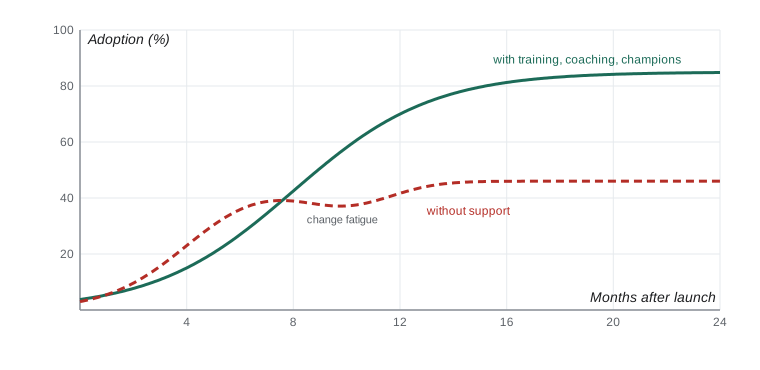
Transformations ask people to learn new ways of working while still delivering the old ones. Too many simultaneous changes cause change fatigue: cynicism, disengagement and burnout. Signs include falling survey scores, rising sick leave and turnover, and passive compliance. Leaders can limit the number of concurrent changes for any one team, sequence changes thoughtfully, stop initiatives that are not working, and recognize the extra effort people are making.
Larchmont tracked a simple 'change load' for each team: the number of significant changes affecting it in a quarter. Teams with more than three were flagged, and the steering group delayed or dropped lower-priority changes for them. In wave two this meant delaying the new time-tracking tool for the service desk, which was already absorbing the virtual agent and the automation academy.
Collecting data about employees during a transformation, such as device telemetry, AI usage logs or productivity measures, raises privacy and employment questions. In Ontario, employers with 25 or more employees must have a written policy on electronic monitoring of employees, describing whether and how they monitor and for what purposes. Federally regulated employers and private sector employers in provinces such as British Columbia, Alberta and Quebec are subject to privacy laws that cover employee personal information. Transparency, proportionality and limiting use to stated purposes are the common thread.
Career paths in a changing organization
People commit more readily to change when they can see a future for themselves in it. Larchmont published career paths for the new roles: service desk analyst to automation specialist or knowledge lead; infrastructure engineer to platform engineer or site reliability engineer; application support to product engineer; change manager to control designer or risk analyst. Each path listed the skills needed, the learning available and examples of people who had already made the move.
The service desk illustrates the shift. As self-service and the virtual agent absorbed routine contacts, the desk's volume fell by about a fifth in the first year, but the remaining contacts were more complex and took longer. Analysts who joined the automation academy built 37 workflows in their first six months, from scanner re-provisioning to new-starter setup, and two became full-time members of the platform team. Others specialized in high-value customer accounts. No analyst lost their job, and voluntary turnover on the desk fell from 24 % to 15 %, which leaders attributed partly to the visible career paths.
Managers' roles change too. In a product model, many decisions move to teams, and managers spend more time coaching, removing obstacles, developing people and connecting teams to strategy. Larchmont ran a leadership program for its 40 IT managers covering outcome-based management, coaching conversations, running blameless reviews and supporting people through transition. Some managers chose to return to specialist roles, which the company treated as a respected choice rather than a demotion.
Common mistakes
MistakeLabelling every concern as resistance.
InsteadUnderstand losses and uncertainty, and involve people in shaping the change.
MistakeAnnouncing the new beginning while people are still processing the ending.
InsteadAcknowledge what is lost and support people through the neutral zone.
MistakeRelying on courses alone.
InsteadBuild capability through coaching, pairing, communities of practice and protected learning time.
MistakePraising experimentation but punishing failure.
InsteadUse blameless reviews and model calm, curious responses to bad news.
MistakeLaunching every change at once.
InsteadTrack change load per team and sequence or drop changes to avoid fatigue.
Summary and key terms
- People resist loss and uncertainty, not change itself; models such as Kotter, ADKAR and Bridges help lead and diagnose change.
- Leaders shape change through behaviour; communication must be frequent, two-way and honest about uncertainty.
- Digital organizations need product, data, automation, platform, security and AI literacy skills, plus durable human skills.
- Capability grows through real work with coaching, communities of practice, champions and protected learning time.
- Generative cultures and psychological safety support learning, honest reporting and better performance.
- Manage change fatigue by limiting concurrent changes and respect privacy when collecting employee data.
- Transition (Bridges)
- The internal psychological process people go through during change: ending, neutral zone and new beginning.
- ADKAR
- A model of individual change: awareness, desire, knowledge, ability and reinforcement.
- AI literacy
- The knowledge and skills to use AI appropriately, understand its limits, check its outputs and handle data safely.
- Psychological safety
- A shared belief that a team is safe for interpersonal risk-taking.
- Change fatigue
- Exhaustion and disengagement caused by too much change at once.
Practice problems
Work each problem on paper first, then reveal the answer to check.
What is the difference between change and transition in Bridges' model?
Show answer
Change is the external event; transition is the internal psychological process of ending, neutral zone and new beginning.
An ADKAR survey shows a team wants the new practice but lacks know-how. What is the fix?
Show answer
Training and coaching to build knowledge and ability, not more persuasion.
Name the three Westrum culture types.
Show answer
Pathological, bureaucratic and generative.
Why is psychological safety important for AI governance?
Show answer
People must feel safe to report AI errors, harms and concerns, or monitoring and incident handling will miss problems.
Give two ways to build capability beyond training courses.
Show answer
Any two: coaching on real work, pairing, rotation, communities of practice, champions, protected learning time, enabling teams.
What is "change load" and how did Larchmont use it?
Show answer
The number of significant changes affecting a team in a quarter; teams above three were flagged and lower-priority changes delayed.
Lesson quiz · 5 questions
Score 60% or more to complete this lesson.
Create a free account to save your progress, take quizzes and earn a certificate.