
ITIL-150 · Lesson 1 of 12 · 24 min
Products and services in the digital age
Ten years ago, most people met their bank, their phone company or their freight carrier through a branch, a call centre or a sales representative. Today the first contact is usually an app, a website, a chatbot or an automated message. The organization behind the screen still runs people, processes, suppliers and technology, but customers judge it by a digital experience that is available all day, changes every few weeks and is compared with the best apps they use anywhere. Service management has had to change to match.
This course is the advanced step in the ITIL track. ITIL-110 introduced the vocabulary of service management, ITIL-120 the guiding principles and governance, ITIL-130 the value system and value chain, and ITIL-140 and ITIL-141 the practices. ITIL-150 looks at four forces that are reshaping all of them: digital products, automation, artificial intelligence (AI) and organizational transformation. It is written for people who will lead or advise on that change, and it maps closely to the ideas behind the advanced ITIL modules on products, experience, AI governance and transformation.
Throughout the course we return to Larchmont Logistics, the invented freight and warehousing company from ITIL-141, and its IT group, Larchmont Technology Services (LTS). In this course Larchmont's board has approved a three-year plan to become a digital logistics provider: customers should be able to quote, book, track and pay for freight entirely online, and LTS is expected to run its own services with far more automation and with AI where it helps. All figures for Larchmont are invented for teaching.
Larchmont is headquartered in Winnipeg, with distribution centres across the Prairies and Ontario. It ships for retailers, farm equipment dealers and food processors, and about a third of its revenue comes from cross-border freight to the United States. Its customers range from national chains with their own integration teams to family businesses that book a few loads a month.
What changed: from IT services to digital products
In traditional service management, IT supported the business: it ran the email system, the warehouse system and the network so that other people could sell, ship and invoice. The customer rarely saw IT directly. In a digital organization, technology is part of what the customer buys. When a Larchmont customer books a load through the portal, the portal is the service. If it is slow, confusing or down, the customer experiences Larchmont as slow, confusing or unavailable, however well the trucks run.
This shift has three consequences for service management. First, the boundary between 'the business' and 'IT' blurs: the people who design the booking app, the people who run it and the people who sell freight must work as one team around the customer journey. Second, the pace of change rises: digital products are improved continuously, so practices built around large, infrequent releases become bottlenecks. Third, data and software become assets in their own right, and their quality, security and ethics become matters for the board, not just the server room.
None of this makes service management less important. A digital product that nobody supports, that changes without control or that leaks data is worse than a paper form. What changes is the emphasis: service management must be faster, more automated, more focused on experience and more closely tied to business outcomes than it was when IT was a back-office function.
Products and services: definitions that still work
ITIL distinguishes products from services. A product is a configuration of an organization's resources designed to offer value for a consumer. A service is a means of enabling value co-creation by facilitating outcomes that customers want to achieve, without the customer having to manage specific costs and risks. A service offering is a formal description of one or more services designed to address the needs of a target consumer group, and it may include goods, access to resources and service actions.
These definitions hold up well in a digital world. Larchmont's online booking capability is a product: a configuration of software, data, people, partner integrations and infrastructure. Customers do not buy the product as such; they buy a service offering such as 'online booking with real-time tracking and next-day invoicing', which bundles access to the portal and app, service actions such as support and claims handling, and sometimes goods such as tracking devices for high-value loads. One product can support many offerings, and one offering can rely on many products.
| Term | Plain meaning | Larchmont example |
|---|---|---|
| Product | A configuration of resources designed to offer value | The booking and tracking platform: apps, APIs, data, people and suppliers |
| Service | A way of co-creating value by facilitating outcomes the customer wants, without the customer managing specific costs and risks | Shipping freight with visibility, without owning trucks or tracking systems |
| Service offering | A described package aimed at a consumer group: goods, access to resources and service actions | "Larchmont Connect": online booking, live tracking, API access and a named account manager |
| Digital product | A product whose value is delivered mainly through software and data | The customer mobile app and the shipment status API |
| Internal product | A product used inside the organization to support other products | The dispatch planning tool used by Larchmont planners |
Published summaries of ITIL (Version 5), released in early 2026, describe the framework as covering both products and services, with a product and service lifecycle running from discovery through design, acquisition, building, transition, operation, delivery and support. That lifecycle takes the place of the six ITIL 4 value chain activities, and lesson 2 uses it. If you are preparing for a particular exam, confirm which edition and terms it uses; the ideas in this course work with either ITIL 4 or Version 5 vocabulary.
Digital products are never finished
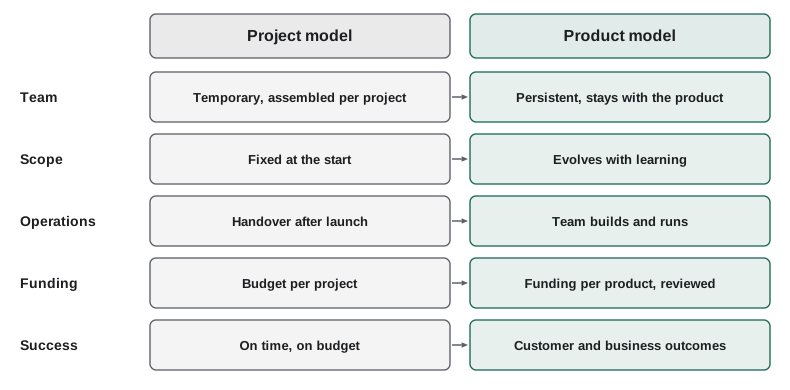
A traditional IT project delivered a system, handed it to operations and closed. Digital products work differently. The booking app Larchmont launches next spring will be changed hundreds of times over its life in response to usage data, customer feedback, new regulations and competitors' moves. The product team does not disband when version one goes live; it stays with the product and keeps improving it.
This has practical effects on every practice. Change enablement must allow frequent low-risk changes without a meeting for each one. Release management uses feature flags and phased rings, as ITIL-141 showed. Service level management must measure the experience of a product whose features change monthly. Financial management moves from project budgets to funding persistent teams. Knowledge management must keep up with features that did not exist last quarter.
The digital customer and the experience economy
Digital customers compare every experience with the best one they have had, in any industry. A shipping clerk who can track a parcel to the minute on a consumer app will not be impressed by a freight portal that updates once a day. Expectations include self-service at any hour, real-time information, consistent experience across channels, personalization, quick resolution when something goes wrong and respect for privacy.
These expectations shift value from functionality to experience. Two freight carriers may offer the same lanes at similar prices; the one whose booking takes three minutes instead of fifteen, and whose problems are fixed without three phone calls, wins the business. Version 5 summaries place experience alongside value and outcomes as a central theme, and lesson 3 covers how to design and measure customer, user and employee experience.
Experience also has an internal side. Larchmont's own staff use dozens of internal products: the dispatch tool, the time-tracking system, the service portal for raising IT requests. Poor internal experience costs productivity, and studies of employee experience regularly link it to engagement and retention. A digital organization treats its employees as users whose experience matters too.
The forces this course covers
Four forces run through the rest of the course. Each one is a large topic on its own; together they describe what a modern service organization has to master.
| Force | What it means | Lessons |
|---|---|---|
| Digital products and experience | Managing products across their whole life, designing for experience, funding persistent teams | 1-3 |
| Automation and DevOps | Automating flow from idea to production and from event to resolution; platforms, observability and AIOps | 4-5 |
| Artificial intelligence | Using AI in service management, including generative AI, and governing it responsibly | 6-9 |
| Transformation | Changing structures, ways of working, skills and culture, and measuring whether the change works | 10-12 |
These forces interact. Automation without good product management simply automates the wrong things faster. AI without governance creates new risks faster than it removes old ones. Transformation without measurement becomes a slogan. The course therefore treats them as parts of one change rather than as separate initiatives.
Larchmont today: a baseline
Before planning any change, a good practitioner establishes a baseline. LTS gathered the following figures in a two-week review. They describe an organization that runs reliable services but is slow to change and largely manual.
| Measure | Current value | What it suggests |
|---|---|---|
| Share of bookings made online | 38 % | Most customers still book by phone or email |
| Average time to book a load online | 14 minutes | Experience lags consumer apps and competitors |
| Production changes per month | 45 | Change is batched and infrequent |
| Lead time from approved idea to production | 74 days | Long queues and handoffs |
| Share of service desk contacts resolved by self-service | 9 % | Little automation or useful knowledge for users |
| Incidents first detected by monitoring (not users) | 41 % | Observability is weak |
| Customer satisfaction with digital channels (1-5) | 3.1 | Below the 4.0 the board wants |
| Staff who say their tools help them do good work | 52 % | Employee experience needs attention |
The board's three-year targets are 75 % of bookings online, booking in under four minutes, changes deployed on demand with a lead time under ten days, 40 % of contacts resolved through self-service, 80 % of incidents detected by monitoring, digital satisfaction of at least 4.0 and at least 75 % of staff positive about their tools. The rest of the course works toward these targets and, in lesson 12, measures progress against them.
Worked problem
Sizing the online booking gap
Larchmont handles about 26,000 bookings a month. Offline bookings take an average of 11 minutes of a customer service agent's time; online bookings take none. How many agent hours a month would be freed if the online share rose from 38 % to 75 %?
Show solution
- Offline bookings now = 62 % of 26,000 = 16,120.
- Offline bookings at target = 25 % of 26,000 = 6,500.
- Reduction = 16,120 - 6,500 = 9,620 bookings a month.
- Agent time freed = 9,620 x 11 minutes = 105,820 minutes, about 1,764 hours a month.
Answer: About 1,760 agent hours a month, roughly ten full-time agents at 175 hours each, which Larchmont plans to redeploy to complex accounts and exception handling rather than cut.
# Baseline vs target gaps for Larchmont's digital plan
baseline = {
    "online booking share %": (38, 75, "up"),
    "minutes to book online": (14, 4, "down"),
    "lead time idea to prod (days)": (74, 10, "down"),
    "self-service resolution %": (9, 40, "up"),
    "incidents found by monitoring %": (41, 80, "up"),
    "digital CSAT (1-5)": (3.1, 4.0, "up"),
    "staff positive about tools %": (52, 75, "up"),
}
print(f"{'measure':<34}{'now':>7}{'target':>8}{'gap closed needed':>20}")
for name, (now, target, direction) in baseline.items():
    change = target - now
    rel = abs(change) / now * 100
    word = "increase" if direction == "up" else "reduction"
print(f"{name:<34}{now:>7}{target:>8}{rel:>12.0f} % {word}")measure now target gap closed needed online booking share % 38 75 97 % increase minutes to book online 14 4 71 % reduction lead time idea to prod (days) 74 10 86 % reduction self-service resolution % 9 40 344 % increase incidents found by monitoring % 41 80 95 % increase digital CSAT (1-5) 3.1 4.0 29 % increase staff positive about tools % 52 75 44 % increase
The output shows that some targets are modest improvements while others, such as lead time and self-service, require changes of several hundred percent. Gaps of that size cannot be closed by working harder within the current model; they need different ways of working, which is why the plan is a transformation rather than a set of projects.
Service management in a digital organization
What stays the same? A great deal. The guiding principles from ITIL-120 apply directly: focus on value, start where you are, progress iteratively with feedback, collaborate and promote visibility, think and work holistically, keep it simple and practical, and optimize and automate. The value system and value chain from ITIL-130 still describe how demand becomes value. The practices from ITIL-140 and ITIL-141 are still needed; incidents still happen, changes still need control and suppliers still need managing.
What changes is how those things are done. Practices are embedded in product teams rather than run only by central functions. Controls are automated in pipelines rather than performed in meetings. Measures focus on outcomes and experience rather than activity. Governance covers new risks such as algorithmic bias and data misuse. Service managers spend less time running queues and more time designing systems of work, coaching teams and managing risk.
Canadian organizations going through this shift must also respect obligations that sit outside ITIL: privacy law (PIPEDA federally, Quebec's Law 25 and provincial public sector acts), accessibility requirements such as the Accessible Canada Act and Ontario's AODA for digital services, official languages for federal institutions, and sector rules such as OSFI guidance for banks and insurers. Digital products make these obligations more visible, because a single design decision in an app reaches every customer at once.
Risks of getting it wrong
Digital change fails often, and the reasons repeat. Organizations buy technology before they understand the customer problem. They launch an app but leave the processes behind it unchanged, so customers hit the same delays one step later. They rename teams 'squads' without changing funding or decision rights. They automate broken processes. They adopt AI because competitors talk about it, without clear use cases or controls. They declare success at launch and stop measuring.
Larchmont's leaders have seen some of this already: a previous customer portal launched in 2019 is used by only a third of customers, because it could not show live truck locations and still required a phone call to confirm bookings. The lesson they drew is that a digital product is only as good as the end-to-end service behind it. That is the central theme of this course.
Common mistakes
MistakeTreating a digital product as a project that ends at launch.
InsteadFund and staff persistent product teams that keep improving the product throughout its life.
MistakeLaunching a new app on top of unchanged back-office processes.
InsteadDesign the end-to-end service, including fulfilment and support, not just the screen.
MistakeAssuming digital transformation makes service management obsolete.
InsteadKeep the practices but embed, automate and measure them differently.
MistakeMeasuring digital success by features shipped.
InsteadMeasure outcomes and experience, such as adoption, task time and satisfaction.
MistakeIgnoring employees as users.
InsteadTreat internal tools as products whose experience affects productivity and retention.
Summary and key terms
- In a digital organization, technology is part of what customers buy, so service management must be faster, more automated and more focused on experience and outcomes.
- A product is a configuration of resources designed to offer value; a service offering packages goods, access to resources and service actions for a target consumer group.
- Digital products are never finished; persistent teams improve them continuously, which affects change, release, financial and knowledge practices.
- Experience is a central source of value, for customers, users and employees.
- This course covers four interacting forces: digital products and experience, automation and DevOps, AI and its governance, and transformation.
- A baseline with clear targets turns a digital ambition into something that can be planned and measured.
- Digital product
- A product whose value is delivered mainly through software and data.
- Service offering
- A formal description of one or more services for a target consumer group, including goods, access to resources and service actions.
- Persistent team
- A team that stays with a product throughout its life rather than disbanding after a project.
- Baseline
- A measured starting point used to set targets and judge progress.
- Experience
- How customers, users or employees perceive and feel about their interactions with a product or service.
Practice problems
Work each problem on paper first, then reveal the answer to check.
Why does the boundary between "the business" and "IT" blur in a digital organization?
Show answer
Because technology is part of what the customer buys, so the people who design, run and sell the digital product must work together around the customer journey.
Give an example of a product and a service offering at Larchmont.
Show answer
Product: the booking and tracking platform. Offering: online booking with live tracking, API access and an account manager.
Name two practices affected by the fact that digital products are never finished.
Show answer
Any two of change enablement, release management, service level management, financial management and knowledge management.
Why did Larchmont's 2019 portal fail to gain adoption?
Show answer
It could not show live truck locations and still needed a phone call to confirm bookings, so the end-to-end service did not improve.
Why can a 74-day lead time not be cut to 10 days by working harder?
Show answer
The gap is too large; it requires different ways of working such as smaller changes, automation and fewer handoffs.
Name one external obligation that digital products make more visible.
Show answer
Privacy, accessibility, official languages (federal Canada) or sector regulation, because one design decision reaches every customer.
Lesson quiz · 5 questions
Score 60% or more to complete this lesson.
Create a free account to save your progress, take quizzes and earn a certificate.