
ITIL-140 · Lesson 1 of 12 · 33 min
How practices work in ITIL
ITIL-130 followed work as it flows through the service value system: from opportunity and demand, through the six value chain activities, to value. That flow tells you what has to happen. Practices tell you how an organization is equipped to make it happen. This course and ITIL-141 study the practices that matter most for running services day to day. ITIL-140 covers the service support practices: the service desk, incident management, problem management, service request management, change enablement, and monitoring and event management. ITIL-141 covers service delivery and improvement practices such as service level management, configuration, release and deployment, relationship, supplier and information security management.
This first lesson explains what ITIL means by a practice, how practices are grouped, how they contribute to value chain activities and value streams, and what the Foundation exam expects you to know about them. It also clears up a source of confusion that catches many newcomers: the word incident means different things in service management, information security and occupational health and safety.
As in the earlier courses, HSM University is independent. ITIL® is a registered trademark of PeopleCert. All scenarios and questions are original, and the course does not reproduce official text or exam questions.
What a practice is
In ITIL 4, a management practice is a set of organizational resources designed for performing work or accomplishing an objective. The definition is deliberately broad. A practice is not just a process document. It includes the people and skills, the information and tools, the partners and suppliers, and the value streams and processes needed to do a type of work well. In other words, each practice is described through the same four dimensions of service management you met in ITIL-110 and ITIL-130.
Think of incident management. A process flowchart for logging and resolving incidents is part of it, but on its own a flowchart restores nothing. The practice also needs trained people who know how to diagnose faults, a tool that records incidents and links them to services and configuration items, monitoring that detects failures, suppliers who answer when their components fail, and agreements that say how quickly each type of incident should be resolved. A practice is the whole capability, not one part of it.
| Dimension | What it contributes to a practice | Incident management example |
|---|---|---|
| Organizations and people | Roles, skills, culture, team structure | Service desk agents, resolver groups, a major incident manager, a blameless culture |
| Information and technology | Data, knowledge, tools and automation | Ticketing tool, knowledge base, monitoring, chat and paging |
| Partners and suppliers | External contributions and contracts | Vendor support contracts with response times, cloud provider status feeds |
| Value streams and processes | How work flows and is coordinated | Logging, categorization, prioritization, escalation and closure steps |
Practices are not departments
A common misunderstanding is to equate a practice with a team. An organization may have a team called the service desk, but the service desk practice also depends on knowledge written by other teams, tools run by an infrastructure group and agreements negotiated by service level managers. Equally, a single team may contribute to several practices. A network operations team might handle events, resolve incidents, investigate problems and implement changes in the same week.
This matters because organizations that equate practices with departments tend to create handoffs and queues between them. Work bounces from team to team while each team optimizes its own metrics. ITIL-130 showed how value stream thinking cuts across these silos. Practices supply the capabilities that value streams draw on; value streams describe how those capabilities combine to create a particular outcome.
How many practices, and how are they grouped?
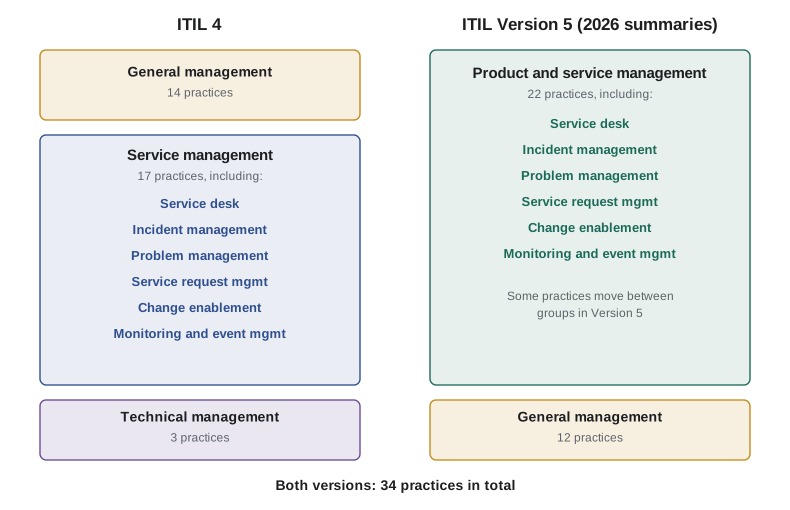
ITIL 4 describes 34 management practices in three groups. General management practices (14) come from wider business management and apply across the organization: examples include continual improvement, information security management, knowledge management, relationship management, risk management and supplier management. Service management practices (17) developed within IT service management: examples include incident, problem, change enablement, service desk, service level, service request and monitoring and event management. Technical management practices (3) adapt technology management for service management purposes: deployment management, infrastructure and platform management, and software development and management.
ITIL (Version 5), launched in 2026, keeps a count of 34 practices but reorganizes them. Published summaries of the Version 5 practice set, checked in October 2026, describe two groups instead of three: product and service management practices (22) and general management practices (12). The technical group disappears, and a handful of practices move between groups. The six practices in this course keep their names and broadly their purposes in those summaries. Because practice descriptions and groupings can change between versions and editions, always check the current official materials before relying on exact wording.
| Version | Groups | Count | Where this course's six practices sit |
|---|---|---|---|
| ITIL 4 | General management, service management, technical management | 14 + 17 + 3 = 34 | All six are service management practices |
| ITIL (Version 5), as summarized in 2026 | Product and service management, general management | 22 + 12 = 34 | All six are product and service management practices |
The six practices in this course
Each practice has a purpose statement. The official wording is owned by PeopleCert, so the descriptions below are paraphrases that capture the idea you need to recognize.
| Practice | Purpose in plain words | Lesson |
|---|---|---|
| Service desk | Capture demand for incident resolution and service requests, and act as the single point of contact between the provider and its users | 2 |
| Incident management | Minimize the negative impact of incidents by restoring normal service operation as quickly as possible | 3 and 4 |
| Problem management | Reduce the likelihood and impact of incidents by finding their causes and managing workarounds and known errors | 5 |
| Service request management | Support the agreed quality of a service by handling predefined, user-initiated requests effectively and in a user-friendly way | 6 |
| Change enablement | Maximize the number of successful changes by assessing risk, authorizing changes and managing the change schedule | 7 and 8 |
| Monitoring and event management | Systematically observe services and components, and record and report selected changes of state identified as events | 9 |
Two further practices run through the whole course even though they are formally covered elsewhere. Knowledge management, a general management practice, is the subject of lesson 10 because support depends on it so heavily. Service level management, covered in ITIL-141, sets the targets that support practices are measured against, so lesson 11 uses it when discussing metrics.
What the Foundation exam expects
The ITIL 4 Foundation syllabus distinguishes two levels of knowledge about practices. For a set of 15 practices, candidates need to recall the purpose. For seven of them, candidates need to explain them in more detail, including key terms and how they work. The seven are continual improvement, change enablement, incident management, problem management, service desk, service level management and service request management. Five of the seven belong to this course; continual improvement was covered in ITIL-120 and ITIL-130, and service level management is covered in ITIL-141. Monitoring and event management is in the purpose-only list.
The Version 5 Foundation syllabus may weight topics differently. ITIL-101 described how to check the current syllabus for the exam you plan to take. This course teaches the practices in enough depth for either edition and for real work, and the capstone in lesson 12 includes an exam strategy for practice questions.
| Practice | ITIL 4 Foundation level |
|---|---|
| Service desk | Explain in detail |
| Incident management | Explain in detail |
| Problem management | Explain in detail |
| Service request management | Explain in detail |
| Change enablement | Explain in detail |
| Monitoring and event management | Recall purpose |
Practices and the value chain
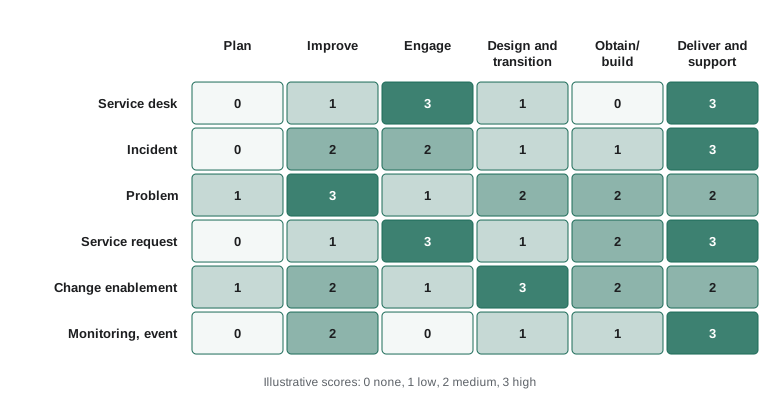
Practices do not map one-to-one onto value chain activities. Each practice contributes to several activities, and each activity draws on several practices. Incident management, for example, contributes most heavily to deliver and support, but it also contributes to engage (communicating with affected users), improve (incident records reveal where services are fragile) and design and transition (incidents after a release show whether transition worked). ITIL publications express this with a heat map that shows how strongly each practice contributes to each activity.
You do not need to memorize heat maps. What matters is the idea behind them: a practice is a reusable capability, and value streams combine practices as needed. When you design or improve a value stream, you ask which practices it needs at each step and whether those practices are mature enough.
Worked problem
Reading a practice contribution grid
A team scores how strongly each support practice contributes to each value chain activity on a scale of 0 (none) to 3 (high). Change enablement scores plan 1, improve 2, engage 1, design and transition 3, obtain/build 2, deliver and support 2. Which activity does change enablement contribute to most, and what is its total contribution score?
Show solution
- Find the highest score: design and transition, with 3.
- Add all six scores: 1 + 2 + 1 + 3 + 2 + 2 = 11.
- Interpretation: change enablement is concentrated in design and transition but touches every activity, which is typical of practices that control risk.
Answer: Design and transition receives the strongest contribution; the total is 11 out of a possible 18.
The code below builds a small illustrative grid of this kind for all six practices and reports, for each value chain activity, which practice contributes most. The scores are invented for teaching; the point is the technique of making contributions visible.
# Illustrative contribution scores, 0 = none to 3 = high (invented for teaching)
activities = ["plan", "improve", "engage", "design/transition", "obtain/build", "deliver/support"]
scores = {
    "service desk":        [0, 1, 3, 1, 0, 3],
    "incident":            [0, 2, 2, 1, 1, 3],
    "problem":             [1, 3, 1, 2, 2, 2],
    "service request":     [0, 1, 3, 1, 2, 3],
    "change enablement":   [1, 2, 1, 3, 2, 2],
    "monitoring/event":    [0, 2, 0, 1, 1, 3],
}
print(f"{'practice':20}" + "".join(f"{a[:9]:>10}" for a in activities) + "   total")
for p, row in scores.items():
    print(f"{p:20}" + "".join(f"{v:>10}" for v in row) + f"{sum(row):>8}")
print()
for j, a in enumerate(activities):
    best = max(scores, key=lambda p: scores[p][j])
    total = sum(r[j] for r in scores.values())
print(f"{a:18} strongest: {best:18} activity total: {total}")practice plan improve engage design/tr obtain/bu deliver/s total service desk 0 1 3 1 0 3 8 incident 0 2 2 1 1 3 9 problem 1 3 1 2 2 2 11 service request 0 1 3 1 2 3 10 change enablement 1 2 1 3 2 2 11 monitoring/event 0 2 0 1 1 3 7 plan strongest: problem activity total: 2 improve strongest: problem activity total: 11 engage strongest: service desk activity total: 10 design/transition strongest: change enablement activity total: 9 obtain/build strongest: problem activity total: 8 deliver/support strongest: service desk activity total: 16
The output shows deliver and support drawing on every support practice, which is why this course spends so much time there, and plan drawing on them least. A real organization would build such a grid from its own value streams and use it to decide where practice improvement would help most.
Practice success factors and key metrics
ITIL practice guidance describes each practice through practice success factors: the conditions that must be in place for the practice to fulfil its purpose. For incident management, examples are detecting incidents early, resolving them quickly and efficiently, and continually improving the approach. Each success factor has key metrics that show whether it is being achieved. Detection might be measured by the share of incidents detected by monitoring before users report them; resolution by the share resolved within target times; improvement by the trend in repeat incidents.
Success factors protect against a trap discussed in ITIL-120: measuring activity instead of outcomes. A service desk that answers thousands of calls is busy, but whether it is succeeding depends on whether users get what they need quickly and whether the number of avoidable contacts is falling. Throughout this course, each practice is presented with its success factors and with metrics that reflect them, along with cautions about how each metric can be gamed.
| Practice | Example success factor (paraphrased) | Example metric |
|---|---|---|
| Service desk | Users can reach support easily and get effective help | Contacts resolved at first contact; user satisfaction after contact |
| Incident management | Incidents are detected early and resolved quickly | Share detected by monitoring; share resolved within target |
| Problem management | Causes of incidents are identified and controlled | Repeat incidents per month; problems with workarounds published |
| Service request management | Requests are fulfilled efficiently and pleasantly | Fulfilment time against target; share fully automated |
| Change enablement | Changes are assessed and authorized appropriately and quickly | Change success rate; lead time for standard changes |
| Monitoring and event management | Significant events are detected and acted on | Share of incidents preceded by an event; alert noise ratio |
Three meanings of incident
The word incident is used in three professional fields with three different meanings, and the confusion causes real errors in policies, contracts and exam answers.
In ITIL, an incident is an unplanned interruption to a service or a reduction in its quality. A printer that will not print, a website that loads slowly and an application that crashes are all incidents. The goal of incident management is to restore normal service as quickly as possible.
In information security, a security incident is an event that actually or potentially jeopardizes the confidentiality, integrity or availability of information or systems, or that violates security policies. Some security incidents are also ITIL incidents (ransomware that encrypts a file server interrupts a service), but many are not (an employee emailing confidential data to a personal account may interrupt nothing). Security incident response follows its own guidance. In the United States, NIST published Revision 3 of Special Publication 800-61 in April 2025, which aligns incident response with the NIST Cybersecurity Framework 2.0. CISSP-113 and the planned CISSP-116 cover that discipline.
In occupational health and safety, an incident is an event that caused or could have caused injury, illness or damage. The HSE courses at HSM University, such as HSE-403 on incident investigation, use the word in that sense.
| Field | What incident means | Main goal | Where to study it |
|---|---|---|---|
| IT service management (ITIL) | Unplanned interruption or reduction in quality of a service | Restore normal service quickly | This course |
| Information security | Event that threatens confidentiality, integrity or availability, or breaches policy | Contain, eradicate, recover, meet legal obligations | CISSP-113 and later CISSP courses |
| Occupational health and safety | Event that caused or could have caused injury, illness or damage | Prevent recurrence and protect people | HSE courses |
Worked problem
Classifying an event in three frameworks
A technician installing a server in a data centre trips on a loose cable, sprains an ankle and pulls the network cable out of a switch, taking the payroll application offline for 20 minutes. Which kinds of incident has occurred?
Show solution
- Service management: payroll was interrupted, so this is an ITIL incident to be logged, prioritized and resolved.
- Occupational health and safety: a worker was injured, so this is a workplace incident to be reported and investigated under health and safety law.
- Information security: confidentiality and integrity were not threatened, but availability was briefly affected. Most organizations would not treat an accidental cable pull as a security incident, though their policy may require it to be recorded.
Answer: It is both an ITIL incident and a health and safety incident. Whether it is also a security incident depends on the organization's definitions, which is exactly why those definitions should be written down.
Practices in different organizations
The same practice looks different in a five-person software start-up and in a national bank. In the start-up, the developers may carry pagers, resolve incidents, make changes and talk directly to customers; the practices exist but are informal and blended. In the bank, there may be dedicated teams for each practice, regulatory reporting obligations and formal authorities. ITIL does not prescribe one model. The guiding principle start where you are, from ITIL-120, applies: understand what each practice already looks like in your organization before redesigning it.
Public sector organizations add further considerations. Government service desks in Canada must offer service in both official languages where the Official Languages Act applies, and provincial governments have their own language and accessibility requirements. In the United States, federal agencies must make support channels accessible under Section 508 of the Rehabilitation Act. Those obligations shape the service desk practice as much as any ITIL guidance does.
How to study the practices
Each practice lesson in this course follows a similar pattern. It explains the purpose in plain words, the key terms the exam and the workplace use, how the work flows, the people and tools involved, the success factors and metrics, common failure patterns and how the practice connects to the others. Worked examples and short programs show the arithmetic behind priority, availability, staffing, risk and improvement decisions. The final lesson brings everything together in a redesign of support for an invented organization.
One habit will help throughout: whenever you read about a practice, ask what outcome it protects for the user and how you would know whether it is working. That question connects the practices to the value focus that runs through all of ITIL.
Common mistakes
MistakeTreating a practice as a process document.
InsteadA practice is a set of organizational resources across all four dimensions: people, information and technology, partners, and processes.
MistakeEquating each practice with one department.
InsteadSeveral teams contribute to each practice, and one team often contributes to several practices.
MistakeAssuming practice names and groups are identical in every ITIL version.
InsteadITIL 4 has three groups; Version 5 summaries describe two. Check the current official materials.
MistakeUsing incident to mean the same thing in IT, security and safety documents.
InsteadDefine the term in each policy; an ITIL incident, a security incident and a safety incident are different things.
MistakeMeasuring how busy a practice is instead of whether it achieves its purpose.
InsteadUse practice success factors and outcome-focused metrics.
Summary and key terms
- A management practice is a set of organizational resources for performing work or accomplishing an objective.
- Practices are described across the four dimensions and are not the same as departments.
- ITIL 4 has 34 practices in three groups; Version 5 summaries describe 34 in two groups.
- This course covers service desk, incident, problem, service request, change enablement and monitoring and event management.
- Five of the seven practices the ITIL 4 Foundation exam treats in detail are in this course.
- Practices contribute to several value chain activities, and value streams combine practices.
- Incident means different things in service management, security and safety; define it clearly.
- Management practice
- A set of organizational resources designed for performing work or accomplishing an objective.
- General management practice
- A practice adopted from general business management, such as risk or supplier management.
- Service management practice
- A practice developed in IT service management, such as incident or change enablement.
- Technical management practice
- In ITIL 4, a practice adapted from technology management, such as deployment management.
- Practice success factor
- A condition that must be met for a practice to fulfil its purpose.
- Key metric
- A measure that shows whether a practice success factor is being achieved.
- Contribution heat map
- A grid showing how strongly each practice contributes to each value chain activity.
- Incident (ITIL)
- An unplanned interruption to a service or a reduction in its quality.
- Security incident
- An event that threatens the confidentiality, integrity or availability of information, or breaches security policy.
- Single point of contact
- One recognized place where users go for all their support needs.
Practice problems
Work each problem on paper first, then reveal the answer to check.
Define a management practice in your own words.
Show answer
A combination of people, information and technology, partners and processes that an organization uses to do a type of work or meet an objective.
Name the three ITIL 4 practice groups and how many practices each contains.
Show answer
General management (14), service management (17) and technical management (3).
How do published summaries describe the Version 5 grouping?
Show answer
Two groups: product and service management (22) and general management (12), still 34 in total.
Which five practices in this course does the ITIL 4 Foundation exam treat in detail?
Show answer
Service desk, incident management, problem management, service request management and change enablement.
Why is a practice not the same as a department?
Show answer
Several teams contribute to each practice and one team may contribute to several; treating them as departments creates handoffs and silos.
A practice scores 0, 1, 3, 1, 2, 3 against the six activities. What is its total and strongest activity if the last score is deliver and support and the third is engage?
Show answer
Total 10; engage and deliver and support tie at 3.
Give one example of an ITIL incident that is not a security incident.
Show answer
A printer jam or a disk filling up and slowing an application.
Give one example of a security incident that is not an ITIL incident.
Show answer
An employee sending confidential files to a personal account without any service interruption.
What is a practice success factor?
Show answer
A condition that must be achieved for the practice to fulfil its purpose, measured by key metrics.
Why should policies define the word incident?
Show answer
Because it has different meanings in service management, security and safety, and confusion leads to wrong reporting and handling.
Lesson quiz · 5 questions
Score 60% or more to complete this lesson.
Create a free account to save your progress, take quizzes and earn a certificate.