
HSE-402 · Lesson 10 of 12 · 20 min
Reporting and records: the Department and the WCB
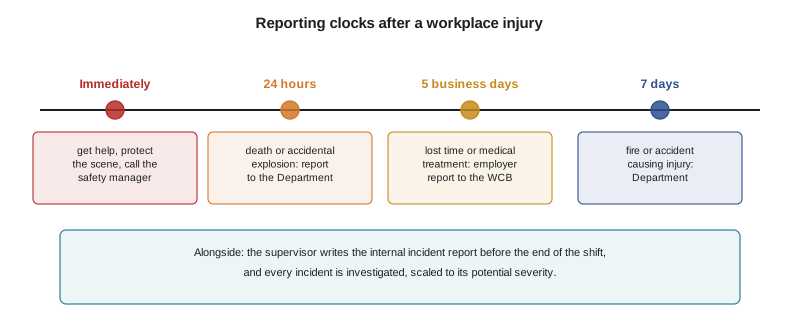
On a Thursday night in Dev's third month, a sanitation worker slipped on a wet ramp, fell against a handrail and cracked a rib. She finished the shift, saw a doctor the next morning and was told to stay off work for a week. Dev knew she needed help and made sure she got a ride to the clinic. What he was less sure about was who had to be told, by when, and on which form. 'There are at least three different clocks running,' Elena told him the next morning. 'Let's go through them.'
This lesson covers the reporting and record-keeping duties that apply after an injury or incident in Nova Scotia: what must be reported to the Department, what must be reported to the WCB, what records must be kept, and why accurate reporting is both a legal duty and a sign of a healthy safety culture.
Reporting to the Department
Nova Scotia's Act requires employers to report certain incidents to the Department. According to the Department's guidance, a death or an accidental explosion must be reported within 24 hours, and a fire or an accident causing injury must be reported within seven days. Serious incidents should be reported as soon as possible by phone to the Department's occupational health and safety line, which is staffed for emergencies. Where a serious injury or death has occurred, the scene generally must not be disturbed, except to rescue people, prevent further harm or protect property, until an officer authorizes it, so that the investigation can see what happened.
The reports must give the facts: who was involved, when and where, what happened, the nature of the injuries and the steps taken. Reporting is the employer's duty, but in practice supervisors are usually the first to know. At Harrowgate Foods Ltd., the procedure was that the supervisor called Elena or the on-call manager immediately for any serious injury, and filled in an internal incident report before the end of the shift. Elena then made the reports to the Department and the WCB.
Reporting to the WCB
Workers' compensation reporting is separate. When a worker is injured at work and loses time beyond the day of the injury, or needs medical treatment, the employer must report it to the WCB, generally within five business days of learning about it. Workers report their own injuries to the employer and file claims with the WCB, and health care providers send their own reports. The employer's report starts the claim process, which pays for treatment and lost wages and helps the worker return to work.
The rib injury needed to be reported to the WCB, because the worker would be off for a week and had seen a doctor. It also needed to be reported to the Department within seven days, as an accident causing injury. Elena made both reports that morning and recorded the dates. The scene, a wet ramp, did not need to be preserved for an officer, but Dev had photographed the ramp and the water source before it was cleaned up, which helped the internal investigation.
Records employers must keep
Beyond incident reports, the law and good practice require employers to keep many safety records. In Nova Scotia these include the written health and safety program and policy, committee minutes and the employer's responses to recommendations, records of workplace inspections and corrective actions, training records, first aid records, records of hazard assessments, monitoring and testing results, equipment inspection and maintenance logs, investigation reports, and records related to harassment complaints under Part 27 of the Workplace Health and Safety Regulations. Some records must be kept for set periods, and many must be made available to the joint occupational health and safety committee or health and safety representative and to officers on request.
Records serve three purposes. They are evidence of compliance and due diligence, as lessons 6 and 8 explained. They are the raw material for learning: injury and near-miss records show where hazards are, and inspection records show whether controls are working. And they protect workers: training records, exposure monitoring and first aid records can matter years later if a worker develops an occupational disease or needs to prove a claim.
Never discourage reporting
Accurate reporting depends on workers being willing to report. Under-reporting is a serious problem across Canada: studies have found that a significant share of work injuries are never reported to compensation boards, often because workers fear consequences or are pressured not to. Nova Scotia's workers' compensation law prohibits employers from discouraging workers from reporting injuries or filing claims, and the Occupational Health and Safety Act prohibits discriminatory action against workers who raise safety concerns. Practices such as rewarding crews for having no reported injuries, requiring a manager's permission before a worker sees a doctor, or disciplining workers for being injured all discourage reporting and can break the law.
HSE-401 described how Harrowgate Foods Ltd.'s distribution centre had a quarterly no-injury bonus that hid injuries. It was replaced with recognition for reporting hazards and near misses. In the year after the change, recorded minor injuries rose and serious injuries fell, which is exactly the pattern a healthy reporting culture produces: problems are seen while they are small.
Measuring with the records
Elena used the WCB claims and internal injury records to calculate injury rates for each site, so the company could compare itself over time. She was careful to show both lost-time claims and all reported injuries, because a falling lost-time rate with rising minor reports usually means reporting is improving.
# Injury rates per 100 workers at each site last year (invented data).
sites = {
    # site: (average workers, lost-time claims, all reported injuries incl. first aid)
    "main plant": (420, 9, 118),
    "distribution centre": (110, 5, 31),
    "sauces plant": (60, 1, 14),
}
for site, (workers, lost, allrep) in sites.items():
    print(f"{site:<20} lost-time per 100 workers {100 * lost / workers:4.1f}   all reports per 100 workers {100 * allrep / workers:5.1f}")
print("rising minor reports with falling lost-time claims usually means reporting is improving")main plant lost-time per 100 workers 2.1 all reports per 100 workers 28.1 distribution centre lost-time per 100 workers 4.5 all reports per 100 workers 28.2 sauces plant lost-time per 100 workers 1.7 all reports per 100 workers 23.3 rising minor reports with falling lost-time claims usually means reporting is improving
The distribution centre had the highest lost-time rate relative to its size, which matched what supervisors already suspected about forklift traffic and manual handling. Its rate of all reports had risen since the bonus was removed, which Elena treated as good news.
Worked problem
Which reports are needed?
Show solution
- A worker at the distribution centre cuts a hand on a pallet strap. First aid is given on site and she returns to work.
- Department: an accident causing injury; Elena checks the Department's current reporting requirements and reports as required.
- WCB: no lost time beyond the day and no medical treatment, so no WCB report is needed; the first aid record is kept.
- Two days later the cut becomes infected and she sees a doctor and gets a prescription: now a WCB report is needed within five business days.
- Internal: the incident is investigated and strap-cutting tools are reviewed.
Answer: Each reporting duty has its own trigger; a case can become reportable later.
The supervisor's part in reporting
Reporting is the employer's legal duty, but it depends on supervisors at every step. The supervisor is usually the first person in management to learn of an injury, so the supervisor's knowledge often starts the employer's clock. A supervisor who learns of a serious injury at two in the morning and waits until the safety manager arrives at eight has used a third of a 24-hour limit before anyone who can make the report knows about it. At Harrowgate Foods Ltd., the rule after the conveyor injury was simple: any injury that needs more than first aid, any injury where a worker leaves for treatment, and any incident that could have caused serious injury is phoned to the on-call manager before the end of the shift, and any death, explosion or serious injury is phoned immediately.
The supervisor's second job is to get the facts down while they are fresh. Dev's internal incident report for the rib injury took fifteen minutes and recorded the time, the place, the task, what the worker said happened, what he saw when he arrived, the names of the two workers who had been nearby, the photographs of the ramp and the leaking hose above it, and the first aid given. He did not try to decide who was at fault. Elena later said that this report was the most useful document in the investigation, because it was written before anyone had a reason to remember things differently.
The supervisor's third job is to make reporting easy and safe for workers. Dev told his crew at the start of every shift that he wanted to hear about every injury, however small, and every near miss. When a worker reported a strained wrist from the hose reel, Dev thanked her in front of the crew, logged it, and had maintenance replace the reel's spring that week. Small acts like that teach a crew more about whether reporting is welcome than any poster does.
Investigations and their records
Every reported incident at Harrowgate Foods Ltd. was investigated, with effort scaled to its potential severity rather than its actual outcome. A near miss on the spiral conveyor, where nobody was hurt, got the same depth of investigation as a lost-time injury, because the next time it might not be a near miss. The investigation looked for causes at three levels: what happened at the moment of the incident, what conditions allowed it, and what in the company's systems, such as procedures, training, maintenance or supervision, allowed those conditions to exist. For the rib injury, the immediate cause was a wet ramp; the condition was a hose that had been leaking for two weeks; and the system cause was that the maintenance request had been made verbally and never logged.
The investigation record listed corrective actions with an owner and a due date for each, and Elena tracked them to completion. The joint occupational health and safety committee received a copy and reviewed whether the actions addressed the system causes, not only the immediate ones. Investigation reports are also among the records an officer is most likely to ask for, and they speak directly to the duty of foresight: a company that investigates near misses and fixes what it finds is showing exactly the kind of care that due diligence requires.
Return to work
Records and reports are also how an injured worker gets back to work safely. Nova Scotia's workers' compensation system expects employers and workers to cooperate in early and safe return to work, and employers that meet size thresholds have specific duties to re-employ injured workers. The details depend on the employer's size and the worker's length of service, so Harrowgate Foods Ltd. relied on its human resources team and the WCB case manager for each case. The supervisor's part was practical: staying in touch with the injured worker, helping identify suitable modified duties, and making sure the crew welcomed the worker back rather than treating modified duties as a punishment or a favour.
The worker with the cracked rib returned after a week on modified duties, checking sanitation records and training a new hire on the chemical dispensing system, before returning to her full job two weeks later. Dev kept a short note of the arrangement in his log. It was a small thing, but it showed the crew that being injured and reporting it did not cost anyone their place.
Common mistakes
MistakeWaiting until the next week to report a serious injury.
InsteadCall the safety manager immediately; some reports have 24-hour limits.
MistakeCleaning up an accident scene before the officer arrives.
InsteadPreserve the scene after a serious injury or death, except to rescue or prevent harm.
MistakeConfusing the Department and the WCB.
InsteadThey are separate reports with separate triggers and time limits.
MistakeRewarding crews for having no reported injuries.
InsteadReward reporting of hazards and near misses; never discourage claims.
MistakeTreating records as paperwork only.
InsteadRecords prove due diligence, drive learning and protect workers' future claims.
Summary and key terms
- Report a death or accidental explosion to the Department within 24 hours, and a fire or accident causing injury within seven days.
- Preserve the scene of a serious incident, except to rescue people or prevent further harm.
- Report lost-time and medical treatment injuries to the WCB, generally within five business days.
- Keep records of the program, committee, inspections, training, first aid, assessments, monitoring and investigations.
- Never discourage reporting or claims; it is unlawful and hides hazards.
- Use records to calculate rates, but treat a low rate with caution.
- Accident causing injury
- An event at work that results in an injury, reportable to the Department within seven days.
- Lost-time injury
- A work injury that keeps the worker off work beyond the day of the injury.
- Preserving the scene
- Leaving an incident scene undisturbed for investigation, except to rescue or prevent harm.
- First aid record
- A record of first aid treatment given at the workplace.
- Under-reporting
- Failure to report injuries or claims that should be reported.
Practice problems
Work each problem on paper first, then reveal the answer to check.
Within what time must a death be reported to the Department?
Show answer
Within 24 hours.
When must an accident causing injury be reported to the Department?
Show answer
Within seven days.
What triggers a WCB report?
Show answer
Lost time beyond the day of injury or medical treatment.
Give three purposes of safety records.
Show answer
Evidence of compliance and due diligence, learning about hazards, and protecting workers' future claims.
Why did recorded minor injuries rise after the bonus was removed?
Show answer
Workers felt free to report, so problems were seen while small.
Lesson quiz · 5 questions
Score 60% or more to complete this lesson.
Create a free account to save your progress, take quizzes and earn a certificate.