
HSE-394 · Lesson 3 of 12 · 23 min
Handling hazardous drugs safely
▶ Video coming soon A video version of this lesson is on the way.
Knowing that hazardous drugs are dangerous is only useful if it changes what happens at each step of the drug's journey through the hospital. This lesson follows a dose of an antineoplastic from the receiving dock to the patient's bedside and covers the controls at each step: engineering controls such as cabinets, rooms and closed-system devices; safe work practices; and the personal protective equipment that is the last line of defence. The next lesson covers what to do when something spills, and how to deal with the waste.
Receiving and unpacking
Shipments of hazardous drugs are contaminated more often than most people expect. Studies have found drug residue on the outside of vials straight from the manufacturer, and vials sometimes break in transit. For that reason, hazardous drugs should be delivered to a defined area, ideally the pharmacy itself rather than the general stores, and unpacked by trained staff.
At Northbridge, cartons labelled as containing hazardous drugs go straight from the receiving dock to the hazardous drug room in pharmacy, on a cart with raised edges. Priya Shah or another trained technician opens them wearing a gown and one pair of chemotherapy gloves, and a spill kit hangs on the wall beside the bench. Any damaged carton is not opened in the open air; it is sealed in a bag and opened inside a cabinet. NAPRA's standards call for hazardous drugs to be unpacked in an area separate from other drugs, and for a spill kit to be on hand wherever they are received.
Storage
Hazardous drugs that must be manipulated, such as powders for injection and vials, are stored apart from other drugs, in a room that keeps any contamination from spreading to the rest of the pharmacy.
Northbridge stores them in the separate negative-pressure hazardous drug room described in HSE-390. The room is exhausted to the outside, kept at lower pressure than the rooms around it so that air flows in rather than out, and has a refrigerator reserved for hazardous drugs. NAPRA's model standards set the design requirements for these rooms in Canadian pharmacies.
Intact tablets and capsules that are only counted or packaged may be stored with other drugs if the facility's assessment allows it, but they are kept on marked shelves so that staff know what they are handling.
Compounding
Preparing doses, called compounding, is where the largest amounts of drug are handled in concentrated form. Reconstituting a powder, drawing liquid out of a vial and injecting it into a bag can all produce aerosols and droplets. All of it is done inside a primary engineering control, a ventilated cabinet that draws air away from the worker and filters it before it is exhausted.
- A Class II biological safety cabinet (BSC) has a front opening with air drawn in at the work surface, a down-flow of filtered air over the work, and HEPA filtration of the exhaust. For hazardous drugs it should be exhausted to the outside.
- A compounding aseptic containment isolator (CACI) is a sealed glove box: the worker reaches in through glove ports, and the inside is kept at negative pressure.
The cabinet sits inside a secondary engineering control: the negative-pressure buffer room itself, with an anteroom where staff put on and take off PPE. The cabinet protects the worker from the drug and keeps the product sterile; the room catches anything the cabinet does not.
Inside the cabinet, technicians use careful technique: a plastic-backed absorbent pad on the work surface, changed after each batch or spill; venting vials only with closed systems rather than by pulling the needle out under pressure; keeping hands and supplies away from the front grille; and wiping the outside of every finished bag or syringe before it leaves the cabinet. Finished doses are sealed in a clear plastic bag inside the cabinet and labelled as hazardous.
Closed-system drug-transfer devices
A closed-system drug-transfer device (CSTD) is a set of connectors that mechanically prevents drug from escaping, and outside contamination from getting in, when drug moves from vial to syringe to bag to patient. Most use a membrane-to-membrane connection or a sealed balloon that captures vapour as the vial is vented. Studies show CSTDs greatly reduce surface contamination in pharmacies and on nursing units.
NAPRA's standards recommend CSTDs for compounding hazardous drugs, and many Canadian cancer programs use them for administration as well. Northbridge uses the same CSTD system in pharmacy and on the oncology day unit, so that every bag arrives with a closed connector already attached.
A CSTD is not a reason to relax other precautions. It reduces exposure but does not eliminate it, and workers still wear PPE and work in a cabinet when compounding.
Personal protective equipment
PPE for hazardous drugs is specific. Ordinary examination gloves and cloth or paper gowns do not reliably stop these drugs.
- Gloves: chemotherapy gloves tested to the ASTM D6978 standard, which measures how long specific cancer drugs take to pass through the glove material. Powder-free, usually nitrile. Two pairs are worn for compounding, administration, spill cleanup and handling body fluids; the inner pair goes under the gown cuff and the outer pair over it. Gloves are changed regularly, commonly every 30 minutes during compounding, and at once if torn, punctured or visibly contaminated.
- Gowns: disposable, long-sleeved, closing at the back, with tight cuffs, made of material shown to resist permeation by hazardous drugs. Cloth lab coats and ordinary isolation gowns absorb liquid and are not suitable. Gowns are not worn outside the area where drugs are handled.
- Eye and face protection: goggles and a face shield, or a full face shield, whenever there is a risk of splashes, such as when working outside a cabinet, cleaning a spill or giving a drug by irrigation.
- Respiratory protection: a fit-tested N95 or better respirator when there is a risk of inhaling powders or aerosols outside a cabinet, such as during spill cleanup or when unpacking a damaged shipment. A surgical mask does not protect the wearer from drug aerosols.
- Head, hair, shoe and sleeve covers in compounding areas, to keep contamination from being carried out.
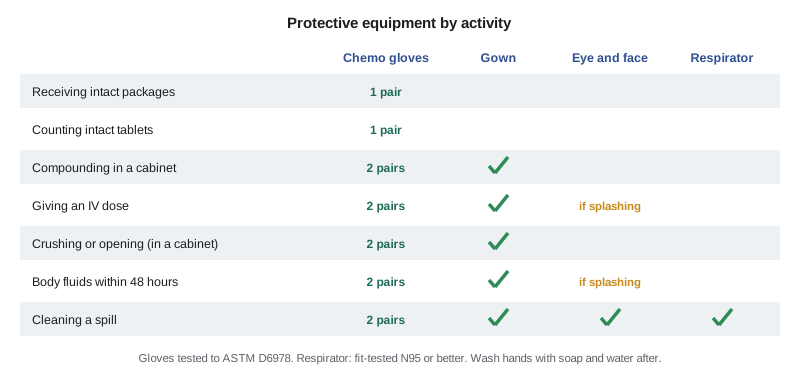
PPE is taken off in an order that keeps contamination off the skin: outer gloves first, then gown and other covers, rolling them inward, then inner gloves, followed by hand washing with soap and water. Alcohol hand rub does not remove drug residue. Used PPE goes into the hazardous drug waste container, not the regular garbage.
Glove changes are easy to forget during a long compounding session. Priya's team uses a simple timer on the cabinet, and the pharmacy manager checked how well the 30-minute rule was being followed by reviewing a week of compounding logs.
# Glove change audit: minutes between glove changes in a week of compounding
sessions = {
    "Mon AM": [28, 31, 29, 30, 27],
    "Mon PM": [30, 33, 41, 29],
    "Tue AM": [26, 30, 30, 28, 29],
    "Wed AM": [35, 38, 44, 31],
    "Thu AM": [29, 30, 28, 30, 30],
    "Fri AM": [30, 29, 52, 30],
}
LIMIT = 30
GRACE = 5   # changes within 35 minutes count as on time

late = []
total = 0
for session, gaps in sessions.items():
    for g in gaps:
        total += 1
        if g > LIMIT + GRACE:
            late.append((session, g))

print(f"glove changes checked: {total}")
print(f"late (over {LIMIT + GRACE} min): {len(late)}")
for session, g in late:
    print(f"  {session}: {g} min")
print(f"on time: {round(100 * (total - len(late)) / total)} in 100")glove changes checked: 27 late (over 35 min): 4 Mon PM: 41 min Wed AM: 38 min Wed AM: 44 min Fri AM: 52 min on time: 85 in 100
Most changes were on time. The late ones clustered on Wednesday and on Friday morning, both days with a single technician covering compounding while another was on vacation, and the 52-minute gap came during a rush order for the emergency department. The fix was staffing, not a reminder poster: the pharmacy now schedules two technicians in the hazardous drug room whenever the batch list is long.
Transport
Prepared doses leave the pharmacy sealed in a labelled plastic bag, placed in a rigid, leak-proof container with a hazardous drug label and a small spill kit. Pneumatic tube systems are not used for hazardous drugs at Northbridge, because a dose that breaks in a tube can contaminate the whole system. Kevin Tran and the other porters who carry the containers have had a short training session on what to do if a container is dropped or leaks: do not open it, keep people away, and call pharmacy and environmental services.
Administration
On the unit, the nurse checks the dose and puts on double chemotherapy gloves and a gown before handling the bag. Good practice at the bedside includes:
- Priming IV tubing in the pharmacy cabinet, or at the bedside with a fluid that contains no drug, never with the drug itself.
- Using the CSTD connectors supplied, and checking connections before opening clamps.
- Placing a plastic-backed absorbent pad under connections and on the work surface.
- Never removing the tubing from a bag that contains drug; the bag and tubing are discarded together.
- Giving oral hazardous drugs straight from the package into a cup, without touching them, and never crushing them at the bedside.
- Keeping a spill kit on the unit and knowing where it is.
- Removing PPE and washing hands before leaving the room or touching anything else.
After the dose: body fluids and linen
For about 48 hours after a dose, and longer for some drugs, patients excrete drug in urine, stool, vomit, sweat and other body fluids. Staff wear double chemotherapy gloves and a gown when handling these fluids or the linen, bedpans and urinals they contaminate, and add face protection if splashing is possible. Toilets are flushed with the lid down. Soiled linen goes into a labelled bag that the laundry handles separately, and the laundry staff who receive it wear gloves and a gown. On 4 West and Maple Court, a magnet on the door frame and a flag in the chart show that a patient has received a hazardous drug in the last 48 hours.
Worked problem
Crushing a tablet at Maple Court
A resident in Oak at Maple Court is prescribed a Table 1 hazardous drug as a tablet, but cannot swallow tablets. The night RPN is about to crush it in the pill crusher at the medication cart and mix it with applesauce. What should happen instead?
Show solution
- Crushing turns the tablet into fine powder that can be breathed in, land on the cart and reach other residents' medications through the shared crusher.
- The nurse should stop and call the pharmacist, who can supply a liquid form if one exists or prepare the dose in the cabinet in pharmacy.
- If a dose must be prepared on the unit in an emergency, it should be done in a closed system, such as dissolving the tablet in water in a closed oral syringe, wearing double gloves and a gown, with the work done over an absorbent pad.
- The pharmacy should flag the resident's profile so the issue is solved before the next dose, and the incident should be discussed with Maple Court staff.
Answer: Do not crush a hazardous tablet in the open; get a liquid or a pharmacy-prepared dose, and use a closed method with full PPE if there is no alternative.
Keeping work areas clean, and checking
Even with good technique, small amounts of drug land on the surfaces of cabinets, counters, carts and floors. Routine cleaning removes them before they build up or spread. Cleaning hazardous drug areas has more steps than ordinary cleaning, because a disinfectant that kills germs does not necessarily remove or break down a drug. Northbridge's procedure, described in detail in the next lesson, uses a cleaning agent to remove drug residue and a separate disinfectant where sterility matters, with the work done from the cleanest area to the dirtiest, using disposable wipes and fresh gloves.
Cleaning schedules depend on the area: the inside of the compounding cabinet at the start and end of each shift and after any spill; the hazardous drug room counters and floor daily; the oncology day unit chairs, IV poles and pumps after each patient; and the transport containers after every trip.
Is the cleaning working? The only way to know is to check. Many hospitals now carry out surface wipe sampling, in which a trained person wipes a measured area with a special pad and a laboratory tests it for marker drugs such as cyclophosphamide, methotrexate and fluorouracil. Results show whether contamination is present and where. Northbridge started wipe sampling twice a year in pharmacy and on the oncology day unit after the register review. The first round found traces on the floor in front of the cabinet, on the handle of the pass-through window and on two IV pump keypads on the unit, but none on the nursing station keyboards. Those findings changed the cleaning list: pump keypads and door handles are now wiped after every patient.
Wipe sampling is a tool for checking controls, not for judging individual workers, and the results are shared with the JHSC and the staff in each area.
Common mistakes
MistakeUnpacking hazardous drug shipments in the general stores area.
InsteadUnpack them in a defined area with PPE and a spill kit.
MistakeWearing regular examination gloves to handle chemotherapy.
InsteadWear two pairs of gloves tested to ASTM D6978.
MistakeUsing a surgical mask to clean up a powder spill.
InsteadUse a fit-tested N95 or better respirator.
MistakePriming IV tubing with the drug at the bedside.
InsteadPrime in the pharmacy cabinet or with a drug-free fluid.
MistakeCleaning hands with alcohol rub after removing chemotherapy gloves.
InsteadWash with soap and water; alcohol does not remove drug residue.
Summary and key terms
- Receive and unpack hazardous drugs in a defined area with PPE and a spill kit.
- Store drugs that need manipulation in an exhausted, negative-pressure room.
- Compound in a ventilated cabinet inside a negative-pressure room, using careful technique.
- Closed-system drug-transfer devices greatly reduce contamination but do not replace other controls.
- Use double chemotherapy gloves, protective gowns, and eye, face and respiratory protection as the task requires.
- Transport in sealed, labelled, rigid containers, never by pneumatic tube.
- Give doses with closed systems and absorbent pads, and handle body fluids and linen with PPE for about 48 hours.
- Biological safety cabinet (BSC)
- A ventilated cabinet that protects the worker and the product with filtered airflow.
- Compounding aseptic containment isolator (CACI)
- A sealed, negative-pressure glove box for preparing hazardous sterile doses.
- Closed-system drug-transfer device (CSTD)
- Connectors that prevent drug from escaping and contamination from entering during transfer.
- ASTM D6978
- The test standard for gloves used with chemotherapy drugs.
- Negative pressure
- Lower air pressure in a room than its surroundings, so air flows in and contamination stays inside.
- Primary engineering control
- A cabinet or isolator where hazardous drugs are manipulated.
Practice problems
Work each problem on paper first, then reveal the answer to check.
Why are hazardous drug shipments unpacked with gloves and a gown?
Show answer
The outside of vials and cartons is often contaminated, and vials can break in transit.
What is the difference between a BSC and a CACI?
Show answer
A BSC has an open front with inward airflow; a CACI is a sealed glove box under negative pressure.
What standard should chemotherapy gloves meet, and how many pairs are worn when giving IV doses?
Show answer
ASTM D6978; two pairs.
Why are hazardous drugs not sent through the pneumatic tube?
Show answer
A broken dose could contaminate the whole tube system.
What did the glove change audit show, and what was the fix?
Show answer
Late changes happened when one technician worked alone; the fix was scheduling two technicians.
How long after a dose should body fluids be handled with chemotherapy PPE?
Show answer
About 48 hours, or longer for some drugs.
Lesson quiz · 5 questions
Score 60% or more to complete this lesson.
Create a free account to save your progress, take quizzes and earn a certificate.