
HSE-392 · Lesson 6 of 12 · 22 min
Sharps containers
▶ Video coming soon A video version of this lesson is on the way.
A sharps container looks like the simplest piece of equipment in a hospital, and it is easy to take for granted. But a large share of sharps injuries happen during or after disposal, and many of those trace back to the container: one that was too full, too far away, mounted too high to see into, the wrong size for the device, or tipped over on a cart. This lesson covers what a container must be, where it should go, how to use it and when to change it.
What a sharps container must be
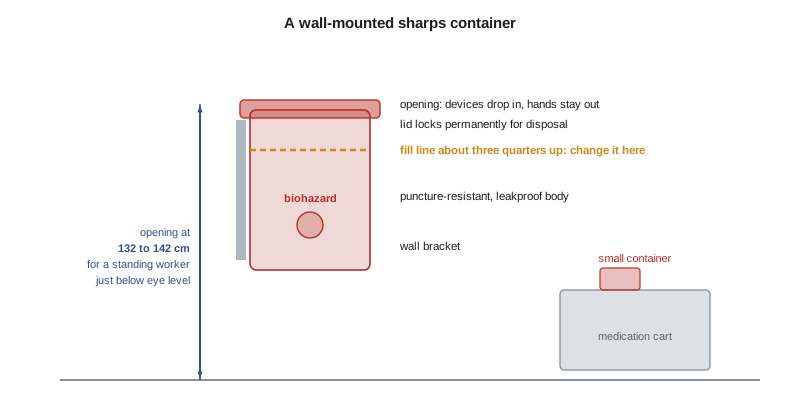
In Canada, sharps containers are expected to meet CSA Standard Z316.6, which sets out tests and requirements for single-use and reusable medical sharps containers. Provincial guidance and Regulation 67/93 procedures require containers that meet it. In Ontario hospitals, sharps containers are usually yellow and carry the biohazard symbol. A compliant container is:
- Puncture resistant on all sides and the bottom, under the conditions it will meet in use.
- Leakproof on the sides and bottom, so that fluid from syringes and tubing does not escape.
- Closable, with a lid that locks permanently for disposal.
- Clearly labelled with the biohazard symbol and a fill line.
- Stable, so it does not tip over when a device is dropped in.
- Designed so that a hand cannot reach inside, and so that sharps cannot easily be shaken back out.
- Large enough for the devices it will receive, including long spinal needles, IV catheters with tubing and blood collection sets.
Where containers go
The goal, as Lesson 5 explained, is a container within arm's reach of wherever sharps are used, so that nobody carries a used sharp. That means containers:
- In every patient room, mounted on the wall near where procedures are done, usually close to the bed and the hand hygiene station.
- On every medication cart and procedure tray, in a size that fits.
- In phlebotomy trays, so that the lab staff who collect blood across the hospital always have one at hand.
- In treatment rooms, emergency department bays, operating rooms, procedure suites and labs.
- In the bags of home care staff, as a small portable container, as Lesson 11 describes.
- Out of reach of children and confused patients in children's units, mental health units and long-term care areas, sometimes with a locking bracket.
NIOSH studied the height at which workers can see into a container and drop a device in safely. For a worker standing at a bed or counter, it recommends the opening be about 132 to 142 cm (52 to 56 inches) from the floor, just below eye level, so the worker can see how full it is. For seated workers, such as lab staff at a bench, the opening should be lower, about 97 to 107 cm (38 to 42 inches). Containers mounted much higher than eye level are a classic hazard: the worker cannot see the opening or the fill line and reaches up blindly.
Containers should not be placed where they block a path, where they can be knocked off a counter, or on the floor. A container on a cart should sit in a holder so it cannot tip.
How to use a container
- Look at the container before you use it. If it is at the fill line, do not add to it; get a new one.
- Drop the sharp in point first, letting it fall. Do not push, force or press down on the contents.
- Never put fingers or hands into the opening, and never try to retrieve anything that has gone in, including a dropped item such as a pen or a medication cap.
- Do not shake a container to make room.
- Keep it upright.
- Close the temporary lid when the container is not in use, where the design allows, especially in areas where patients or visitors could reach it.
- When it reaches the fill line, close and lock the lid permanently, and take it to the designated holding area according to the procedure.
Overfilling is the biggest single problem with containers. As the container fills, sharps near the top stick out or sit just below the opening, where the next device pushes them up. A worker who drops in a needle and pushes it down with a second item, or who tries to squeeze one more syringe into a full container, is at real risk. The fill line, usually about three quarters of the way up, is set to leave a safe margin.
Changing containers
Containers must be changed routinely, before they reach the fill line, not just when somebody notices. Responsibility is split at Northbridge: clinical staff close and lock containers that reach the line during their shift, and environmental services replaces them on a schedule and on request. Marta Kowalski's rounds on 4 West include a look at every container, and she carries replacements on her cart.
The right schedule depends on how fast containers fill. A container in an emergency department bay may fill in a day or two, while one in a quiet outpatient room may take weeks. Joanne and the environmental services lead used a month of change records to set the frequency for each type of area.
# Days for a container to reach the fill line, from a month of change records
fill_days = {
    "ED bay":            [1.5, 2, 1.8, 2.2, 1.6, 1.9, 2.1, 1.7],
    "4 West room":       [9, 11, 8, 12, 10, 9, 13, 10],
    "medication cart":   [3, 4, 3.5, 4, 3, 4.5, 3.5, 4],
    "phlebotomy tray":   [2, 2.5, 2, 3, 2.5, 2, 2.5, 3],
    "outpatient clinic": [21, 28, 25, 30, 24, 26, 22, 27],
}

def schedule(days, margin=0.75):
    # change at the quickest observed fill time, with a safety margin
    return max(1, int(min(days) * margin))

print(f"{'area':20}{'fastest fill':>13}{'average':>9}{'change every':>14}")
for area, d in fill_days.items():
    every = schedule(d)
print(f"{area:20}{min(d):10.1f} d{sum(d) / len(d):8.1f}{every:11} d")area fastest fill average change every ED bay 1.5 d 1.9 1 d 4 West room 8.0 d 10.2 6 d medication cart 3.0 d 3.7 2 d phlebotomy tray 2.0 d 2.4 1 d outpatient clinic 21.0 d 25.4 15 d
Setting the schedule from the fastest fill time, with a margin, means most containers are changed before they are full even in a busy week. The emergency department bays are checked every day, and the code flags the phlebotomy trays for daily changes too, which surprised the team until Daniel pointed out how many blood collection sets go into a small tray container on a morning round. Request-based changes, triggered when a worker closes a full container, cover the rest.
Common problems and their fixes
When the Northbridge committee audited every sharps container in the hospital and Maple Court last spring, it found the same handful of problems again and again. Each has a cause that can be fixed.
| Problem found | Usual cause | Fix |
|---|---|---|
| Container past the fill line | No set change schedule; staff unsure who changes it | Schedule by fill rate; clear split of duties between clinical staff and environmental services |
| Sharp sticking out of the opening | Overfilling, or a device too long for the container | Change at the fill line; larger containers where long devices are used |
| Opening above eye level | Bracket mounted for convenience, or moved during renovation | Remount at the recommended height; check after any renovation |
| No container in the room | Container removed for cleaning and not returned, or never installed | Count containers on each inspection; one per room as standard |
| Container on the floor or a windowsill | Wall bracket broken or missing | Report for repair; use a cart holder in the meantime |
| Temporary lid left open in a resident area | Staff unaware of the closure | Training at orientation; reminder label on the container |
| Wrong type of waste in the container | Gauze, gloves and packaging added | Only sharps go in, so containers do not fill early |
The last problem is easy to miss. Containers that receive gloves, gauze and packaging fill up much faster, which pushes them past the fill line sooner and wastes money, because biomedical waste costs far more to treat than regular waste. Only sharps, and items that the procedure says must go with them, belong in a sharps container.
Sizes and special cases
Containers come in many sizes, from small units for a tray or a home care bag to large floor-standing containers for operating rooms and dialysis units. Choosing the wrong size causes injuries: a long spinal needle or a large IV catheter may not fit through the opening of a small container, tempting the worker to force it or leave it on top. Units that use long devices need containers with an opening and depth that fit them.
Some departments need special containers. Pharmacy and oncology units use containers for hazardous drug waste, which are handled separately, as HSE-394 explains. Labs may need containers that can be autoclaved. Operating rooms use containers sized for scalpel blades, suture needles and the many small sharps of surgery, and some use magnetic counters that hold suture needles until the count is done.
Choosing containers
Containers, like sharps devices, should be chosen with the people who use them. A container that looks sturdy in a sample room may have an opening that is too narrow for an IV catheter with tubing, a temporary lid that is hard to open with one hand, or a bracket that releases too easily. When Northbridge last changed suppliers, the device evaluation team trialled two container systems on 4 West, the emergency department and Maple Court for a month. Staff rated how easy each was to see into, drop into and close, and environmental services rated how easy each was to remove, lock and carry. The system chosen had a wide opening with a rocking flap that let devices fall in but would not open far enough for a hand, and a clear window that showed the fill level from across the room.
After the lid is locked
A full container becomes biomedical waste. It is moved, closed and upright, to a holding area, then collected by a licensed hauler and treated, usually by autoclaving or incineration, under provincial environmental rules and the CSA Z317.10 standard for handling health care waste. Workers who handle closed containers wear gloves, carry them by the handle away from the body, and never throw them into a bin or compact them. If a container is punctured, cracked or leaking, it goes into a second container before it is moved.
Reusable containers, which some hospitals use to reduce plastic waste, are emptied and cleaned by the service company using automated equipment, never by hand at the hospital.
Worked problem
The container in room 412
During a committee inspection on 4 West, Tom Bergstrom finds that the sharps container in room 412 is mounted high above the sink, at about 180 cm (6 feet). It is past the fill line, and a syringe is sticking out of the opening. What should be done right away, and what should change?
Show solution
- Right away: nobody should try to push the syringe down. Tom asks Marta to bring a new container and a pair of tongs. She closes the old container as far as it will go without touching the syringe, places the whole container upright in a larger rigid container and takes it to the holding area.
- A new container is placed on the medication cart for the room until the wall bracket can be moved.
- Maintenance moves the bracket to about 135 cm (53 inches), next to the bed, where staff can see the opening and the fill line.
- The committee asks environmental services to review container heights across the hospital, and adds container height and fill level to the monthly inspection checklist.
Answer: Contain the overfilled container without touching the protruding sharp, provide a temporary container, remount the bracket at a visible height, and check every unit.
Common mistakes
MistakePushing sharps down to make room in a full container.
InsteadClose and lock it at the fill line and use a new one.
MistakeMounting containers above eye level.
InsteadMount the opening just below eye level, about 132 to 142 cm (52 to 56 inches) for standing workers.
MistakeReaching into a container to retrieve something that fell in.
InsteadNever put hands into a container; whatever went in stays in.
MistakeChanging containers only when someone notices they are full.
InsteadChange them on a schedule based on how fast they fill, as well as on request.
MistakeForcing a long device into a small container.
InsteadChoose a container with an opening and depth that fit the devices used.
Summary and key terms
- Sharps containers should meet CSA Z316.6: puncture resistant, leakproof, closable, labelled and stable.
- Place a container within arm's reach wherever sharps are used.
- Mount the opening just below eye level so workers can see the fill line.
- Look before you drop, let the sharp fall in point first, and never push, shake or reach in.
- Close and lock containers at the fill line, and change them on a schedule based on how fast they fill.
- Choose the right size for the devices used.
- Handle full containers as biomedical waste, upright and closed, with a second container if damaged.
- Sharps container
- A puncture-resistant, leakproof, closable container for used sharps.
- Fill line
- The mark on a sharps container showing where it must be closed and replaced, usually about three quarters full.
- Point of use
- The place where a sharp is used, where a container should be within reach.
- Secondary container
- A second rigid, leakproof container used to hold a damaged or overfilled sharps container.
- Biomedical waste
- Waste from healthcare that may be infectious, including used sharps, handled and treated under environmental rules.
Practice problems
Work each problem on paper first, then reveal the answer to check.
List four requirements for a sharps container.
Show answer
Any four of puncture resistant, leakproof on sides and bottom, closable, labelled with the biohazard symbol, stable, hand cannot reach in, right size.
At about what height should the opening be for a standing worker?
Show answer
About 132 to 142 cm (52 to 56 inches), just below eye level.
What is the fill line for, and what do you do when a container reaches it?
Show answer
It marks a safe margin; close and lock the container and replace it.
Why are phlebotomy tray containers changed daily at Northbridge?
Show answer
They are small and fill quickly with blood collection sets on morning rounds.
What should be done with a damaged or leaking container?
Show answer
Place it in a second closable, leakproof container before moving it.
What was wrong with the container in room 412?
Show answer
It was mounted too high to see into, was past the fill line and had a syringe sticking out.
Lesson quiz · 5 questions
Score 60% or more to complete this lesson.
Create a free account to save your progress, take quizzes and earn a certificate.