
HSE-392 · Lesson 5 of 12 · 22 min
Safe handling and disposal of sharps
▶ Video coming soon A video version of this lesson is on the way.
A safety device protects only part of the time a sharp is in someone's hands. The rest depends on how it is handled: how it is passed, how it is carried, when the safety feature is activated, and how quickly and carefully it goes into a container. Most sharps injuries happen not during the procedure itself but in the seconds and minutes after it, when the worker's attention has moved on. This lesson covers the work practices that close those gaps.
When sharps injuries happen
The CDC's analysis of injury reports from hospitals in its surveillance system found a consistent pattern. Roughly 4 in 10 sharps injuries happen during use of the device on the patient. About as many happen after use but before disposal, for example while the device is being recapped, carried, handed to someone else or left on a tray. Most of the rest happen during or after disposal, from overfilled containers, sharps sticking out of containers, or sharps left in linen, waste or beds.
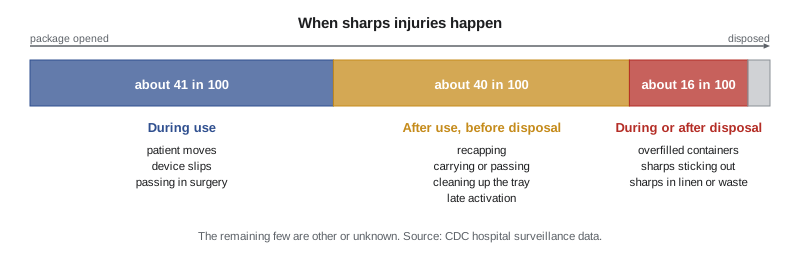
The pattern points to where effort pays off. Injuries during use are reduced by safety devices, help with restless patients and good technique. Injuries after use are reduced by activating the safety feature immediately and by disposing of the sharp at the point of use. Injuries during and after disposal are reduced by proper containers, changed on time, and by a firm rule that sharps never leave the worker's hands except into a container.
Getting help with restless patients
Many injuries during use happen because the patient moves: a confused older patient pulls away, a child jerks an arm, a person in pain or withdrawal flinches. The answer is not to work faster. Before starting, explain what you are about to do, even to a patient who may not understand, and watch how they respond. If a patient is likely to move, ask a colleague to help steady the limb, using a comfortable hold rather than force. Choose the site and the moment carefully: a patient with dementia may be calmer after a meal, or with a family member present. And be ready to stop. A procedure that is abandoned and tried again later is far better than a needlestick to the worker or an injury to the patient. On 4 West, any blood draw on a patient flagged as restless or confused is done by two people, and Daniel's early-morning list marks those patients so he can plan help before he arrives.
Never recap
Recapping a used needle with two hands was once routine, and it caused a large share of all needlestick injuries. The hand holding the cap is in the path of the needle, and a small misjudgement drives the needle into the thumb or palm. The rule now is simple: do not recap used needles.
Ontario's Regulation 67/93 procedures and Public Health Ontario guidance both say used needles are not recapped. In the rare cases where recapping cannot be avoided, such as some dental procedures or when a needle must be removed from a reusable syringe, a one-handed scoop technique or a recapping device is used: the cap is placed on a flat surface, the worker scoops it onto the needle with one hand, and only then secures it.
Activate the safety feature right away
A safety feature protects only from the moment it is activated. If a nurse gives an injection, puts the syringe down on the tray to comfort the patient and plans to slide the shield over it later, the needle is unprotected on the tray for the next person who reaches past it. The rule at Northbridge is that the feature is activated immediately, in the same motion as withdrawal where the device allows, and always before the worker turns away from the patient. If the feature fails, the device goes into the sharps container as it is.
Dispose at the point of use
The single most important habit after use is to take the sharps container to the patient rather than the sharp to the container. A worker who carries a used needle down a corridor to a container in the utility room has dozens of chances to bump into someone, trip, or be distracted. Containers should be within arm's reach wherever sharps are used: wall-mounted in every patient room, on medication carts and procedure trays, in phlebotomy trays like Daniel's, and in a small portable container for home care. Lesson 6 covers the containers themselves.
Other point-of-use habits:
- Bring the container to the bedside before starting, and place it on the side of your dominant hand.
- Drop the sharp in, point first, without forcing it. Never put your hand or fingers into the opening.
- Look at the container before you use it, to check it is not too full.
- Never leave a sharp on a bed, a tray, a meal table or a windowsill, even for a moment.
- Dispose of the whole device, including the attached tubing or holder, where the design calls for it, rather than taking it apart.
Passing and carrying
Sharps should rarely be passed from one person's hand to another's, because two people's hands near one sharp doubles the chance of an injury. When an instrument must be passed, as in surgery, the hands-free technique is used.
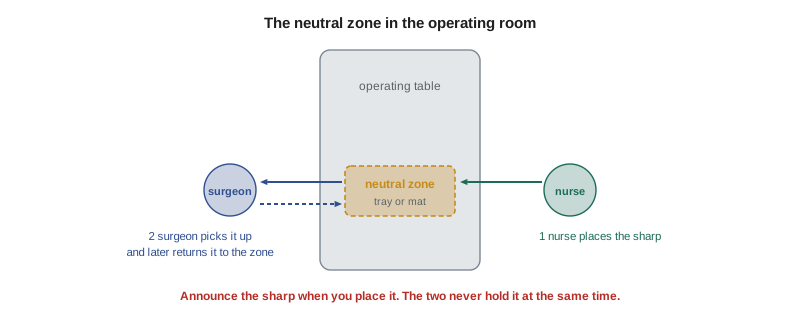
In the hands-free technique, a tray, basin or magnetic mat is agreed as the neutral zone. The scrub nurse places the sharp there, says so out loud, and the surgeon picks it up; the surgeon puts it back in the zone when done. At no time do two people hold the same sharp. Studies in operating rooms have found that using a neutral zone consistently reduces sharps injuries to surgical staff, and professional bodies for perioperative nurses recommend it.
Outside the operating room, sharps are carried only when there is no choice, in a container or a kidney dish, point down or away from the body, and never in a pocket. Lab specimens collected with sharps are transported in sealed, leakproof bags or containers, with the requisition in a separate pouch so nobody reaches into the bag.
Cleaning up after a procedure
The moments after a procedure are some of the most dangerous, because the worker's attention shifts to the patient, the paperwork or the next task. Many injuries happen while clearing a procedure tray, when a scalpel blade or suture needle is hidden under a gauze pad or drape. The person who used the sharp is responsible for disposing of it. Before leaving a bedside or a procedure area, they count the sharps used and check that each one has gone into the container. Clearing a tray is done by looking, not by sweeping a hand through gauze and drapes.
Sharps in places they should not be
Some of the hardest injuries to prevent happen to people who never handled the sharp in the first place: environmental services workers emptying waste, laundry staff sorting linen, porters stripping beds, and family members. In HSE-390, the Northbridge laundry found sharps in linen at a rate of more than 2 per 10,000 kg from the emergency department. Each one is a failure of disposal at the point of use. Northbridge asks every clinical worker to make the same check before leaving a room: no sharps on the bed, the tray, the floor or in the linen.
For supervisors: watching the last step
Supervisors rarely see sharps injuries happen, but they can see the conditions that cause them. On rounds, look at trays, carts and bedside tables for loose sharps. Look inside sharps containers for overfilling. Ask staff where the container is before they start a procedure. Watch for when a container has been moved to the hall because the room is crowded, and fix the room rather than accept the hall. And when a sharp turns up in linen, waste or a bed, treat it as a near miss, find out where it came from, and talk with the team that used it. The goal is not to blame, but to make sure every sharp ends its life in a container within reach of where it was used.
Joanne's review of last year's sharps injuries looks at the phase in which each happened and the device involved, which is the information the sharps injury log is designed to capture.
# Sharps injuries at Northbridge last year: (phase, device, safety feature activated?)
injuries = [
    ("during use", "blood collection set", None), ("during use", "IV catheter", None),
    ("during use", "suture needle", None), ("during use", "insulin syringe", None),
    ("during use", "scalpel", None), ("during use", "pen needle", None),
    ("during use", "blood collection set", None),
    ("after use", "insulin syringe", False), ("after use", "hypodermic needle", False),
    ("after use", "suture needle", None), ("after use", "pen needle", False),
    ("after use", "blood collection set", False), ("after use", "scalpel", None),
    ("disposal", "hypodermic needle", True), ("disposal", "lancet", True),
    ("disposal", "insulin syringe", True), ("in linen or waste", "hypodermic needle", False),
    ("in linen or waste", "suture needle", None), ("in linen or waste", "IV catheter", False),
    ("other", "broken glass", None), ("other", "lancet", True),
]

phases = {}
for phase, device, act in injuries:
    phases[phase] = phases.get(phase, 0) + 1
n = len(injuries)
for phase, k in sorted(phases.items(), key=lambda kv: -kv[1]):
    print(f"{phase:18}{k:3}  ({k / n:.0%})")

with_feature = [i for i in injuries if i[2] is not None]
not_used = [i for i in with_feature if i[2] is False]
print(f"\ndevices with a safety feature: {len(with_feature)}")
print(f" feature not activated at the time: {len(not_used)}")during use 7 (33%) after use 6 (29%) disposal 3 (14%) in linen or waste 3 (14%) other 2 (10%) devices with a safety feature: 10 feature not activated at the time: 6
Seven of the 21 injuries happened during use and six after use, close to the national pattern. Of the 12 injuries from devices that had a safety feature, 7 happened before the feature was activated. Joanne's conclusion for the committee was that the hospital did not need different devices so much as better habits: activate immediately, dispose at the bedside, and check the room before leaving. She also flagged the three injuries from sharps in linen or waste, which hurt people who had never touched the device.
Worked problem
The scalpel under the drape
In the emergency department, a physician closes a laceration and leaves the room to see the next patient. A nurse begins to clear the procedure tray and gathers the drape and gauze in one handful. A scalpel blade hidden in the gauze cuts her palm through her glove. What should have happened, and what follows?
Show solution
- The person who used the sharps, here the physician, is responsible for disposing of them before leaving the bedside. A count of sharps on the tray would have caught the blade.
- The nurse follows the first aid steps from Lesson 9: she removes her glove, washes the cut with soap and water, and reports at once. The source patient is still in the department, which makes testing easier.
- The department agrees on a rule: a safety scalpel is used for laceration repairs, the user disposes of all sharps before leaving, and trays are cleared by looking and lifting items one at a time, never by grabbing.
- The injury goes into the sharps injury log with the device type and brand, and the department's sharps practice is added to the next committee inspection.
Answer: The user should have disposed of the blade before leaving; the nurse gets first aid and assessment, and the department changes its devices and its clean-up rules.
Common mistakes
MistakeRecapping a used needle with two hands.
InsteadDo not recap; if it cannot be avoided, use a one-handed scoop or a recapping device.
MistakePutting a syringe on the tray to activate the safety feature later.
InsteadActivate the feature immediately, before turning away from the patient.
MistakeCarrying a used sharp down the hall to a container.
InsteadBring the container to the point of use.
MistakeHanding a scalpel directly to the surgeon.
InsteadUse a neutral zone so that two people never hold the same sharp.
MistakeLeaving the room without checking for sharps.
InsteadCount your sharps and check the bed, tray, floor and linen before you leave.
Summary and key terms
- About 4 in 10 sharps injuries happen during use, about 4 in 10 after use but before disposal, and most of the rest during or after disposal.
- Never recap used needles; where it cannot be avoided, use a one-handed technique or a device.
- Activate the safety feature immediately, before turning away from the patient.
- Dispose of sharps at the point of use, in a container within arm's reach.
- Use a neutral zone to pass sharps in surgery, and carry sharps only in a container.
- The person who used a sharp is responsible for disposing of it; check the room before leaving.
- Sharps left in linen, beds and waste injure people who never handled them.
- Point of use
- The place where a sharp is used, where the sharps container should be within reach.
- One-handed scoop technique
- A way of recapping, when unavoidable, by scooping the cap from a flat surface with the needle using one hand.
- Neutral zone
- An agreed tray, basin or mat where sharps are placed and picked up, so that they are never passed hand to hand.
- Hands-free technique
- The practice of passing sharps through a neutral zone instead of directly between people.
- Sharps count
- A check that every sharp used in a procedure has been accounted for and disposed of.
Practice problems
Work each problem on paper first, then reveal the answer to check.
In which two phases do most sharps injuries happen?
Show answer
During use, and after use but before disposal, each about 4 in 10.
Why is two-handed recapping dangerous?
Show answer
The hand holding the cap is in the path of the needle, and a small misjudgement drives the needle into it.
When should a safety feature be activated?
Show answer
Immediately, in the same motion as withdrawal where possible, and before turning away from the patient.
What is the neutral zone, and why is it used?
Show answer
An agreed tray or mat where sharps are placed and picked up, so two people never hold the same sharp.
Who is responsible for disposing of a sharp after a procedure?
Show answer
The person who used it.
What did Joanne conclude from the injury review?
Show answer
That the main need was better habits, such as immediate activation and point-of-use disposal, rather than different devices.
Lesson quiz · 5 questions
Score 60% or more to complete this lesson.
Create a free account to save your progress, take quizzes and earn a certificate.