
HSE-374 · Lesson 6 of 12 · 21 min
Column anchorage, anchor rods and base plates
A steel column standing alone on its foundation, before any beams are attached, is held up by four things: its base plate, the anchor rods cast into the concrete, the nuts on those rods, and whatever is under the base plate carrying its weight. If any of those is wrong, the column can lean, twist or fall. A falling column can kill the connector at the top and anyone it lands on, and it can pull the beams already attached to it down with it. That is why the first steel work at the Prairie Gate Community Centre was not lifting at all. It was Bill Okafor and Rosa Delgado walking every column footing with a tape, a level and the anchor rod layout drawing.
This lesson covers how columns are anchored: anchor rods, base plates, leveling methods, grouting, checking the rods before the column arrives, repairs, and deciding whether a standing column needs guying or bracing.
Why four anchor rods
Older buildings sometimes had columns anchored with only two rods. A two-rod column can rotate about the line between the rods with very little resistance; a connector's weight at the top, a bump from a beam or a gust of wind can tip it. Four rods arranged in a rectangle give the column resistance to tipping in every direction.
CSA S16 and the engineer of record's design set the number, size and arrangement of anchor rods for each column. Tallgrass, like most Canadian erectors, requires at least four anchor rods on every column that will stand on its own during erection, with the base plate, the column-to-base-plate weld and the foundation designed to resist an eccentric load at the top of the column during erection. Tallgrass uses the same minimum as OSHA: an eccentric gravity load of 136 kg (300 lb) applied 460 mm (18 in) from the extreme outer face of the column in each direction, which roughly represents a connector and tools hanging off one side.
# Tipping check for a lone column under the erection eccentric load (illustrative).
# The 300 lb load 18 in from the column face makes a moment about the far rods.
column_depth_in = 12.0          # W12 column
ecc_in = column_depth_in / 2 + 18.0   # from column centreline to the load
load_lb = 300.0
moment_lb_in = load_lb * ecc_in
rod_spacing_in = 8.0            # distance between the two rows of anchor rods
uplift_per_row = moment_lb_in / rod_spacing_in
print(f"moment at the base: {moment_lb_in:,.0f} lb-in ({moment_lb_in / 12:,.0f} lb-ft)")
print(f"tension on the near row of rods: {uplift_per_row:,.0f} lb ({uplift_per_row / 2:,.0f} lb per rod)")moment at the base: 7,200 lb-in (600 lb-ft) tension on the near row of rods: 900 lb (450 lb per rod)
The forces are not large for a properly anchored column. The point is that two rods on a line cannot resist them at all in one direction, while four rods resist them easily in every direction, provided the rods are where they should be, are cast to the right depth and have nuts tightened on them.
Getting the rods in the right place
Anchor rods are cast into the concrete by the foundation contractor, usually using a plywood or steel template with holes drilled to match the base plate. The template holds the rods at the right spacing, projection and plumb while the concrete is placed. Rods that move during the pour end up out of position, bent, too short or too long.
Before any column arrives, the prime contractor surveys the rods. At the Prairie Gate Community Centre, the surveyor checked every group of rods for position against the grid lines, spacing within the group, projection above the concrete, plumbness and thread condition. Rods with damaged threads were cleaned and chased with a die. Rods with too little projection, which would not allow a full nut and washer, or rods out of tolerance, were reported to Helen Kowal, the engineer of record.
| Check | Why it matters |
|---|---|
| Position against grid lines | A column set off its grid line throws the whole frame out and may force beams to be modified |
| Spacing within the group | Rods that do not match the base plate holes cannot be used without enlarging holes or replacing rods |
| Projection above the concrete | Too little projection means no full nut; too much can stop the base plate seating or the grout filling |
| Plumbness | Bent rods may be cracked at the bend or may not fit the base plate |
| Thread condition | Damaged or concrete-covered threads stop nuts from running up to full tightness |
Repairs and modifications
If an anchor rod is in the wrong place, too short, bent or broken, nobody on site may cut, bend, drill, weld or replace it without the engineer of record's written approval. Field fixes such as heating and bending rods, welding extensions, or drilling and epoxying new rods change how the rod carries load and may make it brittle or weak. At the Prairie Gate Community Centre, the two misplaced rods at grid line C4 were dealt with by a base plate with slotted holes and heavy plate washers, designed by Helen Kowal. Tallgrass listed the repair in its written notice to Northern Iron Erectors Ltd. before the column was delivered, so that Bill's crew knew to expect the modified plate.
Leveling the column
The base plate must sit at the right elevation and be level so that the column is plumb and the beams arrive at the right height. There are three common ways to support a base plate before grouting.
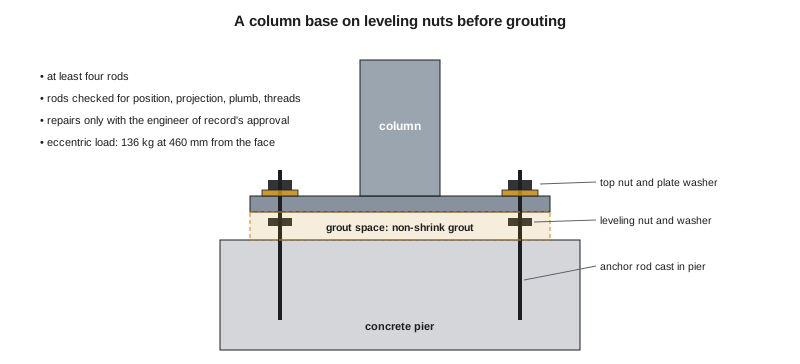
- Leveling nuts. A nut and washer on each rod below the base plate are set to the right elevation, the column is set on them, and the top nuts are tightened. Leveling nuts are quick and adjustable, but the rods then carry the whole column load in compression and bending until the grout is placed, so the erection plan limits how much load the column may carry on leveling nuts alone.
- Shim packs. Steel shims under the base plate carry the load directly to the concrete. They must be large enough and placed so that the column does not rock.
- Leveling plates. A thin steel plate is set and grouted level on the foundation before the column arrives, and the column base plate bears on it.
The columns at the Prairie Gate Community Centre were set on leveling nuts, with the top nuts tightened and the base plates grouted within the time and number of floors set by Sanjay Mehta's erection procedure. Whatever method is used, it must be able to carry the construction loads until the grout is placed and has reached strength.
Washers and oversized holes
Base plate holes are often made larger than the rods to allow for small placement errors. A standard washer may then be too small to bear on the plate around the hole, so heavy plate washers, often welded to the base plate after the column is plumbed, are used. The erection drawings show the washer size. Without the right washer, a nut can pull into an oversized hole under load and the anchorage loses its grip.
Grouting
Non-shrink grout fills the space between the base plate and the concrete, so that the column load is carried evenly into the foundation rather than through the leveling nuts or shims alone. Grout is placed after the column, or the group of columns, has been plumbed and the first level of beams has been connected and adjusted. In cold weather, as at the start of the Prairie Gate Community Centre, grout must be protected from freezing until it gains strength, following the grout manufacturer's instructions. The erection plan said how many levels could be erected before grouting, and Rosa Delgado scheduled the grouting crew accordingly.
Does a standing column need guying or bracing?
Even with four rods, a tall column standing alone can be pushed over by wind or by an impact before beams tie it to its neighbours. The erection plan must say, for each column, whether it can stand alone, how long and in what wind, or whether it needs temporary guy cables or bracing. At the Prairie Gate Community Centre, a competent person, Bill Okafor, assessed each column against Sanjay Mehta's erection procedure, and the 12 m (40 ft) columns at the gymnasium were guyed in two directions until the roof girders were connected.
# Rough wind check for a lone gymnasium column (illustrative values, SI units).
import math
height_m = 12.0
width_m = 0.31           # flange width of a W310 column
drag = 2.0               # shape factor for an I-shape, illustrative
rho = 1.2                # air density, kg/m^3
for wind_kmh in (30, 50, 70):
    v = wind_kmh / 3.6
    q = 0.5 * rho * v ** 2               # dynamic pressure, Pa
    force = q * drag * width_m * height_m
    moment = force * height_m / 2
print(f"{wind_kmh:3d} km/h: force {force:5.0f} N, base moment {moment / 1000:5.1f} kN·m")30 km/h: force 310 N, base moment 1.9 kN·m 50 km/h: force 861 N, base moment 5.2 kN·m 70 km/h: force 1688 N, base moment 10.1 kN·m
The moments rise with the square of the wind speed. A column that is fine in a light breeze can put several times as much load on its anchor rods in a strong gust. Sanjay compared these moments with the capacity of the anchorage on leveling nuts and set a wind speed above which lone columns had to be guyed or not left standing overnight.
Before the column is released
The connectors may not let go of a column, and the crane may not release it, until the column is on its rods, the top nuts are on and drawn up, and any guying the plan requires is attached. At the Prairie Gate Community Centre, Bill also checked that the column was roughly plumb and that its piece mark matched the location on the drawing, because a column set in the wrong place or turned the wrong way may not take its beams.
Worked problem
The short rods at the gymnasium
Show solution
- The survey of the gymnasium column footings found that the rods at two columns projected only 40 mm (1.6 in) above the concrete instead of the 90 mm (3.5 in) on the drawing. The template had slipped during the pour.
- With leveling nuts, a plate washer and a top nut, 40 mm would not allow the top nut to be fully engaged.
- The concrete contractor offered to weld threaded extensions onto the rods. Rosa Delgado refused: no work on anchor rods without the engineer's approval.
- Helen Kowal reviewed the rod material and designed a fix using a thinner leveling method, shim packs instead of leveling nuts, and a recessed base plate detail, with a calculation showing the anchorage still met the design and erection loads.
- Tallgrass sent Northern Iron Erectors Ltd. a written notice of the change before the columns were delivered, and Bill updated the erection plan.
Answer: Anchor rod problems are solved by the engineer of record on paper before the column arrives, never by welding or bending rods in the field.
Records for every column
For each column at the Prairie Gate Community Centre, the file held the survey of its anchor rods, the engineer's approval of any repair, the date the column was set, the competent person's decision on guying, and the date it was grouted. If a question came up later, such as a crack in the grout or a column out of plumb, the records showed exactly what had been done and by whom.
Common mistakes
MistakeSetting a column on two anchor rods because that is all the old detail showed.
InsteadColumns that stand alone during erection need at least four anchor rods.
MistakeHeating and bending a misplaced anchor rod to fit the base plate.
InsteadReport the problem; repairs need the engineer of record's approval and written notice to the erector.
MistakeLeaving columns on leveling nuts for many floors without grouting.
InsteadGrout within the limits in the erection procedure so the leveling method is not overloaded.
MistakeUsing standard washers on oversized base plate holes.
InsteadUse the plate washers shown on the drawings.
MistakeAssuming a four-rod column can always stand alone.
InsteadA competent person assesses each column and installs guying or bracing where needed, especially for tall columns and in wind.
Summary and key terms
- Tallgrass requires at least four anchor rods on columns that stand alone during erection, designed with the base for a 136 kg (300 lb) eccentric load 460 mm (18 in) from the column face.
- Rods are surveyed for position, spacing, projection, plumbness and threads before any column is set.
- Anchor rods are never repaired or modified without the engineer of record's approval, and repairs are reported to the erector in writing.
- Columns are set on level floors, leveling plates, leveling nuts or shim packs adequate for construction loads, and grouted within the limits in the erection procedure.
- A competent person decides whether each column needs guying or bracing, considering its height and the wind.
- Anchor rod
- A steel rod cast into a concrete foundation to hold a column base plate; also called an anchor bolt.
- Base plate
- A steel plate welded to the bottom of a column that bears on the foundation and receives the anchor rods.
- Leveling nut
- A nut set on an anchor rod below the base plate to support the column at the right elevation before grouting.
- Shim pack
- A stack of steel shims placed under a base plate to set its elevation and carry load before grouting.
- Non-shrink grout
- A cement-based or epoxy material that fills the space under a base plate without shrinking as it hardens.
- Guying
- Temporary cables attached to a structure and anchored to the ground or another structure to keep it stable.
Practice problems
Work each problem on paper first, then reveal the answer to check.
Why are four anchor rods safer than two for a lone column?
Show answer
Two rods in a line give almost no resistance to tipping about that line; four rods in a rectangle resist tipping in every direction.
What eccentric load must a column anchorage resist during erection under the OSHA rule that Tallgrass uses?
Show answer
136 kg (300 lb) applied 460 mm (18 in) from the extreme outer face of the column in each direction at the top of the shaft.
Name four checks made on anchor rods before columns are set.
Show answer
Any four of position against grid lines, spacing within the group, projection, plumbness and thread condition.
Who must approve any repair or modification to an anchor rod?
Show answer
The engineer of record, with written notice to the erector before the column is erected.
Why does the wind matter so much for a lone column?
Show answer
Wind force grows with the square of the wind speed, so the base moment on the anchorage rises quickly in gusts.
Lesson quiz · 5 questions
Score 60% or more to complete this lesson.
Create a free account to save your progress, take quizzes and earn a certificate.