
HSE-374 · Lesson 4 of 12 · 21 min
Hoisting and rigging structural members
By the end of the first week at the Prairie Gate Community Centre, Ray Lindqvist had made more than 200 picks: columns, beams, braces and bundles of bolts. Each pick started on the ground, where the rigger, Marcus Lee, read the piece mark, checked the weight on the erection drawing, chose the rigging and hooked on. It ended at the top of the frame, where Jess Moreau and Tomas Vega guided the piece into place and made the first connections. Between those two moments the member was in the air, swinging over a site full of people, held by a hook, a shackle, a sling and the skill of the operator and signal person. Every one of those links had to hold every time.
This lesson covers hoisting structural members: crane inspection, knowing the weight, choosing and inspecting rigging, safety latches, multiple lift rigging, tag lines, signals and keeping people out from under loads.
Before the first pick of each shift
Under Part 23 (Cranes and Hoists) of the regulation, the crane must be inspected by a competent person before each shift and the operator must be qualified and, where the regulation requires, certified for the type of crane. Ray walked around the crane each morning: outriggers fully extended and on their mats, the crane level, the wire rope, sheaves and hook block undamaged, the hook latch working, the load moment indicator and anti-two-block device tested, and the load chart in the cab for the configuration in use. The rigger did the same for the rigging in the gang box.
Know the weight
Every member on the Prairie Gate Community Centre had its weight on the fabricator's erection drawings and shipping lists. Marcus added the weight of the rigging, any spreader bar, and anything attached to the member, such as a safety cable stanchion or a bolt bag, to get the total load on the hook. Ray compared that load with the crane's rated capacity at the radius of the pick, including the weight of the hook block and load line. For any pick over 75 percent of the chart capacity, or any pick involving two cranes, the erection plan called for a written critical lift plan, as on Cottonwood Place.
Guessing weights is dangerous because the most common errors run in the same direction. People forget the rigging, forget the hook block, misread a piece mark, or assume a member is lighter than it looks. A wide-flange beam weighs its nominal weight per length times its length; a W410×60 (W16×40) beam 9 m (30 ft) long weighs about 540 kg (1,200 lb) before any connection plates.
Rigging for steel
Structural members are usually rigged in one of four ways.
- Choker hitch. A wire rope or synthetic sling wrapped around the member and back through its own eye. Simple and quick, but the choke reduces the sling's capacity, and a choker on a smooth member can slip if the load is not balanced.
- Basket hitch with a spreader bar. For long members, a spreader bar keeps the sling legs vertical and stops the member from bending or rolling.
- Beam clamps and lifting lugs. Clamps designed for the flange width and load, or lugs welded on by the fabricator at the centre of gravity.
- Bridle with two or more legs. For columns, panels and assemblies, each leg attached at a designed lifting point.
Each piece of rigging has a rated load, also called its working load limit, marked on its tag or body. Slings without a readable tag are removed from service. Before each use, the rigger checks for broken wires, kinks, crushing, birdcaging, heat damage, cuts and abrasion in wire rope; for cuts, burns, chemical damage and exposed core yarns in synthetic slings; and for wear, stretch and cracks in shackles and hooks. Sharp steel edges cut synthetic slings in seconds, so softeners or edge protectors go on every corner a synthetic sling bends around.
Sling angles
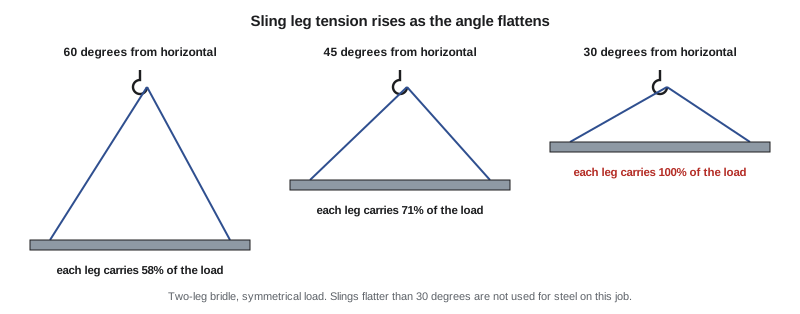
When a sling leg is at an angle to the vertical, the tension in the leg is higher than its share of the load. The smaller the angle between the sling leg and the horizontal, the higher the tension. At 60 degrees from horizontal, each leg of a two-leg bridle carries about 58 percent of the load; at 45 degrees, about 71 percent; at 30 degrees, the full load in each leg. Slings flatter than 30 degrees from horizontal are not used for steel at the Prairie Gate Community Centre.
# Tension in each leg of a symmetrical two-leg bridle.
import math
load = 1200.0   # total load on the hook, kilograms (or any unit)
for angle in (90, 60, 45, 30):          # leg angle measured from horizontal
    tension = load / (2 * math.sin(math.radians(angle)))
print(f"leg angle {angle:2d} deg: each leg carries {tension:6.0f} ({tension / load:.0%} of the load)")leg angle 90 deg: each leg carries 600 (50% of the load) leg angle 60 deg: each leg carries 693 (58% of the load) leg angle 45 deg: each leg carries 849 (71% of the load) leg angle 30 deg: each leg carries 1200 (100% of the load)
Safety latches
Hooks used to hoist steel at the Prairie Gate Community Centre have self-closing safety latches, so that a sling eye cannot jump off the hook if the load is jolted or the sling goes slack. Tallgrass does not allow latches to be tied open or removed. In a few special cases, such as setting light purlins or single joists where releasing the hook from the ground is safer than sending someone up, a latch may be deactivated under a procedure in the erection plan.
Multiple lift rigging
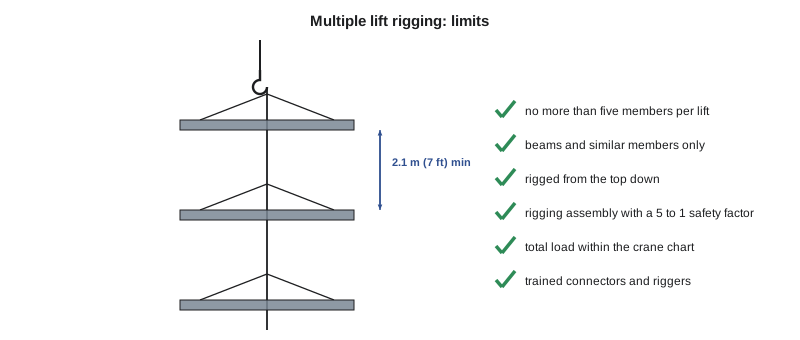
Ironworkers sometimes hoist several beams in one pick, each hanging below the one above on its own rigging, so that the connectors can set them one by one at the top without waiting for the crane to come back down. The arrangement is called multiple lift rigging, or Christmas-treeing. It saves crane time, but if it is done badly, a single failure drops several members onto the people below.
Manitoba's regulation does not describe multiple lift rigging in detail. On its Manitoba jobs, Tallgrass applies the crane and rigging manufacturers' instructions and the same limits found in OSHA's steel erection standard: no more than five members per lift, members rigged at least 2.1 m (7 ft) apart, a rigging assembly designed by a qualified rigger with a 5 to 1 safety factor on all components, only beams and similar members (never columns, bundles or deck), a total load within the crane's chart capacity, and connectors and riggers trained in the procedure.
The connectors must also be able to land and connect each member in turn without being under the members still hanging below. At the Prairie Gate Community Centre, Bill used multiple lift rigging only for the second-floor filler beams in the classroom wing, never more than three members at a time, and only after the crew had walked through the procedure on the ground.
# Multiple lift check: total load on the hook against the crane chart (invented values).
members_kg = [540, 520, 560]          # three filler beams, from the shipping list
rigging_kg = 85                       # multiple lift assembly, shackles and slings
hook_block_kg = 340
chart_capacity_kg = 3800              # at the planned radius, from the load chart
total = sum(members_kg) + rigging_kg + hook_block_kg
print("members:", len(members_kg), "(limit 5)")
print(f"total load on the hook: {total} kg")
print(f"percent of chart: {total / chart_capacity_kg:.0%}")
print("critical lift plan needed" if total > 0.75 * chart_capacity_kg else "standard lift")members: 3 (limit 5) total load on the hook: 2045 kg percent of chart: 54% standard lift
Tag lines and landing loads
Tag lines let a worker on the ground or at the landing point control a load's rotation without touching it or standing under it. At the Prairie Gate Community Centre, every member longer than 3 m (10 ft) had at least one tag line. Tag lines are kept free of knots and loops that could catch a hand or foot, are never wrapped around a hand or body, and are released if the load moves suddenly. Near the north-street power line, tag lines were non-conductive.
The connectors land each member gently, guide it to the connection and get the first bolts in. They do not reach for a load that is still swinging, put their hands between a moving member and the steel it is landing on, or stand where a load can pin them against a column. When a load needs to be adjusted, the signal person tells the operator; nobody pushes or pulls on a load to correct the crane's position.
Signals and communication
Each lift has one designated signal person at a time, and the operator takes signals only from that person, except for an emergency stop, which anyone may give. At the Prairie Gate Community Centre, the connectors at the top used radios on a dedicated channel because Ray often could not see them behind the steel. Standard hand signals were posted in the crane cab and taught to every member of the raising gang. When radio contact was lost, Ray stopped all crane movement until it was restored.
Nobody under the load
The most important rule in hoisting is simple: nobody works or walks under a suspended load. The only people allowed in the path of a load are the connectors receiving it at the top and the rigger hooking it on or off at the bottom, and only while they are doing that job. Load routes are planned so that loads do not pass over other workers, the site trailers or the public, and areas below the work are barricaded. Workers do not ride on loads, hooks or rigging.
Worked problem
The missing tag
Show solution
- On the third morning, Marcus pulled a synthetic round sling from the gang box to rig a bundle of brace angles.
- The tag was missing. It had been cut off, probably by a sharp edge during an earlier lift, and the sling had a small cut in its cover.
- Without a tag, nobody could confirm the sling's rated load, and the cut suggested the core might be damaged.
- Marcus removed the sling from service, cut it so it could not be reused by mistake, and recorded it in the rigging inspection log.
- Bill ordered edge protectors for every synthetic sling in the gang box and added a check of edge protection to the pre-lift routine.
Answer: A sling without a readable tag, or with any visible damage, is removed from service. Damage usually points to a missing control, such as edge protection.
Lifting near people and structures
Some lifts cannot avoid passing near the partly built frame, other trades or the public. For those lifts, the erection plan at the Prairie Gate Community Centre called for a lift-specific route agreed before the lift, with the areas under the route cleared and barricaded, a second signal person where the operator's view was blocked, and the load kept as low as possible. Loads were never swung over the site trailers, the parking area or the street, and the crane was not used to drag, push or pull members sideways, which can overload the boom.
Common mistakes
MistakeEstimating a member's weight by eye.
InsteadUse the weight on the erection drawing or shipping list, and add the rigging, hook block and anything attached.
MistakeUsing a sling with a missing tag because it looks fine.
InsteadRemove untagged or damaged slings from service and destroy them.
MistakeHoisting a deck bundle or a column with multiple lift rigging.
InsteadMultiple lift rigging is for beams and similar members only, no more than five per lift, at least 2.1 m (7 ft) apart.
MistakeTying a hook's safety latch open to make unhooking quicker.
InsteadKeep self-closing latches working, except in the limited cases the erection plan allows.
MistakeWalking under a load because it is only for a second.
InsteadOnly the connectors and the rigger may be in the path of a load, and only while doing their job.
Summary and key terms
- The crane is inspected by a competent person before each shift and checked for level after each set-up.
- Every load is weighed from the drawings, including rigging and the hook block, and compared with the chart at the pick radius; picks over 75 percent need a critical lift plan.
- Rigging is chosen for the member, inspected before each use, protected from sharp edges and used within its rated load, allowing for sling angles.
- Tallgrass limits multiple lift rigging to five beams at least 2.1 m apart on a 5 to 1 assembly, the same limits as OSHA, because Manitoba's regulation does not set them out.
- Tag lines control loads, one signal person directs each lift, and nobody but the connectors and the rigger is ever under a suspended load.
- Rated load
- The maximum load a piece of rigging or a crane is designed to lift in a stated configuration, also called the working load limit.
- Choker hitch
- A sling hitch made by wrapping the sling around the load and passing it through its own eye.
- Spreader bar
- A rigid beam that holds sling legs apart and vertical so that a long load is lifted level without bending.
- Multiple lift rigging
- A rigging assembly that hoists up to five members in one lift, each hanging below the one above; also called Christmas-treeing.
- Tag line
- A rope attached to a load so that a worker can control its rotation from a safe distance.
- Safety latch
- A spring-loaded gate across the opening of a hook that stops a sling from slipping off.
Practice problems
Work each problem on paper first, then reveal the answer to check.
What must be added to a member's weight to get the load on the hook?
Show answer
The weight of the rigging, spreader bar or attachments, and the hook block and load line as the load chart requires.
What happens to sling leg tension as the angle from horizontal gets smaller?
Show answer
It increases; at 30 degrees each leg of a two-leg bridle carries the full load.
State the limits on multiple lift rigging.
Show answer
No more than five members, at least 2.1 m (7 ft) apart, beams and similar members only, a 5 to 1 rigging assembly, a load within the crane chart and trained workers.
Who may be in the path of a suspended load?
Show answer
Only the connectors receiving it and the rigger hooking it on or off, while doing that job.
What should the operator do if radio contact with the connectors is lost?
Show answer
Stop all crane movement until contact is restored.
Lesson quiz · 5 questions
Score 60% or more to complete this lesson.
Create a free account to save your progress, take quizzes and earn a certificate.