
HSE-374 · Lesson 5 of 12 · 21 min
Connecting: the connector's job
Jess Moreau had been connecting for eleven years. Her partner, Tomas Vega, had been doing it for six. Between them they set every column, beam and brace in the classroom wing of the Prairie Gate Community Centre. Their day started at the top of the frame, clipped to a beam or a column, waiting for Ray to swing the next piece toward them. Each piece came in slowly on its tag line. One of them would take the near end and the other the far end, line up the holes with a drift pin, get two bolts in, run the nuts up tight with a spud wrench, and only then call for the crane to let go. Then the next piece. On a good day, a pair of connectors sets forty or fifty pieces.
Connecting is the most exposed job in steel erection. This lesson is about how it is done safely: training, access to the connection, tools and their control, what a connection needs before the crane releases a member, double connections, column and brace connections, and the teamwork between connectors, signal person and operator. Fall protection for connectors is covered in detail in lesson 9, but it runs through everything here.
Who may connect
Connecting is skilled work. At the Prairie Gate Community Centre, the erection plan named the workers allowed to connect, all of them certified journeyperson ironworkers or apprentices working beside one. Every connector had been trained by a competent person in the hazards of connecting, the erection sequence for this building, the connection requirements in the plan, and the fall protection and rescue arrangements. Nora Whitehorse, the first-year apprentice ironworker, did not connect for the first months; she handled tag lines, sorted bolts, helped the rigger and learned by watching.
Connectors must also be fit for the work that day. Connecting at height demands balance, attention and strength. A connector who is tired, ill, affected by medication, alcohol or cannabis, or distracted by something at home should say so and work on the ground. Bill Okafor made a habit of asking each connector at the morning briefing how they were doing, and meant it.
Getting to the connection
Connectors need a safe way to reach each connection point. The safest access is the one that keeps them off the steel as much as possible.
- Aerial lifts. Where the ground is firm and level and the work is within reach, boom lifts let connectors work from a platform with a guardrail. At the Prairie Gate Community Centre, much of the first floor of the classroom wing was connected from lifts.
- Ladders. Ladders tied to columns, extending above the landing point, give access to the top of columns before the beams arrive.
- Column-attached climbing systems and work platforms. Some erectors attach ladders, platforms or vertical lifelines to columns on the ground before the columns are set, so that the first connections can be made with the connector already protected.
- Walking the steel. Where connectors must move along beams, they need a horizontal lifeline or beam anchors installed so that they are protected while they move.
Connectors do not climb on connection material, braces, bolts sticking out of a connection or the hoisting line. They do not ride the load or the hook to the top of the frame. And they do not work above other workers who are not protected from falling objects.
Tools and keeping them on the steel
A connector's tools are simple: a spud wrench (an open-end wrench with a tapered handle for lining up holes), drift pins, a sledge or beater, a bolt bag and sometimes a podger bar or come-along. Every one of those tools can kill someone below if it is dropped. At the Prairie Gate Community Centre, every hand tool used at height was tethered to the worker or the structure, bolt bags had closures, and loose bolts, nuts and washers were never left lying on beams or decking. Areas below the connecting were barricaded, and workers below wore hard hats with chin straps as an extra layer, not as the main control. Lesson 12 covers falling object protection in detail.
What a connection needs before the crane lets go
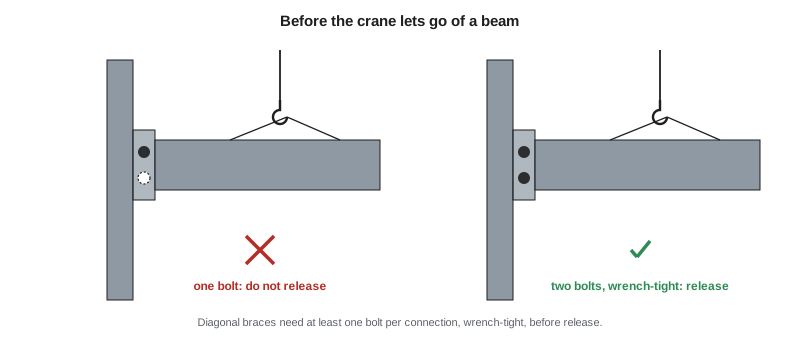
The moment of greatest risk for a connector, after the fall hazard itself, is when the crane releases a member. If the member has not been connected well enough to carry its own weight, plus the connector's weight and any load the connector puts on it, it can drop, swing or roll. CSA S16 and the erection drawings set out what each permanent connection needs. The erection plan for the Prairie Gate Community Centre set the minimum for release: every solid web member, such as a beam or girder, secured with at least two bolts per connection, of the size and strength shown on the drawings, drawn up wrench-tight, or the equivalent the engineer specifies, before the hoisting line is released. Diagonal braces needed at least one bolt per connection drawn up wrench-tight. These are the same minimums OSHA sets in the United States, and Tallgrass applies them on all its jobs.
Wrench-tight means the nut has been run up with a spud wrench until the plies are drawn together. It is not the final tightening, which is done later by the bolting-up crew to the level the engineer specifies, often snug-tight or pretensioned. Two wrench-tight bolts are a minimum for release. They do not make the connection complete, and the plan sets a limit on how far the connecting may get ahead of the bolting-up.
Double connections
A double connection is one where two members, such as two beams framing into opposite sides of a column web or a girder web, share the same bolt holes. When the second beam arrives, the connector must remove the bolts holding the first beam to put the second beam's connection in place. For a moment, the first beam could be hanging with nothing holding it.
To prevent that, the connection must be designed so that the first member stays secured while the second is connected. The usual solutions are a shop-attached or field-attached seat or a similar device that holds the first beam, or a staggered connection that lets at least one bolt with its wrench-tight nut stay in the first member at all times. Tallgrass requires the erector to identify every double connection on the erection drawings and show how the first member will stay secured, and the fabricator to provide seats or staggered holes where needed. OSHA has the same requirement in 1926.756(c), and Tallgrass uses it as its standard in Manitoba too.
At the Prairie Gate Community Centre, the fabricator supplied clipped angle seats at the six double connections in the classroom wing. Jess walked Nora through one of them on the ground before it went up, showing how the first beam would sit on the seat while the bolts were pulled and reinstalled through both beams.
Columns and the first beams
Columns are set on their anchor rods and plumbed, and their stability before the first beams arrive depends on the anchorage, covered in lesson 6. Once two or more columns are standing, the first beams between them turn individual columns into a frame. Until the frame is braced, it can still lean or rack. The erection plan says how many beams and braces must be in place before the connectors may leave the columns, and whether guy cables are needed in the meantime. Connectors must never let go of a column on a lifted column splice until the splice has the bolts the plan requires.
Teamwork at the top
Connecting is done by pairs who trust each other. Each knows what the other will do next. They agree before each pick which end each will take, who will call to the signal person, and what they will do if the piece does not fit. They watch each other's tie-off and call it out if one of them forgets to clip on. When a piece does not fit, they do not force it with the crane: they call for it to be landed safely on the frame or taken back down, and the foreman decides what to do. Reaming holes, cutting or welding to make a piece fit is done only with the engineer's approval.
# Release check the foreman uses on a connection list (invented data).
connections = [
    # member, connection, member type, bolts installed wrench-tight
    ("B2-14", "north end", "beam", 2),
    ("B2-14", "south end", "beam", 2),
    ("B2-15", "north end", "beam", 1),
    ("X2-03", "top", "brace", 1),
    ("X2-03", "bottom", "brace", 0),
]
minimum = {"beam": 2, "brace": 1}
for member, end, kind, bolts in connections:
    ok = bolts >= minimum[kind]
    status = "release OK" if ok else f"HOLD: needs {minimum[kind]} bolt(s), has {bolts}"
print(f"{member:6} {end:10} {kind:5} {status}")B2-14 north end beam release OK B2-14 south end beam release OK B2-15 north end beam HOLD: needs 2 bolt(s), has 1 X2-03 top brace release OK X2-03 bottom brace HOLD: needs 1 bolt(s), has 0
When the connector is the rescuer, or the casualty
If a connector falls and is caught by fall arrest, the partner is the closest person to the casualty, but usually cannot safely reach them without help. At the Prairie Gate Community Centre, the rescue plan used the boom lift kept on the ground near the work and a pre-rigged rescue kit. The partner's job was to call for help, talk to the casualty, and get the lift operator moving, not to climb out along the steel. Suspension in a harness can cause suspension trauma within minutes, so speed matters. The crew practised the rescue with a dummy in the first week.
Worked problem
The beam that did not fit
Show solution
- On the second floor, a beam arrived with its connection holes about 13 mm (0.5 in) out of line with the shear tab on the column.
- Tomas started to lean on the drift pin to force the holes into line, with the crane still holding the beam.
- Jess stopped him. Forcing a misfit with the crane can load the column sideways, shear the drift pin or let the beam jump when it suddenly lines up.
- They had Ray land the beam on the deck below at a marked landing area, out of the way, and called Bill.
- Bill and Helen Kowal checked the drawings: the tab had been welded in the wrong place in the shop. Helen approved a field fix, and the beam went up the next day.
Answer: A piece that does not fit is landed safely and referred to the foreman and engineer. It is never forced into place with the crane or modified without approval.
Pace and pressure
Connecting crews are often paid and judged by how many pieces they set in a day, and crane time is expensive. That pressure is real, and it is behind many shortcuts: one bolt instead of two, unclipping to save a few seconds, forcing a misfit rather than waiting for the foreman. At the Prairie Gate Community Centre, Tallgrass and Northern Iron Erectors Ltd. agreed before the job that no schedule target would ever be a reason to release a member early or work unprotected, and Bill said so at the start-up meeting in front of the crew. When the job fell a week behind after the rain, the fix was a second bolting-up crew and longer crane hours, not faster connecting.
Experienced connectors also look after the apprentices. Nora Whitehorse learned connecting the way most ironworkers do, by watching, asking and working first at low levels beside an experienced partner. Jess Moreau told her that the most important skill in connecting is knowing when to stop and say a piece is not right.
Common mistakes
MistakeReleasing a beam from the crane with one bolt in because the second hole is hard to line up.
InsteadHold the beam on the crane until at least two bolts per connection are drawn up wrench-tight.
MistakePulling the bolts from the first beam at a double connection with nothing holding it.
InsteadUse the seat or staggered connection provided so the first beam stays secured.
MistakeClimbing braces or riding the hook to reach a connection.
InsteadUse lifts, tied ladders, column-attached platforms or protected routes along the steel.
MistakeForcing a misfit with the crane or a drift pin.
InsteadLand the piece safely and get the foreman and engineer to decide on a fix.
MistakeLeaving bolts and tools loose on the steel.
InsteadTether tools, close bolt bags and keep the steel clear of loose material.
Summary and key terms
- Only trained, competent ironworkers named in the erection plan connect, and they must be fit for work that day.
- Connectors reach connections from lifts, tied ladders, column-attached platforms or protected routes, never by climbing braces or riding loads.
- Beams are not released from the crane until at least two bolts per connection are drawn up wrench-tight; braces need at least one.
- At double connections, a seat or staggered connection keeps the first member secured while the second is connected.
- Misfits are landed and referred to the foreman and engineer, tools are tethered, and connecting pairs watch out for each other.
- Spud wrench
- An open-end wrench with a tapered handle, used by ironworkers to tighten bolts and line up holes.
- Drift pin
- A tapered steel pin driven into bolt holes to bring them into line.
- Wrench-tight
- Tightened with a hand wrench until the connected parts are drawn together; a minimum for release, not final tightening.
- Double connection
- A connection where two members on opposite sides of a web share the same bolt holes.
- Solid web member
- A member with a continuous web, such as a wide-flange beam or girder, as opposed to an open-web joist.
- Suspension trauma
- A dangerous condition in which a person hanging motionless in a harness loses blood flow to the brain and heart.
Practice problems
Work each problem on paper first, then reveal the answer to check.
What is the minimum connection on a beam before the hoisting line is released?
Show answer
At least two bolts per connection, of the size and strength on the drawings, drawn up wrench-tight, or the engineer's equivalent.
What is the minimum for a diagonal brace before release?
Show answer
At least one bolt per connection drawn up wrench-tight.
Why are double connections dangerous, and how is the hazard controlled?
Show answer
The first member can be left with nothing holding it when its bolts are pulled; a seat or staggered connection keeps it secured.
Name three safe ways to reach a connection.
Show answer
Any three of aerial lifts, ladders tied to columns, column-attached climbing systems or platforms, and protected routes along beams with a lifeline.
What should connectors do when a beam does not fit?
Show answer
Have it landed safely and get the foreman and engineer to decide on a fix; never force it with the crane.
Lesson quiz · 5 questions
Score 60% or more to complete this lesson.
Create a free account to save your progress, take quizzes and earn a certificate.