
HSE-374 · Lesson 1 of 12 · 21 min
Steel, precast and mass timber erection: the hazards
On a cold Monday morning in March, the first column went up at the Prairie Gate Community Centre, a new three-storey building that Tallgrass Construction was putting up on the north side of Winnipeg while its crews finished Cottonwood Place downtown. Ray Lindqvist, who had run the tower crane at Cottonwood Place, now sat in the cab of a 90 t (100 ton) all-terrain crane. Bill Okafor, the erection foreman for Northern Iron Erectors Ltd., watched two connectors, Jess Moreau and Tomas Vega, guide a 9 m (30 ft) column onto its anchor rods. Nora Whitehorse, a first-year apprentice ironworker, held the tag line. Owen Hartley, the Tallgrass safety coordinator, stood back by the gang box with the erection plan open on a tablet. For the next four months, this frame of columns, beams, joists and metal deck would be the most dangerous place on any Tallgrass site.
This course is about putting structures up safely: structural steel, precast concrete, tilt-up panels and mass timber. It follows the Prairie Gate Community Centre from the first column to the last deck sheet. The building has a steel-framed classroom and office wing with composite metal deck floors, a gymnasium with long-span steel joists and tilt-up concrete walls, precast concrete stairs and elevator shaft panels, and a library pavilion built from glued-laminated timber (glulam) columns and beams with cross-laminated timber (CLT) floor and roof panels. Each system brings its own hazards, but all of them share the same three: people fall, loads fall, and partly built structures fall down.
The three ways erection work kills
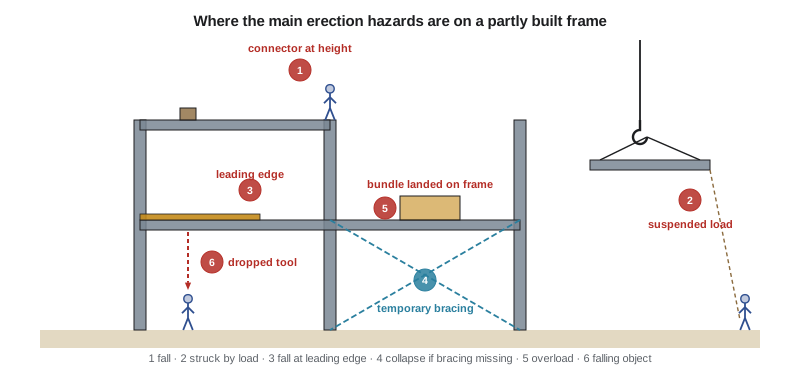
Erection is the stage of a building's life when it is weakest and when people work highest above the ground with the least around them. The permanent floors, walls and bracing that will one day make the structure stiff and stable are not there yet. Workers walk on beams 150 mm (6 in) wide, stand on decking that has not yet been fastened, and guide multi-tonne loads by hand. Three groups of hazards account for most of the deaths and serious injuries.
- Falls from height. Connectors at the top of columns, decking crews at the leading edge, welders and bolters on beams, and anyone walking on unprotected steel can fall. Falls are the leading cause of death among ironworkers.
- Struck by or crushed by loads. Members swinging from the crane, loads dropped when rigging fails or a hook latch is missing, members that roll or slide off a stack, and tools, bolts and offcuts dropped from above all strike workers below.
- Structural collapse. A partly built frame without its permanent bracing can buckle, tip or fall down, especially in wind, when a column is not anchored properly, when connections are left incomplete, or when too much material is landed in one place.
A fourth group, the health and environmental hazards, matters too: welding fume, noise, cold and heat, ultraviolet light from welding arcs, manual handling of heavy bolts and deck bundles, and fatigue on long shifts. These are covered alongside the tasks that create them in lessons 10 and 11.
What the numbers show
Structural iron and steel work is one of the most dangerous trades in North America. In the United States, the Bureau of Labor Statistics' census of fatal occupational injuries (CFOI) calculates a fatal injury rate for each occupation. For structural iron and steel workers, the rate was 26.3 deaths per 100,000 full-time-equivalent workers in 2019 and 32.5 in 2020, compared with about 3.5 for all US workers. That is roughly eight to ten times the average. Roofers are the only construction trade that has had a consistently higher rate.
| Occupation (US, BLS CFOI) | Death rate 2019 | Death rate 2020 |
|---|---|---|
| Roofers | 54.0 | 47.0 |
| Structural iron and steel workers | 26.3 | 32.5 |
| All US workers (about) | 3.5 | 3.4 |
Canada does not publish a national fatality rate by trade, and workers' compensation boards group ironworkers with other construction trades. The pattern in provincial investigation reports and safety association bulletins is the same as in the US data: falls from steel, decking and openings; workers struck by suspended loads or by members that shift or fall; and partial collapses during erection. Manitoba's workplace safety and health officers investigate serious incidents on steel erection sites in the same way as on any other construction site, and the Construction Safety Association of Manitoba publishes serious incident summaries that include falls from steel and dropped loads.
The high rates are not a reason to accept the risk. Most erection deaths follow patterns that are well known and preventable: a connector who was not tied off, decking that was not secured, a column with too few anchor rods, a beam released from the crane with only one bolt in, a load swung over workers, a frame left without bracing before a windstorm. The rest of this course works through those patterns one at a time.
Steel, precast and mass timber compared
The three structural systems on the Prairie Gate Community Centre share many hazards, but each has its own character.
| System | Typical members on this job | Hazards that stand out |
|---|---|---|
| Structural steel | Columns, beams, girders, braces, open-web steel joists, metal deck | Falls from narrow members and leading edges; incomplete connections; unstable frames before bracing; dropped bolts and tools; welding fume and fire |
| Precast and tilt-up concrete | Precast stair flights, elevator shaft panels, tilt-up gymnasium walls | Very heavy single picks; failure of lifting inserts; panels tipping before they are braced; brace failure in wind; crushing between panels |
| Mass timber | Glulam columns and beams, CLT floor and roof panels | Large, light-coloured panels that catch wind; screw and connector installation at edges; slippery surfaces in rain or frost; fire before sprinklers work |
Steel frames are assembled from many relatively light pieces, so there are many lifts, many connections and many people working at height for long periods. Precast and tilt-up concrete come in fewer, much heavier pieces, so each lift is high consequence and the work depends on lifting inserts, rigging and braces designed for each piece. Mass timber panels are large and relatively light for their size, so wind can catch them in the air, and the crews installing them work at panel edges with screws and connectors.
The rules that apply
In Manitoba, the Workplace Safety and Health Act and the Workplace Safety and Health Regulation (Man. Reg. 217/2006) apply to erection work as they do to all construction. The regulation does not have a single part devoted to steel erection. Instead, erection work is governed by the general duties of employers, prime contractors and supervisors, by Part 14 (Fall Protection), Part 23 (Cranes and Hoists) and the general duty and engineering provisions of the Workplace Safety and Health Regulation, and by the requirement to follow the design and instructions of the engineer where structures are under construction. The design standards matter too: CSA S16, the Canadian design standard for steel structures, whose erection clause covers erection loads, temporary bracing and erection tolerances, CSA W47.1, under which the Canadian Welding Bureau certifies companies and their welders and, for the library, CSA O86, the Canadian engineering design standard for wood. the National Building Code of Canada (NBC) as adopted in Manitoba decides how the finished building must perform, and the engineer of record's drawings set out what the structure needs before it can stand on its own.
Lesson 2 looks at who is responsible for what under these rules. For now, the point is that erection safety depends on people well away from the steel: the engineer who designs the structure and its temporary bracing, the fabricator who details the connections, the general contractor who prepares the site and coordinates the trades, and the erector who plans and carries out the work.
Who works on and around the frame
Owen listed every group that would work on or near the steel at the Prairie Gate Community Centre.
- Connectors, who work at the top of the frame bolting each member into place as it arrives from the crane. They spend more time at height on narrow steel than anyone else.
- The raising gang: the foreman, connectors, the signal person, the rigger who hooks on the loads on the ground and the tag line handlers.
- Bolting-up and detailing crews, who follow the connectors to install and tighten the remaining bolts.
- Decking crews, who spread and fasten the metal deck that becomes the floor and roof.
- Welders, who make field welds, attach shear studs and install deck fasteners and embedded plates.
- The crane operator, signal person and riggers.
- Precast and tilt-up crews from Plains Precast Ltd., and the mass timber crew from Boreal Timber Structures Ltd..
- Other trades that follow the erector up the building: concrete placers, plumbers, electricians and the curtain wall installers.
- Inspectors and engineers, including Helen Kowal from Morrow Structural Engineering Ltd., the engineer of record, and the special inspector who checks bolts and welds.
- The public walking past the site on the north and east streets.
Some of these people are experts at working on steel. Others, such as an electrician running conduit along a beam after the erectors have gone, may never have worked at height on a frame before. A good erection plan protects both.
How serious is each task?
Owen likes to rank the tasks before the work starts, using likelihood times severity, with an extra weight for how many people are exposed and how long they are exposed.
# Rough risk ranking of erection tasks at the Prairie Gate job (invented scores).
tasks = [
    # task, likelihood 1-5, severity 1-5, people exposed, hours per week at height
    ("Connecting beams at the second floor", 4, 5, 2, 30),
    ("Spreading deck at the leading edge", 4, 5, 3, 20),
    ("Setting tilt-up panels and braces", 2, 5, 5, 12),
    ("Landing deck bundles on joists", 3, 5, 2, 4),
    ("Bolting up from a lift", 2, 4, 2, 25),
    ("Setting CLT roof panels", 3, 5, 3, 10),
]
rows = []
for name, like, sev, people, hours in tasks:
    exposure = 1 + 0.1 * people + hours / 100
    rows.append((round(like * sev * exposure, 1), name))
for score, name in sorted(rows, reverse=True):
print(f"{score:5.1f} {name}")30.0 Spreading deck at the leading edge 30.0 Connecting beams at the second floor 21.0 Setting CLT roof panels 18.6 Landing deck bundles on joists 16.2 Setting tilt-up panels and braces 11.6 Bolting up from a lift
The numbers are invented, but the order matched what Bill Okafor told Owen from twenty years in the trade: connecting and leading-edge decking were the jobs to watch most closely, and the tilt-up panel lifts were the ones where a single mistake could kill several people at once.
Worked problem
Starting the job: the first-day briefing
Show solution
- Before the first column went up, Owen and Bill held a start-up meeting with everyone who would work on the frame: the raising gang, the crane crew, the deckers, the welders and the Tallgrass labourers who would set up the site.
- Bill walked through the erection sequence on the drawings: columns and first-floor beams on grid lines A to C, then the braced bay, then the second and third floors, then the gymnasium joists, then the tilt-up walls.
- Owen explained the site rules: fall protection above 3 m (10 ft) at all times, nobody under a suspended load, no member released from the crane until the connection met the plan, and a stop on all erection if the wind went above the limit in the erection plan.
- Helen Kowal, the engineer of record, explained which bays were the braced bays that gave the frame its stability, and why the temporary cable bracing could not be removed until the permanent bracing and the floor deck were in place.
- Nora asked who she should tell if she saw something wrong. Bill told her: him first, then Owen, and anyone could stop a lift.
Answer: A start-up meeting that walks through the sequence, the stability concept and the site rules gives every worker the same picture of the job before the first lift.
Common mistakes
MistakeThinking of erection as just another stage of construction.
InsteadErection is when the structure is weakest and people work highest with the least protection; it needs its own plan.
MistakeAssuming that falls are the only serious hazard.
InsteadStruck-by incidents and structural collapse kill ironworkers too, and a collapse can kill several people at once.
MistakeTreating precast and mass timber as safer than steel because there are fewer lifts.
InsteadFewer, heavier or larger picks raise the consequence of each lift and bring hazards such as insert failure and wind on panels.
MistakeLeaving the engineer out of erection safety.
InsteadThe engineer of record and the erection engineer decide what the structure needs to stand safely while it is being built.
MistakeForgetting the trades that follow the erector.
InsteadElectricians, plumbers and concrete crews working on the frame later need protection too.
Summary and key terms
- Erection work kills mainly through falls, struck-by incidents with loads and objects, and structural collapse.
- US structural iron and steel workers had fatal injury rates of 26.3 and 32.5 per 100,000 in 2019 and 2020, roughly eight to ten times the all-worker average.
- Steel frames involve many lifts and long periods at height; precast and tilt-up involve fewer, very heavy picks; mass timber brings large panels that catch wind.
- In Manitoba, erection is governed by the general duties, Part 14, Part 23 and the engineering provisions of the regulation, together with CSA S16 and related standards.
- Safe erection depends on the engineer, the fabricator, the general contractor and the erector working from the same plan.
- Erection
- The work of assembling and connecting the structural members of a building or other structure in their final positions.
- Connector
- An ironworker who works at the top of the frame, receiving members from the crane and making the initial connections.
- Raising gang
- The crew that hoists and connects members: foreman, connectors, signal person, rigger and tag line handlers.
- Structural collapse
- The partial or total failure of a structure, or part of one, while it is being built or used.
- Engineer of record
- The professional engineer responsible for the structural design of the permanent building.
- Mass timber
- Large engineered wood members such as glulam beams and columns and cross-laminated timber (CLT) panels.
Practice problems
Work each problem on paper first, then reveal the answer to check.
Name the three main ways erection work kills.
Show answer
Falls from height, being struck by or crushed by loads and objects, and structural collapse.
About how many times the all-worker rate was the fatal injury rate for US structural iron and steel workers in 2019 and 2020?
Show answer
Roughly eight to ten times (26.3 and 32.5 per 100,000 against about 3.5).
Why can a single tilt-up panel lift be higher consequence than a steel beam lift?
Show answer
The panel is much heavier and depends on lifting inserts, rigging and braces designed for that piece; a failure can crush several people.
Which job on a steel frame spends the most time at height on narrow steel?
Show answer
Connecting.
Why should the engineer of record attend the erection start-up meeting?
Show answer
To explain how the structure gains its stability, which bays are braced, and when temporary bracing can be removed.
Lesson quiz · 5 questions
Score 60% or more to complete this lesson.
Create a free account to save your progress, take quizzes and earn a certificate.