
HSE-371 · Lesson 7 of 12 · 21 min
Concrete pumping and placing
A concrete boom pump is a truck with a folding steel boom, sometimes more than 40 metres (130 feet) long, carrying a pipeline that delivers concrete under high pressure to a rubber hose at the tip. It can place a whole floor of concrete in a morning, reaching over the building from the street. It is also a crane-sized machine with a heavy load moving overhead, outriggers that put enormous loads on small patches of ground, a pipeline under pressure that can burst or blow out, and a hose that can whip violently when a blockage clears. This lesson covers setting up the pump, working near power lines, the hazards of the line and hose, cleaning out, and placing and consolidating the concrete once it reaches the forms.
Who does what
Tri-City Pumping Ltd. supplies the pump and its operator for every slab pour at Cottonwood Place. The operator runs the pump and the boom, usually by remote control from a position where they can see the boom tip, and is responsible for the machine's setup and inspection. The hose crew, two finishers from the placing crew, guide the tip hose and place the concrete. Tallgrass's pour supervisor coordinates trucks, the crane and the deck, and controls the exclusion zones on the ground.
Concrete pumps and placing booms are covered by CSA Z151, the Canadian standard for concrete pumps and placing booms, which sets requirements for design, operation, inspection and maintenance. Manitoba's regulation requires mobile equipment such as concrete pumps to be operated only by competent workers, maintained in safe condition and kept clear of energized power lines. Pump operators are trained by their employer and the manufacturer, and many hold certification from an industry program.
Setting up the pump
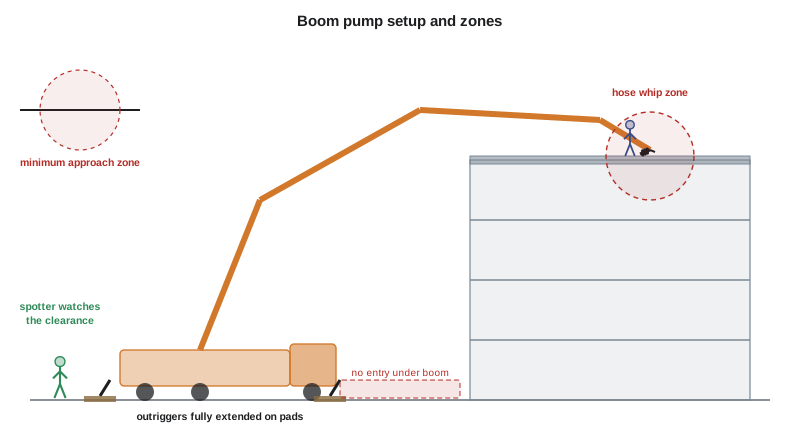
Most boom pump accidents start with the setup. A boom pump is stable only when its outriggers are fully extended as the manufacturer requires and are sitting on ground that can carry the load. When the boom is extended to one side, almost all the weight of the truck and boom can go through one or two outrigger feet. A foot that sinks into soft ground, punches through a slab, or sits on the edge of a trench can let the pump tip over in seconds.
- Choose the spot early. The pour plan shows where the pump will set up, checked against underground utilities, vaults, recently backfilled trenches, excavation edges and slopes.
- Know the ground. The operator compares the outrigger load from the manufacturer's data with the allowable bearing pressure of the ground, and uses pads or cribbing large enough to spread the load, as the program below shows.
- Extend fully. Outriggers are extended to the position the manufacturer's chart requires for the boom movement planned. Partial outrigger setups are used only where the manufacturer allows and with the boom limits that go with them.
- Level the machine. The pump is levelled within the manufacturer's tolerance before the boom is raised.
- Barricade the outriggers. Outrigger legs and pads are in the path of pedestrians and trucks. The area around them is coned or barricaded.
# Outrigger pad check for the boom pump (invented loads; use the manufacturer's outrigger data).
outrigger_load = 210            # kN, maximum on one outrigger with the boom over that corner
soils = {"compacted gravel": 200, "firm clay": 100, "soft or fill": 50}   # kPa allowable, typical values
pads = [0.6, 0.9, 1.2, 1.5]          # m, square pad or crib sizes available
for soil, allow in soils.items():
    needed = outrigger_load / allow          # m2 of bearing area
    fits = [p for p in pads if p * p >= needed]
    pick = f"{fits[0]} m square" if fits else "none of the pads: get engineered cribbing or move the pump"
print(f"{soil:17} needs {needed:4.2f} m2 -> {pick}")compacted gravel needs 1.05 m2 -> 1.2 m square firm clay needs 2.10 m2 -> 1.5 m square soft or fill needs 4.20 m2 -> none of the pads: get engineered cribbing or move the pump
On compacted gravel, a modest pad is enough. On soft fill, none of the pads on the truck spread the load enough, and the pump needs engineered cribbing or a different location. The bearing values are typical figures for illustration; the site's geotechnical information or an engineer sets the real ones. At Cottonwood Place, the pump sets up on the street, and the pour plan confirms with the city that there are no vaults or utility covers under the outrigger positions.
Power lines
A boom pump's boom is long, conductive and moves overhead, often close to the building and the street, where overhead lines run. Contact with a power line can electrocute not only the operator but also the hose crew holding the rubber hose at the tip, workers touching the truck, and anyone standing near the outriggers as current flows into the ground. Concrete pump contacts with power lines have killed hose operators who never saw the boom touch the line.
The rules from HSE-370 lesson 7 apply. The boom is kept outside the minimum approach distance for the line voltage at all times, with a dedicated spotter whose only job is to watch the clearance when the boom works near lines. Where the boom cannot stay outside the distance, the utility is asked to de-energize or relocate the line. On the north side of Cottonwood Place, the pour plan places the pump so the boom never has to swing toward the street lines, and Manitoba Hydro has installed visual markers on the lines along the frontage.
The line and the hose
Concrete moves through the pipeline under high pressure. Most serious injuries on the deck come from three events.
Blockages and hose whip
Concrete can block the line when the mix is too stiff, the line is kinked, the concrete segregates or the pump draws in air. When the pump pushes against a blockage, pressure builds. When the blockage clears, or when air trapped in the line escapes, the end hose can whip violently and spray concrete with great force. Hose whip has caused fatal head injuries and broken bones. The controls are:
- Nobody stands at the tip hose when the pump starts or restarts. The hose crew stays clear until concrete is flowing steadily.
- Keep the tip hose free of kinks. A kink causes blockages; never fold the hose to stop flow.
- Never hold the end of the hose in an awkward position or put a hand in front of it. Guide it with handles or a rope from the side.
- Respect the exclusion zone. The area within reach of the tip hose, which is at least the length of the hose in every direction from the end of the boom, is limited to the hose crew, and only while concrete is flowing steadily.
- Stop before clearing. Blockages are cleared only by the pump operator, with the pump stopped and the pressure released, never by striking the line while it is under pressure.
Pipeline failures
Pipes and couplings wear from inside as abrasive concrete passes through. A worn pipe can burst, and a coupling that is not fully closed and pinned can separate. On line pumps, where steel pipe runs across the deck or up the building, the pipe must be supported and secured so that it cannot move or fall when it surges. The operator checks wear, couplings and clamps as part of the daily inspection, and workers stay out of the area near couplings while the line is pressurized.
Boom failures
Boom sections, pins and welds are subject to fatigue from millions of pressure pulses and movements. Booms have failed and fallen onto workers. CSA Z151 and the manufacturer require frequent inspections by the operator and periodic thorough inspections, often annual, by qualified inspectors, with records kept. The boom is never used to lift anything other than its own pipeline and hose, and never with extra hose added beyond what the manufacturer allows.
Wind, lightning and cold
A placing boom fully extended over a building catches the wind like a crane jib, and the manufacturer sets a maximum wind speed for operating it. The operator watches the wind and folds the boom when the limit is reached, even partway through a pour. Lightning is a hazard to anyone near a tall steel boom; when thunder is heard, the boom is lowered and the hose crew leaves the deck until the storm has passed, using the same 30-minute rule the site uses for the crane. In Winnipeg winters, cold slows everything: hoses stiffen, concrete in a stopped line can start to set, and ice on outrigger pads and decks adds slip hazards. Pours in cold weather are planned with heated enclosures, insulated hoses and extra time, rather than rushing at the end of the day.
Cleaning out
After a pour, the line is cleaned, often by pushing a foam ball or sponge through it with water or compressed air. Cleaning with compressed air is especially dangerous: the ball and the concrete behind it can shoot out of the end of the line at very high speed. Cleanout is done only by the operator, following the manufacturer's procedure, with a catcher or basket on the end of the line and everyone clear of the discharge end. Compressed air hoses have fail-safe connectors so a coupling cannot separate and whip.
Placing and consolidating
Once the concrete reaches the forms, the placing crew spreads it, consolidates it and screeds it.
- Placing. Concrete is placed in layers close to its final position, not dropped from a height or piled in one spot, which would overload the formwork as lesson 2 explained.
- Vibrators. Internal vibrators, or pokers, remove air from the concrete. Electric vibrators need ground-fault protection and undamaged cords, as HSE-370 lesson 7 explains. Holding a vibrator for long periods exposes hands to vibration, which can cause hand-arm vibration syndrome. Workers rotate, take breaks and hold the vibrator lightly. In wall forms, the vibrator is not run deep into concrete that has already stiffened, because that raises form pressure.
- Screeding. Power screeds and laser screeds level the surface. Their moving parts, engines and the edges of the slab create pinch, noise and fall hazards.
- Footing. The hose crew walks backward across a deck covered with rebar and wet concrete, often near edges and openings. A second worker guides the hose crew, and walkways and edge protection stay in place throughout.
Worked problem
The restart
Show solution
- Midway through the level 6 pour, the line blocks. The pump operator stops pumping and the hose crew waits at the tip hose.
- The operator reverses the pump briefly to relieve pressure and then restarts it. One of the finishers is still holding the tip hose at chest height.
- Air trapped behind the blockage escapes as the concrete starts moving, and the hose jerks sideways, knocking the finisher off his feet onto the rebar mat. He is bruised but not seriously hurt.
- The investigation finds the operator could not see the hose crew from the remote-control position at the time, and the crew's practice was to hold the hose through restarts.
- The fixes: on every restart, the hose crew steps back at least the length of the hose and only returns when concrete is flowing steadily; the operator restarts only when the spotter on the deck confirms by radio that the crew is clear.
Answer: Restarts after blockages are when hose whip happens. The crew is clear of the hose until flow is steady, and the operator restarts only on confirmation.
Common mistakes
MistakeSetting up outriggers on whatever ground is closest to the pour.
InsteadCheck the ground, utilities and excavations, and size pads for the outrigger load.
MistakeHolding the tip hose when the pump restarts after a blockage.
InsteadStep clear of the hose until concrete flows steadily.
MistakeFolding the hose to stop concrete for a moment.
InsteadAsk the operator to stop the pump; kinks cause blockages and whip.
MistakeSwinging the boom toward the street without a spotter.
InsteadPlan the boom path away from power lines and use a dedicated spotter near them.
MistakeStanding at the end of the line during compressed-air cleanout.
InsteadUse a catcher and keep everyone clear of the discharge end.
Summary and key terms
- Boom pumps are stable only with outriggers fully extended on ground and pads that can carry the outrigger loads.
- Booms are kept outside the minimum approach distance to power lines, with a dedicated spotter.
- Hose whip happens on starts and restarts and when blockages clear; the crew stays clear until flow is steady.
- Blockages are cleared only with the pump stopped and pressure released.
- Pipes, couplings and booms wear and fatigue; they are inspected daily and thoroughly at intervals.
- Compressed-air cleanout uses a catcher, and everyone stays clear of the discharge end.
- Boom pump
- A truck-mounted concrete pump with a folding placing boom carrying the pipeline.
- Line pump
- A concrete pump that delivers through pipe or hose laid along the ground or up the building, without a boom.
- Outrigger
- An extendable leg that stabilizes a pump or crane by spreading its load to the ground.
- Tip hose
- The flexible rubber hose at the end of the boom that the hose crew guides.
- Hose whip
- Violent movement of the tip hose when pressure is suddenly released, such as when a blockage clears or air escapes.
- Cleanout
- Removing concrete from the pipeline after a pour, often by pushing a ball through with water or compressed air.
Practice problems
Work each problem on paper first, then reveal the answer to check.
Why must outriggers be fully extended as the manufacturer requires?
Show answer
The pump is stable only within the outrigger footprint the manufacturer's chart assumes for the boom movement.
An outrigger load is 210 kN and the ground can carry 100 kPa. How much bearing area is needed? (or 47,000 lb on ground that can carry 2,000 psf)
Show answer
2.1 m² (23.5 ft²), so a 1.5 m (5 ft) square pad or larger.
When is hose whip most likely?
Show answer
When the pump starts or restarts and when a blockage clears or trapped air escapes.
Who can be electrocuted if the boom contacts a power line?
Show answer
The operator, the hose crew holding the tip hose, anyone touching the truck and people near the outriggers.
Why is compressed-air cleanout so dangerous?
Show answer
The ball and concrete can shoot out of the line at high speed; a catcher and a clear zone are needed.
Lesson quiz · 5 questions
Score 60% or more to complete this lesson.
Create a free account to save your progress, take quizzes and earn a certificate.