
HSE-371 · Lesson 5 of 12 · 20 min
Reinforcing steel and impalement protection
Reinforcing steel is what lets a concrete slab span between columns and a concrete wall resist bending. On Cottonwood Place, every footing, wall, column and slab is full of it, and the ironworkers from Ironside Rebar Ltd. handle hundreds of tonnes of bar over the life of the job. Rebar is heavy, sharp, springy and everywhere. It injures workers who lift it, trip over it, cut it and tie it, and in its most dangerous form, a vertical bar sticking up from a wall or footing, it can impale a worker who falls onto it. This lesson covers handling and placing rebar safely, keeping tall rebar cages from collapsing, and protecting everyone on the site from impalement.
Handling and lifting rebar
Rebar arrives on flatbed trucks in bundles sorted by size and length and tagged with the bar mark from the placing drawings. Bundles of long bars are heavy and flexible: a 12 m (40 ft) bundle sags at the ends when lifted from the middle, and bars can slide out of a loose choke.
- Know the weight. Each bar size has a known weight per metre or foot, and the tag shows the count and length. Ironworkers and the crane crew work out the bundle weight before every lift, as the program below shows.
- Rig with two slings. Long bundles are lifted with two chokers spread apart, or with a spreader bar, so the bundle stays level and the bars cannot slide out. Single-point lifts of long rebar are not allowed at Cottonwood Place.
- Use tag lines. Bundles swing and rotate, and long bars can sweep across a deck. A tag line controls the load from a distance.
- Land on dunnage. Bundles are landed on timbers so slings can be removed without reaching under the load, and so the bars are off the ground and easy to pick up.
- Land where allowed. On a deck, rebar is landed only where the formwork drawings allow for the load and spread out, never stacked at the edge or in one bay.
Hand-carrying bars is the other big source of injury. A single 25M bar 6 m long weighs about 24 kg (a #8 bar 20 ft long weighs about 53 lb), and ironworkers carry bars on their shoulders across decks covered with other bars. Back and shoulder strains are among the most common rebar injuries. Two-person carries for long or heavy bars, carrying at shoulder height on the side away from the slab edge, and keeping walkways clear of loose bars all help.
# Rebar bundle weights for the level 5 slab lift (metric bar sizes).
mass_per_m = {"10M": 0.785, "15M": 1.570, "20M": 2.355, "25M": 3.925}   # kg/m
bundles = [("15M", 12.0, 60), ("20M", 12.0, 40), ("25M", 9.0, 50)]       # size, length m, count
sling_wll = 1600      # kg, working load limit of the two-leg sling at the planned angle (invented)
for size, length, n in bundles:
    w = mass_per_m[size] * length * n
    ok = "OK" if w <= sling_wll else "TOO HEAVY for this sling: split the bundle"
print(f"{n} x {size} x {length} m = {w:,.0f} kg -> {ok}")60 x 15M x 12.0 m = 1,130 kg -> OK 40 x 20M x 12.0 m = 1,130 kg -> OK 50 x 25M x 9.0 m = 1,766 kg -> TOO HEAVY for this sling: split the bundle
The 25M (#8) bundle is over the sling's working load limit, even though it looks no bigger than the others. The crew splits it into two lifts. Bar weights per length are standard values; the sling limit is invented for the example and would come from the sling tag and the rigging plan, as covered in TRD-105.
Walking and working on rebar
A slab with two layers of rebar is a grid of round, rolling bars at ankle height, with gaps that catch boots. Trips and ankle injuries are common, and a trip near a slab edge or opening can turn into a fall. Ironworkers learn to walk on the bars, not between them, but other trades who have to cross the mat, such as electricians placing conduit or finishers setting screeds, are not used to it.
- Walkways. Lay planks or purpose-made walkway panels across the mat along regular routes, such as from the stair tower to the work area.
- Housekeeping. Offcuts, bar ties, empty chair bags and tie-wire coils are cleared as the work goes.
- Footwear. Safety boots with a good grip and ankle support.
- No running, no carrying loads blind. Workers carrying bars watch where they step.
Tying rebar means hours of bending at the waist. Long-handled tying tools and battery-powered rebar tying tools let workers tie standing up, and they greatly reduce the bending that leads to back injuries. Tie wire itself is sharp; gloves and eye protection protect against cuts and against the wire end flicking into an eye.
Keeping rebar cages from collapsing
Wall and column reinforcing is often assembled as tall vertical cages before the forms go around it. A cage of vertical bars tied to a few horizontal bars is tall, top-heavy and flexible. It can topple in wind, when a worker climbs it, or when a crane bumps it. Rebar cage collapses have killed ironworkers on many projects, often because the cage was not guyed or braced while the forms were not yet in place.
Manitoba's regulation requires reinforcing steel for walls, columns and similar structures to be supported so it cannot topple or collapse, and the general duty to provide a safe workplace covers the temporary stability of cages. In practice, tall cages are braced or guyed to designed anchors, the stability design is done by a qualified person for tall or heavy cages, and workers do not climb a cage as if it were a ladder unless it has been designed and braced for that.
Welded wire mesh has its own hazard: when a roll is cut open, it can spring back violently. Rolls are controlled while unrolling, for example by securing the ends or by turning the roll over, and workers stand clear of the free end.
Impalement: the hazard
Vertical bars stick up everywhere on a concrete job: dowels from footings into walls, column bars waiting for the next lift, wall bars above the top of a pour, and starter bars at slab edges. If a worker trips, slips or falls onto an exposed vertical bar, the bar can pierce the body. Impalement injuries can be fatal even from a fall of less than a metre onto a short dowel, and from greater heights they are often fatal. A worker can be impaled while walking past a dowel, stepping off a ladder, or falling from a form onto bars below.
Lacerations from bar ends are much more common than impalement, and the simplest bar caps protect against those. But a cap that stops a scratch does not necessarily stop a falling body.
Protecting against impalement
The order of controls, from HSE-370, applies here as everywhere.
- Eliminate. Bend exposed bars over where the design allows, or schedule work so bars are exposed for as short a time as possible.
- Guard the area. Keep people away from fields of exposed bars with barricades, especially below work at height.
- Cover the bars. Use impalement-rated caps or covers. These are stiff, wide caps, usually with a steel plate moulded inside, or long plastic or wooden troughs that cover a whole row of bars, designed and tested to stop a falling worker. Ordinary plastic mushroom caps are designed to prevent scratches and cuts, not impalement. They can be driven through by a falling body.
- Fall protection above. Where workers could fall from height onto exposed bars, fall protection is needed at any height, because the consequence of the fall is so severe.
In Manitoba, the employer's general duty under the Act to protect workers, together with the regulation's fall protection requirements, means protruding rebar that a worker could fall onto must be protected. At Cottonwood Place, Tallgrass's site rule is that every exposed vertical bar that a worker could fall onto is covered with an impalement-rated cap or trough as soon as it is placed, and mushroom caps are used only where the hazard is a scratch, not a fall.
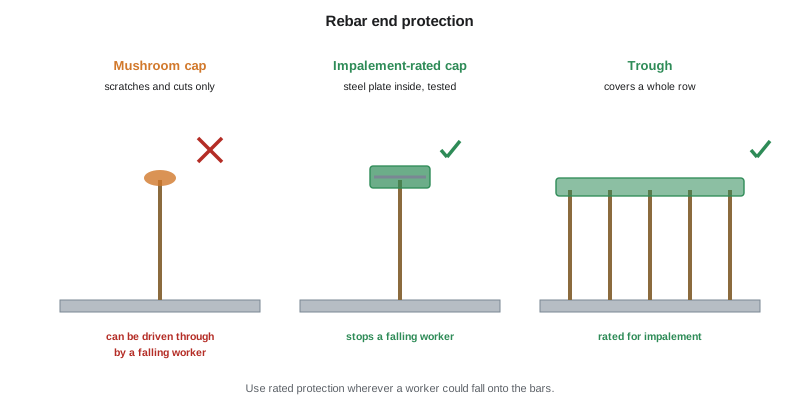
Caps disappear. They are knocked off by forms, removed to fit a waler, or taken by a crew that ran short elsewhere. The ironworker foreman's daily check and Owen Hartley's walk-arounds both include a count of uncovered bars, and anyone who removes caps to do work replaces them before leaving the area.
Rebar near power lines and overhead work
Rebar conducts electricity, and long bars are easy to swing. On the north side of Cottonwood Place, the street has overhead distribution lines along the property line. A 12 m (40 ft) bar carried upright, or raised to slide into a column cage, can reach those lines from the edge of the building. Ironworkers carry long bars horizontally near the north edge, never stand bars on end near the lines, and treat any lift near the lines under the approach-distance rules covered in HSE-370 lesson 7. Bundles are rigged and lifted away from the lines, with a signaller watching the clearance.
Ironworkers also work above other trades. A bar dropped from the top of a column cage, or a bag of chairs knocked off a deck edge, is a struck-by hazard for anyone below. Tools and small materials at height are kept in closed bags or tethered, and the area below active rebar work at height is barricaded while the work goes on.
Planning the rebar work
Most rebar hazards are easier to control at the planning stage than on the deck. Before each floor, the rebar foreman and the forming foreman look at the placing drawings together and agree where bundles will be landed, which bars will be exposed and for how long, which troughs and caps are needed and when they go on, and where walkways will run. The rebar foreman orders enough impalement protection for the floor before the bars arrive, so no one is tempted to use mushroom caps because the rated caps ran out.
Cutting and bending rebar
Bars are cut with shears, abrasive saws or portable band saws, and bent with hand benders or powered benders. Abrasive cut-off saws throw sparks and fragments, so eye and face protection, hearing protection and a clear area are needed, and hot work rules apply if there are combustibles nearby. Powered shears and benders have pinch points that can amputate fingers. Only trained workers use them, with guards in place, and hands stay away from the die while it is operating.
Worked problem
The step off the ladder
Show solution
- A carpenter climbs down a ladder from the top of a level 2 wall form at the end of the day. The base of the ladder is 1.2 m (4 ft) from a row of 20M (#6) wall dowels left uncovered after the forms were set.
- Her boot catches the bottom rung and she stumbles sideways toward the dowels, catching herself on a shore.
- She reports it as a near miss. Owen Hartley classifies it as having serious injury potential: a fall onto those dowels could have been fatal.
- The investigation finds the troughs over the dowels were removed to fit the wall form and not replaced because the crew ran out of time.
- The fixes: troughs reinstalled immediately, the formwork plan updated to show troughs reinstalled as soon as the form is set, and ladders positioned away from exposed bars.
Answer: Impalement protection is easily removed for other work and forgotten. Replacing it is part of finishing the task, and ladders and walkways are placed away from exposed bars.
Common mistakes
MistakeUsing mushroom caps where a worker could fall onto the bars.
InsteadUse impalement-rated caps or troughs wherever a fall onto the bars is possible.
MistakeLifting a long rebar bundle from a single choker.
InsteadUse two slings or a spreader so the bundle stays level and bars cannot slide out.
MistakeClimbing an unbraced column cage to tie the top bars.
InsteadBrace or guy cages and use a ladder, lift or designed access.
MistakeRemoving caps for work and leaving them off.
InsteadReplace caps before leaving the area.
MistakeCutting open a roll of wire mesh while standing at the free end.
InsteadSecure the roll ends or turn the roll over, and stand clear of the free end.
Summary and key terms
- Rebar bundles are weighed, rigged with two slings or a spreader, controlled with tag lines and landed on dunnage where the drawings allow.
- Hand-carrying and tying rebar cause many strains; two-person carries and long-handled or powered tying tools reduce them.
- Walkways and housekeeping reduce trips on rebar mats.
- Tall rebar cages are braced or guyed against collapse, and wire mesh is controlled when unrolled.
- Any protruding bar a worker could fall onto needs impalement protection; mushroom caps protect against scratches only.
- Caps and troughs are replaced as soon as work that disturbed them is finished.
- Dowel
- A short bar projecting from one pour of concrete to tie it to the next.
- Rebar cage
- An assembly of vertical and horizontal bars tied together for a wall or column before the forms go on.
- Impalement-rated cap
- A rebar cap designed and tested to stop a falling worker from being pierced by the bar.
- Mushroom cap
- A small plastic rebar cap that protects against scratches and cuts but not impalement.
- Rebar trough
- A long cover that protects a whole row of exposed bars.
- Bar mark
- The label on the placing drawings and bundle tags that identifies each bar type and location.
Practice problems
Work each problem on paper first, then reveal the answer to check.
What is the difference between a mushroom cap and an impalement-rated cap?
Show answer
A mushroom cap protects against scratches; an impalement-rated cap is designed and tested to stop a falling worker.
Why are long rebar bundles lifted with two slings?
Show answer
So the bundle stays level and bars cannot slide out of a single choke.
What is the weight of 40 bars of 20M, 12 m long? (or 40 bars of #6, 40 ft long)
Show answer
40 × 12 × 2.355 = about 1,130 kg (40 × 40 × 1.502 = about 2,400 lb).
Why must tall rebar cages be braced?
Show answer
They are tall, top-heavy and flexible, and can topple in wind, when climbed or when bumped by a crane.
A crew removes troughs to set a wall form. What must they do?
Show answer
Replace the troughs as soon as the form is set, before leaving the area.
Lesson quiz · 5 questions
Score 60% or more to complete this lesson.
Create a free account to save your progress, take quizzes and earn a certificate.