
HSE-371 · Lesson 1 of 12 · 21 min
Concrete and masonry work: the hazards and who controls them
Concrete and masonry are the bones of most buildings. On Cottonwood Place, the eight-storey mixed-use building that Tallgrass Construction is putting up in Winnipeg, Manitoba, almost everything that holds the building up is concrete: the footings and foundation walls, the underground parking level, the columns, the flat slabs of every floor, the stair and elevator cores, and the block walls of the ground-floor service corridor. Concrete work looks simple from the street. A truck arrives, concrete goes into a form, and a few days later there is a floor. Up close it is one of the most hazardous kinds of construction work, because it combines heavy temporary structures, large loads lifted by crane, pressurized equipment, sharp steel, caustic materials and dust that can scar the lungs.
This course follows the concrete and masonry work at Cottonwood Place from the first formwork drawings to the last block wall. It builds on HSE-370 Construction Site Safety Essentials, which introduced the site, its people and the hazards that injure construction workers most often. This first lesson maps the work, the hazards it creates, the rules that apply and the people who control them.
The work: from drawings to a finished floor
A cast-in-place concrete floor goes through the same cycle at every level, usually in a week or two per floor on a building this size. Each step brings its own hazards.
- Formwork and shoring. Carpenters build the temporary moulds, called forms, that give the concrete its shape, and the shoring that holds the forms up until the concrete can carry itself. On Cottonwood Place, Redline Forming Ltd. uses aluminum beam-and-panel slab forms on adjustable steel shores, and gang forms lifted by the tower crane for the core walls.
- Reinforcing steel. Ironworkers from Ironside Rebar Ltd. place and tie the reinforcing bars, called rebar, that give concrete its tensile strength. Bundles of rebar arrive by truck and are lifted to each floor by crane.
- Embedded services. Electricians and plumbers place conduit, sleeves and boxes in the forms before the pour.
- Placing concrete. Ready-mix trucks from Assiniboine Ready-Mix deliver the concrete, and a boom pump from Tri-City Pumping Ltd. places it in the forms. Smaller pours use a crane and bucket.
- Finishing and curing. Finishers screed, float and trowel the slab, often with ride-on or walk-behind power trowels, and the concrete is kept moist and warm while it gains strength.
- Stripping and reshoring. Once the concrete is strong enough, the forms are stripped and moved up to the next floor, and reshores are installed to share the load of the floors above.
- Cutting and coring. Later, trades saw-cut control joints and core holes for pipes and ducts.
Masonry work runs alongside the concrete frame. Reyes Masonry Ltd. builds concrete block walls around the parking-level stairs and the ground-floor service corridor, including a tall block wall along the west property line beside the occupied office building next door.
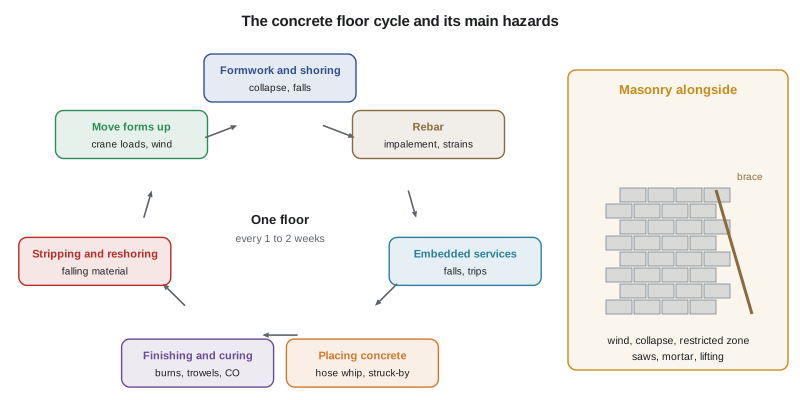
What goes wrong
The hazards of concrete and masonry work fall into a few groups. Each later lesson covers one of them in depth.
Collapse of formwork, shoring and walls
The most catastrophic concrete incidents are collapses. Wet concrete is heavy, about 2,400 kg/m³ (150 lb/ft³), and it pushes sideways on wall forms like a liquid. A 200 mm (8 in) slab weighs about 4.7 kPa (98 psf) before anyone adds workers, equipment or the forms themselves. When shoring is undersized, missing, set on soft ground, removed too early or overloaded, a whole floor can come down in seconds, taking workers with it and sometimes dropping onto the floor below. Masonry walls under construction collapse too, usually in wind, because fresh mortar has almost no strength and a tall, unbraced wall acts like a sail. Lessons 2, 3, 4 and 10 cover these hazards.
Struck-by and caught-between
Concrete work involves heavy lifts and moving equipment: bundles of rebar and gang forms on the crane hook, concrete buckets, ready-mix trucks reversing to the pump, pump booms moving overhead, and power trowels spinning at the operator's feet. Workers are struck by loads, crushed between forms and structure, run over by trucks and hit by pump hoses that whip when a blockage clears. Lessons 6, 7 and 9 cover these.
Falls
Formwork crews work at the open edges of slabs and on top of wall forms long before guardrails are permanent. Ironworkers walk on rebar mats. Masons work from scaffolds that are raised as the wall goes up. Falls are a constant hazard, and they overlap with a hazard unique to concrete work: falling onto protruding rebar. Lessons 4, 5 and 11 cover falls in concrete and masonry work.
Impalement and cuts
Vertical rebar sticking up from walls, columns and footings can impale a worker who falls or trips onto it. Even a low dowel can cause a serious injury. Rebar ends, tie wire and form hardware also cause cuts and puncture wounds. Lesson 5 covers impalement protection.
Health hazards
Wet cement is strongly alkaline and causes chemical burns and dermatitis. Cutting, grinding, drilling and chipping concrete and masonry release respirable crystalline silica, which causes silicosis and lung cancer. Concrete work is also loud, heavy and repetitive: lifting block, placing rebar and kneeling on slabs injure backs, shoulders and knees. Lessons 8, 11 and 12 cover these hazards.
The rules that apply
In Manitoba, the Workplace Safety and Health Act sets the general duties of everyone on the site, and the Workplace Safety and Health Regulation (Man. Reg. 217/2006) sets specific requirements. The regulation has requirements for formwork, falsework and reshoring, for concrete equipment such as pumps and buckets, and for work near protruding reinforcing steel, along with the general rules on fall protection, cranes, hazardous products, noise and silica that apply to all construction. It relies on recognized standards for technical detail. The most important for this course is CSA S269.1, the Canadian standard for falsework and formwork, which covers the design, construction, inspection and removal of temporary structures that support concrete. Concrete pumps and placing booms are covered by CSA Z151, the Canadian standard for concrete pumps and placing booms, and masonry construction by CSA A371. Where the regulation requires a professional engineer to design or approve temporary works, that engineer must be licensed in Manitoba.
Who controls the hazards
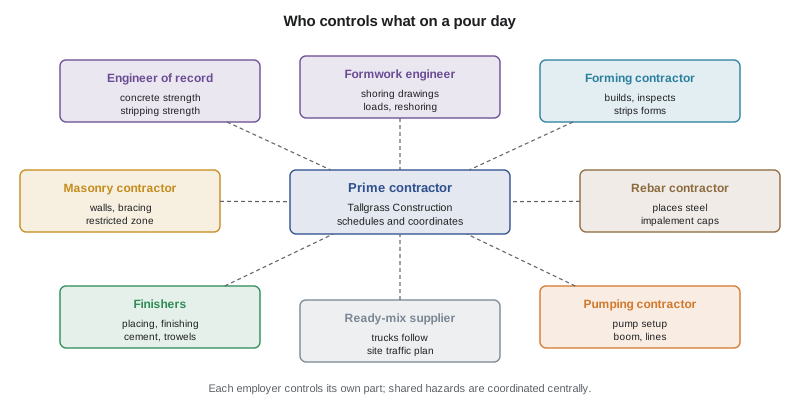
Concrete and masonry work at Cottonwood Place involves at least six employers on any given pour day: Tallgrass as the prime contractor, the forming contractor, the rebar contractor, the pumping contractor, the ready-mix supplier and the finishing crew, often with the electrical and mechanical trades still working in the forms. Each has a part to play.
- The engineer of record designs the permanent structure and specifies the concrete strength, the reinforcing and, often, the minimum strength before forms can be stripped.
- The formwork engineer designs the formwork, shoring and reshoring, and produces the drawings that show shore spacing, beam sizes, loads and the stripping sequence. The forming contractor hires this engineer.
- The forming contractor builds the forms to the drawings, inspects them and strips them when the strength is confirmed.
- The rebar contractor places and ties the steel, supports vertical bars against collapse and installs impalement protection.
- The pump operator sets up and runs the concrete pump and is responsible for its outriggers, boom and lines.
- The ready-mix driver delivers the concrete and follows the site's traffic plan.
- The masonry contractor builds and braces the block walls and sets up the restricted zone around them.
- Tallgrass as prime contractor coordinates all of them: it schedules the pours, sets the site rules, keeps workers clear of crane and pump zones, and checks that each contractor is doing its part. Superintendent Carla Mendes signs off each pour only after the formwork contractor confirms the forms and shores have been inspected.
A day on a pour
On the morning of the level 3 slab pour, Dev Sandhu, the new general labourer who started on site a month ago, arrives at 6:30. The pump truck is already setting up on the street, with its outriggers on cribbing pads and cones around it. Lena Petrov from the forming crew and her foreman are walking the deck one last time with the shoring drawings, checking that every shore is plumb, every head is snug against its beam and no shore has been knocked out by the trades that worked under the deck yesterday. An ironworker is checking that every vertical column dowel has a cap. Owen Hartley, the safety coordinator, checks that the floor edges have guardrails and that the exclusion zone under the pump boom is taped off.
At 7:00, the pour crew gathers for a pre-task briefing. Carla Mendes covers the pour sequence, the signals between the hose operator and the pump operator, the route the ready-mix trucks will take and where the spotter will stand. She reminds everyone of one rule: nobody goes under the deck while concrete is being placed except the two shoring watchers named on the plan, who are there to look for movement and call a stop. The first truck backs up to the pump at 7:20.
Most pours go exactly like this one. The risks are controlled by planning done days before and a few minutes of checking on the morning. The rest of this course explains why each of those checks matters.
A simple hazard map for a pour day
Tallgrass keeps a simple hazard map for every pour, listing each activity and the controls that must be in place before work starts. Owen uses a short program to print the checklist for the morning briefing and to flag any activity without a named person responsible.
# Pour-day hazard map for the level 3 slab (invented data).
pour = [
    # (activity, main hazard, control, responsible)
    ("Shoring check", "collapse", "walk deck with drawings, sign inspection record", "Redline forming foreman"),
    ("Dowel caps", "impalement", "cap every exposed vertical bar", "Ironside rebar foreman"),
    ("Pump setup", "tip-over, power lines", "outrigger pads, 'line clear' check", "Tri-City pump operator"),
    ("Truck backing", "struck-by", "spotter at pump hopper", "Tallgrass spotter"),
    ("Hose handling", "hose whip", "two-person hose crew, no kinks", "Finishing foreman"),
    ("Under-deck watch", "collapse", "two named shore watchers only", ""),
]
missing = 0
for act, hazard, control, who in pour:
    flag = "" if who else "  <-- NO ONE NAMED"
    missing += not who
    print(f"{act:16} | {hazard:22} | {control}{flag}")
print(f"\nActivities without a responsible person: {missing}")Shoring check | collapse | walk deck with drawings, sign inspection record Dowel caps | impalement | cap every exposed vertical bar Pump setup | tip-over, power lines | outrigger pads, 'line clear' check Truck backing | struck-by | spotter at pump hopper Hose handling | hose whip | two-person hose crew, no kinks Under-deck watch | collapse | two named shore watchers only <-- NO ONE NAMED Activities without a responsible person: 1
The printout shows one gap: no one is named for the under-deck watch. Owen asks Lena's foreman to name two carpenters before the briefing. A missing name on a list is a small thing, but on pour day it is exactly the kind of gap that lets a shore move without anyone seeing it.
Worked problem
The block wall beside the office building
Show solution
- The masonry crew is about to start the west block wall, which will be 6.0 m (20 ft) high and runs along the property line beside the occupied office building.
- Owen asks who controls each hazard. The wall itself is built and braced by Reyes Masonry Ltd.. The restricted zone on the unscaffolded side, which is the lane between the wall and the office building, needs to be fenced and kept clear.
- The lane is also the route the office tenants use to reach their back door. That access is controlled by Tallgrass, not the mason.
- At the coordination meeting, Tallgrass agrees to close the lane to the public and arrange another entrance for the tenants. The mason agrees to brace the wall as it rises and to stop work and clear the zone in high wind.
- Both commitments are written into the masonry work plan and the site logistics plan.
Answer: Some hazards cross the boundary between employers. The prime contractor coordinates them, and each employer commits in writing to the part it controls.
Common mistakes
MistakeThinking formwork is just carpentry that anyone can change on the day.
InsteadFormwork is an engineered temporary structure; changes go back to the formwork designer.
MistakeAssuming the pump operator or the mason controls everything about their work area.
InsteadHazards that cross employers, such as access lanes and traffic, are coordinated by the prime contractor.
MistakeTreating cement and concrete dust as just dirt.
InsteadWet cement causes chemical burns and cutting concrete releases silica dust that damages the lungs.
MistakeWorking under a deck during a pour to save time on another task.
InsteadOnly the named shore watchers belong under a deck during placement.
MistakeLeaving rebar dowels uncapped because no one is working near them yet.
InsteadCap exposed vertical bars as soon as they are placed; people trip and fall in unexpected places.
Summary and key terms
- Concrete and masonry work combines heavy temporary structures, crane lifts, pressurized equipment, sharp steel, caustic materials and silica dust.
- The main hazard groups are collapse, struck-by and caught-between, falls, impalement and cuts, and health hazards.
- Manitoba's Workplace Safety and Health Regulation sets requirements for formwork, concrete equipment and protruding reinforcing steel, relying on standards such as CSA S269.1 and CSA Z151.
- Many employers share each pour: the formwork engineer, the forming, rebar and pumping contractors, the ready-mix supplier, the finishers and the masons.
- The prime contractor coordinates the work and the hazards that cross employers, and each employer controls its own part.
- Most pours go safely because of planning done days earlier and a few minutes of checking on the morning of the pour.
- Formwork
- The temporary moulds that hold fresh concrete in shape until it can support itself.
- Shoring
- The temporary vertical supports that carry formwork and fresh concrete loads to the ground or the floor below.
- Reshoring
- Shores placed under a stripped slab so that it shares the load of the floors being built above it.
- Rebar
- Steel reinforcing bars placed in concrete to resist tension.
- Formwork engineer
- The engineer who designs the formwork, shoring and reshoring for a project and produces the drawings the crews build to.
- Pour
- The placing of fresh concrete into a set of forms, usually in one continuous operation.
Practice problems
Work each problem on paper first, then reveal the answer to check.
Name the steps in the cycle of a cast-in-place concrete floor.
Show answer
Formwork and shoring, rebar, embedded services, placing concrete, finishing and curing, stripping and reshoring, and moving the forms up.
Why does fresh concrete create a collapse hazard?
Show answer
It is heavy, about 2,400 kg/m³ (150 lb/ft³), and pushes sideways like a liquid until it sets, so undersized or poorly supported forms and shores can fail.
Who designs the shoring for a slab?
Show answer
The formwork engineer, hired by the forming contractor; the crews build it to the engineer's drawings.
Why did Owen insist on naming two shore watchers?
Show answer
Someone must watch the shoring for movement during the pour and call a stop; a role with no name is a role no one fills.
Who controls a lane next to a masonry wall that tenants use?
Show answer
The prime contractor controls site access and traffic; the mason controls the wall and its bracing. They coordinate and record who does what.
Lesson quiz · 5 questions
Score 60% or more to complete this lesson.
Create a free account to save your progress, take quizzes and earn a certificate.