
HSE-371 · Lesson 6 of 12 · 20 min
Ready-mix trucks, buckets and getting concrete to the forms
Every pour starts with a truck. A typical ready-mix truck carries about 8 to 10 m³ (10 to 13 yd³) of concrete and weighs more than 30 tonnes loaded. On a big pour at Cottonwood Place, a new truck arrives every ten minutes or so, backs up to the pump or the crane bucket, discharges and leaves, all on a tight urban site with workers on foot, a busy street and a lane full of other deliveries. Once the concrete is off the truck, it has to reach the forms by pump, crane and bucket, buggies, conveyor or chute. This lesson covers the hazards of concrete delivery and the methods other than pumping. Lesson 7 covers concrete pumps.
Ready-mix trucks on site
The ready-mix driver works for Assiniboine Ready-Mix, not for Tallgrass, and may be on a different site every hour. The driver depends on the site to tell them where to go, where to stop and who will guide them. Most serious ready-mix incidents involve trucks backing over workers, trucks tipping on soft or sloped ground, and workers caught by chutes and moving parts.
Routes, staging and backing
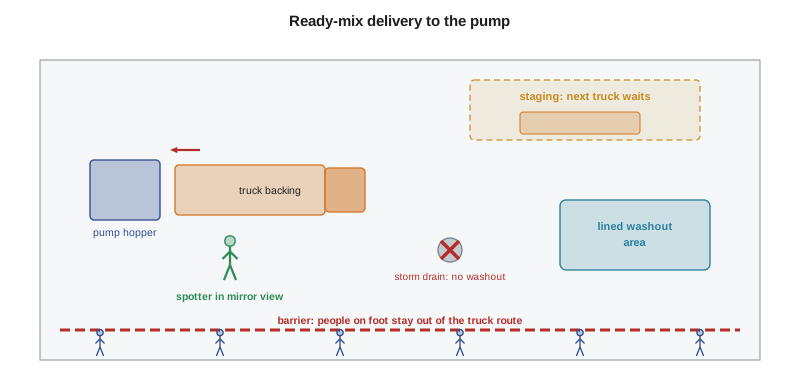
Tallgrass's pour plan shows where trucks enter, where they wait, where they discharge and how they leave. At Cottonwood Place, trucks enter from the street, wait in a marked staging lane, and back up to the pump hopper with a spotter. The rules from HSE-370 lesson 6 apply:
- A dedicated spotter. A trained worker, in high-visibility clothing, guides every truck that backs up to the pump or bucket, stands where the driver can see them in the mirror, and uses agreed hand signals. If the driver loses sight of the spotter, the driver stops.
- Separation. Workers on foot keep out of the truck route and the area behind reversing trucks. Barriers separate the truck lane from walkways where possible.
- One truck at a time. A second truck waits in staging until the first has moved away, so the spotter is never between two trucks.
- Backup alarms and cameras. Trucks have working backup alarms, and many have rear cameras, but neither replaces the spotter.
Ground and slopes
A loaded ready-mix truck puts heavy loads on its wheels, and the drum's weight sits high. Trucks can tip when a wheel drops into a soft spot, the edge of an excavation, a trench backfilled loosely, or a slope across the truck. The pour plan keeps trucks well back from excavation edges, as HSE-370 lesson 8 explains, and the route is checked before the first truck, especially after rain. In Winnipeg, frost and thaw can soften ground overnight, and in summer, heavy rain can turn a gravel staging area to mud.
Chutes and moving parts
The truck's discharge chute swings and folds, and chute sections are heavy. Workers have been struck by chutes that swung when the truck moved, and have had fingers crushed when folding or unfolding chute sections. Only the driver or a trained worker swings or extends the chute, with hands on the handles and away from the hinges. Nobody stands between the chute and the hopper while the truck is moving.
The drum rotates continuously while loaded. Drivers never climb into or reach into a drum to clean or inspect it unless the engine is shut off, the keys are removed and the drum is locked out according to the supplier's procedure. Inside the drum is a confined space with mixing blades, and drivers have been killed when a drum was started while someone was inside.
Washout
After discharging, drivers rinse their chutes, and the pump and tools also need washing. Washout water is strongly alkaline, as caustic as wet cement, and harmful to skin, eyes and waterways. It must not run into storm drains, which in Winnipeg lead straight to the rivers. Cottonwood Place has a lined washout area at the south end of the site, marked on the logistics plan, and drivers rinse only there. Workers who clean tools at the washout wear gloves and eye protection, and the hardened concrete and water are disposed of according to the environmental plan.
Concrete buckets and the crane
Smaller pours at Cottonwood Place, such as stair landings, column tops and the occasional wall placed where the pump boom cannot reach, use a crane and a concrete bucket. A bucket full of concrete is a heavy, dense load, and it is placed slowly and precisely over workers' heads. Buckets bring all the crane hazards from TRD-105 and HSE-370 lesson 9, plus a few of their own.
- Weight. A bucket of 1.5 m³ (2 yd³) of concrete weighs more than 4 tonnes (8,800 lb) once the bucket itself is added. The crane operator needs the total weight and the radius for every lift, as the program below shows.
- Gates. Buckets with hydraulic or pneumatic gates must have positive safety latches or similar devices to stop accidental dumping. Manual gates are opened only by the worker assigned to place the concrete, standing to the side.
- No riding, no one below. Workers never ride concrete buckets, and nobody works or stands under a bucket being raised or swung. Lift paths are chosen to avoid passing over workers.
- Guiding the bucket. The worker placing concrete guides the bucket by its handles once it is close to the form, with the crane under the signaller's control, and keeps feet and hands away from the gate and the edge of the form.
- Hang-ups. Concrete that hangs up inside the bucket can fall out unexpectedly. Buckets are designed so concrete does not cling to the top and sides, and workers do not hammer on a raised bucket to free a hang-up.
# Crane check for a concrete bucket lift (invented crane chart; use the real chart and lift plan).
density = 2400                        # kg/m3, fresh concrete
bucket_tare = 650                     # kg, empty 1.5 m3 bucket
rigging = 60                          # kg, slings and shackles
chart = {30: 6000, 40: 4400, 50: 3400}   # kg capacity by radius (m), invented
for volume, radius in [(1.0, 40), (1.5, 30), (1.5, 40), (1.5, 50)]:
    load = volume * density + bucket_tare + rigging
    pct = load / chart[radius] * 100
    verdict = "OK" if pct <= 75 else ("CRITICAL LIFT: needs a lift plan" if pct <= 100 else "OVER CAPACITY")
print(f"{volume} m3 at {radius} m: {load:,.0f} kg = {pct:3.0f}% of chart -> {verdict}")1.0 m3 at 40 m: 3,110 kg = 71% of chart -> OK 1.5 m3 at 30 m: 4,310 kg = 72% of chart -> OK 1.5 m3 at 40 m: 4,310 kg = 98% of chart -> CRITICAL LIFT: needs a lift plan 1.5 m3 at 50 m: 4,310 kg = 127% of chart -> OVER CAPACITY
A full bucket close to the crane is routine. The same bucket at mid-radius becomes a critical lift, and at the far end of the jib it is over capacity. The 75 percent threshold for a critical lift is the Tallgrass site rule from HSE-370 lesson 9; the crane chart is invented. The crane's load moment indicator is a backup, not the plan: the crane crew works out the load before the lift, and the bucket is filled only to the volume planned for that radius.
Buggies, conveyors, chutes and tremies
Some concrete still moves the old-fashioned way.
- Concrete buggies are wheeled carts, manual or powered, used on decks and in places the pump cannot reach. Buggy runways must be strong enough and wide enough, with no gaps a wheel can drop into, and kept back from slab edges or guarded. Handles on hand-pushed buggies must not stick out past the wheels, so a worker's hands are not crushed against walls and columns. Powered buggies count as a heavier live load on the deck, which the formwork design must allow for.
- Conveyors that carry concrete have pinch points at the head and tail pulleys and along the belt. Guards stay on, and workers do not reach in to clear a jam until the conveyor is locked out.
- Chutes that carry concrete from the truck or a hopper down into a footing or wall must be secured so they cannot shift, and the concrete must not free-fall so far that it separates or knocks a form out of line.
- Tremies are pipes used to place concrete underwater or deep into piles and walls. Their sections are heavy; besides the normal couplings, each section is secured with wire rope or an equivalent so a coupling failure cannot drop sections onto workers.
The street and the public
Cottonwood Place has no room to keep every truck inside the fence, so trucks queue on the street and turn in across the sidewalk. That brings pedestrians, cyclists and traffic into the delivery hazard. The pour plan includes traffic control from the city permit: signs warning drivers, a flagger or traffic control person at the site entrance during pours, and the sidewalk closed or protected where trucks cross it. Pours often start early in the morning, before traffic builds and in the dark for much of the Winnipeg winter, so the entrance and the discharge area are lit and spotters and flaggers wear high-visibility clothing with retroreflective strips.
Communication on pour day
A pour involves people who rarely work together: drivers, the pump operator, the hose crew, finishers, the crane operator and Tallgrass's pour supervisor. Before the first truck, the pour supervisor confirms who signals whom, which radio channel is used, and how anyone calls a stop. Any worker who sees a hazard, such as a truck heading toward someone, a bucket swinging over a crew or shoring moving below, can stop the pour, and the stop is obeyed first and discussed afterward. It is cheaper to waste part of a load of concrete than to hurt someone to save it.
Concrete that waits too long
Concrete starts to stiffen as soon as it is mixed. CSA A23.1, the Canadian concrete construction standard, sets limits on how long concrete can be held in the truck before it is discharged, commonly two hours from batching, unless the specification allows otherwise. Late trucks lead to a common and dangerous temptation: adding water on site to loosen stiff concrete. Extra water weakens the concrete, which matters for how soon forms can be stripped and how much load the slab can carry. Water is added only as the mix design and the specification allow, and the field engineer, not the driver or the hose crew, decides.
Worked problem
The truck that rolled forward
Show solution
- During the level 2 slab pour, a ready-mix truck is discharging into the pump hopper on a slight slope in the lane. The driver gets out to adjust the chute while the drum is still turning.
- The truck's parking brake was not fully set, and the truck creeps forward, swinging the chute toward the hopper. A finisher standing between the chute and the hopper jumps clear.
- The spotter shouts and the driver gets back in and stops the truck. No one is hurt.
- Owen Hartley investigates. The staging and discharge area slope was not on the pour plan, the truck had no wheel chocks, and the finisher was standing in the space between the chute and the hopper.
- The fixes: discharge positions moved to level ground, chocks required whenever a driver leaves the cab with the truck at the hopper, and the space between chute and hopper marked as a no-stand zone.
Answer: Trucks on slopes, drivers out of the cab and workers in pinch points combine into a serious hazard. Level discharge positions, chocks and no-stand zones remove it.
Common mistakes
MistakeLetting a truck back up to the pump without a spotter because the driver has a camera.
InsteadA dedicated spotter guides every truck that backs to the pump or bucket.
MistakeRinsing chutes into the nearest storm drain.
InsteadWash out only in the lined washout area.
MistakeStanding under a concrete bucket to guide it into a form.
InsteadStay clear while it is lowered and guide it by the handles only when it is close and under control.
MistakeAdding water to a stiff load to make it easier to pump.
InsteadOnly the field engineer decides, within the mix design and specification.
MistakeReaching into a turning drum or conveyor to clear a blockage.
InsteadShut down and lock out first.
Summary and key terms
- Ready-mix trucks back up with a dedicated spotter, one at a time, with workers kept out of the route.
- Trucks stay back from excavation edges and soft or sloped ground; chutes and drums are handled only by trained people and drums are locked out before entry.
- Washout goes only into a lined washout area, never storm drains.
- Concrete buckets are weighed against the crane chart, have gate latches, are never ridden and are never swung over workers.
- Buggies, conveyors, chutes and tremies each have rules for runways, guards, securing and coupling.
- Delivery time limits protect concrete quality, and water is added only as the specification allows.
- Ready-mix truck
- A truck with a rotating drum that mixes and delivers concrete batched at a plant.
- Spotter
- A trained worker who guides a reversing vehicle and stays in the driver's view.
- Washout area
- A lined area where trucks, pumps and tools are rinsed so that caustic water and concrete do not reach soil or drains.
- Concrete bucket
- A crane-lifted container with a gate at the bottom for placing concrete.
- Tremie
- A pipe used to place concrete underwater or deep in piles and walls.
- Concrete buggy
- A wheeled cart, manual or powered, for moving concrete across a deck.
Practice problems
Work each problem on paper first, then reveal the answer to check.
What should a ready-mix driver do if they lose sight of the spotter?
Show answer
Stop immediately until the spotter is back in view.
Why must washout water stay out of storm drains?
Show answer
It is strongly alkaline and harms waterways; storm drains lead directly to rivers.
What is the total weight of 1.5 m³ of concrete in a 650 kg bucket with 60 kg of rigging? (or 2 yd³ in a 1,430 lb bucket with 130 lb of rigging)
Show answer
About 4,310 kg (about 9,660 lb).
Why must tremie sections have wire rope or an equivalent in addition to couplings?
Show answer
So that a coupling failure cannot drop heavy sections onto workers.
Who decides whether water can be added to a load of concrete on site?
Show answer
The field engineer, within what the mix design and specification allow.
Lesson quiz · 5 questions
Score 60% or more to complete this lesson.
Create a free account to save your progress, take quizzes and earn a certificate.