
HSE-371 · Lesson 4 of 12 · 21 min
Building, flying and working on formwork
Formwork crews spend their days at the edges of buildings that do not have walls yet. They build decks at the slab edge, stand on top of wall forms to set ties, ride gang forms on the crane hook into place and strip panels from beneath fresh slabs. Their work changes the site every day: a guardrail that was there this morning is gone this afternoon because the deck has moved. This lesson covers the hazards of building and working on formwork, how fall protection is provided while the building is still only a deck, how crane-handled forms are moved safely, and what the pre-pour and daily inspections look for.
Falls from decks and wall forms
Falls are the biggest hazard for formwork crews. A carpenter building the level 6 deck at Cottonwood Place is more than 15 metres above the street at the slab edge, and even inside the building there are openings for stairs, elevators, ducts and pipe shafts. Manitoba requires fall protection where a worker could fall 3 metres or more, or onto hazards such as protruding rebar or into operating machinery at any height, and requires a written fall protection plan where workers use fall arrest at 3 metres or more and other situations listed in the regulation. HSE-370 lesson 5 covers the general rules.
Edge protection that moves with the work
The best protection at a deck edge is a guardrail, because it protects everyone without anyone having to clip on. Modern slab forming systems have guardrail posts that attach to the edge form or to the deck beams before the deck is raised, so the edge is protected as soon as workers step onto the new deck. At Cottonwood Place, Redline Forming Ltd. uses edge-form guardrail brackets on every deck. The sequence matters: the guardrail goes on as the edge forms are set, and comes off only when the permanent edge protection, such as a temporary perimeter barrier fixed to the cured slab, is in place.
Where guardrails are not yet possible, such as while the first beams of a new deck are being set or on top of a wall form, workers use personal fall arrest or restraint tied off to anchors designed for the purpose. Formwork systems include anchor points rated for fall arrest; ordinary form hardware, rebar and shore heads are not anchors. Lena Petrov's crew uses self-retracting lifelines on anchors that clamp to the deck beams, positioned so that the free fall is short and the worker would not swing into a shore.
Openings and covers
Openings in decks are a common cause of serious falls on concrete jobs, because they are cut or formed in the deck and then covered with plywood that someone later moves. Covers must be strong enough for at least twice the load they might carry, secured so they cannot slide or lift, and clearly marked as a hole cover. At Cottonwood Place, covers are screwed down, painted orange and stencilled HOLE. Anyone who needs to remove one for work tells the foreman, guards the opening while it is open, and replaces and refastens the cover before leaving.
Working on wall forms
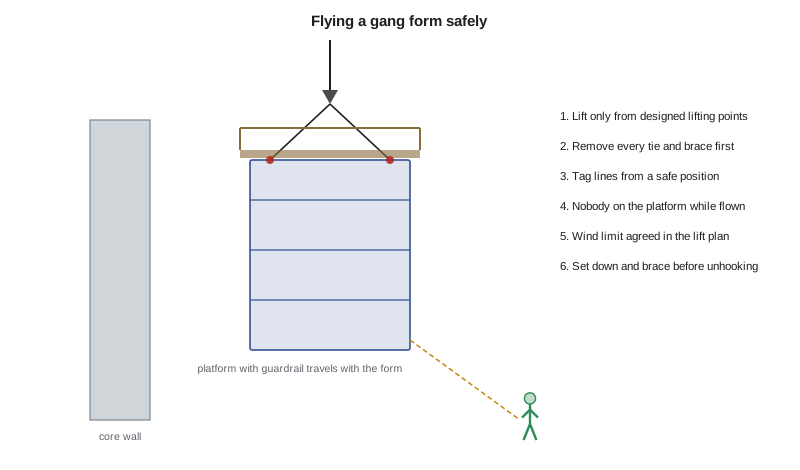
Core walls and columns are formed higher than a person can reach. Gang forms usually come with an integral working platform, with guardrails and toe boards, along the top. Workers reach it by ladders fixed to the form or by stair towers, not by climbing the walers and ties. A platform on a gang form must be complete and fastened before the form is used, and it travels with the form when the crane moves it. Workers do not ride the platform while the form is being flown unless the system is specifically designed for it and the lift plan allows it.
Gang forms and flying forms
Gang forms are large panels assembled from smaller ones and moved as a single unit by crane. Flying forms, or table forms, are complete deck sections that are rolled out from under a cured slab and lifted to the next level. Both save time and labour, and both bring crane hazards to the forming crew: heavy loads, large surfaces that catch the wind, and workers who must guide and connect the forms at height.
- Rigging. Gang and flying forms are lifted only from the lifting points the manufacturer designed, with the rigging shown on the lift drawing. Ordinary form hardware is not a lifting point.
- Release before lifting. All ties, braces and connections to the structure must be removed before the lift. A form still tied to the wall, even at one point, can tear free under crane load and swing, or overload the crane.
- Wind. A large gang form acts like a sail. A form that is easy to control in still air can spin, swing or pull workers off their feet in a gust. Crane and forming crews agree a wind limit for flying forms before the work starts.
- Tag lines. Workers control the form with tag lines from a safe position, never by putting hands or bodies between the form and the structure.
- No riding. Workers are not on the form or its platform while it is flown, unless the system and lift plan allow it.
- Landing. The form is set down and secured, braced or tied before the rigging is released.
The program below shows why the wind limit matters. It estimates the wind force on a gang form at different wind speeds, using a simple formula for wind pressure on a flat surface. The force grows with the square of the wind speed, so doubling the speed quadruples the force.
# Wind force on a gang form (simple estimate; the lift plan sets the real limit).
area = 3.0 * 6.0               # m2, panel face
weight = 2.2                   # tonnes, from the form drawing
cf = 1.2                       # shape factor for a flat panel (typical)
site_limit = 30                # km/h, Tallgrass rule for flying gang forms (invented)
for kmh in [10, 20, 30, 40, 50]:
    v = kmh / 3.6              # m/s
    q = 0.613 * v ** 2         # Pa, dynamic pressure
    force = q * cf * area / 1000   # kN
    pct = force / (weight * 9.81) * 100
    flag = "" if kmh <= site_limit else "  <- above site limit: do not fly"
print(f"{kmh:3} km/h: {force:4.1f} kN sideways ({pct:3.0f}% of form weight){flag}")10 km/h: 0.1 kN sideways ( 0% of form weight) 20 km/h: 0.4 kN sideways ( 2% of form weight) 30 km/h: 0.9 kN sideways ( 4% of form weight) 40 km/h: 1.6 kN sideways ( 8% of form weight) <- above site limit: do not fly 50 km/h: 2.6 kN sideways ( 12% of form weight) <- above site limit: do not fly
At the site limit, the average wind pushes the form sideways with a force of about 4 percent of its weight, roughly what one worker on a tag line can hold. Above the limit the force climbs fast, and gusts can be far stronger than the average speed. A sudden sideways push on a hanging load the size of a garage door is enough to spin it, drag a worker off balance or swing it into the structure. The figures are simple estimates, and the crane and form manufacturers' instructions and the lift plan set the actual limits.
Form ties, snap ties and hardware
Wall forms are held together against the pressure of the concrete by ties that pass through the wall and walers that spread the load. Ties are rated, and the formwork drawings show their type and spacing. Using the wrong tie, leaving one out or overtightening one can cause a blowout during the pour. During stripping, the projecting ends of snap ties and cut-off tie rods are sharp and sit at face and hand height. They are snapped off or capped as soon as the forms come off. Loose hardware, such as wedges, pins and clamps, is a falling-object hazard at height and a trip hazard on the deck, so crews keep it in buckets or bags and clear the deck as they go.
Form oil, nailers and saws
Release agents, or form oil, are sprayed on forms so the concrete does not stick. They can make deck surfaces very slippery, and some are irritating to skin and eyes. Crews apply them before forms are set where possible, follow the safety data sheet, and do not spray on a deck others are walking on. Pneumatic nailers, powder-actuated tools and circular saws are used constantly in forming. Their rules, from HSE-370 and TRD-104, apply here: sequential-trigger nailers for most framing, training and authorization for powder-actuated tools, and guards in place on saws.
Moving forming material up the building
Every floor cycle moves tonnes of forming material up the building: beams, joists, plywood, shores, edge brackets and guardrail posts. Most of it goes up on the crane hook in bundles, landed either on the new deck or on a cantilevered loading platform fixed to the slab edge. Each step is a chance for a struck-by or fall injury.
- Bundle securely. Loose plywood sheets and short shores slide out of slings. Bundles are banded or placed in purpose-made baskets and cradles, and long items are rigged with two slings so they cannot tip out.
- Use the loading platform properly. The platform has its own rated capacity, guardrails on three sides and a gate on the open side. Workers stay behind the gate or tie off while a load comes in, and nobody leans out to grab a swinging bundle.
- Keep the drop zone clear. The area below a lift, and below the deck edge where material is being landed or stripped, is barricaded so no one walks under a load.
- Do not overload the new deck. Land forming material only where the drawings allow and spread it out, for the same reasons as in lesson 2.
Material that will be needed for days is stacked away from the edges and openings, low enough that it cannot blow over, and tied down when wind is forecast. Plywood sheets are among the most dangerous things on a windy deck: a single sheet caught by a gust can knock a worker over the edge or fly off the building onto the street.
Inspecting formwork every day
Besides the formal inspection before a pour, the forming foreman checks the work area at the start of each shift. The daily check covers the guardrails and covers, anchor points, ladder and stair access, the condition of any shoring already erected, material stored on the deck, and any changes made by other trades since the last shift, such as a missing cover over an opening the plumbers used yesterday. Problems are fixed before work starts. The check takes ten minutes, and it is the reason the crew does not find out about a missing cover by stepping on it.
Worked problem
The last tie
Show solution
- A gang form on the elevator core at level 5 is ready to be flown up to level 6. The crane takes up the slack on the rigging.
- As the operator, Ray Lindqvist, starts to lift, the load cell shows the load climbing well past the form weight on the lift plan, and the form does not move.
- Ray stops the lift and lowers the load to zero tension. The signaller asks the crew to check the form.
- A carpenter finds one through-tie near the bottom of the panel that was missed during release because it was hidden behind a waler.
- The tie is removed, the crew walks the whole panel again, and the lift goes ahead. The forming foreman adds a step to the release checklist: two people count the ties against the drawing before each lift.
Answer: A form still tied to the structure can overload the crane or tear free and swing. Every tie and brace is released and counted before the lift.
Common mistakes
MistakeTying off to rebar, shore heads or form hardware.
InsteadUse anchors rated for fall arrest, such as those designed into the forming system.
MistakeRemoving a hole cover and walking away for a minute.
InsteadGuard the opening while it is open and refasten the cover before leaving.
MistakeSteadying a flying form by hand near the structure.
InsteadUse tag lines from a safe position and stay out of pinch points.
MistakeFlying gang forms in gusty wind to stay on schedule.
InsteadStop when the wind reaches the limit in the lift plan.
MistakeClimbing walers and ties to reach the top of a wall form.
InsteadUse the fixed ladder or stair tower to reach the form's working platform.
Summary and key terms
- Falls are the biggest hazard for formwork crews; Manitoba requires fall protection at 3 metres or more and over hazards at any height.
- Guardrails attached to the forming system protect deck edges from the start; fall arrest uses rated anchors where guardrails are not yet possible.
- Hole covers are strong, secured and marked, and are refastened by anyone who removes them.
- Gang and flying forms are lifted only from designed points, with every tie released, tag lines used, no riders and a wind limit.
- Ties and hardware follow the drawings; projecting tie ends are removed or capped after stripping.
- A daily check of guardrails, covers, anchors, access and changes by other trades prevents most surprises.
- Gang form
- A large form panel assembled from smaller ones and moved as one unit by crane.
- Flying form
- A complete deck form section, also called a table form, moved from floor to floor as a unit.
- Form tie
- A rated tension member that passes through a wall form and holds the two sides together against concrete pressure.
- Waler
- A horizontal member on a wall form that spreads tie loads across the form.
- Release agent
- A coating, often called form oil, that stops concrete from sticking to forms.
- Positioning device system
- A body belt or harness system that holds a worker in place on a vertical surface such as a wall form, leaving both hands free.
Practice problems
Work each problem on paper first, then reveal the answer to check.
Why are guardrails preferred over personal fall arrest at deck edges?
Show answer
They protect everyone at once, without depending on each worker clipping on correctly.
What makes a hole cover adequate?
Show answer
It is strong enough for at least twice the expected load, secured against moving and clearly marked.
Why must every tie be removed before a gang form is flown?
Show answer
A tie still holding the form can overload the crane or make the form tear free and swing.
At 40 km/h (25 mph), how does the wind force on a form compare with 20 km/h (12.5 mph)?
Show answer
About four times as large, because wind force grows with the square of the speed.
What does the daily formwork check cover?
Show answer
Guardrails, covers, anchors, access, existing shoring, stored material and changes made by other trades.
Lesson quiz · 5 questions
Score 60% or more to complete this lesson.
Create a free account to save your progress, take quizzes and earn a certificate.