
HSE-103 · Lesson 12 of 12 · 25 min
Reviewing and updating assessments, and capstone
A hazard assessment is a snapshot of the work at one point in time. Work changes, equipment ages, people come and go, new information emerges, and controls degrade. An assessment that is not reviewed gradually becomes a false comfort: a document that says hazards are controlled when they no longer are. This final lesson covers when and how to review assessments, learning from incidents and near misses, using measurement and audits, keeping documentation useful, building assessment into a management system, and the capstone project, in which you carry out and present a complete hazard and risk assessment.
As a reminder, this awareness-level course does not replace the site-specific hazard assessments your employer must carry out under provincial, territorial or federal law, or the training your employer must provide on your work.
When to review
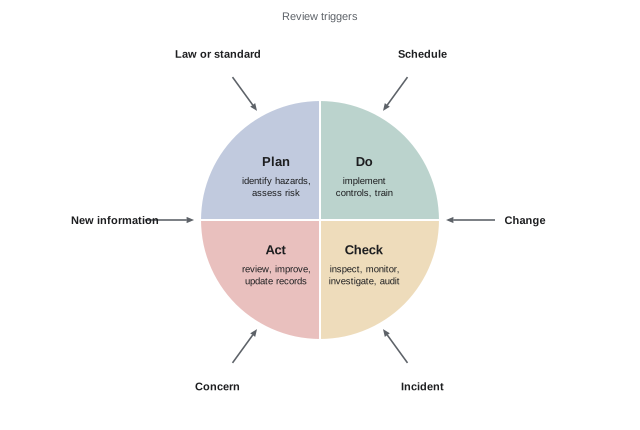
Assessments should be reviewed:
- On a schedule, such as annually or every one to three years, depending on the level of risk and legal requirements.
- When work changes: new equipment, processes, materials, layouts, staffing or procedures (Lesson 10).
- After incidents, near misses and occupational illnesses related to the work.
- When inspections, monitoring or audits find controls not working.
- When workers, supervisors or committees raise concerns.
- When new information becomes available: updated safety data sheets, new exposure limits, regulator alerts, industry incidents or new research.
- When laws, standards or codes change.
- Before seasonal changes, such as summer heat or winter ice, for outdoor work.
Some laws set specific triggers. Alberta's OHS Code requires repeating the hazard assessment at reasonably practicable intervals, when new processes are introduced, when processes or operations change and before significant site alterations; the federal hazard prevention program requires evaluation at least every three years and when conditions change.
How to review
A good review does not simply re-sign the existing document. It returns to the work: observe the task again, talk to the workers who do it, check that the steps in the assessment match reality, confirm that each control is in place and effective, and look for hazards that were missed or have appeared. Review incident and near miss reports, inspection findings, maintenance records, monitoring data and worker reports since the last review. Re-rate risks where conditions have changed. Identify improvements, including higher-level controls that have become practicable through new technology or budgets. Record what was reviewed, by whom, what changed and the actions required, and communicate the results.
Learning from incidents and near misses
Every incident or near miss is a test of the hazard assessment. Investigations should ask: Was the hazard identified in the assessment? Was the risk rated correctly? Were the planned controls in place and working? If not, why not? Did the assessment miss a task, condition or failure mode? Answers lead to changes in the assessment, the controls or the system that produces assessments. Effective investigations look beyond the immediate cause, such as "worker did not follow the procedure", to underlying causes, such as a procedure that was impractical, inadequate training, time pressure, missing equipment or a change made without review. Methods such as the "five whys", cause-and-effect diagrams and systematic causal analysis help reach these deeper causes. HSE stream courses on incident investigation cover these methods in depth.
Worked problem
Updating an assessment after a near miss
A warehouse JHA for "replenishing pick faces with a reach truck" lists hazards of falling loads and pedestrian collisions, controlled by speed limits, horn use and high-visibility vests. A near miss occurs: a pallet falls from the third level into an aisle while a picker is nearby. What should the review consider?
Show solution
- Investigate: the pallet was damaged and the load was not stretch-wrapped; the picker was working in the aisle because pick and replenishment were scheduled at the same time.
- Compare with the JHA: the hazard of falling loads was listed, but controls focused on behaviour; pallet condition and separation of picking and replenishment were not addressed.
- Re-rate the risk: a falling pallet can cause a fatality, so the severity is catastrophic and the likelihood is now known to be credible.
- Add higher-level controls: inspect and reject damaged pallets, require load wrapping, install aisle-entry barriers or presence detection so that pickers cannot be in an aisle during replenishment, and schedule replenishment separately.
- Update the JHA, procedures and training, and communicate the changes at toolbox talks.
Answer: The review should add pallet inspection and wrapping, physical separation of pickers from replenishment and scheduling changes, re-rate the risk as high-consequence, and update the JHA and training.
Measurement and audits
Measurement shows whether hazard assessment and control are working. Leading indicators include the percentage of planned assessments completed and reviewed on time, the number of hazards reported and closed, the time taken to close corrective actions, the percentage of critical controls verified, and participation in inspections and committees. Lagging indicators include injury and illness rates, serious incident counts and workers' compensation costs. Audits, carried out by internal teams or external auditors, examine whether the hazard assessment system meets legal and organizational requirements and whether it works in practice: are assessments specific, current and used, do controls match assessments, and do workers know about them? Audit findings feed back into improvements.
| Indicator | Type | What it shows |
|---|---|---|
| Assessments reviewed on schedule | Leading | Whether assessments stay current |
| Hazard reports closed within target | Leading | Responsiveness and trust |
| Critical controls verified | Leading | Control of serious hazards |
| Near miss reports | Leading or mixed | Reporting culture and emerging hazards |
| Recordable injury rate | Lagging | Past harm, mostly minor injuries |
| Serious injuries and fatalities | Lagging | Failures of control of serious hazards |
Keeping documentation useful
Documentation proves that assessments were done and helps people use them, but it can become a burden. Useful documentation is specific to the work, written in plain language, easy to find at the workplace, version-controlled with dates and reviewers, linked to procedures, training and permits, and concise enough to read. Avoid copying generic templates without adapting them, filling forms with vague entries, or storing assessments where workers cannot see them. Digital systems can help track reviews, actions and versions, and make assessments available on phones and tablets, but they should not replace walking the floor and talking with workers.
Building assessment into a management system
In mature organizations, hazard assessment is not a separate activity but part of an occupational health and safety management system based on the plan-do-check-act cycle described in ISO 45001, CSA Z1000 and ANSI/ASSP Z10. Leadership sets policy and provides resources; workers participate; hazards are identified and risks assessed proactively; controls are implemented using the hierarchy; competence and communication are ensured; performance is monitored; incidents are investigated; and management reviews results and drives improvement. Hazard assessment links to purchasing, design, contractor management, emergency preparedness and change management. Organizations seeking to improve can benchmark against these standards or seek certification, but the real measure is whether hazards are found and controlled before people are hurt.
Capstone: a complete hazard and risk assessment
The capstone asks you to apply the course to a real or realistic task or work area, ideally one you know well. Your submission should include:
- A description of the scope, the work, the people exposed (including contractors, new workers or others at higher risk) and the information sources used.
- A hazard identification using at least two methods, such as an inspection with a tailored checklist, an energy wheel review and worker interviews, covering all hazard categories from Lesson 3.
- A job hazard analysis of one key task, with 5 to 15 steps, hazards and controls.
- A risk rating of the main hazards before and after controls using a defined matrix, with a note on any high-consequence hazards and their critical controls.
- A control plan using the hierarchy of controls, explaining why higher-level controls were or were not chosen, with responsibilities, dates and verification methods.
- A brief management of change and review plan: what changes or events would trigger review, and when the next scheduled review is.
- A communication plan, including a short toolbox talk outline.
- A short summary of the legal requirements that apply in your jurisdiction.
Present the assessment as you would to a supervisor or joint health and safety committee, clearly and concisely.
Common review findings
Reviews of hazard assessments frequently uncover the same kinds of problems. Assessments describe equipment that has since been replaced, or omit tasks that have been added. Controls listed as in place are missing or degraded, such as a guard removed for maintenance and never refitted. Risk ratings were never revisited after incidents. Workers do not know the assessment exists or what it says. Actions from the last review remain open. New hazards, such as a recently introduced chemical, a change to lone work arrangements or an increase in aggressive customers, have not been added. Recording these findings and tracking them to completion is what turns a review into an improvement rather than a formality.
Sharing lessons across the organization
A hazard found or an incident investigated at one site is a lesson for every similar site. Organizations with several locations benefit from systems to share lessons learned: short safety alerts after significant incidents, summaries of investigation findings, reviews of whether the same hazard exists elsewhere, and regular forums where safety staff and committee members compare notes. Industry associations, regulators and safety organizations publish incident reports and alerts that serve the same purpose across companies. The key is to ask, each time a lesson arrives, "Could this happen here?" and to check assessments and controls accordingly.
Preparing your capstone presentation
When you present your capstone, start with the work and the people, not the forms: explain briefly what the job involves and who is exposed. Highlight the two or three most serious hazards and explain how you rated them, using your matrix. Describe the controls you recommend, emphasizing why you chose them over lower-level alternatives, and be honest about residual risk. Show your verification plan and the review triggers. Keep supporting material, such as the full JHA and inspection checklist, in an appendix that readers can consult if they want detail. Invite questions from workers and supervisors, and be ready to revise your assessment based on what they tell you; that willingness is itself a sign of a good assessor.
Where to go next
This course has introduced the core skills of hazard recognition and risk assessment. Other courses in the safety stream build on these skills for specific hazards and roles, including incident investigation, specific high-risk work such as working at heights, confined spaces and lockout, and supervisor responsibilities. Your employer must also provide training specific to your workplace, equipment and jurisdiction, and you should seek out that training and the site-specific assessments that apply to your work.
Keeping the cycle going
The greatest risk to a hazard assessment program is that it becomes a one-time project. Energy is high when a program is launched or after a serious incident, then fades as other priorities take over. Sustaining the cycle requires visible leadership commitment, assigned responsibilities for reviews, scheduled reminders, regular reporting of leading indicators to senior management, recognition for good hazard reporting and assessment work, and regular refresher training for assessors. Organizations that keep the cycle going find that hazards are caught earlier and incidents become rarer.
Above all, remember that an assessment is only as good as the conversation behind it. The best assessments come from people who know the work, look at it honestly, listen to one another and follow through on what they find.
Treat each review as a chance to make the work safer, not merely to update a date on a form.
Common mistakes
MistakeRe-signing assessments without looking at the work.
InsteadObserve the task and talk to workers at each review.
MistakeStopping investigations at "worker error".
InsteadFind underlying causes and update controls.
MistakeMeasuring only injury rates.
InsteadUse leading indicators and audits too.
MistakeStoring assessments where workers cannot see them.
InsteadMake them available at the workplace.
MistakeTreating assessment as separate from the safety system.
InsteadIntegrate it into plan-do-check-act.
Summary and key terms
- Assessments must be reviewed on schedule and after changes, incidents, concerns and new information.
- Reviews return to the work and check controls in practice.
- Incidents and near misses test the assessment and reveal underlying causes.
- Leading and lagging indicators and audits measure performance.
- Useful documentation is specific, current, accessible and concise.
- Assessment is part of a plan-do-check-act management system.
- The capstone brings identification, analysis, rating, control and review together.
- Review trigger
- Event or date that requires an assessment to be reviewed.
- Underlying cause
- Deeper system cause of an incident.
- Five whys
- Asking "why" repeatedly to reach root causes.
- Audit
- Systematic examination of whether a system meets requirements and works.
- Leading indicator
- Measure of proactive activity.
- Lagging indicator
- Measure of past harm.
- Version control
- Tracking document revisions with dates and authors.
- Plan-do-check-act
- Cycle of continual improvement.
- Management system
- Structured framework for managing health and safety.
- Capstone
- Final project applying the course.
Practice problems
Work each problem on paper first, then reveal the answer to check.
Name five triggers for reviewing an assessment.
Show answer
Schedule, change, incident, concern, new information, law change, season.
What should a review do besides re-signing?
Show answer
Observe the work, talk to workers and check controls.
What questions should an investigation ask about the assessment?
Show answer
Was the hazard identified, rated correctly and controlled?
Name a method for finding underlying causes.
Show answer
Five whys, cause-and-effect diagrams.
Give two leading indicators.
Show answer
Assessments reviewed on time, hazards closed, critical controls verified.
What does an audit examine?
Show answer
Whether the system meets requirements and works in practice.
Name three features of useful documentation.
Show answer
Specific, plain language, accessible, version-controlled, concise.
What does PDCA stand for?
Show answer
Plan, do, check, act.
Name three management system standards.
Show answer
ISO 45001, CSA Z1000, ANSI/ASSP Z10.
List four capstone components.
Show answer
Scope, hazard identification, JHA, risk rating, control plan, review plan, communication.
Lesson quiz · 5 questions
Score 60% or more to complete this lesson.
Create a free account to save your progress, take quizzes and earn a certificate.