
GCP-110 · Lesson 4 of 12 · 19 min
Tokens, context windows and model parameters
▶ Video coming soon A video version of this lesson is on the way.
Dana Leclair sends Jules a pricing page and one question: "What is a token, and why are we paying per million of them?" It is a fair question, and the answer turns out to explain much more than the bill. Tokens decide how much a model can read at once, how long its answers can be, how fast it responds and what it costs. This lesson covers tokens, context windows, the two meanings of the word parameter, and the settings that control how a model chooses its words.
Tokens
Language models do not read letters or whole words. They read tokens: chunks of text produced by a tokenizer, the component that splits input into pieces the model knows. A token is often a whole common word, part of a longer word, a punctuation mark or a space attached to a word. "Waterproof" might be one token or two; "Birchline" is probably split into several, because it is rare. Numbers, code and text in other languages often split into more tokens than everyday English.
Every token maps to an ID number in the model's vocabulary, which might contain a few hundred thousand entries. The model works entirely with these IDs and the patterns it learned among them. When it writes an answer, it produces one token at a time, each chosen based on everything before it. That is why responses appear word by word in a chat window: the model is literally generating them in sequence.
Images, audio and video are tokenized too. An image is divided into patches, and audio and video into short segments, each represented as tokens the model can process alongside text. The exact counts vary by model and settings, and providers document them.
A rough rule for English is that a token averages about three-quarters of a word, or equivalently about 1.3 tokens per word. Ravi warns Jules that this is only a planning rule. The real count depends on the tokenizer, and most model providers offer a token-counting tool or API so teams can measure exactly.
# A toy tokenizer: split text into known pieces, falling back to single letters.
vocab = ["water", "proof", "rain", "jacket", " ", "s", "the", "light", "weight", ".", ","]
vocab.sort(key=len, reverse=True)        # try longer pieces first

def tokenize(text):
    tokens, i = [], 0
    while i < len(text):
        for piece in vocab:
            if text.startswith(piece, i):
                tokens.append(piece); i += len(piece); break
        else:
            tokens.append(text[i]); i += 1   # unknown character becomes its own token
    return tokens

for phrase in ["waterproof rain jackets", "lightweight", "birchline"]:
    t = tokenize(phrase)
print(len(t), "tokens:", t)7 tokens: ['water', 'proof', ' ', 'rain', ' ', 'jacket', 's'] 2 tokens: ['light', 'weight'] 9 tokens: ['b', 'i', 'r', 'c', 'h', 'l', 'i', 'n', 'e']
What this code does
A tiny tokenizer splits text into pieces from a small vocabulary, always trying the longest matching piece first and falling back to single letters. Common words split into a few meaningful pieces, while an unfamiliar name breaks into individual letters. It shows why unusual words use more tokens.
The toy vocabulary is tiny, so the unfamiliar word "birchline" breaks into single letters, which is exactly why rare names and unusual words cost more tokens in real models. Real tokenizers learn their vocabularies from data, so common words become single tokens and rare ones split into a few pieces rather than letters.
Why tokens matter for cost and speed
Most generative AI services charge by the token, usually with separate prices for input tokens (everything sent to the model: instructions, documents, conversation history, images) and output tokens (everything the model writes back). Output tokens usually cost more, because generating them takes more computing work. Larger, more capable models cost more per token than smaller ones.
Speed follows tokens too. The time to the first token depends on how much input the model must process, and the time to finish depends on how many output tokens it writes. A shopping assistant that pastes the whole catalogue into every request will be slow and expensive; one that sends only the relevant products will be fast and cheap.
# Estimate monthly cost for two Birchline workloads. Prices are illustrative
# planning figures in US dollars per million tokens, not published rates.
PRICE = {"large": {"in": 1.25, "out": 10.00}, "small": {"in": 0.10, "out": 0.40}}

def monthly(model, requests, tokens_in, tokens_out):
    p = PRICE[model]
    return requests * (tokens_in * p["in"] + tokens_out * p["out"]) / 1_000_000

email = monthly("small", 20_000, 600, 20)       # classify emails into queues
descr = monthly("large", 300, 1_500, 400)       # draft product descriptions
chat_large = monthly("large", 90_000, 2_500, 250)
chat_small = monthly("small", 90_000, 2_500, 250)
print("email sorting, small model:", round(email, 2))
print("descriptions, large model:", round(descr, 2))
print("assistant, large vs small:", round(chat_large, 2), "vs", round(chat_small, 2))email sorting, small model: 1.36 descriptions, large model: 1.76 assistant, large vs small: 506.25 vs 31.5
What this code does
A function estimates monthly cost from the number of requests and the tokens going in and out, using illustrative prices per million tokens for a large and a small model. The program costs two workloads and then compares the shopping assistant on both models. The large model would cost about 506 a month against about 32 for the small one.
With these illustrative prices the email sorting and descriptions cost little, and the shopping assistant is the line to watch because of its volume. Dana circles the comparison between a large and a small model for the assistant: it is the kind of choice evaluation should settle, by testing whether the small model is good enough before paying for the large one.
Context windows
The context window is the maximum number of tokens a model can consider in a single request, counting the input and, for most models, the output it generates. Everything the model knows about the current task must fit inside it: the instructions, any documents or examples, the conversation so far, images and the answer.
Context windows have grown dramatically, from a few thousand tokens in early models to hundreds of thousands and, for some Gemini models, a million tokens or more. A million tokens is roughly the length of several long novels, a large codebase or hours of audio. Large windows make it possible to give a model an entire manual or a long contract in one request.
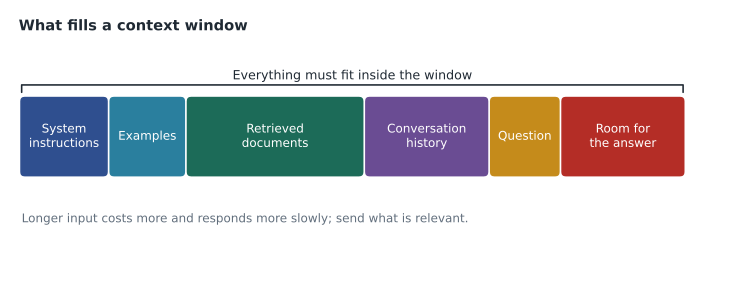
A large window is not a reason to send everything. Longer inputs cost more and respond more slowly, and models can pay less attention to details buried in the middle of very long inputs. Good design still selects what is relevant. Lesson 6 introduces retrieval-augmented generation, which finds the most relevant passages and sends only those.
When a conversation exceeds the window, something must give. Applications typically drop or summarize the oldest turns. Models do not remember previous conversations on their own; any memory an assistant appears to have is the application sending earlier messages, or saved notes, back in each new request.
Two meanings of parameters
Jules notices that "parameters" is used in two different ways, and Ravi confirms that the exam uses both.
Model parameters (also called weights) are the internal numbers a model learns during training. A model with billions of parameters has billions of adjustable values that together encode what it learned. More parameters generally allow more capability but require more memory and computing power to run, which is why smaller models are cheaper and faster. Customers never set these directly; training and tuning change them.
Generation parameters (also called sampling settings or inference parameters) are settings the caller chooses for each request to control how the model produces its output. They do not change the model; they change how it picks tokens. The main ones are temperature, top-p, top-k, maximum output tokens, stop sequences and safety settings.
How a model chooses each token
At every step, a model computes a score for every token in its vocabulary, converts the scores into probabilities and then picks one token. Always picking the most probable token gives predictable but sometimes repetitive text. Sampling from the probabilities gives more varied text. Generation parameters control that choice.
Temperature reshapes the probabilities before sampling. A low temperature, near zero, sharpens them so the most likely tokens dominate: output becomes focused, consistent and close to deterministic. A higher temperature flattens them so less likely tokens get more chances: output becomes more varied and creative, and also more likely to wander or make mistakes.
import math
scores = {"durable": 2.0, "rugged": 1.5, "lightweight": 1.0, "sparkly": -1.0}

def probabilities(scores, temperature):
    exp = {w: math.exp(s / temperature) for w, s in scores.items()}
    total = sum(exp.values())
    return {w: round(v / total, 3) for w, v in exp.items()}

for t in (0.2, 1.0, 2.0):
print("temperature", t, probabilities(scores, t))temperature 0.2 {'durable': 0.918, 'rugged': 0.075, 'lightweight': 0.006, 'sparkly': 0.0}
temperature 1.0 {'durable': 0.494, 'rugged': 0.3, 'lightweight': 0.182, 'sparkly': 0.025}
temperature 2.0 {'durable': 0.383, 'rugged': 0.299, 'lightweight': 0.233, 'sparkly': 0.086}What this code does
Scores for four candidate words are turned into probabilities, with a temperature setting that controls how evenly the chance is spread. At a low temperature the top word gets almost all the probability, while higher temperatures give the other words more of a chance. This is how the temperature setting makes output more predictable or more varied.
At temperature 0.2 nearly all the probability goes to "durable", the top choice. At 2.0 even "sparkly", an odd word for hiking boots, gets a real chance. That is the whole intuition: low temperature for facts, extraction and classification; moderate temperature for natural writing; higher temperature for brainstorming.
Top-k limits sampling to the k most likely tokens; with top-k set to 3, only the three best candidates can be chosen. Top-p (nucleus sampling) limits sampling to the smallest set of tokens whose probabilities add up to p; with top-p of 0.9, the model chooses only among tokens that together make up 90 out of every 100 parts of the probability. Top-p adapts to the situation: when the model is confident, few tokens qualify; when it is unsure, more do.
# Which candidate tokens survive top-k and top-p filters?
probs = {"durable": 0.55, "rugged": 0.25, "lightweight": 0.12, "comfy": 0.05, "sparkly": 0.03}
ranked = sorted(probs.items(), key=lambda kv: kv[1], reverse=True)

def top_k(k):
    return [w for w, _ in ranked[:k]]

def top_p(p):
    kept, running = [], 0.0
    for w, pr in ranked:
        kept.append(w); running += pr
        if running >= p: break
    return kept

print("top-k 2:", top_k(2))
print("top-p 0.8:", top_p(0.8))
print("top-p 0.95:", top_p(0.95))top-k 2: ['durable', 'rugged'] top-p 0.8: ['durable', 'rugged'] top-p 0.95: ['durable', 'rugged', 'lightweight', 'comfy']
What this code does
Five candidate words are ranked by probability. Top-k keeps a fixed number of the best words, while top-p keeps adding words until their combined probability reaches the target. The output shows which words survive each filter and are allowed to be chosen.
Maximum output tokens caps how long a response can be, which controls cost and stops runaway answers; set it too low and answers are cut off mid-sentence. Stop sequences are strings that end generation when produced, useful when an application expects a fixed format. Safety settings adjust how strictly the service blocks content in categories such as harassment, hate speech, sexually explicit material and dangerous content; Birchline keeps them at the defaults or stricter for anything customer-facing.
| Setting | What it controls | Lower values | Higher values | Birchline starting point |
|---|---|---|---|---|
| Temperature | Randomness of token choice | Focused, consistent | Varied, creative | Low for email sorting; moderate for descriptions |
| Top-k | How many top candidates can be chosen | Safer, more repetitive | More variety | Provider default |
| Top-p | Share of probability mass considered | Narrow, predictable | Broader choice | Provider default |
| Max output tokens | Length limit of the answer | Short, cheaper, may truncate | Longer, costlier | About 300 for a description |
| Safety settings | How strictly harmful content is blocked | Stricter blocking | Looser blocking | Default or stricter for customers |
Ravi's rule of thumb is to change one setting at a time and evaluate the effect on real examples. Providers tune defaults sensibly, and many problems blamed on settings are really problems with the prompt or the data.
Determinism and repeatability
Even at temperature zero, outputs can vary slightly between runs because of how computations are spread across hardware, and models are periodically updated. Leaders should not design processes that assume a model will give exactly the same words every time. When repeatability matters, such as for classification labels or extracted fields, use low temperature, ask for structured output with a fixed set of allowed values, pin a specific model version where the platform allows it, and validate every response in code.
Common mistakes
MistakeAssuming a token is a word.
InsteadTokens are pieces of text; a word may be one token or several, and rare words split into more.
MistakeFilling a large context window because it is available.
InsteadLonger inputs cost more and respond slower; send only what is relevant.
MistakeConfusing model parameters with generation parameters.
InsteadModel parameters are learned weights; generation parameters are per-request settings such as temperature.
MistakeRaising temperature to fix wrong facts.
InsteadTemperature controls randomness; wrong facts need grounding and better prompts, and usually lower temperature.
Worked problem
Choosing settings for three tasks
Jules must configure three requests: extracting the fabric and weight from supplier PDFs, drafting a product description, and brainstorming twenty names for a new tent line. What temperature and output limits fit each?
Show solution
- Extraction needs the same answer every time and no invention: temperature near zero, a structured output format and a short output limit.
- A description needs fluent, natural writing that stays faithful to the specifications: a low to moderate temperature and an output limit around the target length.
- Brainstorming values variety: a higher temperature and an output limit large enough for twenty names.
Answer: Near-zero temperature for extraction, low to moderate for descriptions, higher for brainstorming, each with an output limit matched to the task.
Summary and key terms
- Models read and write tokens, pieces of text produced by a tokenizer, and also tokenize images, audio and video.
- Services charge separately for input and output tokens, and token counts drive speed as well as cost.
- The context window is the most a model can consider in one request, including room for its answer; large windows help but relevant input is still better.
- Model parameters are learned weights, while generation parameters are per-request settings.
- Temperature, top-k and top-p control how tokens are sampled; maximum output tokens, stop sequences and safety settings control length, format and blocking.
- Outputs are not perfectly repeatable, so validate them.
- Token
- A piece of text, or of other media, that a model reads or writes.
- Tokenizer
- The component that splits input into tokens from a fixed vocabulary.
- Context window
- The maximum number of tokens a model can consider in one request.
- Model parameters
- The internal weights a model learns during training.
- Temperature
- A setting that controls how random token choices are.
- Top-k
- Sampling only from the k most likely tokens.
- Top-p
- Sampling only from the smallest set of tokens whose probabilities reach p.
- Maximum output tokens
- The limit on how many tokens a response may contain.
Practice problems
Work each problem on paper first, then reveal the answer to check.
Why does a rare brand name cost more tokens than a common word?
Show answer
The tokenizer splits rare words into several smaller pieces.
Does a model remember yesterday's conversation by itself?
Show answer
No. Any memory comes from the application sending earlier messages or saved notes back in the request.
Which setting would you lower to make classification labels more consistent?
Show answer
Temperature, ideally together with a fixed list of allowed labels.
Lesson quiz · 5 questions
Score 60% or more to complete this lesson.
Create a free account to save your progress, take quizzes and earn a certificate.