
GCP-110 · Lesson 3 of 12 · 19 min
Multimodal models and the Gemini family
▶ Video coming soon A video version of this lesson is on the way.
Jules arrives at the third session with his phone. Over the weekend he photographed a customer's returned hiking boot, its sole peeling at the toe, and asked an AI assistant what had gone wrong. The assistant described the separation, guessed at the cause and suggested how the return should be coded. "It read a photo and answered in words," he says. "That is not the same as a chatbot." Ravi agrees, and uses the example to introduce multimodal models and the family of models Google offers on Google Cloud.
What multimodal means
A modality is a kind of data: text, images, audio, video and code are each modalities. A multimodal model can take in, and in some cases produce, more than one modality. It can read a photo and a question together and answer in text; listen to a recorded call and summarize it; watch a video and list what happens in each scene; or read a chart in a PDF and explain the trend.
Early AI systems handled modalities separately: one model for speech recognition, another for image labels, another for text, connected by code that passed outputs from one to the next. A natively multimodal model is trained on several modalities together from the start, so it can reason across them directly. When the boot photo and the question "Is this a manufacturing defect or wear?" go in together, the model can relate the visible damage to the words.
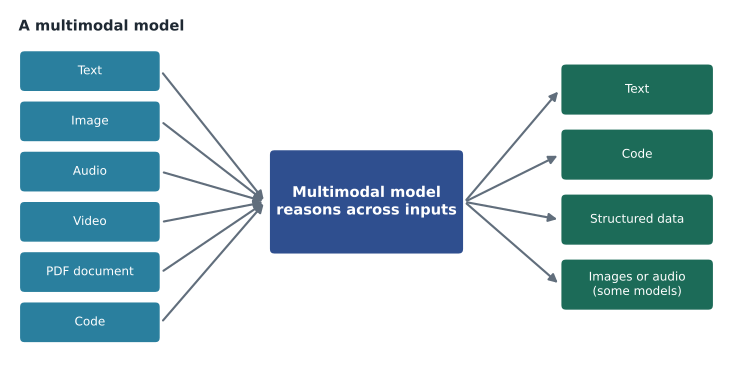
For a business, multimodality matters because so much information is not text. Birchline's shop has 140,000 product photos, store managers send pictures of damaged deliveries, the help desk records calls, and suppliers send specifications as scanned PDFs. A multimodal model can work with all of these without first converting each into text by a separate system.
| Input | Example task | Typical output |
|---|---|---|
| Image and text | Describe this jacket for a product page in Birchline's style | A draft description |
| Image | Does this delivery photo show crushed boxes? | A yes or no with a short reason |
| Audio | Summarize this recorded help desk call and list follow-ups | A summary and action list |
| Video | List the steps shown in this tent-pitching video | Numbered steps with timestamps |
| PDF document | Extract the fabric, weight and warranty from this supplier sheet | Structured fields |
| Text | Write an image prompt for a winter campaign banner | Text that an image model can use |
Google's foundation models
Google builds several families of foundation models and offers them on Google Cloud. The Generative AI Leader exam guide names four that leaders should be able to match to use cases: Gemini, Gemma, Imagen and Veo. Model versions and sizes change frequently, so Ravi advises learning what each family is for rather than memorizing version numbers.
Gemini
Gemini is Google's flagship family of multimodal models. Gemini models were designed from the start to work with text, images, audio, video and code, and they can reason across these inputs together. They are offered in several sizes, from larger models suited to complex reasoning, coding and long documents to smaller, faster and cheaper models suited to high-volume tasks such as classification or quick replies. Gemini models support very large context windows, so they can consider long documents, large codebases or long recordings in a single request; lesson 4 explains what that means.
Gemini appears in many places. It powers the Gemini app that consumers use, Gemini in Google Workspace that helps staff write and summarize in Gmail and Docs, Gemini Enterprise for organizations, and coding tools such as Gemini Code Assist. Developers reach Gemini models on Google Cloud through the Gemini Enterprise Agent Platform (earlier materials call it Vertex AI) and through Google AI Studio. GCP-111 tours these products; this course concentrates on what the models can do.
For Birchline, Gemini is the natural candidate for the shopping assistant, the description writer and the review summaries, because these tasks involve language, product photos and long collections of text. Ravi's plan is to test a larger and a smaller Gemini model on each task and pick by measured quality, speed and cost.
Gemma
Gemma is Google's family of lightweight open models, built from the same research and technology as Gemini. Gemma models publish their parameters, so organizations can download them, run them on their own hardware, on Google Cloud or even on laptops and phones, and tune them for specialized tasks under the Gemma terms of use. Because they are smaller, they need less computing power to run.
Gemma suits situations where an organization wants control: running a model where data must not leave a particular environment, tuning a small model deeply for one narrow job, building something that must run offline, or keeping costs predictable at very high volumes. Farah mentions that Birchline's stores have unreliable internet in a few mountain towns, and a small model that runs on a store device is one way to keep a simple product lookup working there.
Imagen
Imagen is Google's family of text-to-image diffusion models. Given a written description, Imagen generates new images; it can also edit images, for example changing a background or extending a scene. Marketing teams use image generation for campaign concepts, mood boards, product backgrounds and variations of a design.
Jules is enthusiastic until Teresa joins the conversation. Generated images raise questions a retailer must answer before using them: whether a generated image could mislead a customer about what a product actually looks like, how generated images are labelled, and how intellectual property is respected. Google applies SynthID, an invisible digital watermark, to images generated by its models so that they can be identified as AI-generated later. Birchline decides that generated images may be used for campaign backgrounds and concepts, never as a substitute for real photographs of the product a customer will receive.
Veo
Veo is Google's family of video generation models. It creates short video clips from text descriptions or from images, with control over style and camera movement, and newer versions can generate sound with the video. Uses include advertising concepts, social media content, storyboards and training material. As with images, generated video carries a SynthID watermark, and the same honesty rules apply: a generated clip of a tent standing up to a storm must not be presented as a real product test.
| Model family | What it is | Good fit | Birchline example |
|---|---|---|---|
| Gemini | Multimodal models in several sizes, offered through Google services and APIs | Reasoning, writing, summarizing, coding, understanding images, audio, video and long documents | Shopping assistant, description drafts, review summaries |
| Gemma | Lightweight open models built from Gemini research | Running locally or on own infrastructure, deep tuning for narrow tasks, cost control at scale | A small product lookup model on store devices |
| Imagen | Text-to-image diffusion models | Generating and editing images from descriptions | Campaign backgrounds and concept art |
| Veo | Video generation models | Short clips from text or images | Storyboards for a spring campaign video |
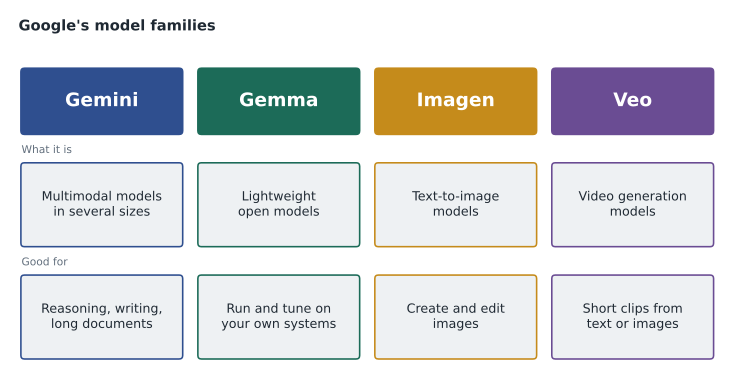
Google offers other specialized models as well, for example for speech and for music, and Model Garden lists models from other companies too. The four above are the ones leaders are expected to know by name and use case.
Capabilities that cross modalities
Ravi shows Jules three capabilities that only make sense with multimodal models, because they change what Birchline can automate.
Visual question answering. A store manager photographs a shelf and asks which items are missing labels. The model reads the image and answers in text. The same capability can check that a product photo matches its listing, for example that a jacket labelled red is actually red.
Document understanding. Supplier specification sheets arrive as scanned PDFs with tables, logos and handwritten notes. A multimodal model can read the whole page, including the table layout, and extract fields such as fabric, weight and care instructions into structured data. Previously this needed a separate optical character recognition system plus hand-built rules for every supplier's format.
Long-media summarization. A one-hour recorded supplier meeting or a set of help desk calls can be summarized in one request when the model's context window is large enough, with timestamps for the moments that matter.
# Estimate how much of a model's context a mixed request uses.
# The rates below are illustrative planning figures, not published limits.
TOKENS_PER_WORD = 1.3          # rough average for English text
TOKENS_PER_IMAGE = 260         # illustrative cost of one small image
TOKENS_PER_AUDIO_MINUTE = 2000 # illustrative cost of one minute of audio

request = {"instruction words": 120, "spec sheet words": 900,
           "product photos": 4, "call recording minutes": 6}

total = (request["instruction words"] + request["spec sheet words"]) * TOKENS_PER_WORD
total += request["product photos"] * TOKENS_PER_IMAGE
total += request["call recording minutes"] * TOKENS_PER_AUDIO_MINUTE
print("estimated input tokens:", round(total))
for window in (32_000, 128_000, 1_000_000):
print(f"share of a {window:,}-token window: {total / window:.3f}")estimated input tokens: 14366 share of a 32,000-token window: 0.449 share of a 128,000-token window: 0.112 share of a 1,000,000-token window: 0.014
What this code does
Rough planning rates convert each part of a request into tokens: words of text, product photos and minutes of audio. The program adds them up to estimate the total input, about 14,400 tokens. It then shows what share of three different context window sizes that request would fill.
The rates are illustrative, and real token costs for images, audio and video depend on the model and its settings, which the provider documents. The point is the habit: before designing a multimodal workflow, estimate how much input each request carries, because input size drives both cost and whether the request fits at all.
Limits of multimodal models
Multimodality widens what models can do, but it does not remove their weaknesses. A model can misread a blurry photo, miscount small objects, misjudge colours under poor lighting, or invent details that are not in an image. Audio transcription degrades with background noise and strong accents. Generated images can contain distorted text or impossible details. And because more kinds of input are sensitive, privacy questions multiply: a photo of a store may include customers' faces, and a recorded call contains a customer's voice and personal details.
Teresa adds two rules to Birchline's draft AI policy as a result. Images and recordings that include customers must be handled under the same privacy rules as other personal information, including PIPEDA and, for Quebec shoppers, Law 25. And any automated decision based on an image, such as approving a return, must be reviewable by a person.
Common mistakes
MistakeAssuming multimodal means the model can generate every kind of media.
InsteadMany multimodal models take many kinds of input but produce mainly text; image and video generation use models such as Imagen and Veo.
MistakeMemorizing model version numbers.
InsteadVersions change often; learn what each family is for and test current versions on real tasks.
MistakeUsing generated product images as if they were photographs.
InsteadGenerated images can mislead customers about what they will receive; use real photos for products and label generated content.
MistakeForgetting that images and audio can be personal information.
InsteadFaces and voices in photos and recordings need the same privacy care as other personal data.
Choosing a size within a family
Within the Gemini family, the choice between a larger and a smaller model is usually a trade between quality on hard tasks and speed and cost on easy ones. Ravi tests both sizes on the same twenty examples of each task. For the review digest, the smaller model misses subtle complaints buried in long reviews, so the larger one earns its price. For tagging product photos with colour and category, the smaller model is as accurate and answers several times faster. Many teams end up using two or three sizes in one application, sending each request to the cheapest model that handles it well, a pattern sometimes called model routing.
Worked problem
Picking a model family for four requests
The marketing team asks for: concept art for a winter campaign; a ten-second social clip of a campsite at dusk; answers to staff questions using the 300-page operations manual; and a small model that keeps working in stores with poor internet. Which Google model family fits each?
Show solution
- Concept art from a description is text-to-image generation: Imagen.
- A short clip from a description is video generation: Veo.
- Answering questions about a long manual needs strong language understanding and a large context window: Gemini.
- A small model that runs locally on store devices points to a lightweight open model: Gemma.
Answer: Imagen for the art, Veo for the clip, Gemini for the manual and Gemma for the offline store model.
Summary and key terms
- A modality is a kind of data such as text, images, audio, video or code, and a multimodal model works with several together.
- Natively multimodal models reason across inputs directly, which suits the many images, recordings and documents organizations hold.
- Gemini is Google's flagship multimodal model family in several sizes with large context windows.
- Gemma is a family of lightweight open models for running and tuning on your own infrastructure.
- Imagen generates and edits images from text, and Veo generates video.
- Generated media carries a SynthID watermark, and must not mislead customers.
- Multimodal models can still misread inputs and raise extra privacy questions.
- Modality
- A kind of data, such as text, images, audio, video or code.
- Multimodal model
- A model that takes in, and sometimes produces, more than one modality.
- Gemini
- Google's family of multimodal foundation models offered in several sizes.
- Gemma
- Google's family of lightweight open models built from Gemini research.
- Imagen
- Google's family of text-to-image generation models.
- Veo
- Google's family of video generation models.
- SynthID
- Google's invisible watermark for identifying AI-generated content.
- Document understanding
- Extracting meaning and fields from documents, including layout and tables.
Practice problems
Work each problem on paper first, then reveal the answer to check.
A store manager photographs a damaged delivery and asks whether the boxes are crushed. What capability is this?
Show answer
Visual question answering by a multimodal model.
Why might a business choose Gemma instead of Gemini?
Show answer
To run a small open model on its own infrastructure or devices, tune it deeply for a narrow task, or control costs at high volume.
What rule should apply to generated product imagery?
Show answer
It must not substitute for real photos of the product a customer receives, and generated content should be identifiable.
Lesson quiz · 5 questions
Score 60% or more to complete this lesson.
Create a free account to save your progress, take quizzes and earn a certificate.