
FILM-420 · Lesson 2 of 12 · 28 min
Copyright in photographs and films
Copyright is the legal foundation of every creative business. It gives the owner of an original work a bundle of exclusive rights: to reproduce it, to distribute copies, to adapt it, to perform or communicate it to the public and, in the digital world, to make it available online. Anyone who wants to do those things with the work needs the owner's permission unless an exception applies. This lesson explains what copyright protects, how long it lasts and how protection arises.
In Canada, copyright is governed by the federal Copyright Act. Protection arises automatically when an original work is created in a fixed form. Registration with the Canadian Intellectual Property Office is optional, but a registration certificate is evidence that copyright exists and that the registered person owns it, which can help in a dispute.
What copyright protects
Copyright protects original expression. Original means the work was created by the author rather than copied, and involves some creative choice; it does not have to be novel, artistic or good. Expression means the particular way an idea is expressed, not the idea itself. Facts, ideas, methods, systems, short phrases, titles and names are not protected by copyright, although some may be protected in other ways, such as titles by trademark law.
The Supreme Court of Canada set the Canadian standard of originality in CCH Canadian v Law Society of Upper Canada (2004): a work must be the product of an author's exercise of skill and judgment that is more than a purely mechanical exercise. Copying or arranging material with no skill or judgment is not enough, but the bar is not high.
For image makers, the important categories are photographs, films and other audiovisual works, music and sound recordings, scripts and other literary works, artistic works such as paintings, drawings, sculptures and graphic designs, and architectural works. Each may appear in your work, and each may have a different owner.
| Element | Protected by copyright? | Notes |
|---|---|---|
| The screenplay | Yes, as a literary or dramatic work | Owned by the writer unless transferred |
| The idea of a heist film set on a train | No | Ideas and plots in general are free |
| The finished film | Yes, as a cinematographic or audiovisual work | Usually owned by the production company |
| The title | Usually not | May be protected as a trademark or against passing off |
| A famous person's real life events | No, facts are not protected | Privacy and defamation may still apply |
| The music score and recordings | Yes, as musical works and sound recordings | Often two separate owners |
| Stock characters and familiar scenes | No | Scènes à faire are free to use |
The idea and expression line
The line between an idea and its expression is the most important and the most argued line in copyright. Two photographers can photograph the same landmark from the same public spot at sunset without infringing each other, because the idea and the scene belong to no one. But if the second photographer deliberately recreates the first photographer's distinctive choices of angle, lens, lighting, pose, timing and processing, a court may find that the expression was copied.
Courts look at what was copied, not just whether the results look similar. Similarity in elements that are unprotected, such as facts, common settings, stock poses or natural features, does not count. Similarity in protected creative choices does. For filmmakers, the same principle applies to stories: a plot about two rival families is free; a detailed sequence of specific scenes, characters and dialogue may not be.
Rights in a photograph
A photographer's choices give the photograph its originality: the subject, the moment, the composition, the angle, the lens and the light, the posing and direction of people, the timing and the processing. That is why nearly every photograph is protected, even a casual snapshot. The degree of creativity affects how much protection the photograph gets: a highly staged image protects many choices, while a simple record photograph protects little beyond its exact copy.
Since the Copyright Modernization Act came into force in November 2012, the photographer is the author of a photograph and, unless an employment or contract rule says otherwise, its first owner. Before 2012, the person who commissioned and paid for certain photographs, such as portraits, owned the copyright, and the owner of the negative could be treated as the author. Those old rules still matter for photographs taken before November 2012. Lesson 3 covers ownership in more detail.
Rights in a film
A film combines many works: the screenplay, the score, the recordings, the production design, the cinematography and the editing. The finished film is itself protected as a work. Most of the contributors transfer their rights to the production company through employment, contracts and union agreements, so that one owner controls the film and can sell it. Without that consolidation, distributors and insurers will not take the film, because any contributor could block its exploitation.
The Copyright Act protects cinematographic works, which include any work expressed by a process similar to cinematography, with or without sound. The authorship of a film is not defined in detail in the Act; in practice the production company acquires the rights of the screenwriter, director and other creative contributors by contract. Collective agreements with the Directors Guild of Canada, the Writers Guild of Canada and ACTRA set minimum terms, including payments for later uses.
How long copyright lasts
Copyright does not last forever. When it ends, the work enters the public domain and anyone can use it without permission. Knowing whether a work is still protected is one of the most useful practical skills in clearance.
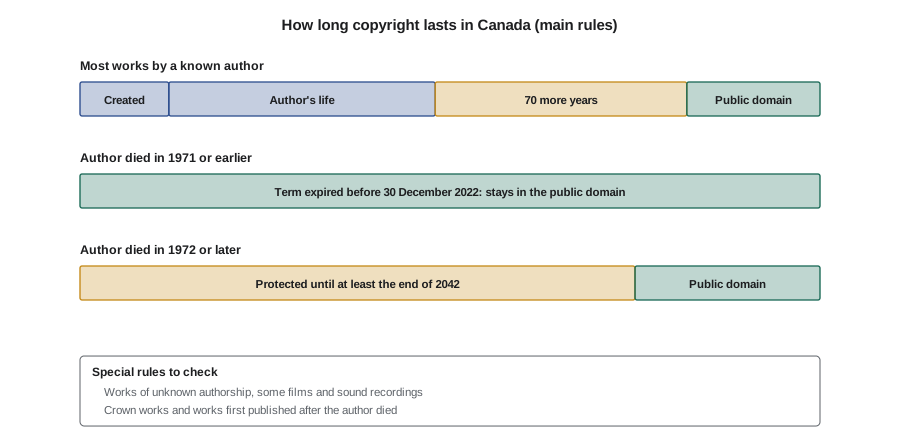
For most works, Canadian copyright lasts for the life of the author plus 70 years, ending on 31 December of that year. The term was extended from life plus 50 years by an amendment that came into force on 30 December 2022, to meet Canada's obligations under the Canada–United States–Mexico Agreement. The extension was not retroactive: works whose copyright had already expired stayed in the public domain.
In practice, this means that works by authors who died in 1971 or earlier are in the public domain in Canada, while works by authors who died in 1972 or later are protected until at least the end of 2042, so no new works will enter the Canadian public domain through the death-based term until 1 January 2043. Special rules apply to works of unknown authorship, some films and sound recordings, and Crown works, so check the Act for anything unusual.
Worked problem
Is this photograph in the public domain in Canada?
A documentary wants to use a portrait taken in 1955 by a photographer who died in 1975. The portrait has never been licensed. Is it in the public domain in Canada in 2026?
Show solution
- Identify the rule: life of the author plus 70 years for works by authors who died in 1972 or later.
- The photographer died in 1975, so protection lasts until 31 December 2045.
- Check ownership: under the pre-2012 rules, a commissioned portrait may belong to the person who commissioned it, but the term is still measured by the life of the photographer.
Answer: The portrait is still protected in Canada until the end of 2045. The producers need a licence from the current owner or must rely on an exception such as fair dealing.
def public_domain_year(death_year, years_after=70):
    # protection runs to the end of the calendar year, so the work is free on 1 January of the next year
    return death_year + years_after + 1

for name, died in [("Photographer A", 1968), ("Photographer B", 1975), ("Painter C", 2001)]:
print(name, "died", died, "-> free from 1 January", public_domain_year(died))Photographer A died 1968 -> free from 1 January 2039 Photographer B died 1975 -> free from 1 January 2046 Painter C died 2001 -> free from 1 January 2072
The code applies only the basic life plus 70 rule. It cannot account for transitional rules, works made for hire, unknown authors, renewals or the Canadian rule that kept works by authors who died in 1971 or earlier in the public domain. Photographer A, who died in 1968, is already free in Canada because the old term had expired before 2022, even though the simple rule would say 2039. Treat any calculation as a starting point for a proper check.
The public domain is not always simple
A public domain work can still raise issues. A new translation, edition, restoration, arrangement or photograph of a public domain work may have its own copyright in the new contribution. A recording of a public domain symphony is protected as a sound recording. A museum may control access to a painting and require you to follow its terms of entry, even if the painting's copyright has expired. And a work can be in the public domain in one country and protected in another, because terms differ.
In Canada, faithful photographs of two-dimensional public domain artworks may not be original enough to attract copyright, but the question has not been settled definitively, so producers often obtain the image from a source with a clear licence.
Registration and notice
Copyright arises without registration in both countries, and a copyright notice, such as the © symbol with the year and owner's name, is no longer required. Using a notice is still good practice because it tells the public who claims ownership and makes it harder for an infringer to claim innocence.
Canadian registration is quick and inexpensive. The Canadian Intellectual Property Office does not examine the work, and the certificate creates a presumption that copyright subsists and that the registered owner owns it. Registration is not required to sue or to claim statutory damages, but it can make a case easier and can defeat a defence of innocent infringement for the remedy of damages.
Many Canadian producers register their screenplays and finished films in Canada, and they register in the United States as well if they plan to exploit the work there, because the American registration rules (described in the American version of this course) can affect remedies in American courts.
Worked problem
Deciding whether to register
A Toronto photographer posts 300 new images a year online, and some are copied by businesses each year. Should she register them?
Show solution
- Registration in Canada is optional and inexpensive; it adds evidence of ownership but is not needed to claim statutory damages.
- If her clients and infringers are mostly in the United States, American group registration may be worth more, because American remedies depend on it.
- She can register her most valuable images in Canada and, for images licensed to American clients, consider American registration within three months of publication.
Answer: She should register strategically: the images she sells most, and in the country where infringements are likeliest to be pursued.
Neighbouring rights and related rights
Some rights protect contributions that are not traditional works. Performers have rights in their performances, record producers have rights in sound recordings, and broadcasters have rights in their signals. Image makers meet these rights whenever they use recorded music or film a performance.
Canada calls these neighbouring rights. Performers and makers of sound recordings share in equitable remuneration when recordings are played on radio or performed in public, collected by Re:Sound, and performers have the right to authorize the fixation and reproduction of their performances.
Practical checklist
Before using any third-party material, ask five questions. Is it protected by copyright, or is it an idea, fact or public domain work? Who is the author, and who owns the rights now? Is the use you plan within an exception? If not, what permission do you need, for which media, territory and term? And how will you document the answer? The next lessons answer each of these in turn.
Common mistakes
MistakeThinking that ideas, facts and plots are protected
InsteadCopyright protects original expression; ideas, facts and general plots are free.
MistakeAssuming that a work with no © symbol is free to use
InsteadProtection is automatic; a notice is not required.
MistakeApplying the life plus 70 rule without checking transitional rules
InsteadCheck special rules for older works, films, sound recordings and unknown authors.
MistakeAssuming a public domain painting means any photograph of it is free
InsteadCheck whether the reproduction or edition has its own rights and the source's terms.
MistakeIgnoring registration until a dispute arises
InsteadDecide early whether and where to register, especially if American remedies matter.
Summary and key terms
- Copyright protects original expression fixed in a form, not ideas, facts or titles.
- Photographs and films are protected works, and a film contains many separately owned works.
- Most works are protected for the author's life plus 70 years, with special rules for some categories.
- Public domain status depends on the country and on transitional rules.
- New editions, recordings and restorations of public domain works can have their own rights.
- Registration is optional for protection but affects evidence and, in the United States, remedies.
- Performers, record producers and broadcasters have related rights that affect music and performances.
- Originality
- The minimum creative contribution a work needs to be protected by copyright.
- Fixation
- Recording a work in a tangible or stable form.
- Public domain
- Works no longer, or never, protected by copyright.
- Idea and expression line
- The principle that copyright protects the expression of an idea, not the idea itself.
- Scènes à faire
- Stock elements that naturally follow from a theme or genre and are not protected.
- Copyright notice
- The © symbol with the year and the owner's name.
- Registration certificate
- An official record of a copyright claim that serves as evidence.
- Statutory damages
- Damages set by law within a range, without proof of actual loss.
- Neighbouring rights
- Rights of performers, record producers and broadcasters related to copyright.
- Term of protection
- The length of time a work remains protected by copyright.
Practice problems
Work each problem on paper first, then reveal the answer to check.
What two conditions must a work meet to be protected by copyright?
Show answer
It must be original and fixed in some form.
Is the idea of a road movie about two sisters protected?
Show answer
No, ideas and general plots are free.
Who is the first owner of a photograph taken by a freelance photographer today?
Show answer
The photographer, unless a contract or employment rule says otherwise.
How long does copyright usually last for a work by a known author?
Show answer
The author's life plus 70 years, to the end of the calendar year.
Can a new recording of a public domain symphony be protected?
Show answer
Yes, the sound recording has its own protection.
Is a copyright notice required for protection?
Show answer
No, but it is good practice.
Why do filmmakers consolidate rights in one production company?
Show answer
So that one owner can sell the film without any contributor being able to block it.
Name two elements in a film that may have different copyright owners.
Show answer
For example, the screenplay and the music.
Why should a calculated public domain date be treated as a starting point?
Show answer
Transitional and special rules can change the result.
What is a neighbouring right?
Show answer
A right of performers, record producers or broadcasters related to copyright.
Lesson quiz · 5 questions
Score 60% or more to complete this lesson.
Create a free account to save your progress, take quizzes and earn a certificate.