
FILM-420 · Lesson 10 of 12 · 29 min
Contracts and licensing agreements
Most rights in media are cleared by contract. Option agreements secure stories, writer and composer agreements secure scripts and scores, crew deal memos secure contributions, releases secure people and places, licences secure music and footage, and distribution agreements send the finished work into the world. A producer or photographer who can read these documents, spot the clauses that matter and negotiate sensible terms avoids most of the disputes that end up in court.
BUS-210 covers the general law of contracts: formation, terms, breach and remedies. FILM-410 covers how contracts fit into financing and production. PHOT-410 covers estimates, terms and conditions for photography clients. This lesson focuses on the clauses that are specific to media rights and on the chain of title that connects them.
The anatomy of a rights agreement
Whatever their name, rights agreements share a common structure. Learning to recognize it makes any new contract easier to read.
- Parties and recitals: who is contracting and why, including any background facts the agreement relies on.
- Grant of rights: what rights are granted, whether by assignment or licence, exclusive or non-exclusive.
- Media, territory and term: where, in what forms and for how long the rights can be used.
- Consideration: fees, advances, royalties, backend participation, deferrals and payment timing.
- Approvals and consultation: who must approve what, such as cuts, credits, stills or marketing.
- Credit: the form, size, placement and conditions of on-screen and paid advertising credit.
- Representations and warranties: each party's promises about facts, such as that the grantor owns the rights and the work does not infringe anyone else's rights.
- Indemnity and insurance: who pays if a promise is broken and a third party sues, and what insurance each party must carry.
- Termination and reversion: when the agreement can end and whether rights return to the grantor.
- Governing law and disputes: which jurisdiction's law applies and how disputes are resolved, such as by arbitration or in a named court.
The grant clause and the representations and warranties do most of the work. A grant clause that says "all rights" sounds broad but may be read narrowly if it is vague, while a precise grant ("the exclusive right to produce one feature-length motion picture based on the work, and to exploit it in all media now known or later devised throughout the universe in perpetuity") leaves less room for argument.
Options and purchase agreements
Producers acquire rights in books, articles, plays, life stories and existing films through option and purchase agreements. An option gives the producer the exclusive right, for a set period, to buy the rights on pre-agreed terms. The producer pays an option fee, often a small fraction of the purchase price, and uses the option period to develop the project and raise money. If the producer exercises the option, it pays the purchase price and acquires the rights; if not, the rights stay with the owner, who keeps the option fee.
| Term | Example | Notes |
|---|---|---|
| Option period | 18 months | Often with a right to extend for a further fee |
| Option fee | 5,000 | Often applicable against the purchase price |
| Purchase price | 2 per cent of the final budget, with a floor of 50,000 and a ceiling of 200,000 | Paid on exercise, usually before principal photography |
| Rights granted | Motion picture and allied rights, including sequels, remakes and series | Author often reserves print, audio and stage rights |
| Backend | 2.5 per cent of producer's net profits | Defined in the agreement |
| Credit | "Based on the novel by" credit | Size and placement specified |
| Reversion | Rights revert if no film is produced within a set period after purchase | Protects the author |
The purchase agreement is usually attached to the option agreement so that the terms are fixed in advance. Producers should check the underlying rights before paying: who owns them, whether they were previously optioned or sold, whether any reversion or termination rights apply (Lesson 3), and whether the work itself infringes anyone else's rights.
Worked problem
Checking an option before paying
A producer wants to option a memoir published ten years ago. The author says she owns the film rights. What should the producer check before signing?
Show solution
- Read the publishing contract: some publishers acquire or share film rights, or have approval rights.
- Search for previous options or sales: a prior option may still be running, or rights may have been sold.
- Review the memoir for people it portrays: depiction releases or life rights may be needed from them, especially for private individuals portrayed negatively.
- Confirm the author's identity and capacity to sign, and, if the author has died or will die during the term, how the estate will be bound.
Answer: The producer should get a short chain-of-title search and a representation and warranty from the author, backed by an indemnity, before paying the option fee.
Life rights and depiction agreements
A film or series about a real person does not legally require that person's permission in every case: news, documentary and biography about public matters are generally protected expression, and facts are not owned by anyone. But producers often acquire life rights or sign depiction agreements anyway, because they provide access to the person's own story and materials, reduce the risk of privacy, publicity and defamation claims, and reassure insurers and buyers.
A life rights agreement typically gives the producer the right to portray the person, to fictionalize and dramatize events, to use the person's name and likeness, and to use their private information and materials, together with a waiver of claims. The person may receive a fee, a consultant role and credit. Producers should not overpromise approval rights, which can paralyse a production.
In Canada, the absence of a general right of publicity outside appropriation of personality and Quebec's Civil Code means that life rights deals are mainly about access, cooperation and risk management. For a story set in Quebec or about Quebec residents, the Civil Code's protection of reputation, privacy and image makes depiction releases especially valuable.
Agreements with creative contributors
Each creative contributor needs an agreement that delivers their work into the production company's ownership or control.
- Writer agreements set fees for drafts and rewrites, credit determination (often under guild rules), and the transfer of rights; they usually include work-for-hire language or an assignment, plus a moral rights waiver where available.
- Director agreements cover services, creative controls such as final cut or consultation rights, credit and the transfer of rights in the director's contributions.
- Composer agreements may be packages (the composer delivers the score for a fixed sum, including musicians and studio costs) or services deals; the producer usually owns or licenses the score for the film, while the composer often keeps the writer's share of performance income.
- Crew deal memos are short contracts for each crew member, setting the role, rate, hours, kit rental and the transfer of rights in their work. Without them, a production may lack clear ownership of footage shot by a camera operator or designs created by an art director.
- Performer agreements, under union agreements where applicable, grant the right to use the performance and the performer's name and likeness in the work and its promotion, and set residuals or use fees.
Canadian agreements usually include an express waiver of moral rights, because moral rights cannot be assigned (Lesson 5). Federally regulated and Quebec productions are also affected by status of the artist laws: Quebec's reformed Act respecting the professional status of artists, in force since 2022, requires written contracts with professional artists containing specified terms, so producers working in Quebec should use compliant forms.
Licences to and from image makers
Photographers and filmmakers grant licences as well as take them. A licence to a client should describe the use precisely, such as the media, size and placement, territory, term, exclusivity and the number of copies or impressions, and should reserve all rights not expressly granted. PHOT-410 lesson 4 covers pricing usage; here the focus is on the legal terms that make a licence enforceable and fair.
Common points of negotiation include exclusivity (clients often want it; photographers price it), term (perpetual licences cost more), modification rights (crops, retouching and AI-assisted edits), credit, the photographer's right to use the work in a portfolio, termination for non-payment, and liability limits. A clause stating that the licence takes effect only on full payment protects the licensor.
Worked problem
Reading a client's licence clause
A client's standard terms say: "Photographer grants Client all rights in the Images for any purpose." The photographer was asked for images for a product launch website and trade show. What is the problem, and what is a better clause?
Show solution
- "All rights for any purpose" may be read as an assignment or a very broad licence, covering advertising, resale and other uses the fee did not contemplate.
- The photographer cannot license the images to anyone else, and the client could use them in national advertising without paying more.
- A better clause grants a non-exclusive licence to use the images on the client's website and at trade shows for two years in North America, reserves all other rights and allows the client to buy additional uses at agreed rates.
Answer: The photographer should replace the "all rights" language with a defined licence and an option for additional uses, and add a clause that the licence takes effect on full payment.
Representations, warranties and indemnities
Every rights agreement allocates risk. Representations and warranties are promises about facts; an indemnity is a promise to pay for losses if a promise turns out to be false or if a claim arises from a party's conduct. A producer delivering a film to a distributor typically warrants that it owns or controls all rights in the film, that the film does not infringe or defame anyone, and that all required payments to contributors have been or will be made, and indemnifies the distributor against claims arising from breach. The producer, in turn, gets similar warranties and indemnities from those who supplied rights to it, such as the author of the underlying book.
Indemnities are only as good as the party behind them. A small production company's indemnity is worth little if it has no assets, which is why distributors require errors and omissions insurance. Contributors can limit their exposure by limiting warranties to their own knowledge, capping liability at the fees received and excluding liability for material supplied by others.
The chain of title
The chain of title is the set of documents that proves the producer owns or controls the rights needed to make and exploit the work. It runs from the original source, such as a novel, life story or original idea, through every option, purchase, writer agreement and assignment, to the production company that owns the finished work, and on to its distributors. Buyers, financiers, completion guarantors and insurers review it before they commit.
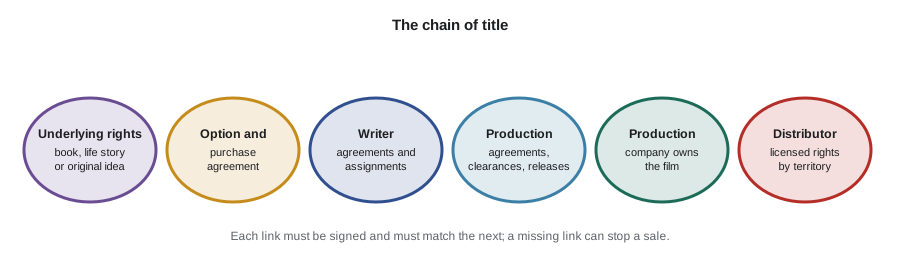
- Underlying rights: the option and purchase agreement, with any publishing contract clauses and prior option releases.
- Script: writer agreements, certificates of authorship and any assignments from earlier producers.
- Production: agreements with the director, producers, composer, key crew and performers.
- Third-party material: music licences, footage licences, artwork clearances and releases, summarized in the clearance log.
- Registrations and searches: copyright registrations, title reports and copyright reports where available.
A complete chain of title is a selling point; an incomplete one costs money and time at the worst moment, when a buyer is ready to sign.
Investment, crowdfunding and securities
Raising money for a film or creative project from investors is regulated by securities law. Offering people a share of a film's profits in exchange for money is usually an offer of securities, even if it is described as a donation or a perk, unless it falls within an exemption. FILM-410 lesson 3 covers financing models; the legal point here is simple: get legal advice before asking anyone for an investment.
In Canada, securities are regulated provincially by securities commissions such as the Ontario Securities Commission and the Autorité des marchés financiers in Quebec. Raising money from investors generally requires a prospectus unless an exemption applies, such as the accredited investor exemption, the family, friends and business associates exemption or the offering memorandum exemption, each with conditions. Reward-based crowdfunding, in which backers receive a product or perk rather than a share of profits, is generally not a securities offering.
Common mistakes
MistakeSigning an agreement with a vague "all rights" grant
InsteadDefine the rights, media, territory and term precisely, and reserve rights not granted.
MistakePaying an option fee without checking the underlying rights
InsteadSearch for prior options, publisher rights and depiction issues first.
MistakeGiving a real person approval over the final film
InsteadOffer consultation and accuracy review rather than approval rights where possible.
MistakeSkipping crew deal memos on small shoots
InsteadGet a short signed memo transferring rights from every contributor.
MistakeOffering investors profit shares without legal advice
InsteadTreat profit-sharing offers as possible securities and get advice before raising money.
Summary and key terms
- Most media rights are cleared by contract, and rights agreements share a common structure.
- The grant clause and representations and warranties do most of the work.
- Options secure the exclusive right to buy rights on pre-agreed terms during a set period.
- Life rights and depiction agreements provide access and reduce risk even when permission is not strictly required.
- Every creative contributor needs an agreement that transfers or licenses their work.
- Indemnities allocate risk but are only as good as the party or insurance behind them.
- The chain of title proves ownership and is reviewed by buyers, financiers and insurers.
- Grant of rights
- The clause stating what rights are assigned or licensed.
- Option
- The exclusive right to buy rights on agreed terms during a set period.
- Purchase price
- The amount paid to acquire rights when an option is exercised.
- Life rights
- Rights acquired from a person to portray their life story and use their materials.
- Deal memo
- A short contract setting out a crew member's terms and the transfer of rights in their work.
- Representation and warranty
- A contractual promise that certain facts are true.
- Indemnity
- A promise to pay losses arising from a breach or claim.
- Chain of title
- The documents proving ownership or control of the rights in a work.
- Reversion
- The return of rights to the grantor under agreed conditions.
- Accredited investor
- An investor who meets financial thresholds allowing investment without a prospectus or registration.
Practice problems
Work each problem on paper first, then reveal the answer to check.
Name four parts of a typical rights agreement.
Show answer
For example, parties, grant of rights, consideration and warranties.
What does an option give a producer?
Show answer
The exclusive right to buy the rights on agreed terms during a set period.
What happens to the option fee if the producer does not exercise the option?
Show answer
The owner usually keeps it.
Why might a producer acquire life rights even when permission is not legally required?
Show answer
For access, cooperation and reduced risk of claims.
What does a crew deal memo typically include?
Show answer
Role, rate, hours, kit rental and the transfer of rights.
Why is a small company's indemnity often not enough for a distributor?
Show answer
The company may lack assets, so errors and omissions insurance is required.
What is the chain of title?
Show answer
The documents proving ownership or control of the rights in a work.
Why should a photographer avoid "all rights for any purpose" language?
Show answer
It may grant far more than the fee contemplates.
Is reward-based crowdfunding usually a securities offering?
Show answer
Generally not, if backers receive perks rather than profit shares.
What should a producer do before offering investors a share of profits?
Show answer
Get legal advice on securities law.
Lesson quiz · 5 questions
Score 60% or more to complete this lesson.
Create a free account to save your progress, take quizzes and earn a certificate.