
FILM-120 · Lesson 5 of 12 · 27 min
The coming of sound and the studio era
In just a few years at the end of the 1920s, synchronized sound transformed cinema. Studios rebuilt stages and cinemas, careers rose and fell, new genres appeared and the industry consolidated. Through the 1930s and 1940s, a handful of Hollywood studios ran a highly efficient system that produced hundreds of films a year in recognizable genres, under a self-imposed censorship code. Colour arrived through the three-strip Technicolor process. This lesson explains how sound technology worked, how the studio system was organized, what the Production Code required, and how genres structured the era often called Hollywood's golden age.
Experiments before synchronized sound
Inventors had tried to combine pictures and recorded sound since the 1890s; Edison's laboratory experimented with linking the phonograph and the Kinetoscope. The problems were synchronization, amplification loud enough to fill a cinema, and recording quality. Electrical recording and vacuum-tube amplifiers, developed in the telephone and radio industries in the 1910s and 1920s, finally solved the amplification problem.
Sound on disc and sound on film
Two systems competed in the late 1920s.
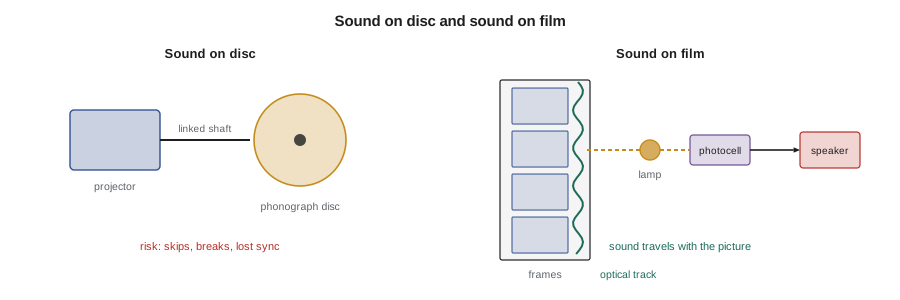
- Sound on disc: the Vitaphone system, developed by Western Electric and adopted by Warner Bros., recorded sound on large phonograph discs synchronized mechanically with the projector. Each reel of film had its own disc.
- Sound on film: systems such as Fox's Movietone, based on work by Theodore Case and Lee de Forest, recorded sound as an optical track, a strip of varying light printed beside the images on the film itself. A light shone through the track onto a photoelectric cell in the projector and was converted back into sound.
Sound on disc gave good quality at first, but discs could skip, break or fall out of sync, especially if a damaged film was repaired by cutting out frames. Sound on film kept picture and sound physically together, and by the early 1930s optical sound on film had become the industry standard. The optical track occupied part of the 35 mm frame, so the picture area was adjusted, and in 1932 the Academy of Motion Picture Arts and Sciences standardized a frame proportion of about 1.37 to 1, known as the Academy ratio.
The Jazz Singer and the conversion to sound
Warner Bros. premiered Vitaphone programmes in 1926 with Don Juan, which had a synchronized musical score and effects but no spoken dialogue, plus short films of musical performances. On 6 October 1927, Warner Bros. released The Jazz Singer, starring Al Jolson. It was mostly a silent film with intertitles, but it included several synchronized songs and some ad-libbed spoken lines, including Jolson's famous promise that the audience "ain't heard nothin' yet." The film was a major success and is often cited as the moment talking pictures arrived. It is also important to note that Jolson performs in blackface in the film, part of the racist minstrel tradition, which is why the film is studied critically as well as celebrated as a technical turning point.
Within about three years, the American industry converted almost entirely to sound. Studios built soundproof stages, cinemas installed sound equipment, and silent production ended in Hollywood by about 1930. The conversion was expensive and was financed partly through bank loans, tying studios more closely to Wall Street and helping the largest companies consolidate.
Worked problem
The cost of converting cinemas
Suppose that in 1929 an illustrative 12,000 cinemas needed sound equipment costing an average of 15,000 dollars each, and that by the end of 1930 about 85 % had converted. Estimate the total cost of conversions by 1930.
Show solution
- Cinemas converted: \( 12000 \times 0.85 = 10200 \).
- Total cost: \( 10200 \times 15000 = 153000000 \) dollars.
- Express in millions: about 153 million dollars at the time.
Answer: In this illustrative calculation, conversions cost about 153 million dollars, a huge sum at the start of the Great Depression. Real costs varied widely from small towns to picture palaces, but the scale explains why sound helped concentrate power in companies that could raise capital.
How sound changed filmmaking
Early sound filmmaking faced practical problems. Cameras were noisy, so at first they were placed inside soundproof booths, which limited camera movement. Microphones had to be hidden on set and actors had to stay near them. Some early talkies feel static and stagy as a result. Within a few years, filmmakers solved many problems: cameras were enclosed in soundproof housings called blimps, microphones were mounted on booms that followed actors, and re-recording and mixing allowed music, dialogue and effects to be combined after shooting.
Sound changed acting and writing too. Studios hired playwrights and stage actors who could deliver dialogue. Some silent stars whose voices or accents did not suit the new medium saw their careers fade, though the idea that many careers ended simply because of bad voices is often exaggerated. Musical films flourished, and genres built on dialogue, such as gangster films and fast-talking comedies, became popular. Live musicians who had accompanied silent films lost their jobs in large numbers.
Sound also ended silent cinema's easy international circulation. Studios experimented with shooting multiple-language versions of the same film on the same sets, then moved to dubbing and subtitling. In Canada, French-language audiences in Quebec gained a new interest in French-language films, which fed later debates about language and cinema.
The studio system
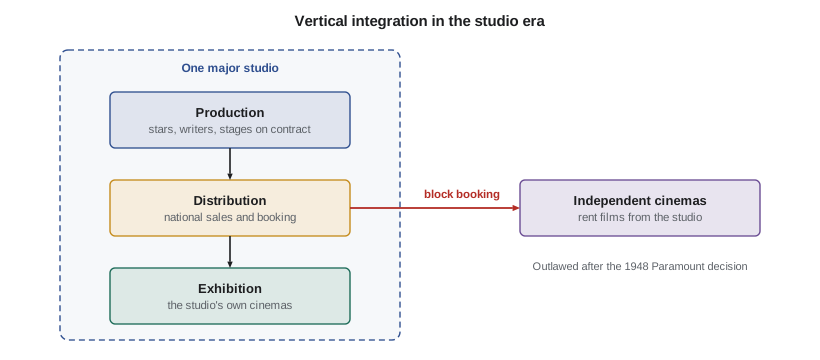
By the 1930s, the American film industry was dominated by eight companies. The "Big Five" majors, Paramount, Metro-Goldwyn-Mayer (owned by Loew's), Warner Bros., Twentieth Century-Fox and RKO, were vertically integrated: each controlled production, distribution and a chain of cinemas. The "Little Three", Universal, Columbia and United Artists, produced or distributed films but did not own large theatre chains. Smaller "Poverty Row" studios made low-budget westerns and serials.
Vertical integration let the majors guarantee screens for their films. Through block booking, they required independent cinemas to rent groups of films, including weaker ones, in order to get the most desirable titles. Blind bidding forced cinemas to book films they had not seen.
Inside the studios, filmmaking worked like a factory. Actors, directors, writers, cinematographers, composers and designers were usually employed on long-term contracts, typically seven years with options the studio could renew or drop. Departments specialized in scripts, costumes, sets, music, sound and editing. Producers supervised many films at once, and each studio developed a recognizable style: MGM's polished glamour, Warner Bros.' gritty social dramas and gangster films, Universal's horror cycle, Paramount's European sophistication.
Worked problem
Studio output
Suppose that in an illustrative year of the late 1930s, the eight largest studios together released about 360 feature films, and a major studio's output was 50 films. If the year has 52 weeks, how many features did that studio release per week, and what share of the eight-studio total did it represent?
Show solution
- Per week: \( 50 \div 52 \approx 0.96 \), almost one feature every week.
- Share: \( 50 \div 360 \approx 0.139 \), about 14 %.
- Average per studio: \( 360 \div 8 = 45 \) features.
Answer: The studio released almost one feature per week and about 14 % of the eight-studio output. Factory-like scheduling was needed to keep the majors' cinemas supplied with new programmes, usually a feature plus shorts, newsreels and often a second feature.
The Production Code
After scandals and pressure from religious groups and civic organizations, the Hollywood studios' trade association, then called the Motion Picture Producers and Distributors of America, adopted the Motion Picture Production Code in 1930. It set rules about crime, sex, violence, religion and morality: wrongdoing had to be punished, married couples were shown in separate beds, criminals could not be shown sympathetically, and many subjects were banned. At first the Code was weakly enforced, and films of the early 1930s, now called "pre-Code" films, were often frank about sex, crime and social problems.
In 1934, facing threatened boycotts organized by the Catholic Legion of Decency, the industry created the Production Code Administration, headed by Joseph Breen. From July 1934, films needed a certificate of approval to be released in member companies' cinemas. The Code shaped Hollywood films for more than three decades, encouraging indirect storytelling, innuendo and moral endings. It weakened in the 1950s and 1960s and was replaced in 1968 by a rating system.
The Code also enforced racial prejudice: it prohibited depictions of interracial relationships, reinforcing segregation on screen. Studying it shows how industry self-censorship reflected and shaped social attitudes.
In Canada, censorship was handled not by the industry but by provincial government boards. Ontario created a film censorship board in 1911, and other provinces followed. Each board could cut or ban films, so the same Hollywood film might be shown differently in different provinces, and Quebec's board was historically among the strictest, especially in relation to religion and morality.
Genres of the studio era
Studios organized production around genres, which helped them plan, market and reuse sets, costumes and stars. Major genres included:
- The musical, from backstage stories to lavish dance spectacles, made possible by sound.
- The gangster film, especially in the early 1930s, often criticized for glamorizing crime.
- Horror, notably Universal's cycle beginning in 1931, shaped by German Expressionist design.
- Screwball comedy, with fast dialogue, battles of the sexes and class satire.
- The western, a staple of both prestige and low-budget production.
- The melodrama or "woman's picture", centred on female protagonists and family and romantic conflict.
- Film noir, a term French critics applied after the war to dark American crime films of the 1940s with shadowy lighting, fatalistic plots and morally ambiguous characters.
Animation also flourished. Studios such as Disney, Warner Bros. and the Fleischer brothers produced cartoon shorts for every programme, and Disney released the first American full-length cel-animated feature in 1937.
Colour: three-strip Technicolor
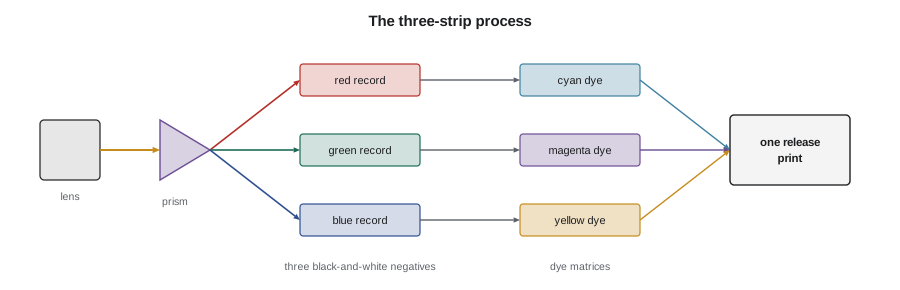
Colour had existed since early cinema through colour painted by hand, stencils, tinting (dyeing the whole film) and toning, and through early two-colour processes. In 1932 Technicolor introduced a three-strip camera. Inside it, a beam-splitting prism divided light from the lens onto three separate black-and-white negatives, each recording one primary colour. In the laboratory, each negative was used to make a matrix that transferred cyan, magenta or yellow dye onto a single print, a process called dye transfer or imbibition.
The first live-action feature shot entirely in three-strip Technicolor, Becky Sharp, appeared in 1935. Technicolor cameras were large and expensive, the process required intense lighting, and the company supplied its own camera operators and colour consultants who influenced how colour was used. Through the 1930s and 1940s, colour was reserved mostly for musicals, fantasies, historical spectacles and prestige films, while black-and-white remained standard for dramas, comedies and crime films. Single-strip colour negative films introduced in the 1950s, such as Eastmancolor, gradually replaced the three-strip camera.
| Year | Development |
|---|---|
| 1926 | Warner Bros. premieres Vitaphone with Don Juan |
| 1927 | The Jazz Singer released on 6 October |
| 1930 | Production Code adopted; Hollywood's conversion to sound nearly complete |
| 1932 | Academy ratio standardized; three-strip Technicolor introduced |
| 1934 | Production Code Administration begins enforcing the Code |
| 1935 | Becky Sharp, first three-strip Technicolor live-action feature |
| 1937 | First American full-length cel-animated feature released |
| 1939 | A peak year of studio-era prestige production |
Common mistakes
MistakeSaying The Jazz Singer was the first all-talking film
InsteadDescribe it as mostly silent with synchronized songs and some speech, and note its use of blackface
MistakeAssuming early talkies were all static because filmmakers lacked skill
InsteadExplain the technical limits of camera booths and microphones, which were soon overcome
MistakeTreating the Production Code as government law
InsteadDescribe it as industry self-regulation, while noting state boards and Canadian provincial censors
MistakeThinking colour films did not exist before the 1930s
InsteadNote tinting, toning, stencils and two-colour processes before three-strip Technicolor
MistakeForgetting the studio system's control of exhibition
InsteadExplain vertical integration, block booking and blind bidding
Summary and key terms
- Electrical recording and amplification made synchronized sound practical in the late 1920s.
- Sound on film, an optical track printed beside the images, replaced sound on disc as the standard by the early 1930s.
- The Jazz Singer (1927) marked the arrival of talking pictures; Hollywood converted to sound by about 1930.
- The Big Five majors were vertically integrated and used block booking to control exhibition.
- The Production Code (1930), enforced from 1934, shaped Hollywood content for over three decades.
- Studios organized production around genres such as musicals, gangster films, horror, screwball comedy, westerns and noir.
- Three-strip Technicolor (1932) used a prism and three negatives; colour was reserved mostly for spectacle until the 1950s.
- Sound on disc
- A system synchronizing film with sound recorded on separate phonograph discs
- Optical soundtrack
- Sound recorded as a strip of varying light printed beside the images on film
- Academy ratio
- The standard sound-era frame proportion of about 1.37 to 1, set in 1932
- Blimp
- A soundproof housing that lets a film camera run quietly
- Vertical integration
- Ownership of production, distribution and exhibition by one company
- Block booking
- Requiring cinemas to rent groups of films to get desirable titles
- Production Code
- Hollywood's self-censorship rules, adopted in 1930 and enforced from 1934
- Pre-Code film
- A Hollywood film made between about 1930 and mid-1934, before strict Code enforcement
- Three-strip Technicolor
- A colour process using a prism and three black-and-white negatives
- Dye transfer
- Technicolor's printing method using matrices to transfer dyes onto a print
Practice problems
Work each problem on paper first, then reveal the answer to check.
Why did sound on film replace sound on disc?
Show answer
Picture and sound stayed physically together, avoiding lost synchronization.
What was the Academy ratio and why was it introduced?
Show answer
About 1.37 to 1, standardized in 1932 to accommodate the optical soundtrack.
Why did early talkies often have little camera movement?
Show answer
Noisy cameras were enclosed in soundproof booths and actors had to stay near hidden microphones.
Name the Big Five studios.
Show answer
Paramount, MGM, Warner Bros., Twentieth Century-Fox and RKO.
What was block booking?
Show answer
Requiring cinemas to rent groups of films, including weaker ones, to get the most popular titles.
When did strict enforcement of the Production Code begin?
Show answer
In July 1934, with the Production Code Administration.
Who censored films in Canada?
Show answer
Provincial government censorship boards, starting with Ontario in 1911.
How did three-strip Technicolor capture colour?
Show answer
A prism split light onto three black-and-white negatives recording different primary colours.
If 9,000 cinemas converted at 12,000 dollars each, what was the total cost?
Show answer
\( 9000 \times 12000 = 108 \) million dollars.
Why was colour used mostly for spectacle in the 1930s and 1940s?
Show answer
It was expensive, needed intense lighting and was associated with musicals, fantasies and prestige films.
Lesson quiz · 5 questions
Score 60% or more to complete this lesson.
Create a free account to save your progress, take quizzes and earn a certificate.